
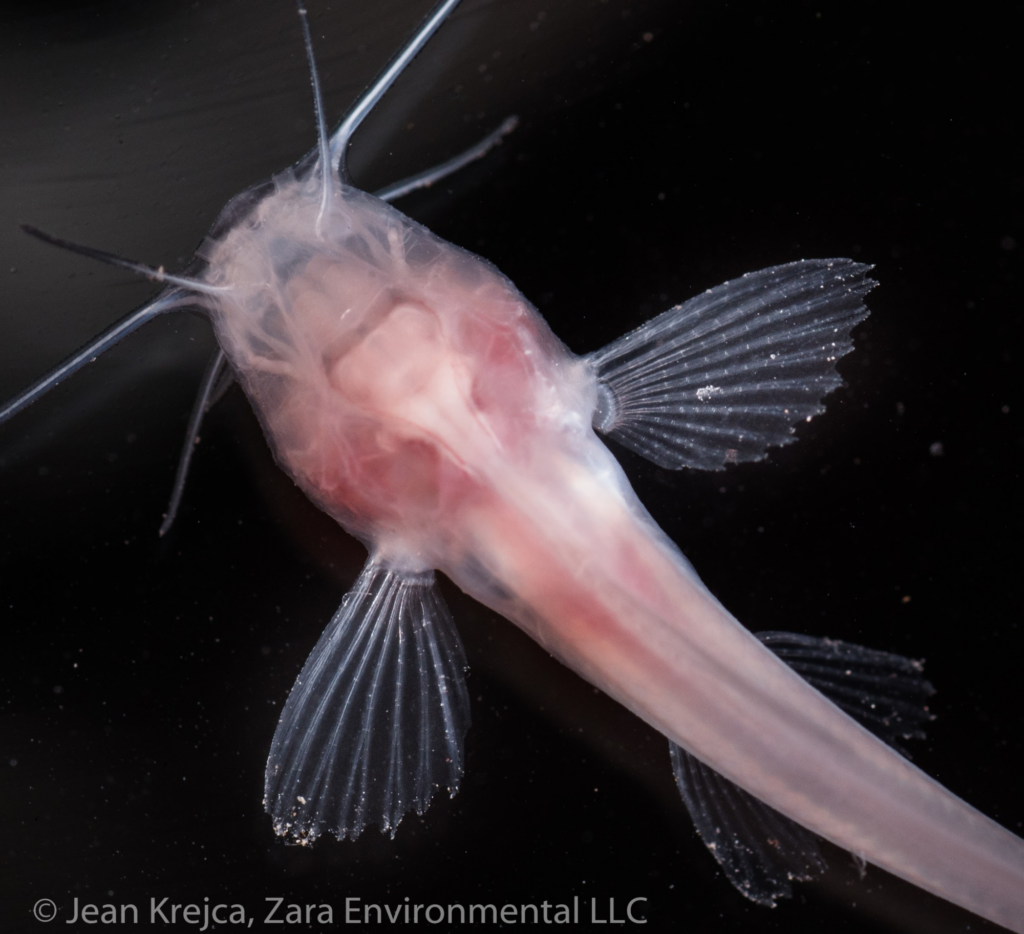
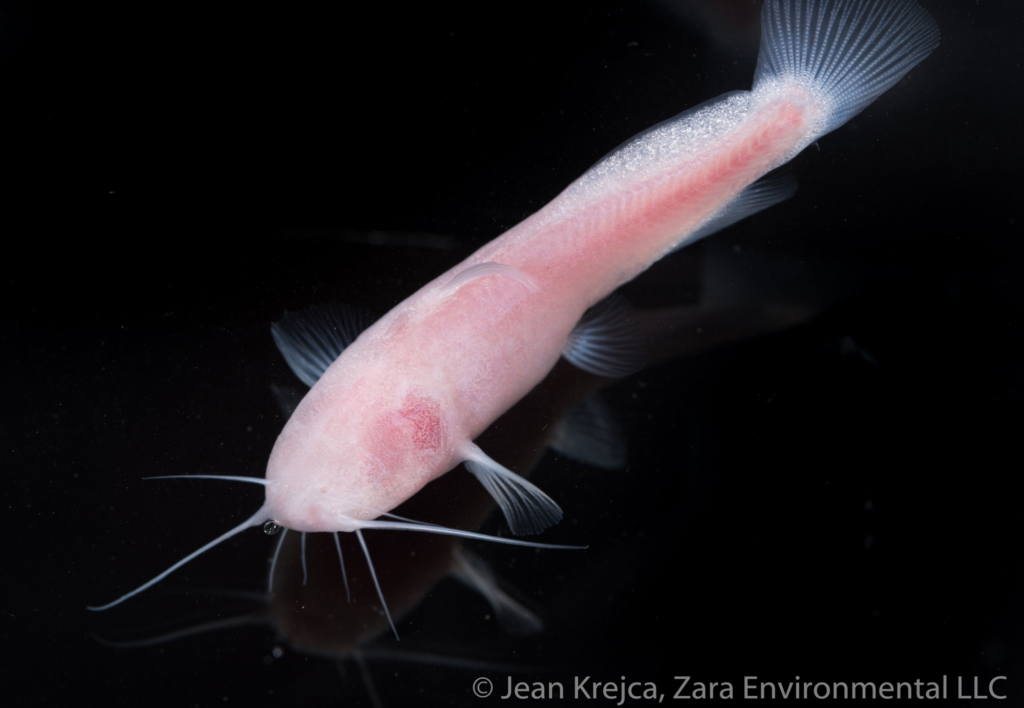
Prietella phreatophila – live specimens from Amistad National Recreation Area, Texas (photos by Jean Krejca)
October 16, 2021 – Mexican Blindat is the focus of a great mural in Del Rio, Texas. Thank you Del Rio and Center for Biological Diversity (and Andy Gluesenkamp for this photo from the unveiling party).
Hendrickson’s work with Mexican blindcats and many collaborators on both sides of the border goes way back, starting with serious explorations of caves throughout northern Coahuila and Tamaulipas in the 1990s and early 2000s to learn more about both Prietella species. Unlike the deep Edwards Aquifer blindcats, humans can at least access the habitats of both of these, but only by rappeling into some deep caves, and then sometimes SCUBA diving after getting off rope. As a result of those explorations, we now know (Hendrickson et al. 2001) of at least 10 caves or wells where Prietella phreatophila lives, or, from what local residents tell us, where they used to be found in recent history, and much later they finally turned up in Texas too (as we long suspected). Morphology and unpublished DNA sequences both indicate the Texas and Coahuila specimens are of the same species, adding more evidence to support management of the Edwards-Trinity aquifer as binationally shared between the U.S. and México. At the same time, with the help of cave divers, Hendrickson was also seeking specimens of the other member of the genus, Prietella lundbergi, known from only a single formalin-preserved specimen. Eventually a few were obtained from a previously unexplored cave not far from the type locality, allowing us to do some genetics. Surprisingly, the southern species was a very distant relative of the Mexican blindcat, and should not be in the genus Prietella. Finally, in 2026, divers again explored that cave and obtained another specimen, which is not being analyzed in the lab of Dra. Patricia Ornelas in the Instituto de Biología at UNAM in Mexico City. Most of the world’s preserved specimens of Prietella are held in the Fish Collection of the Biodiversity Center at UT Austin. Maps and photos of all known specimens of the genus can be perused in GBIF
A live colony of Prietella phreatophila was established in the Hendrickson lab in 1992. and many interesting observations regarding longevity and behaviour were made (see Hendrickson et al. 2001). Eggs were laid and guarded several times, but never hatched. Thus, the colony never grew, and rigorous science with solid experimental design was never possible. Following arrival of the first Texas specimens, the colony was gifted to the San Antonio Zoo in 2016, and a special facility was eventually built there to maintain the colony in perpetuity. One of the original specimens from Mexico, brought to the lab in 1997 as a mid-sized individual, was still alive there at the time of the most recent update of this page (2026), further substantiating the apparent extreme longevity of individuals.
With support from National Park Service, we continue to explore caves on Amistad National Recreation Area, where the new discovery was made. We’re hoping to get back to sampling in Coahuila soon to re-assess how the species is doing there, and to get more DNA samples for more detailed population genetics analyses that should help us better understand the fish, and better assess the true extent of its internationally shared aquifer. We published one of our presentations about that here.
Finally, others have become interested in the species and promoting its conservation. Following discovery of Mexican blindcat in Amistad National Recreation Area, adjacent to Del Rio, Texas, a gorgeous mural depicting the species was completed, and later a beautiful childrens book about the species was produced.