Monthly Archives: June 2023

Use Word’s Navigation Pane to Improve Organization

I like to use the Navigation Pane in Microsoft Word to help me with large-scale organization. Here’s a step-by-step guide and then an example.

First, you need to be using Styles in Word. Here’s my brief guide to using Styles. Now, open a document in which you’ve used Styles to create headings. Then—

1. Click the View tab

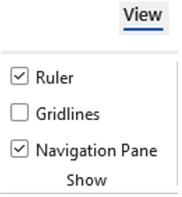
2. Look for the option that includes Ruler, Gridlines, and Navigations Pane:

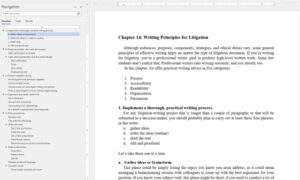
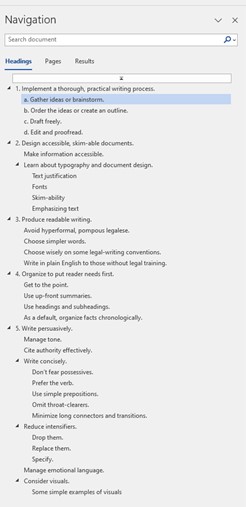
3. Check the box for Navigation Pane, so your screen should look like this:

4. Focus on the left-side Navigation Pane, which shows all the headings you’ve created in your document. It’s clickable and collapsible.

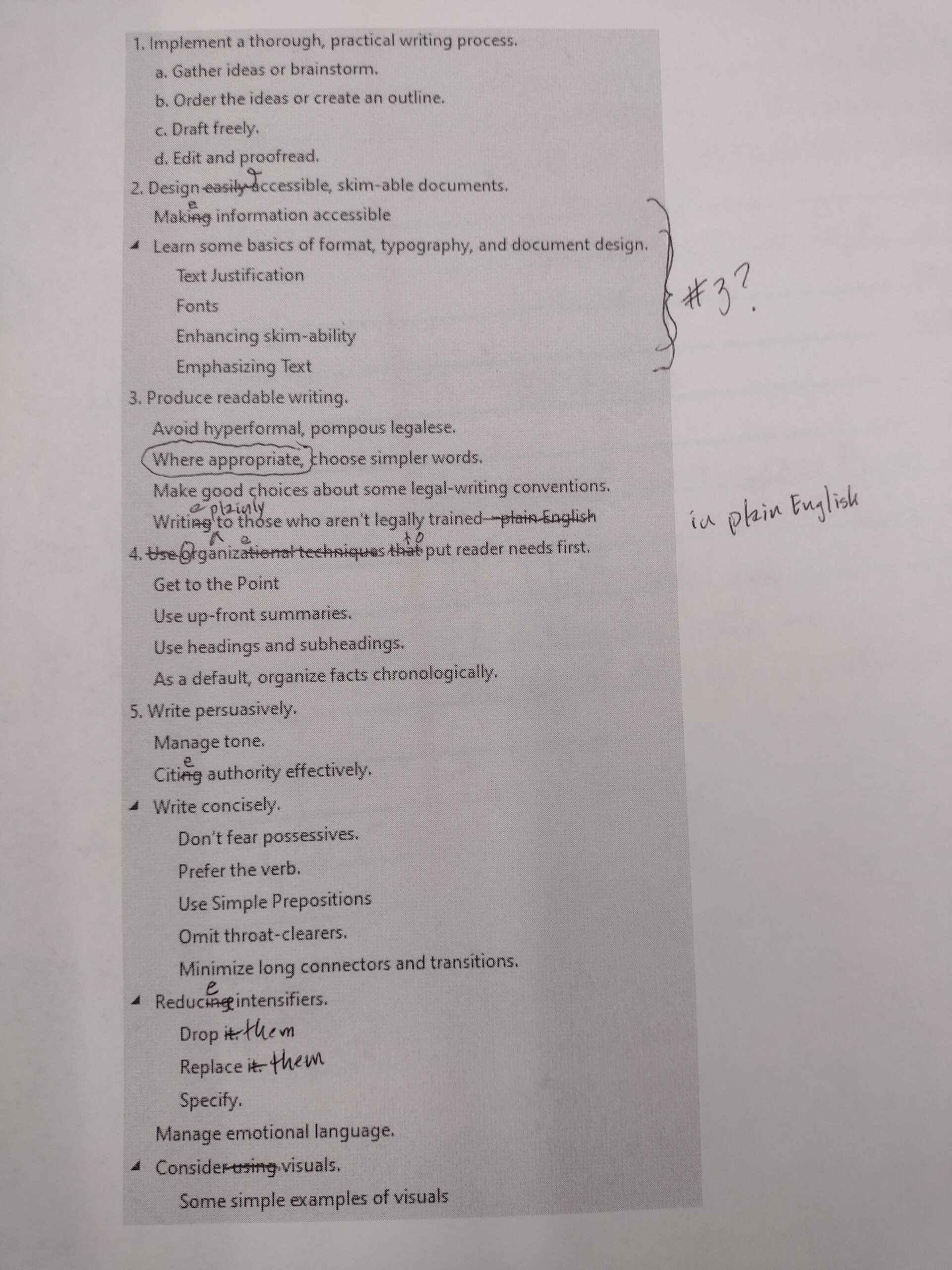
5. Read through all your headings, subheadings, and sub-subheadings—or do what I did: take a screenshot of it, print it out, and read it on paper.

You’re looking for anything related to the organization:

  • Are my main topic headings in the right order? A good order?
  • Are my headings parallel? That is, are all the headings or subheadings that are at the same outline level structured the same way? All complete sentences, for example.
  • Does the entire set of headings form a coherent outline?

Here’s a picture of the screencaptured Navigation Pane from one of my writing projects. You can see that I made notes on it, and I then made those edits to the headings in the document.

Writing in Threes

The power, the magic, and the charm of three

Anecdotal evidence suggests that when trying to persuade, presenting three concepts is better than presenting two. Or four. Or more. We see examples of memorable, powerful threes in advertising, in literature, and even in the Declaration of Independence:

  • snap, crackle, and pop
  • I came; I saw; I conquered
  • life, liberty, and the pursuit of happiness

Yes, I just gave three examples.

Do you have a sense of the importance of three in writing? Did you ever learn to write a “five-paragraph essay”? You present an introduction and a conclusion, but in between you write the first point, the second point, and the third point. The power of three.

When creating lists, when presenting claims, or when organizing arguments, writing in threes is common advice from legal-writing experts. Patrick Barry says, “Judges use the Rule of Three. Practitioners use the Rule of Three. And so do all manner of legal academics.”[1] Diana Simon advises that when possible, “distill your arguments down to three main points … and, if possible, eliminate arguments after that point .…”[2] And Bryan Garner reports that “A mathematician once told me that there are really only four numbers in the world: one, two, three, and many.[3]

But is the persuasive power of three anything more than good advice? Yes. Empirical studies validate the “magic of three,” as Diana Simon summarized in a recent article.”[4]

In one study, subjects learning a new word were better able to understand and apply the word’s meaning after being given three examples.[5] Similar research suggests that we consider evidence and examples to establish a pattern or a “streak” once they hit three.[6]

In another study, subjects described getting back together with an ex-partner, and the descriptions had from one to six reasons that the renewed relationship was good. In one scenario, the person described the ex-partner with four words: “intelligent, kind, funny, and cute.” Researchers noticed that the fourth word provoked skepticism in listeners, and overall, those who heard three positive traits were more likely to approve of the relationship than those who heard four.[7] The authors of that and other studies concluded that “the optimal number of claims is three ….”[8]

In the real world, you can’t always force legal standards into threes. After all, premises liability in Texas has four elements. But if one element is beyond dispute or if one has been waived or stipulated, your memo, motion, or brief can present the three remaining elements. Or maybe for the fourth element is supported by three arguments or three key pieces of evidence.

Would using some examples help you present your position? If so, consider using one or three, but not two—and definitely not four: remember the power of three. And when constructing sentences, if you have the opportunity to present parallel ideas, phrases, or clauses, see if you can reasonably present them in threes. So this:

  • The employer’s responses were hasty, terse, superficial, and disrespectful.

Is likely not as powerful as this:

  • The employer’s responses were hasty, terse, and superficial.

When you can, take advantage of the power of three.

_____

[1] Patrick Barry, The Rule of Three, 15 Legal Comm. & Rhetoric 247, 247–48 (2018).

[2] Diana J. Simon, The Power of Connectivity: The Science and Art of Transitions, 18 Leg. Comm. & Rhetoric: JALWD 65, 80 (2021).

[3] Bryan A. Garner, Good Headings Show You’ve Thought Out Your Arguments Well in Advance, ABA J. (2015), https://www.abajournal.com/magazine/article/good_​headings_​show_​youve_​thought_​out_​your_​arguments_​well_​in_​advance/

[4] Simon, The Power of Connectivity, at 76-77.

[5] Simon, The Power of Connectivity, at 77 citing Suzanne B. Shu & Kurt A. Carlson, When Three Charms but Four Alarms: Identifying the Optimal Number of Claims in Persuasion Settings, 78 J. Marketing 127, 137 (2014) citing J.B. Tenenbaum & F. Xu, Word Learning as Bayesian Inference, Psychol. Rev., 114(2), 245–72 (2000).

[6] Kurt A. Carlson & Suzanne B. Shu, The Rule of Three: How the Third Event Signals the Emergence of a Streak, 104(1) Org. Behav. & Hum. Decision Processes 113 (2007).

[7] Shu & Carlson, When Three Charms, as reported in Susannah Jacob, The Power of Three, N.Y. Times (Jan. 3, 2014), https://www.nytimes.com/2014/01/05/fashion/Three-Persuasion-The-Power-of-Three.html

[8] Id. at 138.
Connecting Legal Writing

Research and recommendations for transitions

In a recent article, Professor Diana J. Simon of the University of Arizona James E. Rogers College of Law gathered results from some empirical studies on the use of “connectives” (what I’d call “transitions”) in writing. Prof. Simon’s article is called, “The Power of Connectivity,”[1] and the advice is informative and valuable to legal writers who want to write readable, easily comprehensible prose.

Research by psycholinguists and cognitive psychologists shows that transitions in writing improve reader comprehension and even speed up reading and understanding.[2] Some of the research is basic and aligns with common sense: in one study, connecting two related sentences with the word “because” resulted in faster comprehension than the same two sentences without the connecting “because.”[3]

In another study, participants were given equal time to read multiple pairs of sentences. But one group read pairs connected with “because,” one group read pairs connected with “and,” and the third group read pairs with no connectives. When asked to write down what they remembered, recall was better for those who read the “because” pairs than for the other two groups.[4]

And one study asked participants to read four technical essays and then take a 10-question quiz about the content. Half the essays contained “logical connectives,” and half did not. The test scores were higher for those who read the connected essays, leading the researchers to conclude that “logical connectives appear to aid readers in understanding expository prose.”[5]

Professor Simon then describes transitions (connectives) as mainly linking or substantive. Understanding these two kinds of transitions can help us write connected prose.

Linking transitions are the most common type, and are well known to legal writers. They connect one idea or concept to another and show relationships. Here are some relationships with examples of linking transitions: addition (further, also), causation (therefore, thus), comparison (similarly, likewise), contrast (however, but), and sequence (first, second, third). Granted that these transitions are basic, nearly all legal writing could be improved by more and better use of linking transitions.

Substantive transitions show substantive links between ideas. Professor Simon focuses on three subcategories: repetition, restatement, and roadmapping.[6]

Repetition means literally repeating a key word or phrase from a previous sentence or paragraph, and when not overdone, creates connections in the reader’s mind. For example, when writing about a claim of premises liability, it would be unwise to refer to the claim as “premises liability” and then later “premises defect,” and later “owner liability.” That’s confusing. By repeating the key term, premises liability, the writing stays connected, easing the reader’s way.

Professor Simon notes that even the way we use cases employs repetition:

When the defendant is a governmental entity, a statutory prerequisite may be jurisdictional. Key v. ABC Co., 123 S.W.3d 456, 457 (Tex. 2000). In Key, the court used a three-step test to determine what is a jurisdictional prerequisite. Id.

The repeated case name, Key, creates the connection.

Restatement means recasting a concept for efficiency and reference:

The state argues that a statutory prerequisite is jurisdictional whenever the defendant is a governmental entity. This broad argument circumvents the court’s three-step test for determining what is a jurisdictional prerequisite.

Here, “broad argument” restates, in abbreviated form, the longer phrasing of the argument, creating a connection between the two sentences.

Finally, Professor Simon discusses roadmapping, which introduces a coming idea or ideas or can “alert the reader to a shift in thought ….”[7] For example:

  • The applicant’s request is supported by three key facts. First, …
  • Two valuable public policies underlie the statutory language. These policies are …
  • [From earlier in this column:] Professor Simon focuses on three subcategories: repetition, restatement, and roadmapping.

The techniques discussed here can help all legal writers increase and improve their use of transitions in legal writing. After all, science backs it up.

_____

[1] Diana J. Simon, The Power of Connectivity: The Science and Art of Transitions, 18 Leg. Comm. & Rhetoric: JALWD 65 (2021).

[2] Id. at 66 n. 2, 3 and sources cited there.

[3] Id. (citations omitted).

[4] Id. at 67-68 (citations omitted).

[5] Id. at 78 (citations omitted).

[6] Id. at 74-75.

[7] Id. at 76.