Gathering Opinions on New Legal Writers

In summer 2023, I interviewed 23 attorneys to gather input for improving my teaching of legal writing. This project built on a similar project I carried out in 2022. This post summarizes what I did and what I learned.

My questions

I sent these questions to the attorneys in advance:

  • What kind of work-related writing projects do you ask new lawyers to do?
  • What do you think of new lawyers’ writing abilities?
  • What are your biggest pet peeves or the most common mistakes you see?
  • What do you think of new lawyers’ ability to manage writing projects?
  • What are some changes or additions to law school legal-writing instruction you would recommend?

What I learned

The most important thing I learned was that the writing new lawyers are asked to do varies widely—much more widely than I realized, especially when the new attorneys work for publicly funded or public-interest organizations. The building blocks of legal writing in first-year courses are objective analysis (often in the form of a memo) and persuasive argument (often in the form of a brief). But new lawyers are asked to do many, many kinds of writing. I will describe some here.

Many attorneys assign these kinds of projects:

  • Traditional research memos, email memos, email correspondence, case summaries, CLE or presentation papers, PowerPoint presentations, editing others’ writing

And within certain practice areas, the following:

  • Administrative law: correspondence with complainants and complainees, demand letters, petitions, discovery documents, motions, settlement agreements, closing arguments, enforcement orders, administrative rules
  • Civil litigation: demand letters, petitions, discovery documents, pre-trial motions, trial motions, proposed orders
  • Criminal cases: pre-trial motions, trial motions, proposed orders
  • Judicial writing: bench memos, recommendation memos, draft judicial opinions, one-page assessments of a case, summaries of grant-worthiness of a petition, oral-argument questions
  • Legislative work: statutory reports and history documents
  • Web-based legal advice and information for nonlawyers

Improvement

According to my consultants, some new attorneys could focus better on their readers. They should know—or find out—what the reader knows and doesn’t know, what the reader wants, and what the reader needs.

Some new attorneys could be better at managing projects and should check in after completing some research, ask informed questions, and stay in touch. They should communicate to avoid producing something that wasn’t wanted.

In fact, I learned that finding the right amount of checking in and following up is a small but recurring problem—certainly understandable behavior by novices who don’t know much about the law or the way the employer’s organization works. And new attorneys may hesitate to ask questions for fear of looking uninformed. As a result, many of my consultants told me that they have built-in systems or policies for checking in and following up.

At the word and sentence level, new attorneys sometimes write in a style that is wordy, complex, and poorly organized. They can do better, my consultants said, at focusing on concision and organization to save the reader time and effort:

  • State the point, conclusion, or recommendation early or right up front.
  • Use headings to enhance skim-ability.
  • Edit for concision: remove unnecessarily formal or complex words, reduce legalistic tone, manage sentence complexity and length.

Occasionally, new attorneys over-qualify their conclusions or hedge too much—they may be worried about taking a strong position. My consultants encourage new attorneys to be bold and let the senior attorney ask questions to test the conclusion.

Recommended changes

The most common recommendations for changes or additions to the curriculum for first-year legal writing were these. More—

  • Quick-turnaround, short-response projects, particularly by email
  • Practice editing your own or someone else’s writing
  • Opportunities to work with forms, models, and templates
  • Opportunities to practice creativity in legal analysis (assign factual scenarios and legal standards that don’t fit a clear-cut analysis, but that could be resolved with some creative thinking)
  • Practice with statutory interpretation
  • Transactional assignments
  • Practice going beyond prediction or conclusion (ask them, “how do we win?”)

Ultimately, the most important thing I learned is that the new attorneys’ writing is not terrible or weak. It is generally good, is rarely poor, and is sometimes excellent. That was wonderful to hear.
 

Plagiarism in Law School and in Law Practice

Some examples and a new view

This column summarizes two kinds of legal-writing plagiarism and then presents a recent article that proposes a new view of plagiarism in law practice.

Law school plagiarism

In In re Zbiegien, a student who committed plagiarism in a law-school seminar paper was confronted, admitted the plagiarism, and accepted the law school’s penalty: a grade of F. Although he disclosed the plagiarism and penalty on his bar application, he was denied admission. He appealed to the Illinois Supreme Court, which granted him admission, stating, “He has been punished; he is ashamed. … [The law school] elected to give him a second chance. We, too, believe that this conduct will not be repeated.” Two justices dissented.[1]

Reported cases in which law-school plagiarism results in bar discipline are rare, but here are two more that involved lawyers who went back to law school to get an L.L.M. In In re Harper, a lawyer was publicly censured for failing to disclose on his bar application that he had been dismissed from an L.L.M. program for plagiarism.[2] In In re Lamberis, a lawyer committed plagiarism in an L.L.M. thesis and was publicly censured by the state bar. One dissenting justice would have suspended the license.[3]

Plagiarism in court

As those bar-discipline cases show, judges take academic plagiarism seriously. But many courts are just as serious about law-practice plagiarism. In United States v. Sypher, a lawyer’s brief stated the law governing ineffective-assistance-of-counsel claims, but the trial judge discovered that the statement had been copied from Wikipedia. According to the judge, “such cutting and pasting, without attribution, is plagiarism.” The judge also reminded counsel that “Wikipedia is not an acceptable source of legal authority in the United States District Courts.”[4]

And in Columbus Bar Association v. Farmer, a lawyer took over a criminal appeal from another lawyer. He told the client that the appellate brief filed by the previous lawyer “wasn’t worth the paper it was written on,” and withdrew it. But he then filed a brief the court described as “a nearly verbatim recasting of his predecessor’s brief.” His two-year suspension for plagiarism was upheld by the Ohio Supreme Court—though the suspension could be reduced to one year if he refunded all but $1000 of the fee collected in the case.[5]

A new view of plagiarism

In a 2019 law-review article, legal-writing Professor Andrew Carter of Arizona State proposed a bold thesis: Plagiarism of previously written legal briefs by practicing lawyers should no longer be considered a violation of professional norms. (Academic plagiarism is a different matter, he says).[6]

Professor Carter accurately reports that courts in the United States consistently enforce a strong professional standard against plagiarism in legal briefs (see the two cases above). However, although courts condemn plagiarism as “reprehensible” and “wholly intolerable,” they rarely provide a clear rationale for why plagiarism deserves such severe sanctions. Instead, they treat plagiarism as an inherently immoral act, assuming that its prohibition requires no further justification.

In reality, Carter opines, the courts are mistaken. Plagiarism of a previously submitted legal brief violates no universally accepted moral code. Moreover, when we remove moral considerations, it becomes challenging to identify any benefits served by the courts’ prohibition of plagiarism. Carter then argues that if plagiarism of filed briefs were acceptable, society would see certain benefits.

We could increase access to justice if high-volume, low-resource practitioners acting in the public interest were allowed to plagiarize other lawyers’ briefs. In fact, virtually no cognizable harm would arise, and tremendous good might be achieved. Ultimately, Carter concludes, if we consider advantages gained through plagiarism, the argument is strongly in favor of regarding it as a legitimate method for crafting legal briefs.[7]

Carter’s thesis is controversial. What do you think?

_____

[1] In re Zbiegien, 433 N.W.2d 871, 872, 877 (Minn. 1988).

[2] In re Harper, 645 N.Y.S.2d 846, 846-48. (App. Div. 1996).

[3] In re Lamberis, 443 N.E.2d 549, 550, 553 (Ill. 1982).

[4] United States v. Sypher, 2011 WL 579156, at *3 n.4 (W.D. Ky. Feb. 9, 2011), aff’d, 684 F.3d 622 (6th Cir. 2012).

[5] Columbus Bar Association v. Farmer, 855 N.E. 2d 462, 465, 473 (Ohio 2006).

[6] Andrew M. Carter, The Case for Plagiarism, 9 UC Irvine L. Rev. 531, 535 (2019).

[7] Id. at 554.

Readability of Briefs

Two empirical studies

This post discusses two studies of appellate-brief writing that reached different conclusions and call for different explanations.

The first study scored nearly every merits brief submitted to the U.S. Supreme Court from 1969 to 2004 using four readability-assessment tools,[1] two of which are described here.

The Flesch Reading Ease Scale:

  • uses sentence and word length to assess readability and assigns a score: zero to 30 is “very difficult,” while 90 to 100 is “very easy,” and 60 is “plain English.”[2]

The Flesch-Kincaid Grade Level:

  • reports the number of years of formal education a reader needs in order to understand the text: 12 means a high-school graduate, 16 means a college graduate, and 19 means a law-school graduate.

For the time period assessed, U.S. Supreme Court briefs averaged a Flesch Reading Ease score of 35 (difficult) and a Flesch-Kincaid Grade Level of 14 (sophomore in college).

Also, during that time period, the grade level of Facts sections moved from 15 to 12—becoming simpler. The grade level of Argument sections moved from 14 to 13—again, becoming simpler. And the readability score for Argument sections moved from 33 to 39—becoming more readable.[3]

What does this trend to simpler, more-readable writing mean? Does it represent “the dumbing of America”? Should we conclude that even Supreme Court advocates are incapable of writing complex, sophisticated prose?

No. Given the high caliber of attorneys writing briefs to the Supreme Court, I draw a different conclusion. These advocates understand that a readable brief, written as simply as possible given the complex subject matter, will be more persuasive and engaging. It’s a good reminder for all legal writers.

The second study assessed briefs to the New York Court of Appeals from 1969 to 2008, and it relied on the tools already described: the Flesch Reading Ease Scale and the Flesch-Kincaid Grade Level.[4] But this study didn’t have good news.

Based on scores by decade (1969-78, 1979-88, 1989-98, 1999-2008), the average Flesch Kincaid Grade level moved from 13 to 14—becoming less simple, and the average Flesch Reading Ease Score moved from 42 to 32—becoming less readable.[5] The author was dismayed by these results in part because the time period, 1969-2008, roughly corresponds with a trend toward more and better legal-writing instruction in U.S. law schools.

Does this mean that legal-writing teachers, like me, aren’t making writing better—we’re making it worse? I took that pretty hard. I wanted a different explanation, and I think I found one.

Granted, when viewing the numbers by decade, you see a trend to less simple, less readable legal writing. But if you view the numbers by year, you see that there probably isn’t a clear trend.

In fact, when viewed by year, the numbers fluctuate widely and almost annually. For example, the grade level for 1990 is 8, but for 1996 it’s 16. From legal writing an 8th grader could understand to writing that would require a college graduate—in 6 years? It’s hard to explain.[6]

The readability scores rise and fall in a similar way. The score for 1981 is 52 (a high score for legal writing) but drops to 40 (difficult) in 1982. It then moves back up to 52 in 1990 but drops to 30 (very difficult) by 1993.[7]

In fact, the author’s charts that report scores by year look like up-and-down zig zags without (to me) a clearly discernible trend.

So here’s my explanation: briefs to the U.S. Supreme Court are produced by a fairly small and highly sophisticated group of appellate attorneys, and their writing gets better—simpler and more readable—over time. Briefs to the New York Court of Appeals come from a wider range of attorneys with a wider range of experience and skill, and their writing shows no definite pattern of improvement.

Now I feel better.

_____

[1] Brady Coleman & Quy Phung, The Language of Supreme Court Briefs: A Large-Scale Quantitative Investigation, 11 J. App. Prac. & Process 75, 76 (2010).

[2] Rudolf Flesch, How to Write Plain English 25 (1979).

[3] Coleman & Phung at 98, 99 (numbers rounded).

[4] Ian Gallacher, When Numbers Get Serious: A Study of Plain English Usage in Briefs Filed Before the New York Court of Appeals, 46 Suffolk U.L. Rev. 451 (2013).

[5] Id. at 465, 472.

[6] Id. at 472.

[7] Id. at 466.

Use Word’s Navigation Pane to Improve Organization

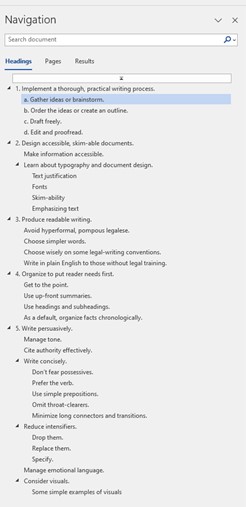
I like to use the Navigation Pane in Microsoft Word to help me with large-scale organization. Here’s a step-by-step guide and then an example.

First, you need to be using Styles in Word. Here’s my brief guide to using Styles. Now, open a document in which you’ve used Styles to create headings. Then—

1. Click the View tab

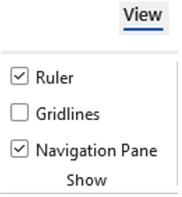
2. Look for the option that includes Ruler, Gridlines, and Navigations Pane:

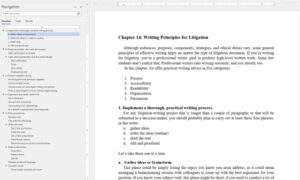
3. Check the box for Navigation Pane, so your screen should look like this:

4. Focus on the left-side Navigation Pane, which shows all the headings you’ve created in your document. It’s clickable and collapsible.

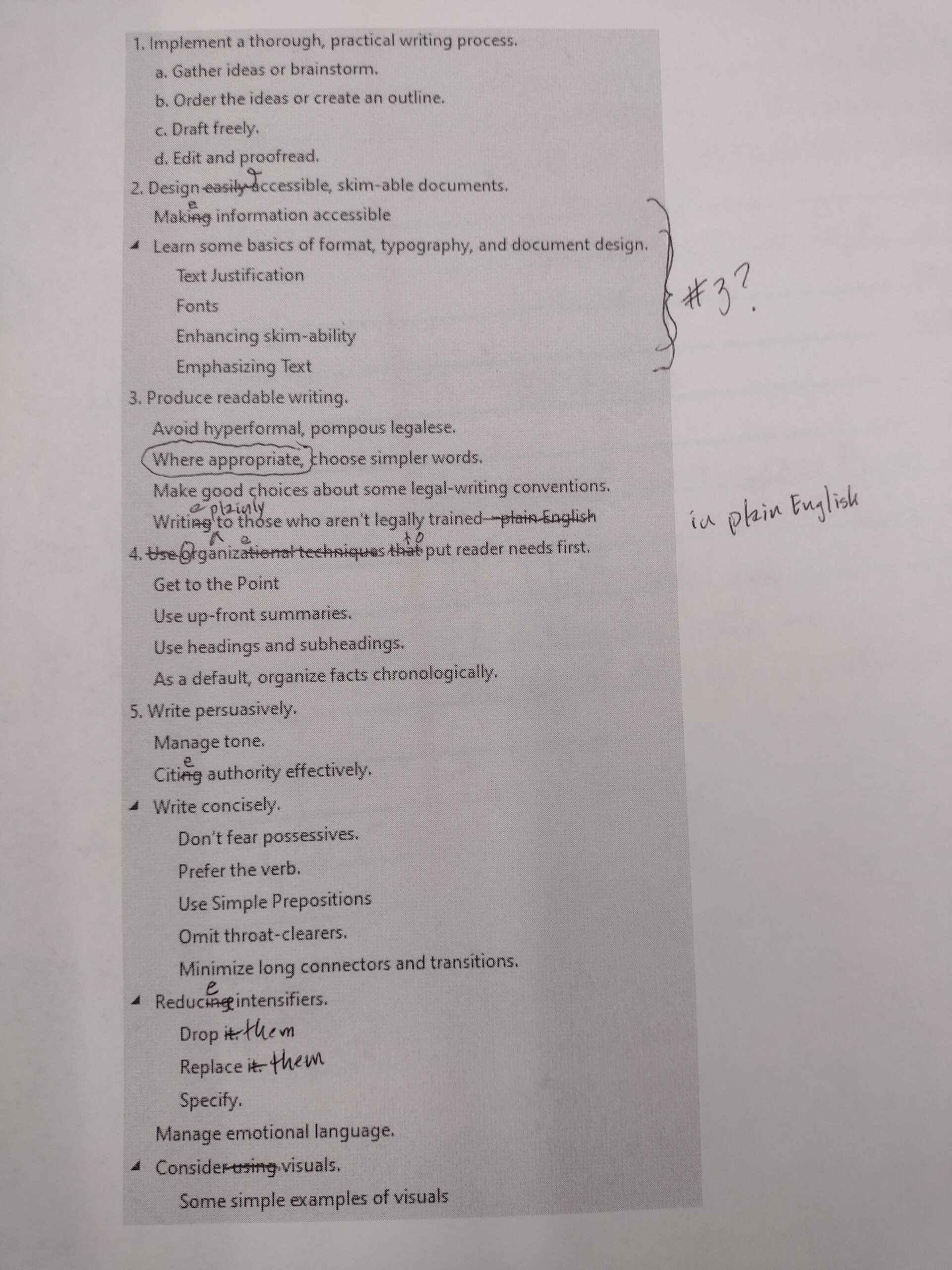
5. Read through all your headings, subheadings, and sub-subheadings—or do what I did: take a screenshot of it, print it out, and read it on paper.

You’re looking for anything related to the organization:

  • Are my main topic headings in the right order? A good order?
  • Are my headings parallel? That is, are all the headings or subheadings that are at the same outline level structured the same way? All complete sentences, for example.
  • Does the entire set of headings form a coherent outline?

Here’s a picture of the screencaptured Navigation Pane from one of my writing projects. You can see that I made notes on it, and I then made those edits to the headings in the document.

Writing in Threes

The power, the magic, and the charm of three

Anecdotal evidence suggests that when trying to persuade, presenting three concepts is better than presenting two. Or four. Or more. We see examples of memorable, powerful threes in advertising, in literature, and even in the Declaration of Independence:

  • snap, crackle, and pop
  • I came; I saw; I conquered
  • life, liberty, and the pursuit of happiness

Yes, I just gave three examples.

Do you have a sense of the importance of three in writing? Did you ever learn to write a “five-paragraph essay”? You present an introduction and a conclusion, but in between you write the first point, the second point, and the third point. The power of three.

When creating lists, when presenting claims, or when organizing arguments, writing in threes is common advice from legal-writing experts. Patrick Barry says, “Judges use the Rule of Three. Practitioners use the Rule of Three. And so do all manner of legal academics.”[1] Diana Simon advises that when possible, “distill your arguments down to three main points … and, if possible, eliminate arguments after that point .…”[2] And Bryan Garner reports that “A mathematician once told me that there are really only four numbers in the world: one, two, three, and many.[3]

But is the persuasive power of three anything more than good advice? Yes. Empirical studies validate the “magic of three,” as Diana Simon summarized in a recent article.”[4]

In one study, subjects learning a new word were better able to understand and apply the word’s meaning after being given three examples.[5] Similar research suggests that we consider evidence and examples to establish a pattern or a “streak” once they hit three.[6]

In another study, subjects described getting back together with an ex-partner, and the descriptions had from one to six reasons that the renewed relationship was good. In one scenario, the person described the ex-partner with four words: “intelligent, kind, funny, and cute.” Researchers noticed that the fourth word provoked skepticism in listeners, and overall, those who heard three positive traits were more likely to approve of the relationship than those who heard four.[7] The authors of that and other studies concluded that “the optimal number of claims is three ….”[8]

In the real world, you can’t always force legal standards into threes. After all, premises liability in Texas has four elements. But if one element is beyond dispute or if one has been waived or stipulated, your memo, motion, or brief can present the three remaining elements. Or maybe for the fourth element is supported by three arguments or three key pieces of evidence.

Would using some examples help you present your position? If so, consider using one or three, but not two—and definitely not four: remember the power of three. And when constructing sentences, if you have the opportunity to present parallel ideas, phrases, or clauses, see if you can reasonably present them in threes. So this:

  • The employer’s responses were hasty, terse, superficial, and disrespectful.

Is likely not as powerful as this:

  • The employer’s responses were hasty, terse, and superficial.

When you can, take advantage of the power of three.

_____

[1] Patrick Barry, The Rule of Three, 15 Legal Comm. & Rhetoric 247, 247–48 (2018).

[2] Diana J. Simon, The Power of Connectivity: The Science and Art of Transitions, 18 Leg. Comm. & Rhetoric: JALWD 65, 80 (2021).

[3] Bryan A. Garner, Good Headings Show You’ve Thought Out Your Arguments Well in Advance, ABA J. (2015), https://www.abajournal.com/magazine/article/good_​headings_​show_​youve_​thought_​out_​your_​arguments_​well_​in_​advance/

[4] Simon, The Power of Connectivity, at 76-77.

[5] Simon, The Power of Connectivity, at 77 citing Suzanne B. Shu & Kurt A. Carlson, When Three Charms but Four Alarms: Identifying the Optimal Number of Claims in Persuasion Settings, 78 J. Marketing 127, 137 (2014) citing J.B. Tenenbaum & F. Xu, Word Learning as Bayesian Inference, Psychol. Rev., 114(2), 245–72 (2000).

[6] Kurt A. Carlson & Suzanne B. Shu, The Rule of Three: How the Third Event Signals the Emergence of a Streak, 104(1) Org. Behav. & Hum. Decision Processes 113 (2007).

[7] Shu & Carlson, When Three Charms, as reported in Susannah Jacob, The Power of Three, N.Y. Times (Jan. 3, 2014), https://www.nytimes.com/2014/01/05/fashion/Three-Persuasion-The-Power-of-Three.html

[8] Id. at 138.