
Research Themes
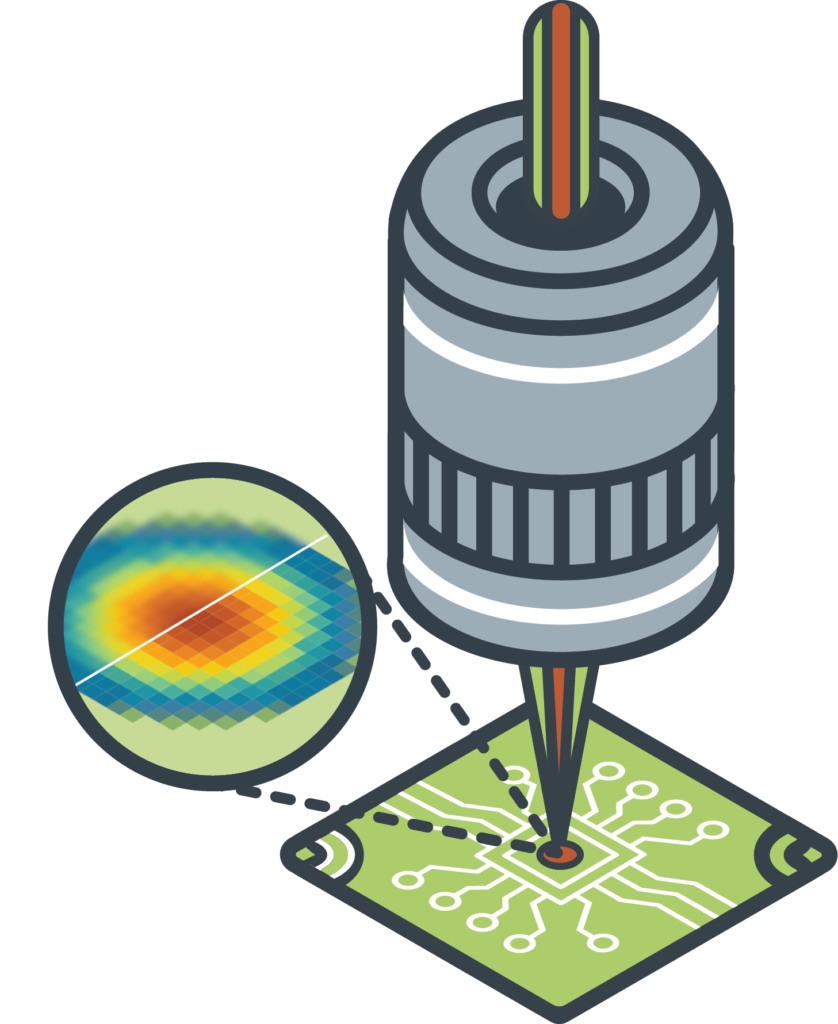
Optical Super-Resolution Nanothermometry
Super-resolution techniques revolutionized biological imaging by revealing cellular structures in unprecedented detail, as recognized by the 2014 Nobel Prize in Chemistry. Such methods combine nanoscale spatial resolution and far-field optics to achieve non-invasive, high-resolution optical imaging. Applying super-resolution concepts to thermometry would likewise yield immense benefits, from unraveling device thermal failure mechanisms to validating predicted deviations from classical heat transfer laws at the nanoscale. To realize this outcome, we are developing stimulated emission depletion (STED) super-resolution nanothermometry techniques based on upconverting nanoparticles (UCNPs) and related lanthanide-containing materials. Using our custom-built STED system, we perform temperature-dependent STED imaging and spectroscopy measurements, develop novel detection schemes, and ultimately apply these new optical super-resolution nanothermometry techniques to operating devices.
As part of this work, we contribute super-resolution nanothermometry measurements to the Center for Single-Entity Nanochemistry and Nanocrystal Design (CSENND), a Phase 2 NSF Center for Chemical Innovation focused on leveraging the inherent heterogeneity of nanocrystals to discover nanocrystals with exceptional properties. Our capabilities support this goal by resolving thermal behavior at the single-nanocrystal level.

Thermal Contributions to Plasmonic Photocatalysis
Many experimental demonstrations have shown that chemical reaction rates can be strongly enhanced when reactions are performed on the surfaces of plasmonic nanostructures. Plasmonic photocatalysis is appealing because it could potentially reduce the energy input required for important industrial reactions and allow the use of sunlight, rather than fossil fuel-derived energy, to catalyze these reactions. However, the detailed mechanisms behind the observed plasmonic enhancement remain strongly contested, particularly in terms of the relative contributions of hot electron effects vs. surface heating. We have developed a dual-mode operando thermometry and reaction monitoring technique, which allows for simultaneous yet separate measurements of the plasmonic surface temperature via upconverting nanoparticle (UCNP)-based luminescence thermometry and the reaction progress via Raman spectroscopy. We have used this method to study the photocatalyzed dimerization of 4-nitrothiophenol to 4,4′-dimercaptoazobenzene, with the goal of disentangling the relative contributions of laser-induced heating and non-thermal effects to the observed plasmonic enhancement.

Expanding Applications of Luminescence Thermometry
Luminescence thermometry has matured to the point where it can be deployed as a practical measurement tool across a growing range of scientific and engineering problems. A recurring theme in our work is applying these approaches to new systems and operating environments where temperature plays an important role but is difficult to measure by conventional means. Current and recent examples include probing internal temperatures in operating batteries, characterizing heat generation in tandem catalysts, and investigating microscale heating for localized crystallization processes. Many of these projects are collaborative, pairing our thermometry capabilities with domain expertise in other fields, and we anticipate continued expansion into new application areas as opportunities arise.
Funding
We gratefully acknowledge our past and present funding sources for making this research possible.





Experimental Platforms
[Coming soon]