
by Gunjan Malhotra
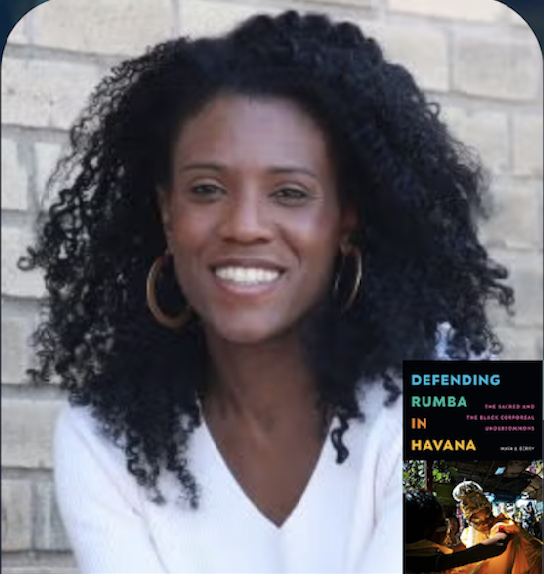
On Friday, April 3rd, 2026, the Department of Religious Studies welcomed Dr. Maya J. Berry of the University of North Carolina, Chapel Hill, for a rich and thought-provoking session for its Caribbeanist Labs on Religion and LLILAS Caribbean Studies Initiative event. The event was co-sponsored by the Butler School of Music, the Department of Anthropology, and the John L. Warfield Center for American and African Studies. Dr. J. Brent Crosson from the Department of Religious Studies mediated the session and introduced Dr. Berry. Trained as a socio-cultural anthropologist and a Rumba dancer, Dr. Berry’s work bridges social sciences and ethnomusicology through an anthropological and ethnographic focus on Cuba. Questions such as: How does examination of black political life, black feminist praxis, and, crucially, the embodied sonic practices through which knowledge, community, and resistance are produced, drive her research? Her award-winning monograph, Defending Rumba in Havana: The Sacred and Black Corporeal Undercommons (2025 Duke University Press First Book Award), formed the basis of her presentation, alongside insights from her recently edited volume, Fugitive Anthropology: Embodying Active Research (University of Texas Press).
Dr. Berry opened by situating her ethnographic fieldwork within the shifting economic landscape of post-revolutionary Cuba, emphasizing how political reforms have disproportionately affected African-descendant working-class communities. Yet, rather than reading these conditions only as a backdrop, she foregrounded how musical and ritual practices, especially Rumba, serve as a primary site through which these transformations are experienced, interpreted, and contested.
Focusing on the post-Fidel era, Berry traced the transformations initiated under the Cuban military regime, particularly the updating of the Cuban economy from a Soviet to a capitalist model. These reforms, which expanded the private sector and reduced state subsidies, were celebrated internationally as signs of progress. However, Berry’s ethnography reveals a starkly different perspective from the ground. For many black and poor Cubans, these changes just marked a regression in quality of life, exacerbating existing racial and class disparities. The contraction of the public sector, coupled with the encouragement of entrepreneurism, produces new forms of priority, particularly for those who have been historically reliant on state-supported social welfare.
At the center of Berry’s intervention is a reconceptualization of Rumba. Far from being merely a genre of music and dance, Rumba emerges in her work as a complex sonic-ritual and epistemological practice—one that organizes social life in Cuba. It is at once a musical performance, embodied knowledge, and sacred relation through percussion, voice, and movement, where Rumba is a shared space of sacralized performance, what Berry calls a “ sacred choreo-geography”.
Berry argued that Rumba must be understood as a form of knowledge production: its rhythms, choreographies, and call-and-response structures do not simply express social realities; they actively generate modes of relation and belonging. In this sense, music is not just representational, but constitutive. The acoustic field of Rumba – drumming, singing, and dancing – becomes a medium through which communities negotiate survival, dignity, and collective life—all—under conditions of racial and economic constraint.
Berry outlines three central claims of her work: first, that practitioners of Rumba sustain a “corporeal undercommons” through embodied practices that challenge inequalities based on race, gender, and class; second, that these undercommons cannot be understood outside “the politics and poetics of the sacred”, as the relations with African-derived divinities such as the pagan gods called Orishas, including the river goddess, Yemaya and the thunder god, Shangó, remain central to these practices; and third, while Rumba offers a “space of refuge” from various forms of oppression, it simultaneously reproduces certain gender hierarchies, revealing the complexity and ambivalence of the social formations.
While Rumba has often been categorised as a secular, cultural form separate from religious practices, such as Santeria, where Afro-Cuban performers sing and play drums for temple rituals dedicated to pagan gods, Berry demonstrates that for practitioners, such distinctions are neither stable nor meaningful. Instead, ritual, Rumba performance, and everyday life are deeply intertwined. The state did its best to turn it into a secular domain. In doing so, the state wants the practice to be dedicated to nationalist values, and therefore offered the Rumba performers to either serve and sing for the nation and get a $20 monthly salary, with a cultural heritage status or face economic and social distress. Berry demonstrated how these practices function as spaces of refuge, mutual aid, and covert political organization even in post-Fidel Cuba, tracing their origins to colonial-era gatherings among enslaved Africans and their descendants, which reduced them to a mere spectacle unaligned with European and Christian aesthetic sensibilities.
A key contribution of Berry’s talk was an insistence on the inseparability of music and ritual. Performances in ostensibly secular venues, such as nightclubs, often incorporate liturgical rhythms, invocations of the very same pagan deities worshipped in the temple, and forms of audience participation that mirror ritual practice. In these moments, the sonic space transforms: drumming patterns call for spiritual presence, dancers embody deities, and spectators engage through the prayer gestures of offering and recognition, while the performers simultaneously practice ritual rotation in remembrance of Orishas.
Central to her argument is the idea of a “black corporal undercommons” sustained through the musical and ritual practices of Rumba gatherings, whether in neighbourhood places, religious ceremonies, or stage performances. All of these facilitate the circulation of resources: material, emotional, and spiritual. These practices, Berry showed, are not only symbolic but efficacious. Musical performance becomes a site of exchange between human and “more-than-human actors.” Practitioners understand the ability to sing, play drums, or dance as inseparable from divine forces that guide and sustain them. Thus, music is not merely an aesthetic expression, but a form of relational, sacred and ritual labour, which she describes as “religious work”, through which livelihoods are secured, and communities maintained.
Dr. Berry’s talk offered a powerful reorientation for the study of religion and music. In centring Rumba as a sonic ritual practice, she demonstrates that music operates as a critical site of knowledge, relation, and political possibility. Her work invites scholars to take seriously how sound and embodiment shape not only cultural expression, but also the political and social enactment of rituals in performative spaces.
Dr. Berry’s presentation opened important venues for thinking about music, ritual, and the enduring power of embodied knowledge in the study of religion, where the anthropology of religion plays a key role.
Gunjan Malhotra is a PhD student in the Department of Religious Studies at UT Austin. Her research focuses on the interface between music and religion in early Modern South Asia.