
Answers – Part 1
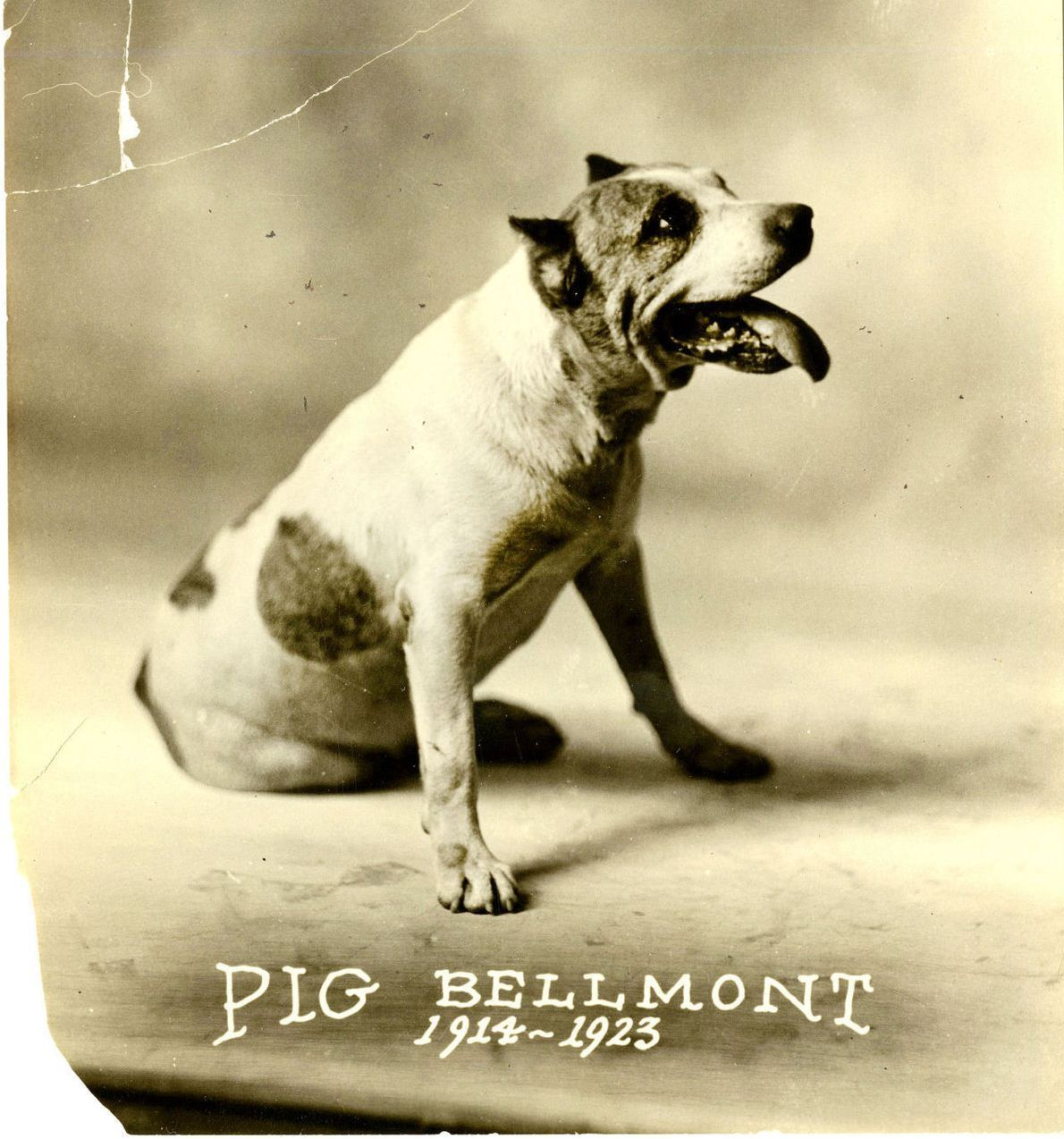
1. Who was the first live mascot of the University of Texas?
c. Pig
While University athletic teams have been known as “Longhorns” since 1904, UT’s first live mascot was a tan and white dog named Pig Bellmont, owned by Athletic Director Theo Bellmont. Pig was named for football team captain Gus “Pig” Dittmar, spent most of his time on campus, and attended football, baseball, and basketball games. When Pig died in 1923, he was given a well-attended funeral procession down Guadalupe Street and buried just north of today’s Graduate School of Business building. Engineering Dean Thomas Taylor delivered a 20-minute eulogy to several thousand mourners, compared Pig to the faithful dog of Lord Byron, and claimed that Pig was on an “orange and white rainbow” to canine heaven.
2. Today’s Battle Hall opened in 1911 as the University’s first library building. What famous library did architect Cass Gilbert use for inspiration?
b. The Boston Public Library
New York architect Cass Gilbert was hired by the University in 1910 and designed the Library (today’s Battle Hall), Sutton Hall, and provided a campus master plan. The UT Library, with its now-familiar broad arched windows, medallions, and second-floor reading room was inspired by the design of the Boston Public Library.

3. During World War II, about 1,000 UT women students considered it their “patriotic duty” to participate in this program, headquartered at the Texas Union.
c. Dating Service
In the 1942 fall term, the War Effort Council, a student committee charged with coordinating student war-related activities, made plans to improve the morale of “lonely” soldiers stationed in the Austin area. The result was a University Dating Bureau, headquartered at the Texas Union. Almost 1,000 women students registered – after first receiving permission from their parents – with their names, ages, hometowns and interests. A college-age soldier who had likewise registered could visit the Bureau and request a date for the upcoming weekend. Every effort was made to match couples with similar interests, though the couple was only permitted to go to places approved by the Dean of Women.
4. What was the best-known UT student organization for the spring 1974 semester?
b. The Association of Streaking Students (A.S.S.)
Streaking – running outdoors in one’s birthday suit – was a national fad in 1974, and UT students weren’t about to miss out. Administrators, however, were less than enthused at the idea of students romping across campus in the buff, declared it illegal, and charged a $50 fine to anyone caught. Undeterred, the students responded by founding the Association of Streaking Students (A.S.S.), accepted donations, and paid the fines of those ran afoul of the law.

5. Which University structure once had its own zip code?
d. Jester Center
Opened in 1969, Jester Center was imagined to be something like a residential college, where both living and learning environments were integrated. Meant to house 1,800 women and 1,200 men students, changes to the design while construction was already in progress eliminated the residential college concept, and Jester Center – UT’s largest single building project up to that time – became a rather awkward combination residence hall and adjoining classroom building. For its 20 years or so, the complex housed enough persons to merit its own zip code: 78784.

6. The University’s first athletic field was named for James Clark, who was UT’s initial:
All of the Above
James Clark, a lawyer in Bonham, Texas, and member of the Board of Regents, resigned from the Board in 1885 to become the University Proctor, essentially a UT staff of one. Clarks was registrar, bursar, academic counselor, librarian, secretary to both the faculty and the Board of Regents, head groundskeeper, and a host of other duties. If a student fell ill, Clark would visit them. In later years, Clark personally financed an annual Christmas dinner for the “leftovers” – students unable to get home for the holiday. It’s not a surprise that, while Clark was still living, students chose to name the athletic field in his honor.

7. Which structure is the tallest?
a. The UT Tower
University of Texas Tower 307 feet
Statue of Liberty 305 feet
Texas Capitol 302 feet
United States Capitol 288 feet
8. What was the average faculty salary when the University opened in 1883?
b. $2,500 per year
Through 1881 and 1882, the inaugural Board of Regents worked tirelessly to recruit the best faculty they could find for the soon-to-be-opened University of Texas. It wasn’t easy. There weren’t many qualified in-state candidates, and outside of Texas, Austin was widely viewed as a backwards frontier town where the weather (long before the invention of air conditioning) was too warm, too often. As a financial inducement, and with support from Governor Oran Roberts, the regents were able to offer a $2,500 salary, a generous sum for professors in the 1880s.
