The Williamson Lab is very proud to have not one, but two articles published in the latest issue of Journal of Consulting and Clinical Psychology. These papers examine when and how couple-focused interventions benefit families, particularly those facing higher levels of stress and economic disadvantage.
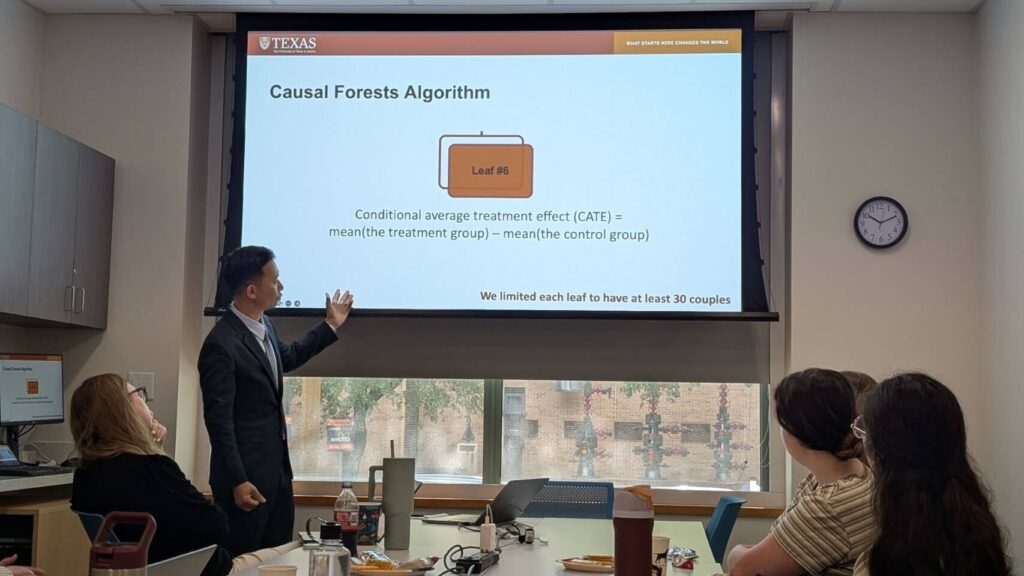
In the first paper, which is drawn from Nick Chen’s dissertation research, we use a machine learning approach to examine heterogeneity in treatment effects of couple relationship education (CRE) programs. Drawing on data from two large randomized controlled trials, the study shows that CRE effects are far from uniform: couples experiencing higher psychological distress, greater stress exposure, and lower baseline relationship happiness tend to benefit the most, especially in terms of improvements in relationship happiness and reductions in negative emotions and behaviors. These patterns replicated in an independent sample, highlighting the promise of data-driven approaches for improving how relationship interventions are targeted and evaluated.
The second paper, which was led by our collaborator Justin Lavner at the University of Georgia, focuses on whether improvements in couple functioning translate into benefits for children in low-income families. Using longitudinal data from more than 6,000 couples, the study tests indirect effects of a couple-focused intervention on multiple child outcomes 30 months later. Results indicate significant indirect effects on children’s self-regulation, behavioral problems, cognitive and academic performance, and social competence, with some variation by child age. These findings provide a rigorous test of a core assumption underlying couple-focused prevention efforts: that strengthening couple relationships can promote children’s well-being over time.