
Nick Chen has a new lead author publication in Journal of Family Psychology examining the impact of supportive equity on negative affect in middle-aged and older adults. The study shows that emotional support equity is associated with decreased negative affect for older adults compared with middle-aged adults, highlighting the benefit of supportive equity for older adults and the need for more research on middle-aged adults
Lab News
Congratulations Dr. Chen!
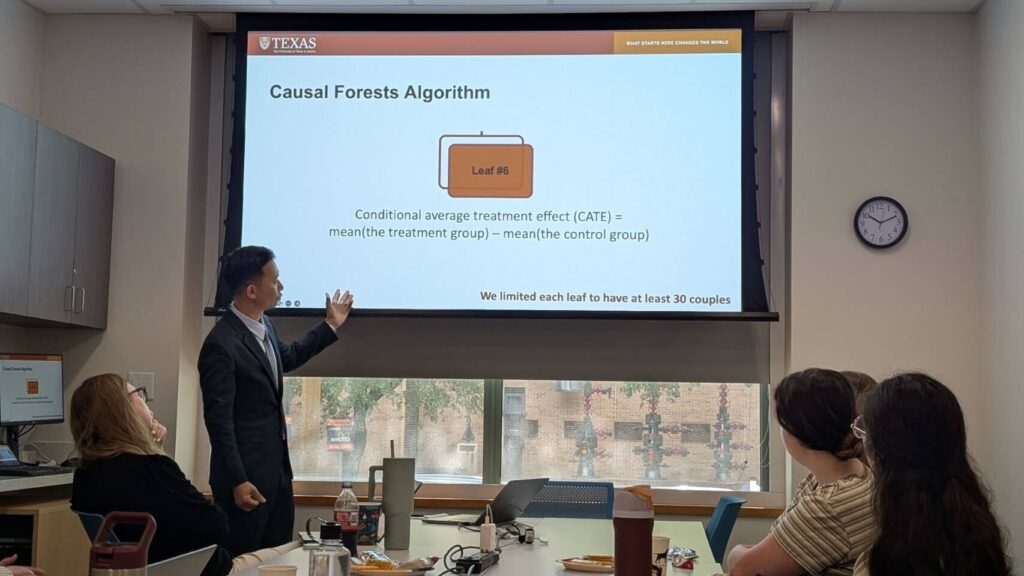
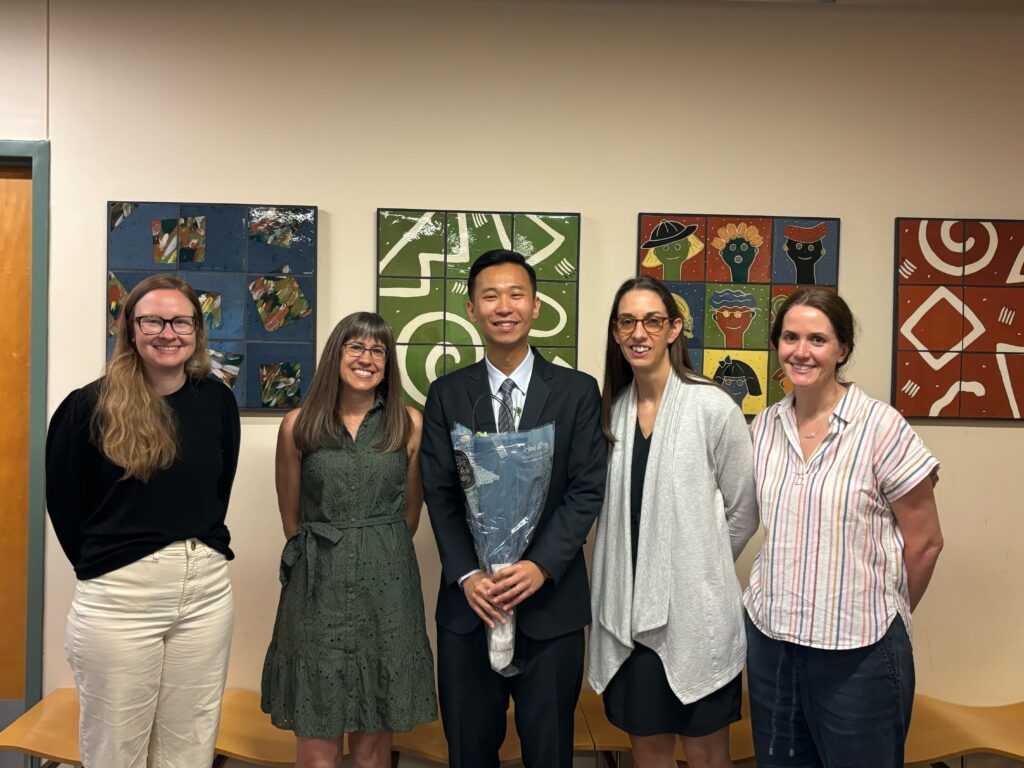
Congratulations to graduate student Po-Heng Nick Chen for successfully defending his dissertation, entitled: Characterizing Heterogeneous Treatment Effects of Couple Relationship Education: A Machine Learning Approach.
Congratulations to Isabella
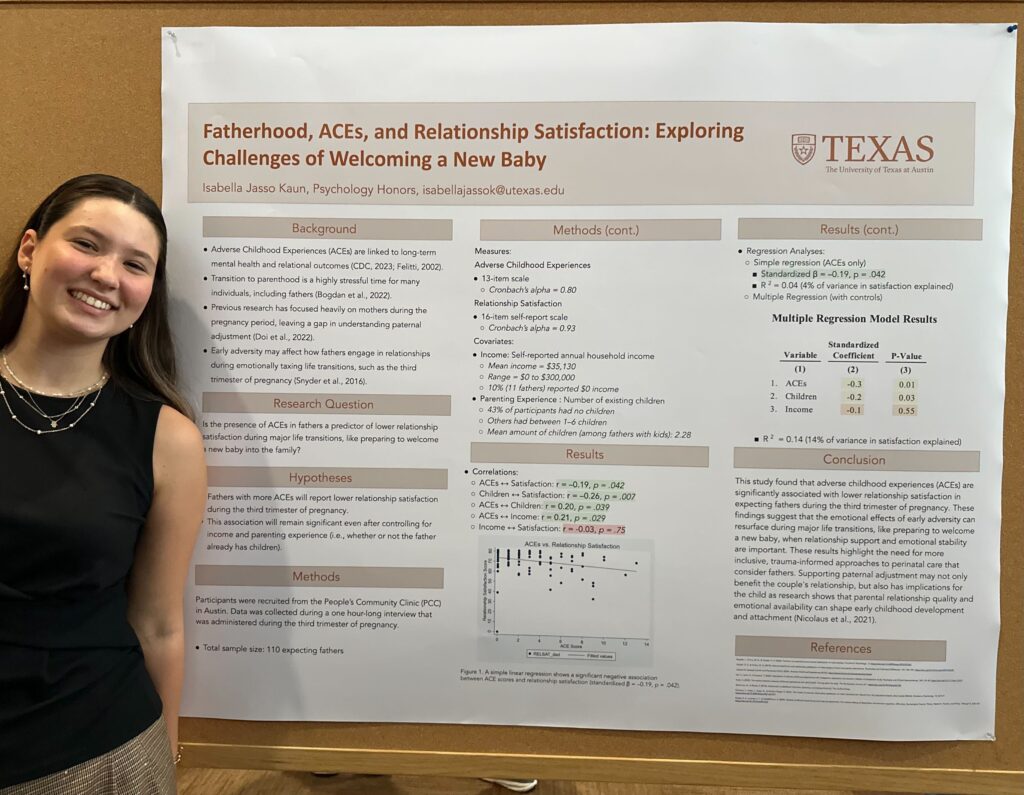
Congratulations to Isabella for successfully completing and presenting her honors thesis “Fatherhood, ACEs, and Relationship Satisfaction: Exploring Challenges of Welcoming a New Baby”
Thank you to outgoing lab members!
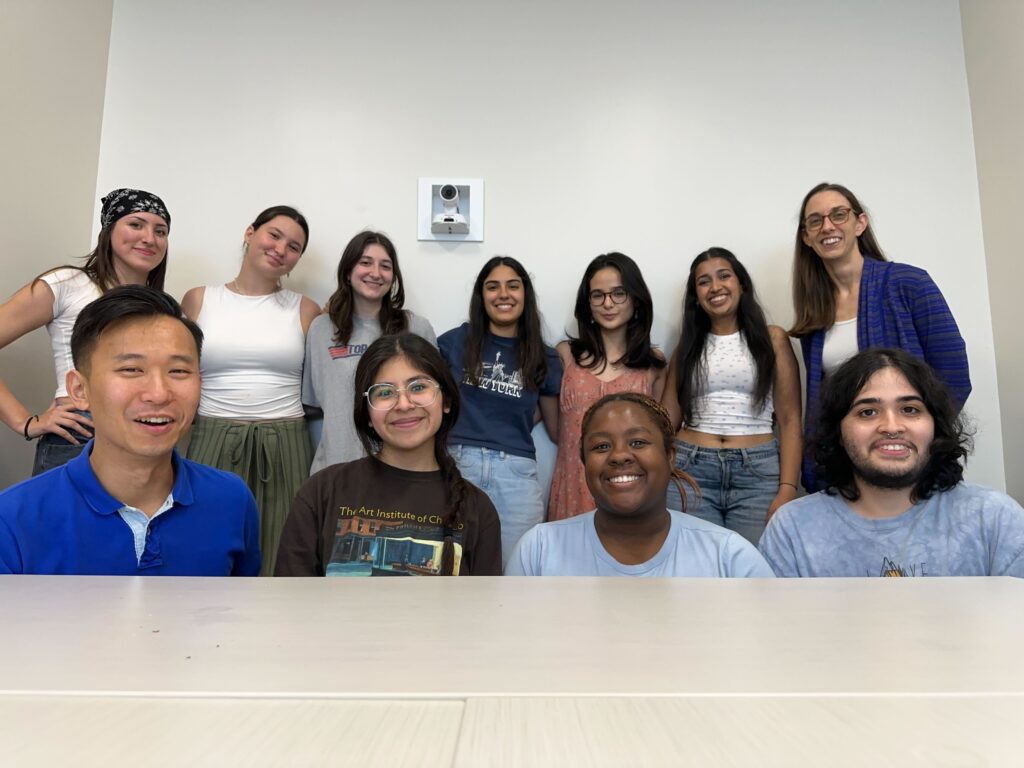
Thank you to our amazing research assistants who have been with the lab for the 2024-2025 school year (and longer). Best of luck to Jenni, Isabella, Ruhani, Estefania, Anusha, and Lucian who are graduating this semester.
Happy summer!
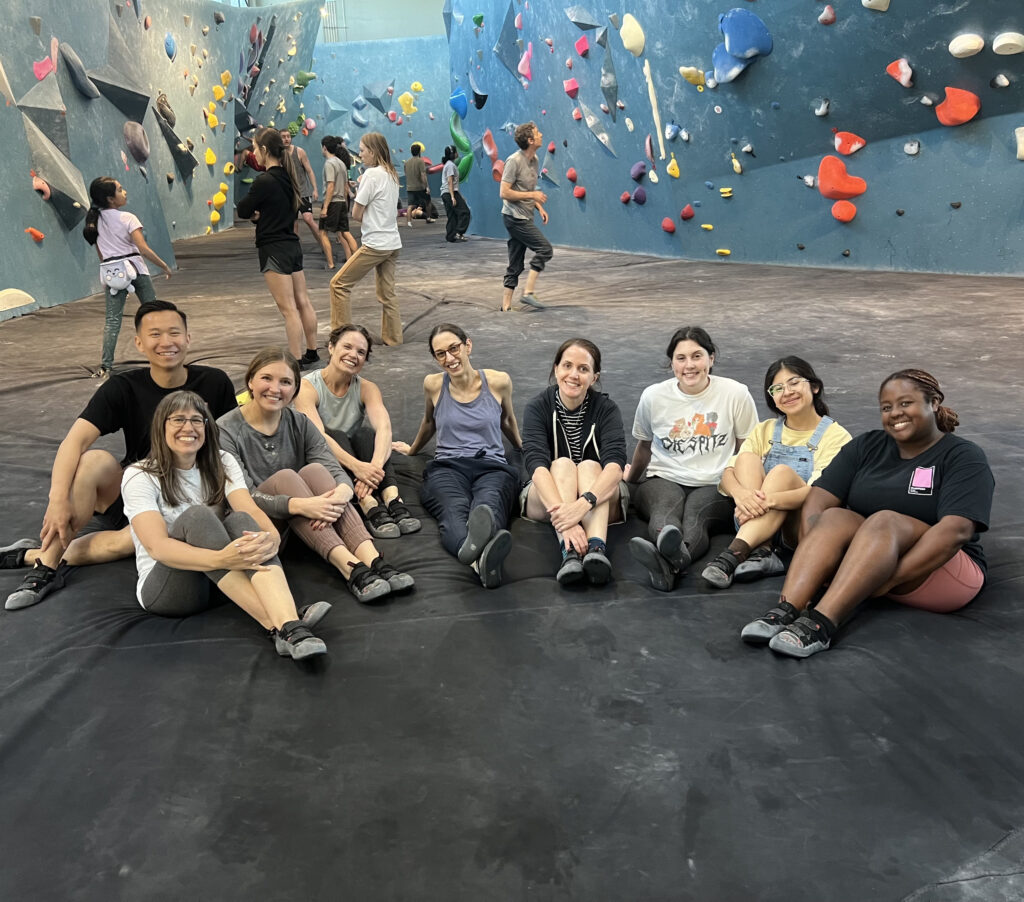
To celebrate the end of the academic year, the relationships area went on an end of the year outing to Austin Bouldering Project.
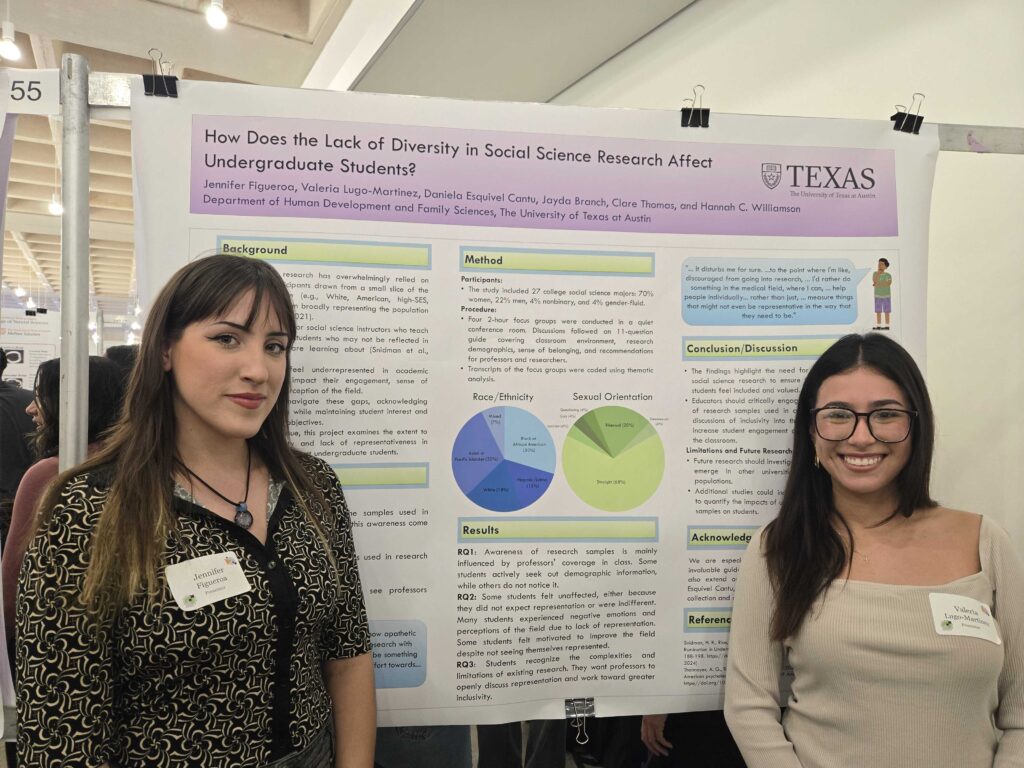
Research Presentation: How does the lack of diversity in social science research affect undergraduate students?
Congratulations to Jenni & Valeria
Undergraduate RAs Jenni Figueroa and Valeria Lugo-Martinez presented a new Science of Teaching and Learning project from the Williamson Lab at the UT Undergraduate Research Forum. This project investigates the extent to which undergraduate social science students are aware of the lack of diversity in research samples, how they are affected by it, and how they would like professors to address this issue in their classes.
New paper in press at Couple and Family Psychology: Research and Practice
The first paper from the New Parents Project has been published in Couple and Family Psychology: Research and Practice. In this article we detail the procedures we used to recruit this sample of 110 low-income, primarily Spanish-speaking couples who were expecting a child. We hope this detailed information will help other couple and family researchers who want to improve their study procedures to broaden the scope of people who are included in our research.
New paper in press at Social and Personality Psychology Compass
Graduate student Nick Chen and Dr. Williamson have a new paper in press at Social and Personality Psychology Compass entitled “Current theories and epistemologies of couple communication center White American modes of interaction.” This article argues that observational methods that are commonly used to study couple communication are well-equipped to capture White American modes of communication and interaction which prioritize openly and directly confronting problems, but do not adequately capture the various ways that couples from other cultural backgrounds deal with relationship problems or communicate love and support. By upholding this rigid epistemological definition of “good science,” relationship scholars are limiting our ability to accurately understand relationship functioning among couples from cultural backgrounds that are not aligned with White American ideals, and perpetuating the White American mode of interaction as the “correct” way to behave in a relationship. The article then discusses adjustments that must be made to this methodology, as well as alternative methodological approaches for studying couple communication, that should be adopted in order to move toward an inclusive, global science of close relationships.
New article in press in Journal of Social and Personal Relationships
The first article from Dr. Williamson’s collaborative work with Drs. Valor-Segura and Alonso-Ferres during her time in Spain has been published in the Journal of Social and Personal Relationships. This article presents a translation and adaptation of the widely used Perceived Responsiveness and Insensitivity Scale for use with Spanish-speaking participants. You can find the full text of the measure here.
