Category Archives: Thoughts

All Staff Reflection: July 2024

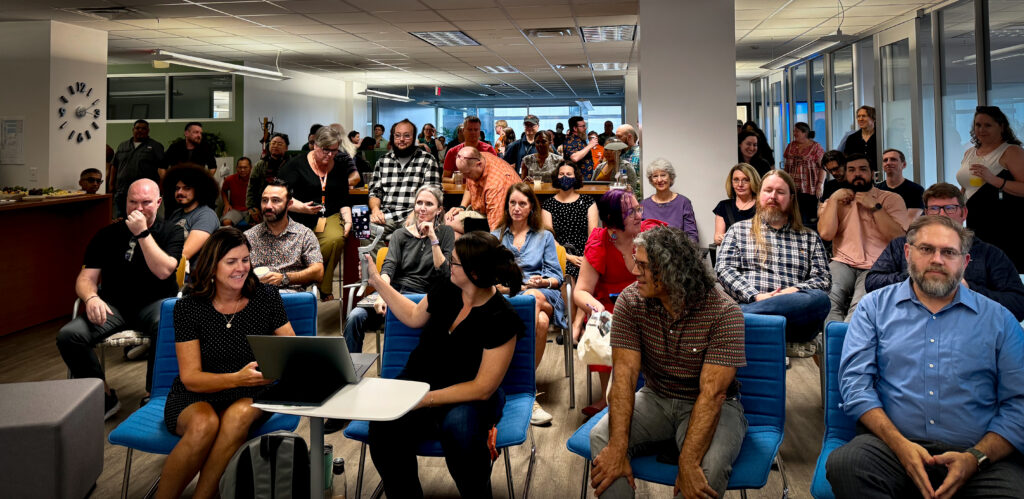
Yesterday we hosted my first hybrid all staff meeting in our new UTA Commons space on the Austin campus. At first, to be completely honest, it was a bit overwhelming seeing so many people together in a room that until yesterday I had not seen more than 10-15 people in at a time. I feel like I am not 100% over the isolation practices of the pandemic times — lots of people in a constrained space make me a little uncomfortable. It is weird because I am in crowded places all the time — airports, concerts, and the like. But, for some reason, it all felt a little surreal doing it in the context of our workspace with over 100 people. By about halfway into the meeting that feeling was replaced with excitement and I can’t wait to do more of it!

Photo of all staff meeting in UTA Commons.

Once the technology started to (mostly) cooperate, I was able to share some thoughts on the organization, the University, and how I want us to shape our role in being the drivers of progress and digital change. I reviewed the slides I shared in my previous post, but this time I was able to pause and talk about the “why” behind the decisions we have made. I was also able to spend a bit of time highlighting a couple of the organizational values we have developed and why I believe they are critically important — I highlighted the importance of Engagement, Service, and Security and how those three values need to be top of mind and at the center of our decision making going forward.

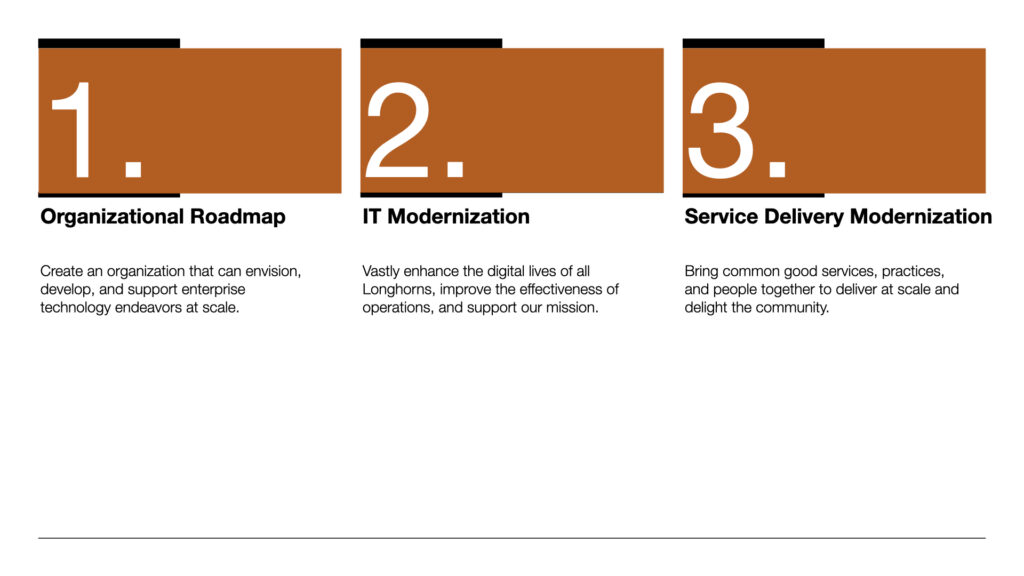
We reviewed the three primary pillars of our emerging strategy and discussed how we see ourselves getting there. The first thing we talked about was the Organizational Roadmap that will provide the guideposts to organizing ourselves appropriately and communicating change to campus.

Screenshot of a powerpoint slide describing our organizational roadmap approach.

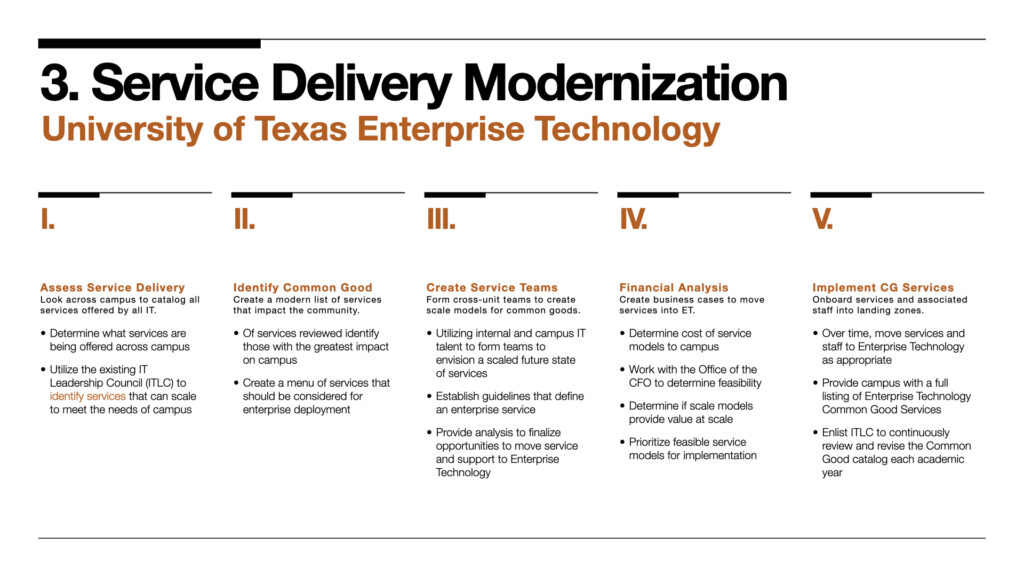
We then did a bit of a dive into the IT Modernization workstream that I am aligning with the President’s Change Starts Here strategic plan. The power in this alignment allows us to utilize existing governance structures to address our largest enterprise technology challenges, hear directly from campus leaders, and turn these challenges into opportunities. The slide I shared aligns to five critical areas of focus for us to organize around. You can see it below, and to be honest, the five areas are even more important at this moment than the initiatives contained within each. This framework should help us work with campus partners to make significant progress in the most critical areas of need.

Finally, we discussed how we wanted to improve both the services we currently offer and identify those offered across campus that should be provided at the enterprise level. Essentially, my perspective is allowing the identified services to help dictate how they are delivered and supported in a holistic, enterprise way. In other words, find the services that have enterprise level consumption and treat them like actual enterprise, common good offerings from a central provider. Our campus customers should not need to know who offers a service, just that it is available. This work will need to lean on all of our campus partners, governance groups, and the needs of our audience as the guiding principle.

We closed with what felt like a very open conversation about many topics — talent, growth, work from alternative locations, the need for the team to understand how our budget works, and more. Coming out of the meeting I will be launching a Coffee with Cole series that aims to bring small numbers of staff together with me for more personal conversations. These skip level meetings have always been an important part of my understanding of the real challenges people are facing while trying to do their jobs. And with that said, I cannot wait to continue this journey with my new colleagues as we work to build upon the legacy of innovation in our work supporting this amazing university.

Making Progress

Several weeks ago, I met with President Hartzell to discuss our emerging strategy going forward. We have talked many times about his goals for technology at the University and this was a first opportunity to reflect that discussion back to him to make sure we are moving in the right direction. We had a great discussion, where he listened, provided feedback, and told me to keep pushing in this direction. It was an honest discussion about how we need to position ourselves for long-term success. I thought it would be helpful to share a little bit about some of the early changes we are making

I have mentioned before that we are taking on the daunting task of rebranding our new organization. Now that we have brought the existing ITS team together with AIS and eBITS we have the opportunity to focus our energy at solving the largest, most complex challenges at the University as it relates to technology. Our focus is centered around envisioning, creating, and implementing enterprise level technology solutions, hence the selection of, The University of Texas Enterprise Technology as our new organizational name. There are a number of steps that need to be taken to finalize this change before we launch a branding campaign around the start of the new fall semester.

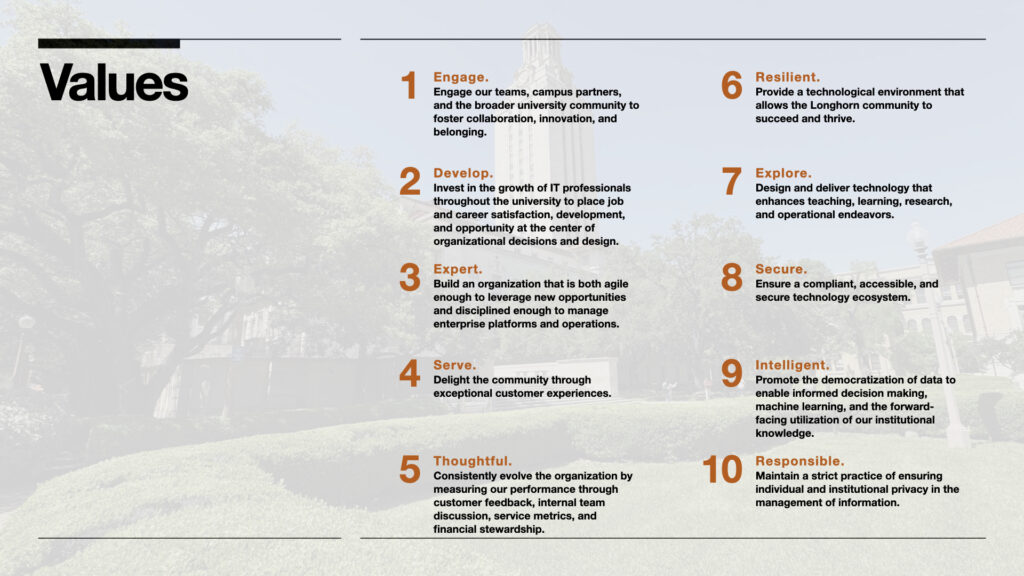
I am a firm believer in the idea that every organization must express their values proudly and transparently. When the senior leadership team sat down for this discussion, we knew that we wanted to create a series of values that represent the scope and scale of the work we perform while giving us some guardrails we can use to guide our work. To me, what is so important about being overt with our value statements is that it gives us a collection of lenses to look through to help guide our decision making. We can ask ourselves if we are living up to these values whenever we are making decisions, sitting in meetings, doing strategy work, or executing on our day-to-day activities. Values guide our actions, and the SLT believes that these 10 values will help guide us to make better decisions and express who we are.

I then took him through in detail the three primary components of our emerging roadmap. The first being a plan to rebrand our new organization and a focus on getting our own operations in order to rise to the challenge of driving the enterprise conversation forward. The second piece is where the bulk of our strategic roadmap will focus. I have worked with the Change Starts Here (CSH) strategy office to think about how we will work together to address our IT modernization efforts around CSH 3.9, Modernizing IT. By aligning with CSH, we will be able to leverage those existing governance models to help us move our programs forward.

Finally, I believe that we as a campus community need to draw a line in the sand as it relates to common good services, service delivery practices, and the alignment of our community to the delivery of these services. This will not be easy, but by working closely with the ITLC, other governance groups, and our internal teams I am confident that we will be able to make major strides in the area of common good and enterprise service delivery.

At our next staff meeting I will deep dive into the three areas of our strategic roadmap, and we can have some real dialogue about what it all means. I will also be putting together a post here that will attempt to do the same. Until then, find me on Teams or reach out to get a meeting scheduled if you have questions or just want to talk.

June Updates from the Office of the CIO

I am thrilled to share some significant updates on various IT projects and initiatives happening at the University of Texas. These projects are set to enhance our digital infrastructure, improve service delivery, and foster innovation across the campus.

One of the major highlights is the Networking and Telecommunications Upgrade. Our campus wireless network is undergoing a major lifecycle upgrade, with 91% of the new Wi-Fi 6e wireless access points already installed across 160 buildings. This upgrade is expected to be completed by August 30, 2024.

In addition, we are making strides in Mainframe Modernization. Efforts are underway to improve application interconnectivity and developer tools for the mainframe, including enhancements to the Log4Natural product to enable better logging and alerting via Splunk. The campus rollout is expected in July.

Another exciting development is the Data Center Onboarding. The University of Texas Medical Branch (UTMB) is being onboarded as a new regional customer in the data center. Electrical upgrades and the installation of 76 new devices have been completed, with the first live migration scheduled for July 9th.

The UT Works Program is also making significant progress. Currently in the End-To-End testing phase for its Phase 1 implementation, the program aims to modernize campus operations and improve service delivery and data management. It is set to go live in November 2024.

We are also fostering collaboration among IT groups through the Service Desk Collaboration initiative. Regular meetings and a dedicated Teams room have led to improved issue resolution and service desk efficiency.

Moreover, the Caption and Transcription Service team has been integrated into Enterprise Technology to streamline digital accessibility support and form a Digital Accessibility Center (DAC).

In collaboration with AWS Innovation Center, we have launched the AI Tutor Initiative. This project aims to personalize learning by providing a customizable AI solution for faculty, with an initial six-week venture underway.

For a more detailed overview of these projects and initiatives, we invite you to download the full report in PDF format. Stay tuned for more updates as we continue to enhance our digital infrastructure and services!

First.

I want to take a moment to introduce myself. My name is Cole Camplese, and I am the new Vice President for Technology and CIO at The University of Texas at Austin. I am tremendously excited to be here. I have spent most of my career dedicated to higher education and in the last 10 years, I have been the CIO at Stony Brook University, the University of Chicago, and Northeastern University. Before that, I spent 16 years at The Pennsylvania State University where I served in multiple roles from instructional designer to institute director, co-lead for the Center for Online Innovations in Learning, and Senior Director of Teaching and Learning with Technology. I have taught courses in disruptive innovations and the information sciences. I have done quite a bit of work with many of the companies we are all familiar with, such as Dell, Microsoft, and Apple, among others.

Even though I have yet to meet you all, I am overwhelmed by the welcome I have received from so many of you. Each one brings a smile to my face. I have also been thrilled to hear many of my new colleagues outside of IT, particularly in the administrative ranks, praise the efforts of this team. Many of them have singled out individuals who make their lives easier and their offices run smoothly. A theme that has emerged is that our leadership is beyond appreciative of the work this team does and fully understands the challenges and opportunities laid before us. They see that technology is a driver of our strategic direction as an institution.

“What Starts Here Changes the World” isn’t just a slogan to me at this point. Before I landed in Austin, I thought it might just be another catchy phrase to attach to a campaign. But what I have learned in my first week is that it is much deeper than that; it is a rallying call for us all. I am struck by the enormous opportunity we have to help invent the future for this incredible University, the State of Texas, the nation, and the world. The work we do is often the underpinning of the great discoveries that advance society; it challenges the status quo and opens doors to new questions that we never thought to ask. I like to think of this team as the thread that weaves together the fabric of progress President Hartzell is asking us to create.

Through all the hype, emergent technologies are moving our existence into some very unfamiliar territory. But with that said, we have seen moments like this before in our own lifetime–the dawn of the personal computer, the emergence of the internet, the radical cultural shifts powered by web 2.0 and social media, and today, the rise of contextual artificial intelligence. We have lived through these digital revolutions and have always stepped up to the challenges of preparing our faculty to use new tools in their classrooms, to transform the way they conduct research, to help students build digital literacy skills, to shape the efficiencies of our operations, and most recently, power us all through a global pandemic. We are the stewards of the future of our institution, and I am both humbled and thrilled to be a part of it. What is most exciting to me, however, is that we get to tackle these enormous changes together.

In the coming days, weeks, and months, we will work as a team to embark on another journey: to put a new organization to work in ways that will rise to not only meet these challenges, but to prepare for what lies around the corner. I have heard many of the reasons why we may not be able to do it: technical debt, funding challenges, redundancy, staffing levels, etc. What I have not heard anyone mention is a lack of talent and expertise in our organization. That tells me something very important: we have the power to take control and convert it into action. And that is what we are going to do, together.

All of this will not be easy, but I am convinced with your help, insights, and passion we can be the national standard for higher education technology leadership. Our university aspires to be the best in the world, and we have the opportunity to power that climb. Our work will power researchers in their quest for the next Nobel Prize, will help prepare our students for whatever world awaits them, and will empower our faculty and staff to smoothly do their jobs every day supporting this great institution. There is a lot of work to be done, both in running the trains on time right now and building many new tracks for the future. We are empowered right now to organize and take chances to reinvent the things we think about, the way we support our customers, what services we offer, and most importantly, how we rise to meet the incredible challenges we collectively face. I am bullish on our future, and I believe we can make a dent in the universe, together.