Category Archives: SLT

Organizational AI Enablement

Last March I attended my first Kung FU AI advisory board meeting. I walked away feeling way out in front, we had contracts in place with Microsoft, OpenAI, and Anthropic for campus to safely consume the best of the emerging AI market. It was a classic “if you provide it, they will come” approach. Fast forward to March of 2026 and I walked away from the same annual meeting with a different feeling: that we have let the early momentum slide.

What I listened to as I sat and looked around the room were CTO, CEO, COO type people not talking about procurement wins or what they were thinking about AI, but instead about how they spent much of the year activating and enabling their IT organizations to be AI-first in their decision making. The intentional adoption of AI to drive impact was more important than early wins and “low hanging fruit.”

I left that meeting feeling a different kind of urgency, one that was aimed directly at enabling the teams that make up Enterprise Technology. One of the first things I did was schedule an all day retreat with the ET senior leadership team. Mario and I sat down and laid out the sketch of how we wanted to approach the SLT and built a framework that was meant to challenge each of us. The challenge was to come to a place where we would take a very intentional turn and focus on internal adoption, diffusion, and enablement.

That is a hard turn for an organization that spends nearly all of its time looking out across campus. We have rightly focused on campus adoption, diffusion, and enablement while often times leaving ourselves behind. What I learned from the advisory board meeting was that the only way to grow outside of ET is to first grow inside ET.

With that in mind we walked into our retreat and declared that that day was Day Zero of ET’s intentional AI adoption and enablement practice. We each made commitments. We also addressed the outcomes of our first ET AI Use Survey, where we learned that our staff were reluctant to adopt AI for reasons we hadn’t considered: environmental, ethical, and uneven tooling concerns dominated the results. It was an opportunity for us as the leadership team to square our organizational expectations and commit to focusing significant effort inside ET to enable success for all of campus.

Today we sent a strong message to the ET staff that they have the support and commitment from their leaders to bring us all into the world of AI to improve our own work, support campus, and to challenge ourselves to rise to this moment. My favorite part of the memo reads:

ET’s core values are not a backdrop to this work. They are the reason for it. We exist to advance the university’s digital ecosystem so the Longhorn community can learn, discover, and succeed. That mission requires us to develop our people, engage our campus partners, build an organization that is agile enough to act on new opportunities, measure our progress honestly, and enhance the technology environment for teaching, learning, and research. AI is the most consequential technology shift of our time. Sitting it out is not an option that is consistent with who we say we are. 

In the coming weeks and months there will be lots of ongoing conversations, training, and events designed to enable our teams. We have AI Enablement workshops starting next week that will bring all of our teams up to a baseline with both OpenAI and Claude. We have made the SLT commitments available to every member of Enterprise Technology and we will deliver. We have another AI in a Day event planned that will allow our staff to hear directly from the audiences we serve across campus to spark ideas and new partnerships. And we will culminate this calendar year with an event designed to bring our AI champions together in an ET Build event that will focus on deepening our skills and using them to solve our own problems of practice.

All of this is designed to get us to a point where we can begin to work with our campus partners in new and exciting ways. This means understanding what the offices of the CFO, COO, Advancement, Student Affairs, Legal Affairs, and all the others struggle with — challenges that can be augmented by AI, agents, and workflows. The focus inward is intentional and we believe it will be the unlock we need to continue our AI leadership in higher education.
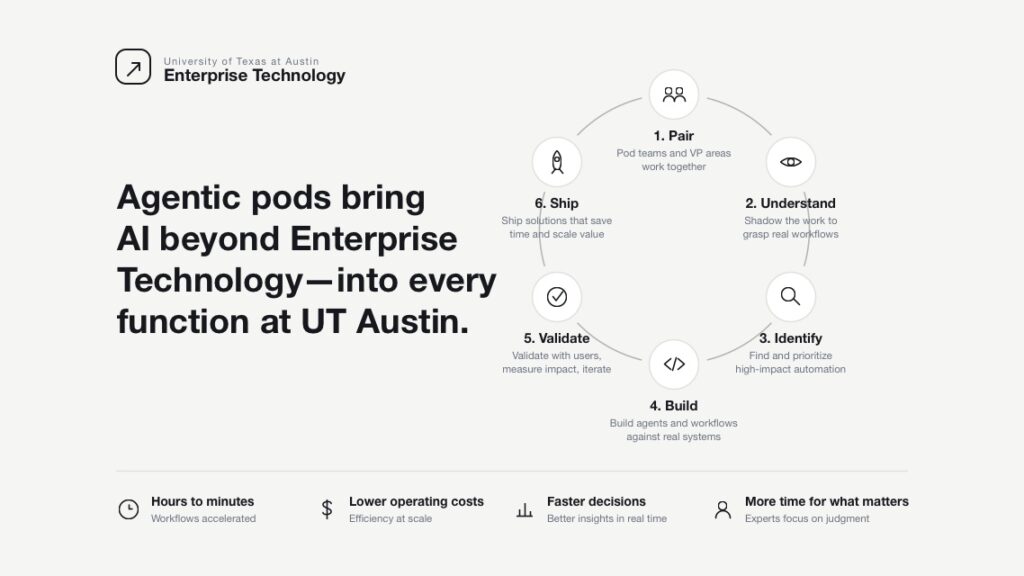
Future state of Enterprise Technology Agentic pods.

As our teams grow their skills in AI, we will pair with offices across campus to create “agentic pods” to move our enablement work to them. The method itself isn’t new; it is simply an evolution of the tooling and practices we are all familiar with. When the UT.AI Studio fully launches, we will be able to augment our teams with our AI Student Builders and further expand impact. I am grateful to be at a place that demands to be on the forefront of discovery and we get to be part of that journey in a very meaningful way.

February ‘26 ET Leadership Updates

I’m excited to share two leadership updates that position us better to be a leader in AI innovation while strengthening our commitment to teaching, learning, accessibility, and digital adoption across campus.

Mario Guerra Jr. Promoted to Associate Vice President, AI Platforms & Innovation

Mario Guerra Jr. will transition from Director of Enterprise Learning Technology into a newly created role as Associate Vice President for AI Platforms & Innovation.

In this role, Mario will build and lead UT.AI Studio, our flagship AI innovation program that brings together enterprise platform development, student talent cultivation, and strategic corporate partnerships. This promotion recognizes Mario’s vision and leadership in emerging technologies and reflects our commitment to moving with urgency and intention in advancing AI across the university. Mario will oversee:

  • AI Platform Engineering: Enterprise AI platforms serving the UT community, including UT Spark, UT Sage, Microsoft 365 Copilot, and custom AI agents
  • UT.AI Academy: A student talent development program training more than 100 students annually through industry certifications and real-world project experience
  • Corporate Partnerships: Strategic relationships with technology partners, including our anchor partnership with Dell Technologies

Under Mario’s leadership, we will continue to distinguish ourselves as a national leader in higher-education AI—not only by deploying technology, but by transforming how we teach, learn, conduct research, and operate as an institution.

New Role: Associate Vice President, Enterprise Initiatives & Instructional Technology

This AVP will lead our technology-enabled learning ecosystem while driving digital adoption across campus and overseeing major, cross-cutting institutional initiatives. The role brings together instructional technology, accessibility, learning environments, and enterprise program execution under a single strategic leader.

This AVP will be responsible for:

  • Instructional Technology Solutions: Canvas LMS, instructional tools, faculty engagement, and teaching innovation
  • Digital Accessibility Services: Accessible course design, universal design for learning, and inclusive pedagogy
  • Learning Spaces & Educational Environments: Technology strategy for classrooms, learning spaces, and active learning environments
  • Digital Adoption & Campus Dexterity: Building faculty and staff fluency with Microsoft 365, Canvas, AI platforms, and learning technologies
  • Enterprise Program Execution: Leading major CIO-sponsored transformation initiatives that span organizational boundaries

Critically, this AVP will partner closely with Mario and the UT.AI Studio team to translate AI platform innovation into faculty- and staff-facing programs, training, and support, ensuring our AI investments result in meaningful, scalable adoption across campus.

WHY THIS MATTERS

Artificial intelligence is transforming higher education at an unprecedented speed. This leadership realignment reflects our commitment to lead that transformation with both bold vision and responsible execution.

By establishing focused executive leadership for AI platforms and innovation and for instructional technology and digital adoption, we ensure each area receives the strategic attention, resources, and accountability it requires.

Mario’s elevation to AVP recognizes the critical importance of AI to UT Austin’s institutional future. The creation of a second AVP role ensures we continue advancing excellence in teaching and learning, while strengthening digital fluency, accessibility, and adoption across campus.

These are deliberate investments in our ability to:

  • Serve more than 50,000 students
  • Enable faculty innovation at scale
  • Position UT Austin as a national model for AI in higher education

WHAT’S NEXT

The new Associate Vice President for Enterprise Initiatives & Instructional Technology position will be posted on February 4.

We are seeking a relationship-driven leader with:

  • Deep instructional technology expertise
  • Experience as an Associate Vice President, CIO, or Deputy CIO
  • A strong track record in digital adoption and change leadership
  • A passion for faculty engagement and inclusive learning environments

I’m grateful to Mario for his leadership and vision, and excited about the future we are building together. Please join me in congratulating him on this well-deserved promotion.

Strengthening Our Data Strategy: D2I Transitioning to Enterprise Technology

At The University of Texas at Austin, we understand that data is essential for making informed decisions and driving innovation. I’m thrilled to announce that Data to Insights (D2I) will officially start reporting to the Vice President of Technology and Chief Information Officer on May 1, 2025.

This transition will enhance collaboration, align practices, and strengthen our commitment to providing top-notch data solutions for our faculty, staff, and students. By integrating D2I under the VP’s portfolio alongside Enterprise Technology, we’re aiming for a more unified and scalable approach to data governance, analytics, and tech services across the university.

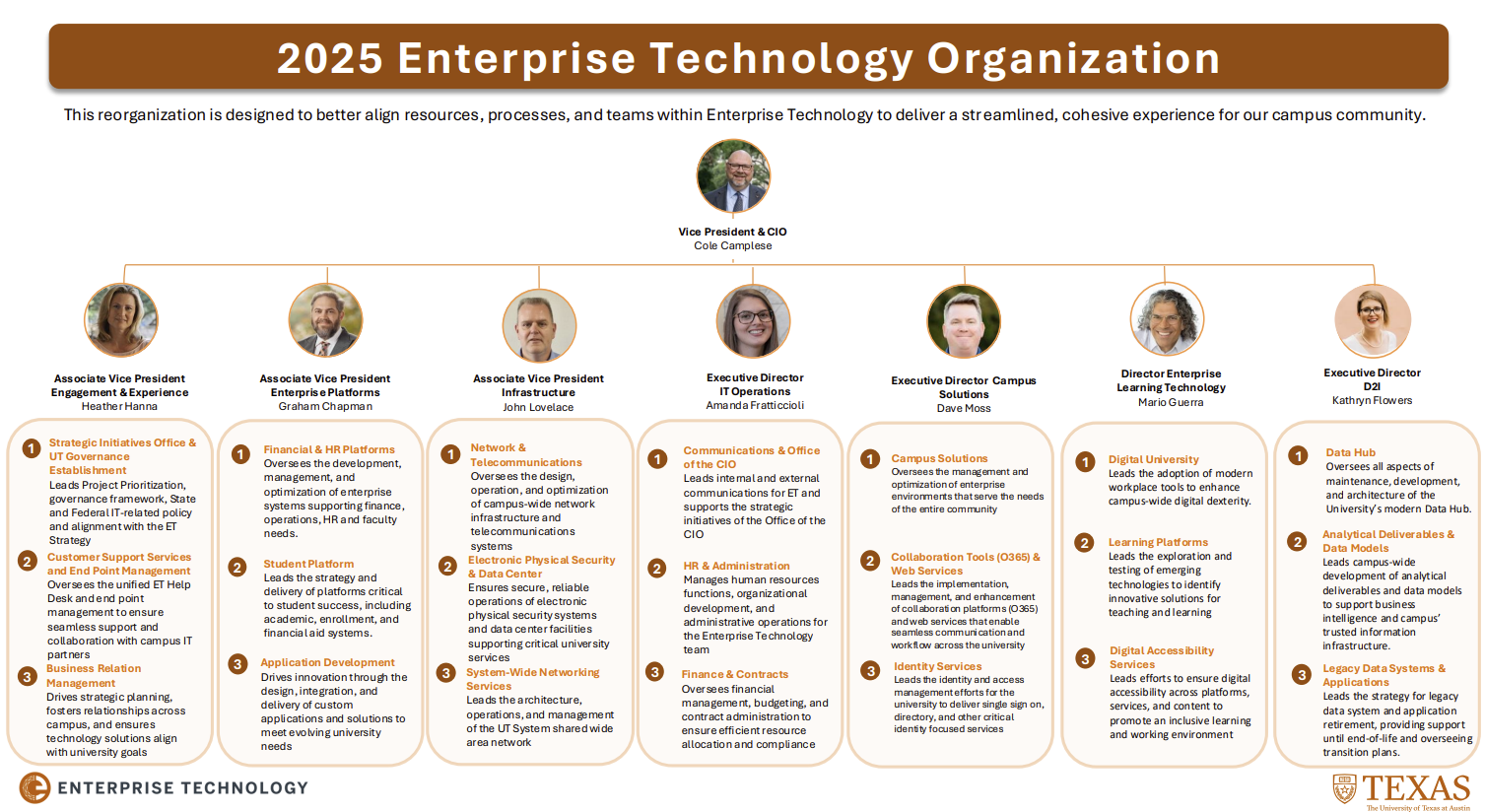
Brian Roberts, Vice Provost for Data to Insights, will take on a special advisor role to the Office fo the CIO during the transition as we continue planning for D2I’s long-term future. Kathryn Flowers will join the CIO senior leadership team will lead the D2I team as the Executive Director, ensuring smooth leadership and execution of D2I’s mission.

Enterprise Technology April 2025 Org chart.

Rest assured, this transition won’t cause any immediate changes to D2I’s ongoing projects or services. I am confident that our teams will work closely to make this change seamless and enhance our ability to deliver value to the university community.

Enterprise Technology and D2I will be partnering with the CFO’s Office, the Provost’s Office, and the COO’s Office to assess and realign the university’s data analytics goals in support of institutional priorities, with an emphasis on scaling adoption of and best practices in interaction with the Data Hub. Over the next six months, these teams will collaborate to develop a comprehensive data analytics strategy, reliant on the centralized Data Hub, to be presented to university leadership, with the aim of implementing it by the FY26–27 fiscal year. This effort will include extensive stakeholder engagement, including interviews and cross-functional collaboration across multiple groups, to ensure the strategy is informed, aligned, and positioned to drive meaningful impact across the university.

Thank you for your continued support as we take this important step in aligning our technology and data strategy with the university’s broader goals. If you have any questions or feedback, please feel free to reach out.

Living the Digital Transformation We Preach

As the IT leaders at UT Austin, we spend a lot of time talking about digital transformation. We encourage campus to embrace modern tools, work smarter, and take advantage of the technology investments we’ve made. But here’s the real question, are we practicing what we preach? If we want to lead the university into a more digital, connected, and efficient future, we need to start with ourselves. We need to live in the environment we’re asking others to adopt, not dismiss it, not just support it, but fully commit to it.

Right now, we’re operating in a fragmented digital world. Some teams use Slack, others use Teams. Files are scattered across OneDrive, SharePoint, Box, Wikis, and more. Some meetings are on Zoom, others on Teams. We are juggling platforms when we could be harnessing the power of our enterprise-supported ecosystem and putting Copilot to work for us.

When groups on campus reach out for help improving their digital workflows, we should be the experts they turn to. But how can we do that if we aren’t fully invested ourselves? If we don’t know Teams inside and out, how can we teach others to maximize it? If we’re not using OneDrive and SharePoint to store our work, how can we expect others to move away from Box? This isn’t just about efficiency, it’s about leadership. The best way to drive change across campus is to lean into the change. And imagine the stories we can share with the community as we do!

Here’s our challenge, we need to standardize our own workflows before we can credibly push others to do the same.

  • Teams over Slack. All our internal communications should happen on Teams—chats, channels, file sharing, and collaboration. We can’t ask campus to make the switch if we haven’t fully embraced it.
  • OneDrive & SharePoint over Box. Moving documents to a single, integrated storage platform makes collaboration easier and security more resilient. I am not talking about engineering new workflows that support campus operations, I am primarily concerned with our internal workflows.
  • Teams Meetings over Zoom. We already have a robust, enterprise-supported meeting platform in Teams. It integrates with our calendars, our files, and our workflows. Let’s stop defaulting to Zoom when Teams can do the job. I completely understand that incoming meetings are often up to the organizer, but once we can start to show value in the automation that Copilot in Teams meetings provide, we have a reason for other groups on campus to make the change.
  • Microsoft Forms over Qualtrics. I am honestly tired of responding to basic questions using our most powerful enterprise survey tool. MS Forms should be used for all lightweight data collection.
  • AI & Automation with Copilot. Microsoft Copilot is already here, and it should be changing the way we work. But we won’t understand its full impact unless we actively use it. How can AI streamline our daily tasks? What reports, emails, and meetings can we automate? The only way to know is to test, learn, and apply. The SLT has decided that we are providing M365 Copilot to the entire organization.

I want to be clear, every time we use tools outside our enterprise systems, we create more work, more risk, and more fragmentation. We make it harder to secure data, harder to collaborate, and harder to support the very systems we advocate for. If we want campus to streamline their tech stack, we have to start with our own teams. That means cutting out redundant tools and fully investing in M365, not just because we’re told to, but because it makes our work more effective.

Digital transformation isn’t just about technology, it’s a cultural shift. It’s about building habits that make work easier, faster, and more connected. But culture change starts with us. I am asking us to set the example.

I want us to create a comprehensive plan for making this the new normal within Enterprise Technology. I know who some of the people are who can help lead this, but I am actively looking for people who can help and will take some responsibility in leading this.

OpenAI generated image showing people working together in a UT themed room.

Image created by OpenAI.

All Staff Reflection: July 2024

Yesterday we hosted my first hybrid all staff meeting in our new UTA Commons space on the Austin campus. At first, to be completely honest, it was a bit overwhelming seeing so many people together in a room that until yesterday I had not seen more than 10-15 people in at a time. I feel like I am not 100% over the isolation practices of the pandemic times — lots of people in a constrained space make me a little uncomfortable. It is weird because I am in crowded places all the time — airports, concerts, and the like. But, for some reason, it all felt a little surreal doing it in the context of our workspace with over 100 people. By about halfway into the meeting that feeling was replaced with excitement and I can’t wait to do more of it!

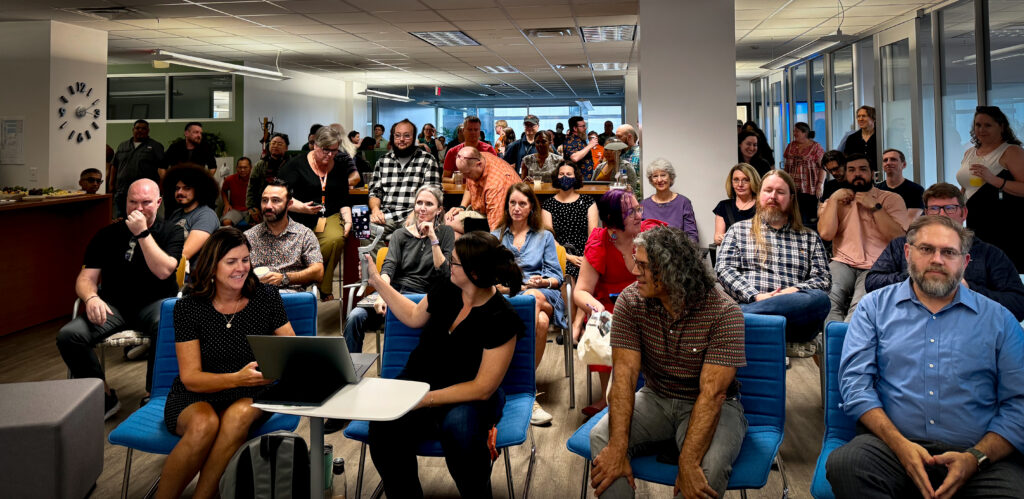
Photo of all staff meeting in UTA Commons.

Once the technology started to (mostly) cooperate, I was able to share some thoughts on the organization, the University, and how I want us to shape our role in being the drivers of progress and digital change. I reviewed the slides I shared in my previous post, but this time I was able to pause and talk about the “why” behind the decisions we have made. I was also able to spend a bit of time highlighting a couple of the organizational values we have developed and why I believe they are critically important — I highlighted the importance of Engagement, Service, and Security and how those three values need to be top of mind and at the center of our decision making going forward.

We reviewed the three primary pillars of our emerging strategy and discussed how we see ourselves getting there. The first thing we talked about was the Organizational Roadmap that will provide the guideposts to organizing ourselves appropriately and communicating change to campus.

Screenshot of a powerpoint slide describing our organizational roadmap approach.

We then did a bit of a dive into the IT Modernization workstream that I am aligning with the President’s Change Starts Here strategic plan. The power in this alignment allows us to utilize existing governance structures to address our largest enterprise technology challenges, hear directly from campus leaders, and turn these challenges into opportunities. The slide I shared aligns to five critical areas of focus for us to organize around. You can see it below, and to be honest, the five areas are even more important at this moment than the initiatives contained within each. This framework should help us work with campus partners to make significant progress in the most critical areas of need.

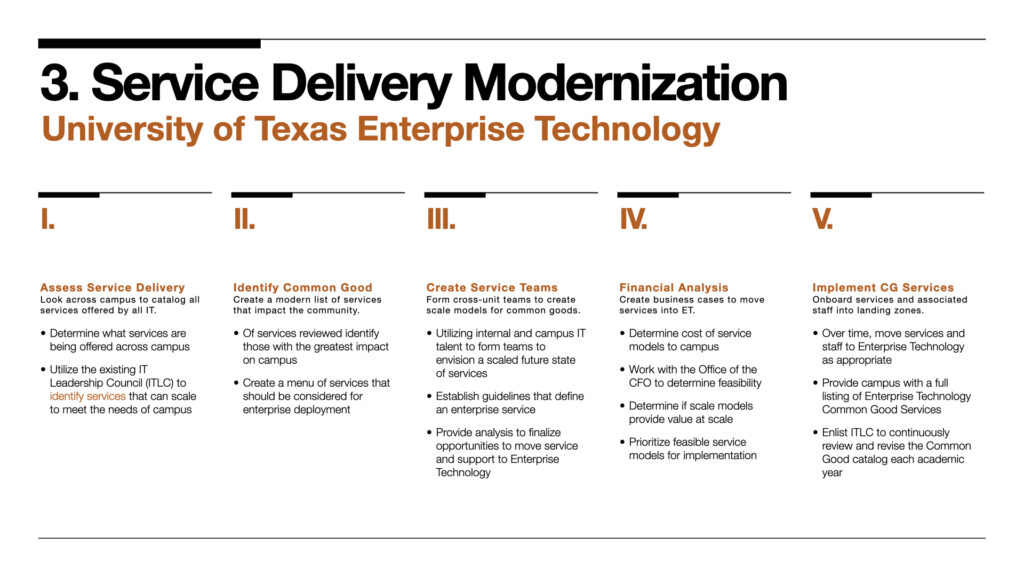
Finally, we discussed how we wanted to improve both the services we currently offer and identify those offered across campus that should be provided at the enterprise level. Essentially, my perspective is allowing the identified services to help dictate how they are delivered and supported in a holistic, enterprise way. In other words, find the services that have enterprise level consumption and treat them like actual enterprise, common good offerings from a central provider. Our campus customers should not need to know who offers a service, just that it is available. This work will need to lean on all of our campus partners, governance groups, and the needs of our audience as the guiding principle.

We closed with what felt like a very open conversation about many topics — talent, growth, work from alternative locations, the need for the team to understand how our budget works, and more. Coming out of the meeting I will be launching a Coffee with Cole series that aims to bring small numbers of staff together with me for more personal conversations. These skip level meetings have always been an important part of my understanding of the real challenges people are facing while trying to do their jobs. And with that said, I cannot wait to continue this journey with my new colleagues as we work to build upon the legacy of innovation in our work supporting this amazing university.