Category Archives: Updates

February ‘26 ET Leadership Updates

I’m excited to share two leadership updates that position us better to be a leader in AI innovation while strengthening our commitment to teaching, learning, accessibility, and digital adoption across campus.

Mario Guerra Jr. Promoted to Associate Vice President, AI Platforms & Innovation

Mario Guerra Jr. will transition from Director of Enterprise Learning Technology into a newly created role as Associate Vice President for AI Platforms & Innovation.

In this role, Mario will build and lead UT.AI Studio, our flagship AI innovation program that brings together enterprise platform development, student talent cultivation, and strategic corporate partnerships. This promotion recognizes Mario’s vision and leadership in emerging technologies and reflects our commitment to moving with urgency and intention in advancing AI across the university. Mario will oversee:

  • AI Platform Engineering: Enterprise AI platforms serving the UT community, including UT Spark, UT Sage, Microsoft 365 Copilot, and custom AI agents
  • UT.AI Academy: A student talent development program training more than 100 students annually through industry certifications and real-world project experience
  • Corporate Partnerships: Strategic relationships with technology partners, including our anchor partnership with Dell Technologies

Under Mario’s leadership, we will continue to distinguish ourselves as a national leader in higher-education AI—not only by deploying technology, but by transforming how we teach, learn, conduct research, and operate as an institution.

New Role: Associate Vice President, Enterprise Initiatives & Instructional Technology

This AVP will lead our technology-enabled learning ecosystem while driving digital adoption across campus and overseeing major, cross-cutting institutional initiatives. The role brings together instructional technology, accessibility, learning environments, and enterprise program execution under a single strategic leader.

This AVP will be responsible for:

  • Instructional Technology Solutions: Canvas LMS, instructional tools, faculty engagement, and teaching innovation
  • Digital Accessibility Services: Accessible course design, universal design for learning, and inclusive pedagogy
  • Learning Spaces & Educational Environments: Technology strategy for classrooms, learning spaces, and active learning environments
  • Digital Adoption & Campus Dexterity: Building faculty and staff fluency with Microsoft 365, Canvas, AI platforms, and learning technologies
  • Enterprise Program Execution: Leading major CIO-sponsored transformation initiatives that span organizational boundaries

Critically, this AVP will partner closely with Mario and the UT.AI Studio team to translate AI platform innovation into faculty- and staff-facing programs, training, and support, ensuring our AI investments result in meaningful, scalable adoption across campus.

WHY THIS MATTERS

Artificial intelligence is transforming higher education at an unprecedented speed. This leadership realignment reflects our commitment to lead that transformation with both bold vision and responsible execution.

By establishing focused executive leadership for AI platforms and innovation and for instructional technology and digital adoption, we ensure each area receives the strategic attention, resources, and accountability it requires.

Mario’s elevation to AVP recognizes the critical importance of AI to UT Austin’s institutional future. The creation of a second AVP role ensures we continue advancing excellence in teaching and learning, while strengthening digital fluency, accessibility, and adoption across campus.

These are deliberate investments in our ability to:

  • Serve more than 50,000 students
  • Enable faculty innovation at scale
  • Position UT Austin as a national model for AI in higher education

WHAT’S NEXT

The new Associate Vice President for Enterprise Initiatives & Instructional Technology position will be posted on February 4.

We are seeking a relationship-driven leader with:

  • Deep instructional technology expertise
  • Experience as an Associate Vice President, CIO, or Deputy CIO
  • A strong track record in digital adoption and change leadership
  • A passion for faculty engagement and inclusive learning environments

I’m grateful to Mario for his leadership and vision, and excited about the future we are building together. Please join me in congratulating him on this well-deserved promotion.
UT.AI Spark Preview

Most people aren’t aware, but there is something new getting ready to happen on campus. For our team, this is the quiet before the storm right now. Those of us working toward this have a quiet energy about us, the kind that comes with anticipation and a sense that something big is about to unfold. Over the past few months, we’ve been quietly working with teams across Enterprise Technology, ITLC members, Microsoft, and CloudForce to bring a new platform to life. It has been designed to put artificial intelligence directly into the hands of our community. We’re calling it UT.AI Spark, and while it’s still in preview, the excitement is already building as more and more people get a chance to explore what it can do.

What’s interesting about Spark isn’t just the technology (though, yes, it’s powerful and flexible and all the things you’d hope for in a modern AI platform). It’s the way we’re approaching this launch. Instead of flipping a switch and calling it done, we’re inviting people in early, listening closely, and letting the platform grow in response to real needs and real feedback. Our partners at CloudForce are right there with us, each request turning into a, “what if we could create …” conversation to see how we can make it happen. It’s a little bit messy, a little bit experimental, and very much in the spirit of how I prefer to do things: open, transparent, and always focused on what’s actually useful for students, faculty, and staff.

What we plan to release in the next month or so is a stable and robust 1.0 version of our own OpenAI deployment that all of us can use. It means there will be a roadmap articulated so the community can help us go from 1.0 to 1.1 to 1.2 and so on.

Already, early adopters are finding creative ways to use Spark, from analyzing data in new ways, to brainstorming lesson plans, to simply asking better questions, to creating custom agents to do their bidding. And as each new group comes on board, the community around Spark is starting to take shape. There’s a lot of curiosity, a healthy dose of skepticism, and a genuine desire to figure out what responsible, meaningful AI use looks like in a university setting.

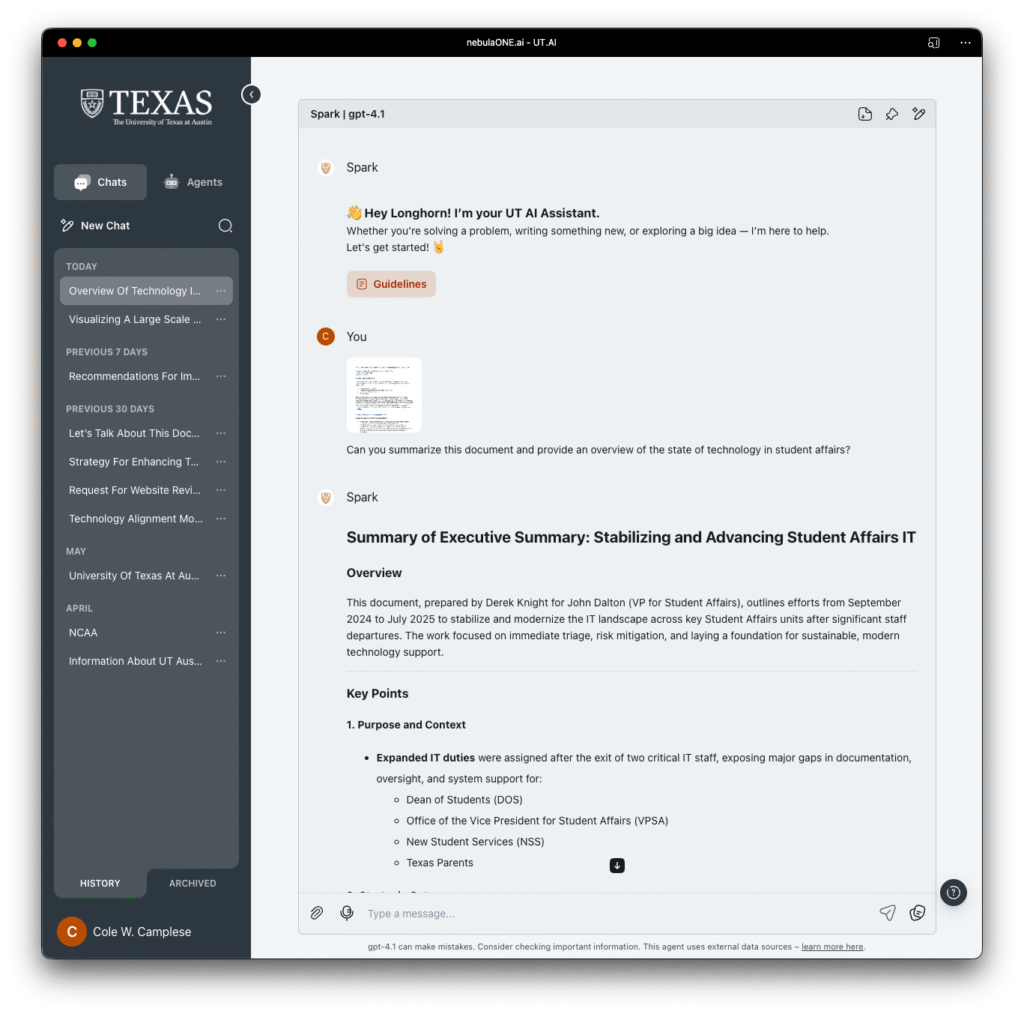
UT.AI Spark interface screenshot.

As the fall semester rolls around, everyone at UT will have access. That’s when things will really get interesting. We’ll have workshops, training, and plenty of opportunities for people to share what they’re learning. But even before that, the most important work is happening now: listening, iterating, and building something that feels right for this campus.

If you’re curious, keep an eye out for updates and invitations to try Spark for yourself. And if you’re already part of the preview, thank you for helping shape what comes next. This isn’t just about rolling out another tool, it is about starting a conversation and seeing where it leads. I can’t wait to see what we create together.

Strengthening Our Data Strategy: D2I Transitioning to Enterprise Technology

At The University of Texas at Austin, we understand that data is essential for making informed decisions and driving innovation. I’m thrilled to announce that Data to Insights (D2I) will officially start reporting to the Vice President of Technology and Chief Information Officer on May 1, 2025.

This transition will enhance collaboration, align practices, and strengthen our commitment to providing top-notch data solutions for our faculty, staff, and students. By integrating D2I under the VP’s portfolio alongside Enterprise Technology, we’re aiming for a more unified and scalable approach to data governance, analytics, and tech services across the university.

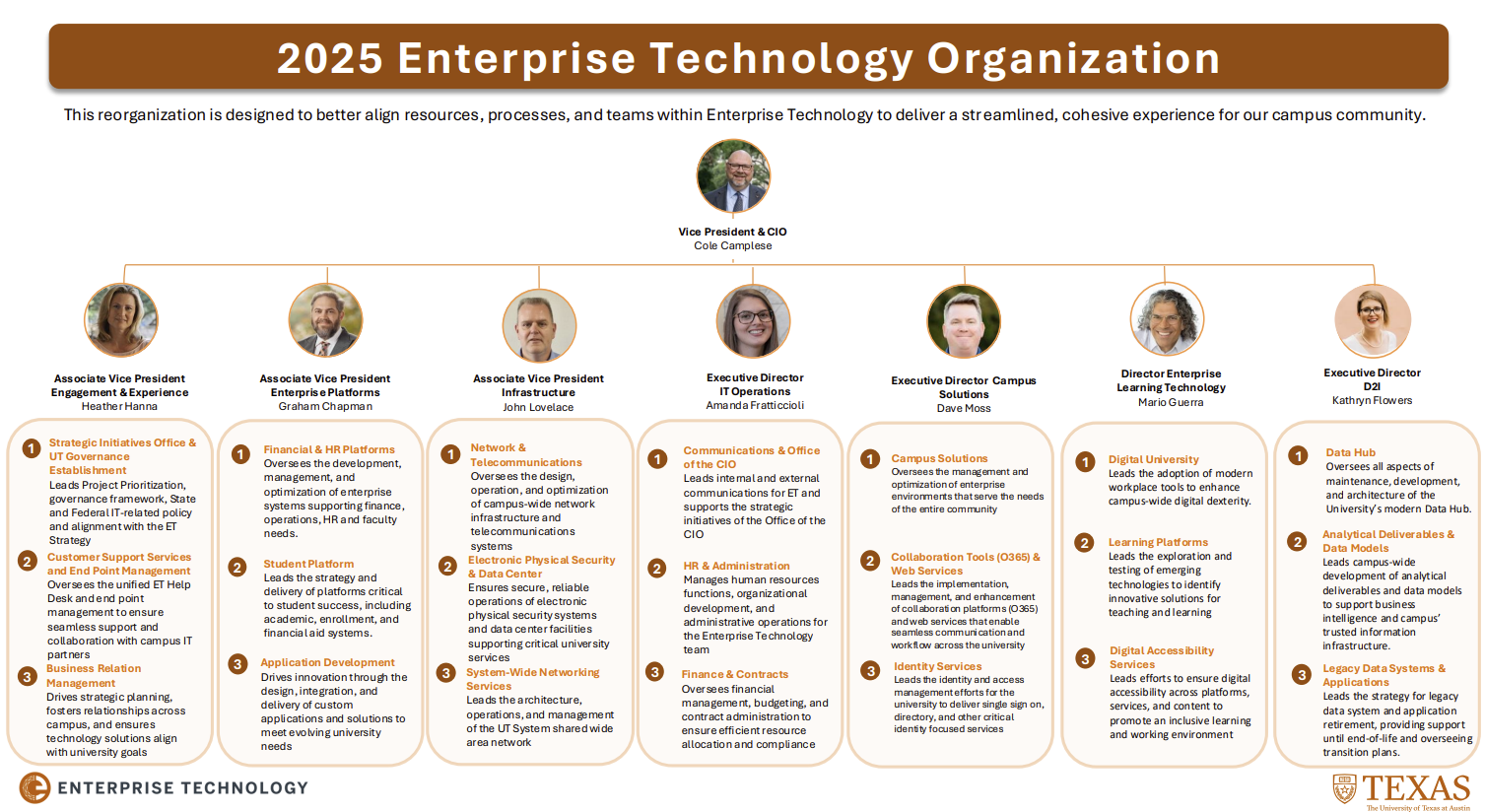
Brian Roberts, Vice Provost for Data to Insights, will take on a special advisor role to the Office fo the CIO during the transition as we continue planning for D2I’s long-term future. Kathryn Flowers will join the CIO senior leadership team will lead the D2I team as the Executive Director, ensuring smooth leadership and execution of D2I’s mission.

Enterprise Technology April 2025 Org chart.

Rest assured, this transition won’t cause any immediate changes to D2I’s ongoing projects or services. I am confident that our teams will work closely to make this change seamless and enhance our ability to deliver value to the university community.

Enterprise Technology and D2I will be partnering with the CFO’s Office, the Provost’s Office, and the COO’s Office to assess and realign the university’s data analytics goals in support of institutional priorities, with an emphasis on scaling adoption of and best practices in interaction with the Data Hub. Over the next six months, these teams will collaborate to develop a comprehensive data analytics strategy, reliant on the centralized Data Hub, to be presented to university leadership, with the aim of implementing it by the FY26–27 fiscal year. This effort will include extensive stakeholder engagement, including interviews and cross-functional collaboration across multiple groups, to ensure the strategy is informed, aligned, and positioned to drive meaningful impact across the university.

Thank you for your continued support as we take this important step in aligning our technology and data strategy with the university’s broader goals. If you have any questions or feedback, please feel free to reach out.

February 2025 Updates from the Office of the CIO

Enterprise Technology Logo Header

As part of our ongoing effort to enhance the accessibility of our online landscape, we are pleased to announce the successful closure of the Department of Justice (DOJ) web audit at the University of Texas at Austin. This achievement was made possible through a cross-disciplinary approach, with the Digital Accessibility Center (DAC) coordinating efforts across various departments. The DOJ commended UT for its commitment to accessibility, stating, “In light of UT’s demonstrated commitment to accessibility and its robust response.” This positive feedback underscores our dedication to providing a learning and working environment in which all users can meaningfully participate. Key insights from the DOJ report, combined with ongoing collaborations with committees, working groups, and policy creation facilitated by the DAC, will help unify digital accessibility knowledge and resources across the UT community. These efforts will ensure that our digital platforms remain accessible, user-friendly, and compliant with the latest accessibility standards. 


As part of our ongoing effort to enhance collaboration and productivity within the iSchool, a project has begun to migrate many of their existing data and systems to Microsoft 365. This migration will significantly improve efficiency and collaboration for the iSchool team, while also optimizing resource management and reducing operational costs. This transformation began with a series of initial lunch and learn sessions aimed at familiarizing team members with the Microsoft365 tools and functionalities. After the success of the lunch and learns, the iSchool staff were very interested in moving forward with a strategic migration. The project began with hiring 4 student workers to migrate the iSchool’s comprehensive wiki, with a focus on utilizing the more visual user-friendly SharePoint page designs. 


So far, the team has replaced 95 of the 250 (38%) outdoor wireless access points on campus. The entire lifecycle upgrade is planned to be completed before the start of the fall semester. The new wireless access points support newer encryption technologies, offer improved performance and support more user devices. The outdoor wireless access points on campus are reaching end of life and need to be replaced. In addition to mitigating the risk of these aging devices failing, the new access points offer greatly improved performance.