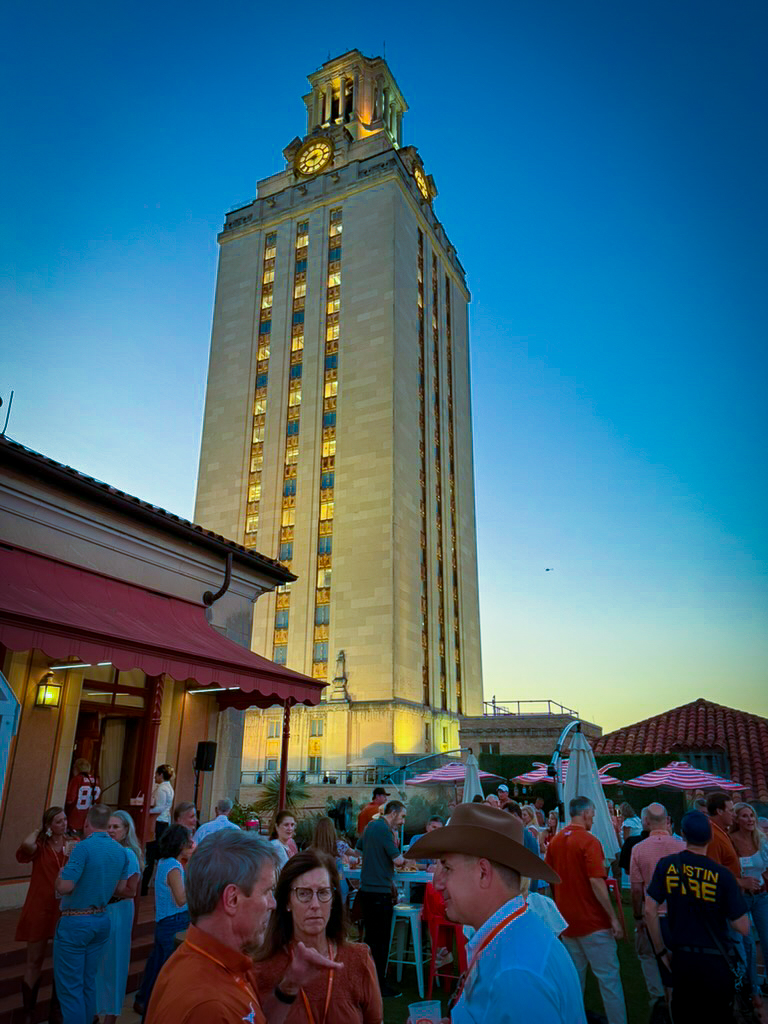
I have been trying to be more active at taking pictures and working with them on a regular basis. This was shot on my iPhone 15 Pro and edited in Lightroom on the iPad.
Celebrating Our Achievements: A Summary of Recent Projects
As we continue to innovate and enhance our digital infrastructure, I am thrilled to share some of the remarkable work our teams have accomplished recently. These projects not only demonstrate our commitment to excellence but also highlight the collaborative spirit that drives our success.
Business Process Workflow for Mobile Application Development
Scott Richardson, Manager of the Technical Customer Support Team, recognized the need for a defined process for mobile application development. This initiative ensures that applications are useful, intuitive, secure, and aligned with the UT brand. Scott’s team has been instrumental in guiding customers through this process, and they are currently finalizing the workflow and approvals1.
REDCap Service for the Research Community
In collaboration with the VP-Research, our Campus IT Infrastructure and Services team has initiated a project to provide a central REDCap service for the campus researcher community. This secure, web-based application supports data capture for research studies and aims to offer a robust, scalable service shared across multiple colleges and units2.
GitHub Copilot Proof of Concept (POC)
There is significant interest across campus in testing GitHub Copilot to improve developer productivity and generate more secure code. This POC, a collaboration with Enterprise Technology and many CSUs, has received ISO approval and is now underway3.
MS Azure AI/ML Cloud Services Approval
We are excited to announce that MS Azure AI and ML services are now ISO approved for confidential data. This approval allows CSUs across campus to use these cloud services to support their business needs, significantly expanding our capabilities4.
New MyUT Student Portal
The new MyUT student portal, launched on July 25, 2024, offers a secure, streamlined, and personalized student service. This project, in partnership with Modo Labs, improves security, enhances the student experience, and reduces annual renewal costs. The new portal is a testament to the collaborative efforts of many teams across the university5.
Onboarding of New Data Center Regional Customer
We have successfully onboarded the University of Texas Medical Branch (UTMB) as our newest and largest regional customer in the data center. This migration project helps lower the subsidy needed to run the data center, freeing up additional budget for Enterprise Technology6.
5G Cellular Wireless Network Upgrades
Our Network and Telecommunications team has overseen the installation of new radios and antennas to support 5G services on the main campus and at DKR-Texas Memorial Stadium. These upgrades will significantly enhance network speeds, capacity, coverage, and reliability7.
Financial Aid and Scholarship Management Systems
We have rolled out new financial aid and scholarship management systems to modernize student services on campus. These systems provide improved compliance, better visibility into financial aid offerings, and more powerful tools for scholarship awarding committees8.
Acknowledgments
I want to extend my heartfelt thanks to the UT ET team and all of our partners for their dedication and hard work. These achievements would not have been possible without your collaboration and commitment to excellence.
Yesterday we hosted my first hybrid all staff meeting in our new UTA Commons space on the Austin campus. At first, to be completely honest, it was a bit overwhelming seeing so many people together in a room that until yesterday I had not seen more than 10-15 people in at a time. I feel like I am not 100% over the isolation practices of the pandemic times — lots of people in a constrained space make me a little uncomfortable. It is weird because I am in crowded places all the time — airports, concerts, and the like. But, for some reason, it all felt a little surreal doing it in the context of our workspace with over 100 people. By about halfway into the meeting that feeling was replaced with excitement and I can’t wait to do more of it!
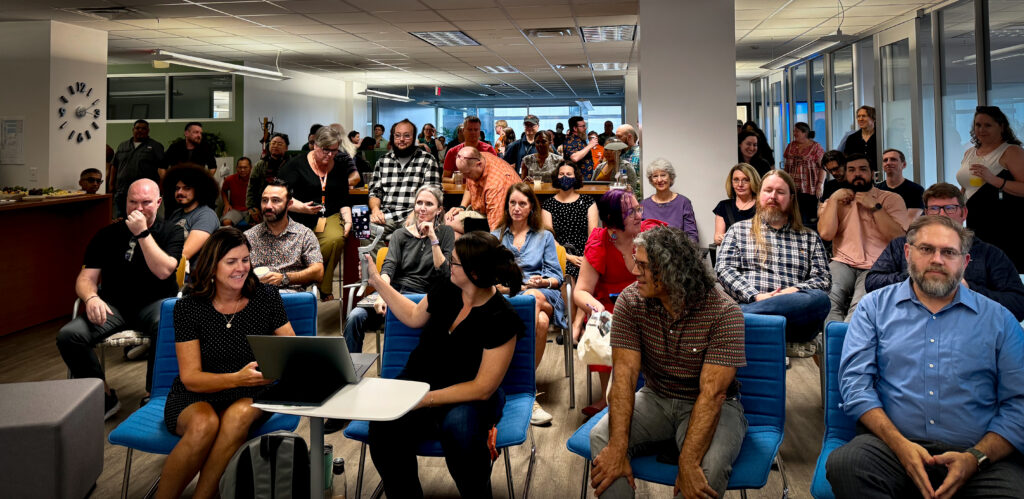
Once the technology started to (mostly) cooperate, I was able to share some thoughts on the organization, the University, and how I want us to shape our role in being the drivers of progress and digital change. I reviewed the slides I shared in my previous post, but this time I was able to pause and talk about the “why” behind the decisions we have made. I was also able to spend a bit of time highlighting a couple of the organizational values we have developed and why I believe they are critically important — I highlighted the importance of Engagement, Service, and Security and how those three values need to be top of mind and at the center of our decision making going forward.
We reviewed the three primary pillars of our emerging strategy and discussed how we see ourselves getting there. The first thing we talked about was the Organizational Roadmap that will provide the guideposts to organizing ourselves appropriately and communicating change to campus.

We then did a bit of a dive into the IT Modernization workstream that I am aligning with the President’s Change Starts Here strategic plan. The power in this alignment allows us to utilize existing governance structures to address our largest enterprise technology challenges, hear directly from campus leaders, and turn these challenges into opportunities. The slide I shared aligns to five critical areas of focus for us to organize around. You can see it below, and to be honest, the five areas are even more important at this moment than the initiatives contained within each. This framework should help us work with campus partners to make significant progress in the most critical areas of need.

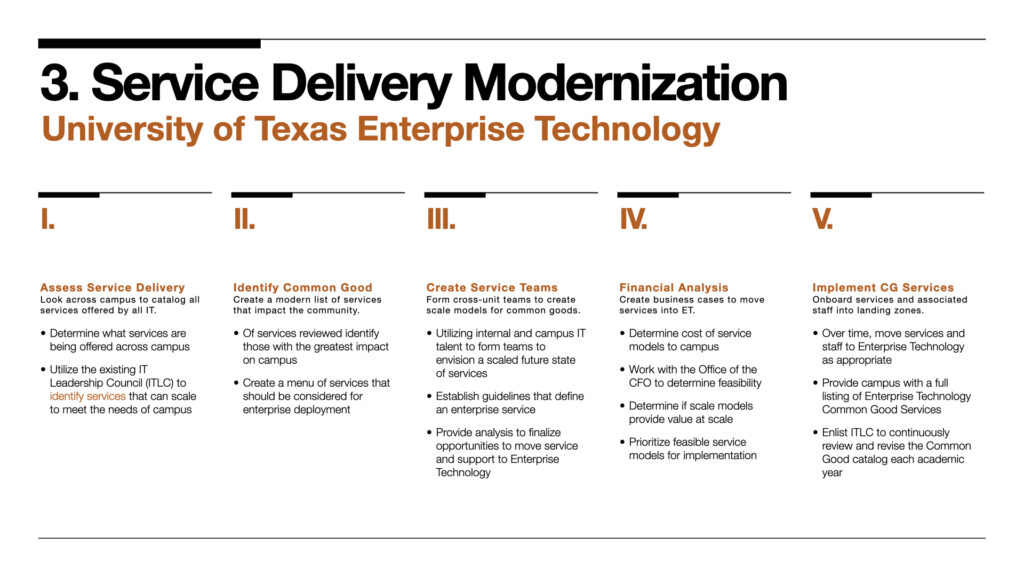
Finally, we discussed how we wanted to improve both the services we currently offer and identify those offered across campus that should be provided at the enterprise level. Essentially, my perspective is allowing the identified services to help dictate how they are delivered and supported in a holistic, enterprise way. In other words, find the services that have enterprise level consumption and treat them like actual enterprise, common good offerings from a central provider. Our campus customers should not need to know who offers a service, just that it is available. This work will need to lean on all of our campus partners, governance groups, and the needs of our audience as the guiding principle.
We closed with what felt like a very open conversation about many topics — talent, growth, work from alternative locations, the need for the team to understand how our budget works, and more. Coming out of the meeting I will be launching a Coffee with Cole series that aims to bring small numbers of staff together with me for more personal conversations. These skip level meetings have always been an important part of my understanding of the real challenges people are facing while trying to do their jobs. And with that said, I cannot wait to continue this journey with my new colleagues as we work to build upon the legacy of innovation in our work supporting this amazing university.