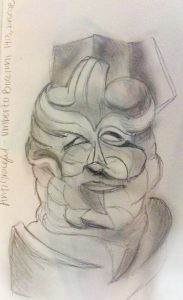
One piece I wanted to focus on is Antigraceful by Umberto Boccioni, which happens to be a bust of his mother from 1913. This sculpture is one of the first sculptures that emphasizes his rejection of past and present art canons. There was this quote that Boccioni stated “We must smash, demolish, and destroy our traditional harmony, which makes us fall into a gracefulness created by a timed and sentimental cubs.” This sculpture was part of Palazzo Reale’s Umberto Boccioni: genius and memory exhibition. This sculpture emphasizes a drastic change from his older work that was very traditional of the time. He painted dozens of rationalists/impressionist paintings and studies of people/portraits. It is tempting to assume that this work was influenced by some of Pablo Picasso’s work, but it could vice versa. The cubist portrait emphasizes his mothers features such as her eyes and nose, but in a way makes each of the wrinkle lines change in different directions.
In the class reading over the past week in the book Made in Italy, there is this quote on futurism and design: “In the words of Merjian, “Rather than use design as bulwark against industry, the Futurists were the first avant-gardists to collapse such distinctions so radically or at least to call for their collapse.” Befitting, perhaps, a movement glorifying war, futurism can be said to have inaugurated Italian design’s age of extremes, by bringing together modernist aesthetics and the material culture of industrial society.” Boccioni is an excellent example of Italian artists of the futurism movement, changing the process and work of his art.
In the drawing and sketches of Contre-Jour in 1910, is also one of his first examples of taking a step back from what he has created in the past, and changed his concepts to a more futuristic approach with the more crazy details than the image looking more like a portrait from the past.
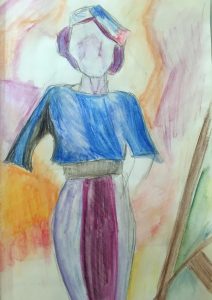
A later painting I wanted to learn more about is called “Study of a Woman with Houses”, by Boccioni. This painting still uses pastels similar to the impressionists but it starts to have more of a cubist futurist aesthetic. I read theFuturist manifesto at the Museo 900, where this painting was located, “ All things move, all things run, all things are rapidly changing a profile is never motionless, before our eyes but constantly appears and disappears.” This painting shows how the light and shapes are frequently changing, and to form compositions with more rigid lines than to make the work perfectly organic and alive.