Umberto Boccioni only lived to be 34 years old, yet he is known to be the “principal artist of futurism.” This speaks to how the vast amount and quality of his work and how high he is held especially by the city of Milan.
Being able to walk through his beginnings allowed for a better understanding of Boccioni’s work and process. Due to his worldly travels as a young man, he was able to study under some great European artists and try out many different styles and techniques to help shape his career.

One work of his that I was drawn to at the Boccioni exhibit is “Three Women,” a portrait that was done at the dawn of futurism. Categorized as a divisionist work, Boccioni’s brush strokes are done in a way so that you can see the individual colors instead of there being a gradient between them. This piece is a good example of the transition from divisionism to futurism because you can see Boccioni begin to focus more on the lighting in the women’s hair and dresses instead of the actual women. The strokes that are meant to be rays of light coming in somewhat take the focus away from the women.
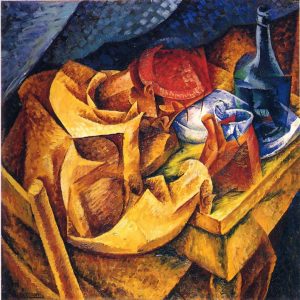
This painting, “The Drinker 1914,” was done at the height of futurism for Boccioni. Compared to the portrait above, the brush strokes are much more pronounced, the lighting is even more dramatic, and the color is more intense and vibrant. Unlike much of his earlier commissioned work, this painting is an observation of Boccioni’s, not something he is getting asked to paint by a patron. The man featured is not really the focus at all. Boccioni has also broken down the painting into shapes and colors, leaning towards some inspiration possibly from Pablo Picasso.