The Mapping Project

The path between Torre Velasca and University Luigi Bocconi, which my group (Kendall, Angelica, and Anissa) and I have been assigned for the mapping project, is a rather interesting experience. There is a very tangible change in mood as one walks the streets from one spot to the other. Now this could very well be due to the fact that we were hyper aware of everything we passed, but I would like to believe in the contribution of the subconscious registering a change in atmosphere.

We started out walking in a rather bright and dandy looking spot, lots of hip looking college kids, green green park space across the street, a smattering of food spots, the likes. We also ventured into the university building, and although the security guard said they were closing, he allowed us five minutes to take in the front lobby at least. I’d say they were quite inviting.
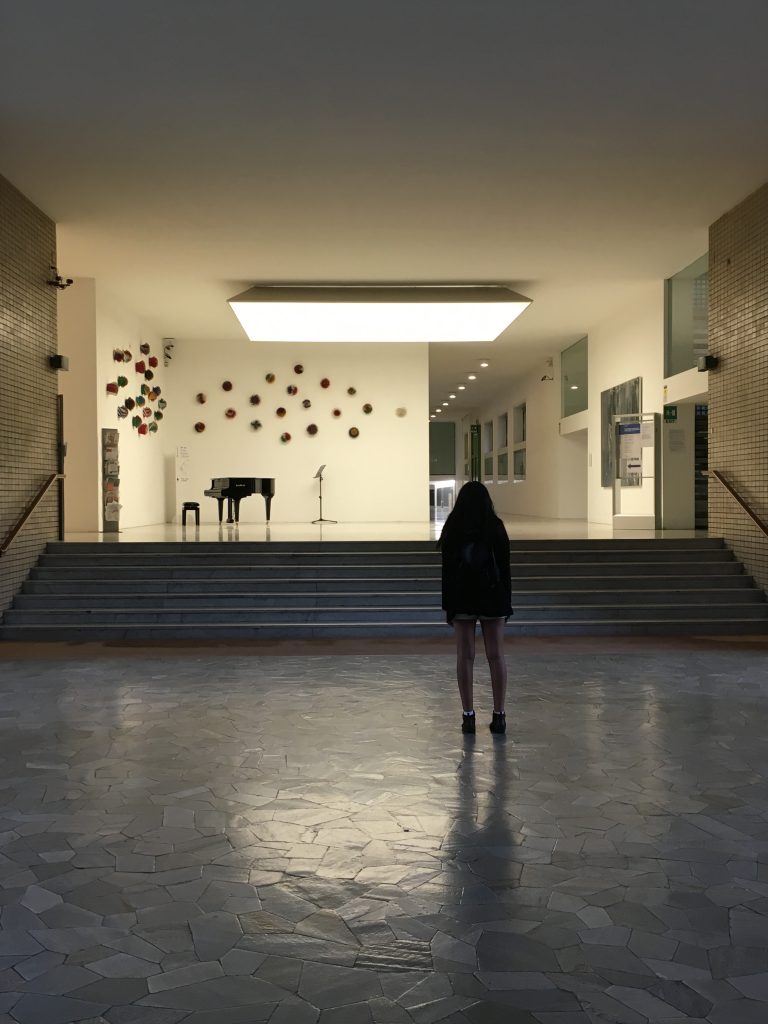
Inside of the Università Luigi Bocconi

The mood changed as we walked towards the tower. The college aged crowd started to morph into suited older men and women, shops became more formal. The quaint old buildings became a little more daunting. The last point of comfort was a little church like building on the street just perpendicular to the tower.  The mood of the place took a drastic turn to the gloomy side.

Torre Velasca was built in the form of a medieval watch tower and it really does accomplish that goal. The street was quieter, the buildings surrounding were more somber. I also felt uncomfortable goofing for the camera which is really not something I have a hard time with.
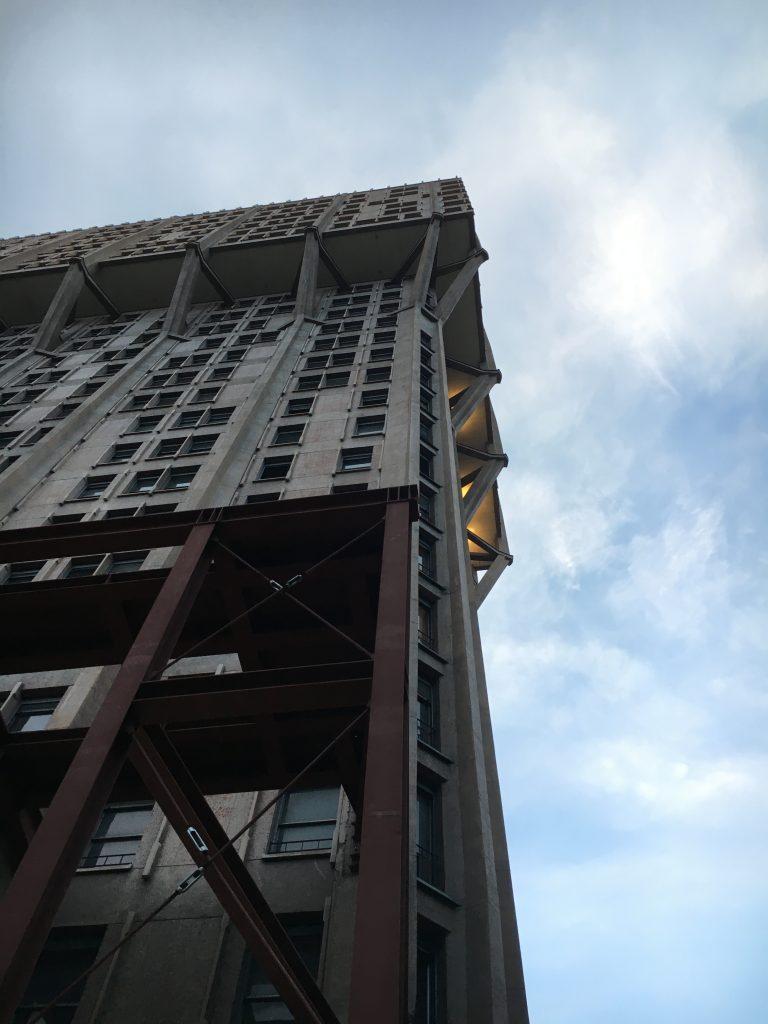
Worm's eye view of the tower
Worm’s eye view of the tower

This helped us settle on our theme for the mapping project. This was a personal brief on the experience of walking the path. Specifics will be talked about in our presentation on Tuesday!
W.Women in Italian Design @ the Triennale

Entrance to W.Women in Italian Design

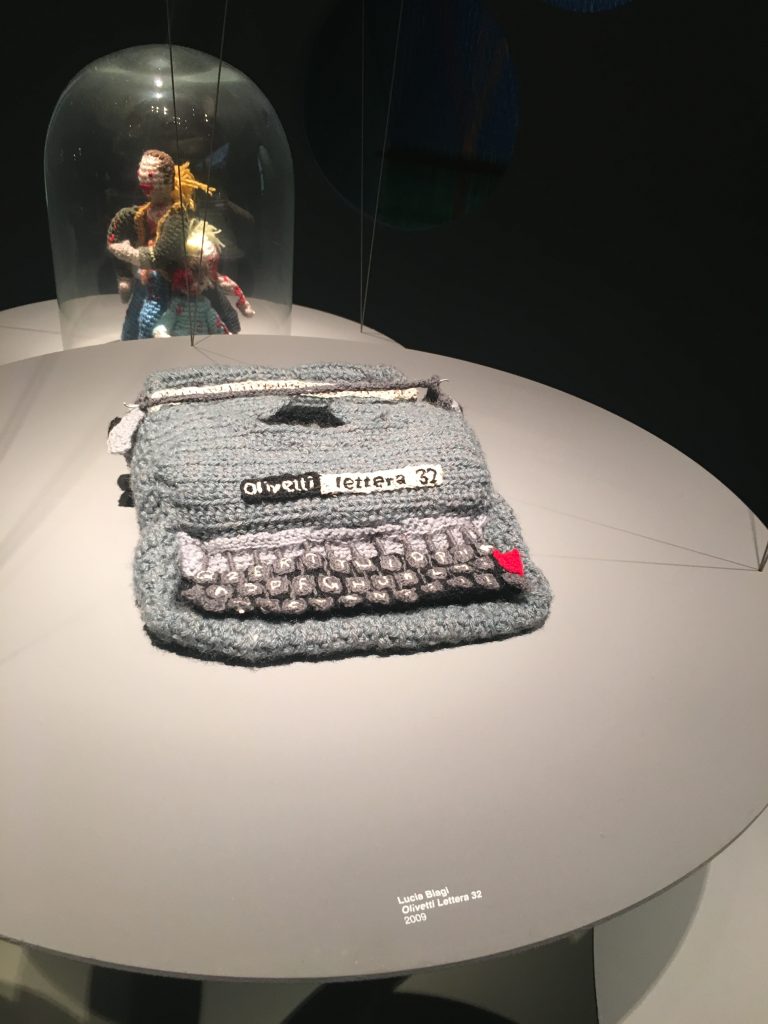
This was by far my favorite exhibition that we have been to thus far. This exhibition was especially important and memorable to me because it gives me validation and representation as a woman in design as well. Although I may not be 100% Italian, I was excited and proud to see this exhibition so prominent at the Triennale. Since design has been, and in some cases, still is dominated by men and the male perspective, it gave me great joy to see women represented at such a level. To have a whole exhibition solely focused on women in design is a powerful movement for the design world.  Many times in the past, women’s work was subsumed under a male peer’s name, withholding the recognition women deserved.

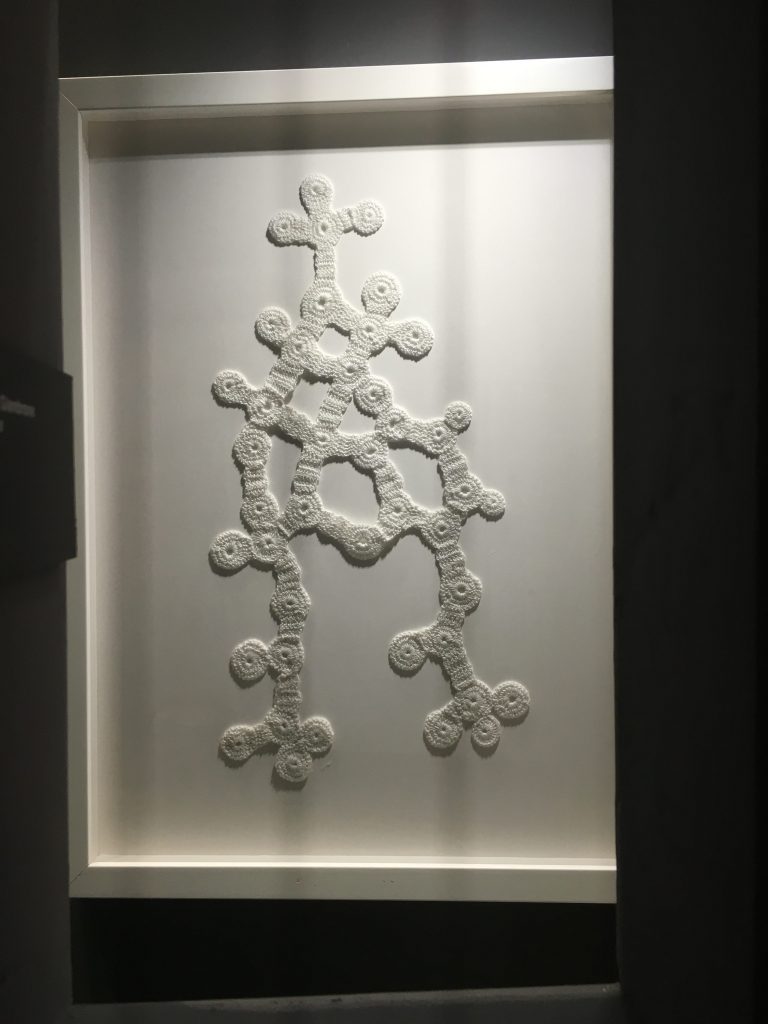
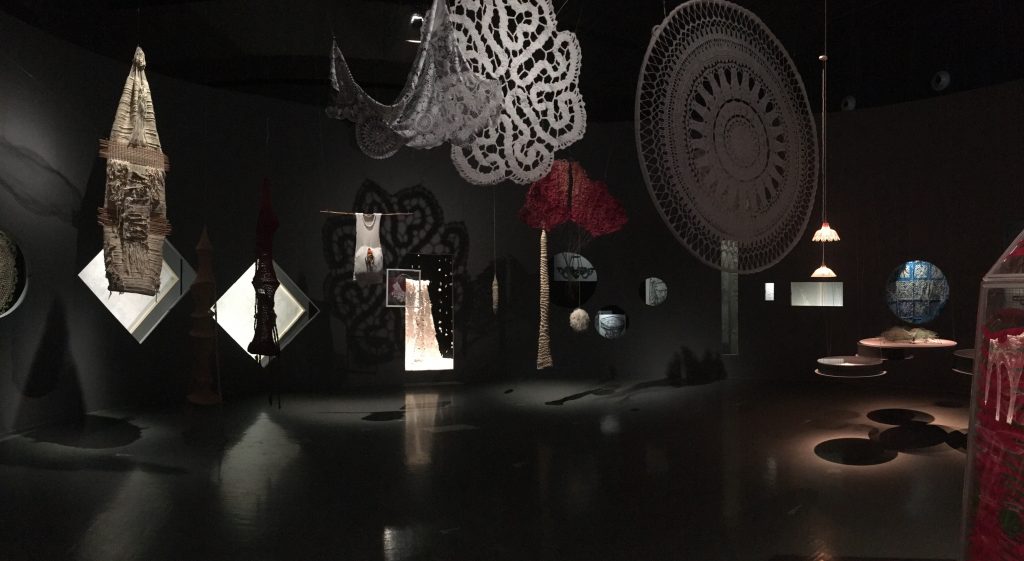
The beginning of the exhibition immediately caught my attention. I was so pleased to see so much craft work, so much design with fibers!! I, myself am an avid crocheter (that’s with a hook, not two needles), and was overjoyed by giant doilies hanging from the ceiling, and various crochet sculptural objects on display.

First view when entering exhibit; giant doilies hanging from ceiling
The first view when entering exhibit; giant doilies hanging from ceiling

My mind was going a hundred miles an hour after walking through the first part of the exhibit. I was thinking of all the ways that I could incorporate crocheting, yarn, and fibers into my senior design project. The validation that came from seeing something that I only thought as my hobby, in a museum, was inspiring.

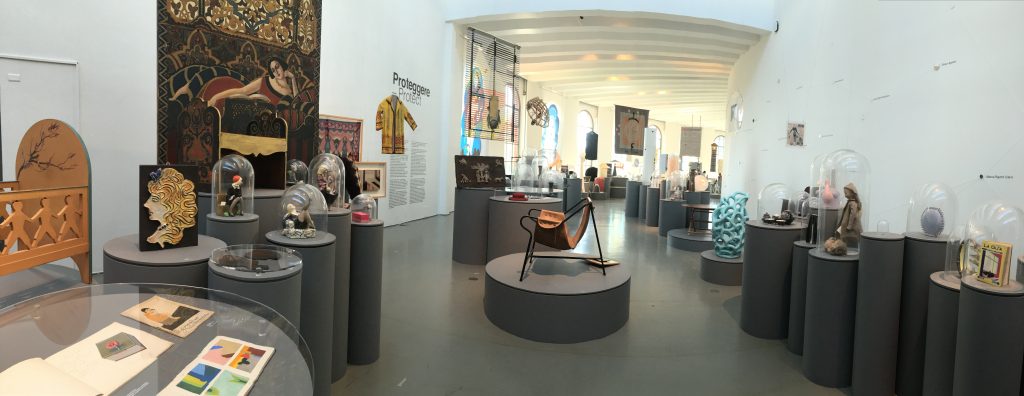
After that experience walking through the dark room with my favorite things in it, I came into a large and airy hallway type room that showcased hundreds of designs from women. I never knew that so much design came out of Italian women! My mind now was thinking about so many things! If these women did it, and it’s in a museum, then I can do it for my senior project, surely.

View of second part of exhibit

Overall, this made my inner feminist leap with joy that these women achieved such recognition for their talents and innovations. I believe that the society we live in now is getting better about giving credit where it is due, but it could still use some improved. Way to take a step in the right direction, Triennale! Brava!


Tra Arte e Moda – Ferragamo


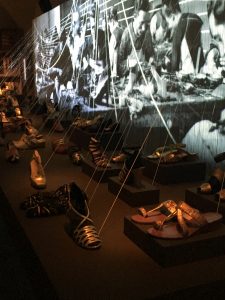
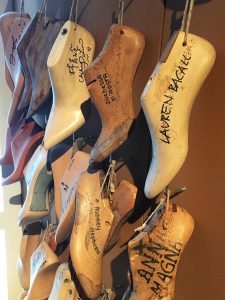
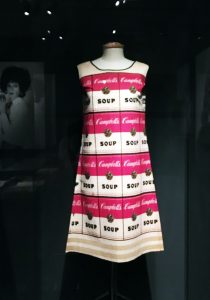
sam4While In Florence I visited the Museo Salvatore Ferragamo, and the exhibit in English is called Across Art and Fashion. When you first walk into the museum there is an installation that has multiple kinds of shoes, and a piece of string that connects the shoe to the a mini animation of shoemakers from the past. The show illustrates Salvatore Ferragamo’s inspirations, and collaborations of the 1950s and 1960s. Osam1nce you pass the shoes that are with the animation there is a wall that is covered in custom shoes of famous celebrities like Audrey Hepburn. There is a constant back and forth between fashion and art. As you continue walking there is a series of huge self-portraits of Andy Warhol. A few of them are out of focus, and there is one that he has completely transformed his appearance as a girl with 60s hairspray hair. The museum also features multiple pieces of fashion like dresses, and mirrors, that go beyond just Ferragamo’s shoes. Not only was Ferragamo inspired by pop culture but also the Futurists. He shared their views and interests of bright colors, and geometric shapes, and he also enjoyed experimenting with unusual materials. This exhibit is a must if you are in Florence! It is also nice to be in a museum that you do not have to wait in a very long line as well!
sam2

John Thackara

After my airport experience, I recalled John Thackara’s article regarding design. The quote that arose for me was “After building objects as projections of our bodies, we can now begin to consider them as projections of our minds.” This is a beautiful inspiring note. Not only does it inspire me to continue with my research, but also encourages me to ask questions … How do we begin to design objects after design? How do we design them to remind us of who we truly are? How do we begin to design artifacts that inspire our minds to grow? How do we reconnect with one another? How do we negotiate and navigate these questions with the global markets? I don’t have any answers to these questions, but it sure is exciting that there are conversations happening. There are small actions taking place in the design world. Let’s hope that the transformations occurring take us (the designers) back to aspirations of the futurists, to the radical movements that inspired and helped shift the ideals of everyday life. As John Thackara commented that small actions can transform bigger experiences and systems. Let’s hope that we begin to reconnect to the ground, to nature, to our true selves.

London Airport Retail

A weekend in Scotland via London… stuck in an airport in a 4-hour layover was stranger than strange. As I walked out of the immigration checkpoint and into the “gates” area, I found myself surrounded not only by advertisements, I was bombarded by these massive airport retail stores. My first thought was, wow… who’s designing these and who’s making money? The second thought, after I took a minute to digest all this information—and it is the most important … How is this affecting our lives and the way we communicate with each other? Am I the only one noticing something wrong with this picture? Everyone was shopping without realizing that they had become numb to their surroundings. Most people were either shopping or looking down on to their phones. Never had I experienced such an unsual event. The beauty at airports for me was seeing people communicate with one another—either saying goodbye to someone with a long affectionate embrace, happy smiles because their on vacation or simply, a caring glance to the person sitting next to you. The luxury of traveling (at least for me) was to converse with others across the globe, meet new people and experience new places. I don’t recall traveling as a shopping experience. Have we lost the art of traveling or has it simply shifted as our needs have changed? Has our environment simply adjusted to the populations needs? Are consumers asking for this or are they being fed this? Has traveling simply shifted to shopping? How is this impacting the way we travel and live? Lots of questions … maybe, a topic for another discussion.

Gucci concept development center at Novara

We went on a walk through of the factory where catwalk collections (prototypes) are made for Gucci, Alexander McQueen and Stella McCartney and others. We saw where the designers sketches are developed toile and the departments where patterns are digitized, cut, fabricated and finished – fascinating!

http://www.kering.com/

Sketchbook Update!

Now that we are about half way through our trip, my sketchbook is nearly halfway used. When I started sketching, I was terrified. I’m not an art/design major, nor do I have any background in art, so I was nervous that not only would I not enjoy it but that I’d be terrible at it.

However, I have grown to love my sketchbook; I make notes in there, sketch my daily life, and attempt to keep up with the assignment. Now when I don’t sketch or journal, I don’t feel right. Using my journal as my creative outlet has become very therapeutic, and I couldn’t imagine not having it.

13435585_1716198285299970_4502388786072671196_n
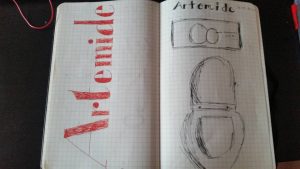
Artemide’s flushing mechanism
13450270_1716198301966635_9162381105455337234_n
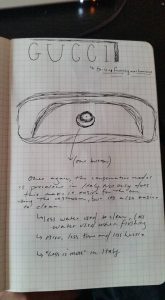
Gucci’s flushing mechanism


My focus for my journal is the flushing mechanisms in Europe (Italy, primarily, but also Scotland), and I wanted to compare them to the ones we have back home in the States in the attempt to figure out why they are so distinctly different.

Thus far, Europeans tend to favor the single button flusher or the two-buttoned one, because they want to conserve water and reduce waste as much as possible. The two-buttoned restrooms are especially conservation centered: the large button used for waste and the smaller one for water conservation.

Toilets
Toilettes (toilets) in Italy are very different from those we’ve experienced in The United States.

In America, however, the handle flush is widely used except in a few upscale locations such as big corporations or more environmentally conscious areas (i.e. Austin, TX).

The concept of focusing on this was to easily compare the two ways of living; my American lifestyle never took into account the level of water consumption, because I never had to, yet here in Italy we are forced to pay for water or pay for the restroom or use toilets that are a bit foreign. It really makes you pay attention to the rest of your life.

For instance, trash is separated here in Italy between glass, plastic, paper, compost, and general trash, while in the States people may occasionally recycle or reuse, but there’s no enforcement nor incentive. I think once I’m  back home, I’ll be able to implement all of the useful, environmentally helpful things I’ve picked up here – maybe even convince others to try it as well. It would be interesting to say the least if we could implement more conservative methods both in our consumption and waste back home.

Week: Artemide

This year I had a very special birthday. It entailed a day touring the ground of Artemide, a lighting company. Founded in 1959 by Mundi, they pride themselves on their ingenuity and attention to detail. They focus on the relationship between man and light. How does man interact with light, and how does light affect man’s surroundings and emotions? Their products/projects attend to these ideas.

They produced “The Human Light” (1980-1990) which was an idea that focussed on how light can change the perception of a place. After this they created touch sensitive lighting that changed colors (1900-2000) which gave the user more control and creativity in their lighting process using Metamorforsi Technology. My favorite project was a group of lights that all interacted with each other. They were all bulbs of glass with a single light emitted through one point. As a user touches one in a sliding motion, it dims this light, but all the others as well. In this way one can connect with all of the lights through any point, not simply through a switch on the wall. This is useful, yet also an interesting study in the way that appliances can relate and interact with eachother.

We then discussed the change of their production methods as the LED light was produced. This was a time with innovation met tradition, as LED technology was combined with traditional Italian design such as their glass factory in Venice. With this we were shown a list of patents of that Artemide had acquired. Their passion was transferred not only through design but into the sciences. The Alphabet of Light, Ameluna, LoT, LoT Reflectors were some patents, to name just a few.

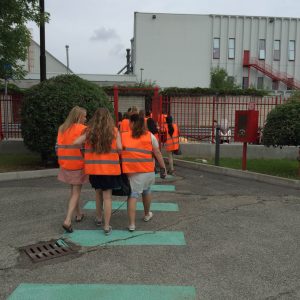
We viewed this passion through their creations and facility. We were allowed to walk through their factory. Here, dawned in our orange reflective vests, we saw metal pellets being spat from the mouths of machines. We saw CNC routers cutting sheets of metal as a man shook out the results. Piles of metal lined the shelves that reached the factory ceiling. Pieces of lamps hung from a rack and moved throughout the building.

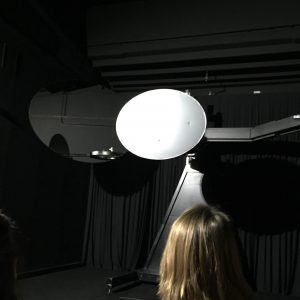
We then removed the vests and traveled to the laboratory. Here we learned just how much attention Artemide paid to details. They had a machine that tested the intensity and light distribution of their products with a rotating mirror and sensors. Another room tested the longevity of the lights. The products were put in devices that heated them and acted as x-many years of outdoor life. Most interesting, there was a machine (looked as a simple sphere on a pole) that received the radiation as a human body would. In this way they can attend to all of the Italian regulations.

Artemide was a wonderful example of collaboration. Designers + scientists + engineers all coming together to produce products that spread light + innovation.

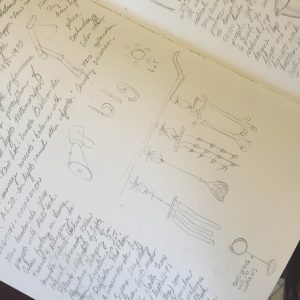
Artemide Sketch
Artemide Sketch
Artemide: Light Testing
The Little Orange Vest Crew

Artemide

Artemide

3 collections of Artemide:

  1. Design: Glass and Tech
  2. Architectural: Indoor and Outdoor
  3. Danese: Professional and Environmental

From the 1960s to now, Artemide has experienced drastic changes. For instance, in the beginning, the company focused on Plastic and many new materials, and they did (and still do) extensive research on the relationship between man and light. In the early stages, they were experimenting with how different designs changed how people used their products as well as how to efficiently make changes that were both aesthetic and functional. However, Artemide now focuses more on remakes and the aesthetic of their design.

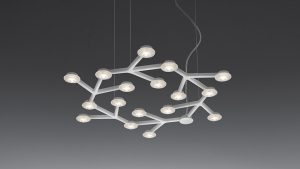
One of the biggest advances of the company was through the revolutionary use of LED lights. LED lights don’t give off much light, but they gave the company the ability to add color and dimension to their previous inventions. Not only could they completely change their old products and bring forth a new model, but designers were able to create completely new products – many beyond the comprehension of those in their time. They brought in real-life applicable techniques such as the addition of joints to lamps and changing the shapes in order to cast light in a whole new way.

LED lights from Artemide

As of 2015, the company has begun using more glass, technology, and modern approaches to design in order to reduce their environmental impacts through their old techniques (i.e. large consumption of Plastic). Now, they try to mix tradition with innovation in order to keep their brand as familiar as possible while still making grand strides towards advancement.

Many great projects include: Li-fi and Ameluna:

“Li-fi” is the interaction between humans and light sources. By creating a dialogue between the two, data and information can be communicated between light sources; this new science is still in the process, but it opens new forms of communication as well as a more in-depth understanding of the relationship between man and their environment.

And Ameluna is a “bright future project” that continues that push for environmental awareness. Light and heat relationship brings about the technical and emotional connections humans have with their environments.

There is also the use of lights to create fonts and creative outlets through the extensive use of lights. Michele de Lucchi, for example, created the Tycho Professional of 2016, which incorporates light by creating a font and building a light-based alphabet. It goes by the acronym: LoT, Light over Time. It’s Reflective Technology that uses LED lights (both colored and not). It can be scheduled through a time sequence, and it creates light symmetry through the programming of light and appliances.

Overall, Artemide is about modernity and functionality. It was a great pleasure to explore their shop as well as their factory. It gives one a new perspective on the relationship between us (humans) and light.