Week 3: Biennale (Angel)

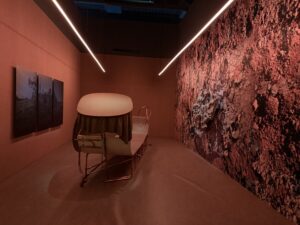
This week (as usual), we saw so much good design. Going to Treviso and Venice was such a cool experience. I really enjoyed going to the Biennale. Going into it, I had no idea what it even was. I loved how each country had their own building to really separate themselves from the others. It was interesting to see how some of the interiors were designed completely differently than the exteriors. I loved how countries approached similar topic in different ways. Some relied heavily on sights, some utilized sounds, and some even used feelings. For example, Germany had a room that was warmer than the others to convey the impacts of global warming.

Overall, the Biennale was a pleasant surprise and I would definitely recommend it to anyone going to Venice. It was a beautiful example of how the world can be united by design.

Sophie Leung-Lieu Week 4, 2025

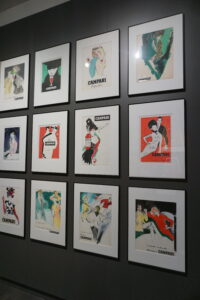
Today marked the bittersweet ending of our wonderful month abroad. For one of our final visits, we saw the Campari Gallery, a museum exhibition showcasing the history and art of a famous Italian liqueur company. 

One of the most interesting things we saw was the unique form of advertisement that Campari executed in the 1900s. From music and film to prints and paintings, we saw a history of interdisciplinary advertising that often challenged norms and made Campari the company it is today. One billboard we dissected was named controversial because of the details of her hair color, which ring finger had a wedding ring, etc. 

Campari also designed many different everyday objects with their branding to promote the company. There were subway handles, dog bowls, pianos, all fitting the same color scheme and logo that made Campari recognizable. 

I loved seeing all the artwork and posters made to promote Campari, as they had so many creative graphic designs that showcased a variety of fonts and themes that created a strong identity for the brand. 

Week 3 Dominik Puente 2025

This week was really eventful. Staring off with La Scala, where we finally got to wear the outfits we had spent the entire week looking for. It was my first time experiencing an opera, and afterwards we saw the Duomo at night. Although the event itself wasn’t about design, it taught me a lot about the local culture. It was also an opportunity to reflect on the architecture and interior design and how this can influence our social interactions.

On Tuesday, Fondazione Achille Castiglioni was very inspiring. It showed how design can be fun, playful, and full of personality. It reminded me that research comes in very different shapes and forms and being there allowed me to think of my designs as a way to break through the seriousness of the world.

Lastly, my favorite thing this week was going to Artemide, especially when we went to the factory area. I loved seeing the full process of taking an idea and bringing it to life. We often forget how much time and effort it takes to complete this process, and we just admire the finish product, when the art of making is also a product of itself. Seeing how many different people, machines, and processes work together towards a common goal was so inspiring and meaningful that now I want to find a job there.

Everything, Everywhere, All at once!

This week was incredibly fast-paced and jam-packed, but it was also incredibly fun! Spending the week at Castilogni’s studio and an evening at La Scala could not have been more perfect. I enjoyed seeing the joy and life still honored within Castilogni’s studio even after his passing. La Scala was even more surreal than I could have imagined. Hearing beautiful music in the space was magical – my favorite part was looking around at how captivated people were by the singer’s voice, people draping themselves over the balconies, leaning closer to the stage, it was beautiful. Visiting Artemaide and Alfa Romeo on the same day was a treat! I never truly knew how much went into the production of quality things until then, and boy, is it a lengthy process, but so worth it to see how the designs on paper come to life with the help of so many different people. Alfa Romeo was a surprising favorite for me. I’ve never been super into cars, but the cars there were art within themselves, and learning their history was just the cherry on top. The trip to Tipoteca was also one of my favorites. I mean, come on, getting to letterpress a print with an old Italian man in the middle of nowhere Italy is a once-in-a-lifetime experience that I am so grateful for. I did not include any pictures from the biennale because I was so absorbed in every space I went to there that I did not take any! This exhibit was unlike anything I’ve ever seen before, and I could have stayed there the whole day. My favorite from the exhibit was the Poland exhibit because it was very literal and was focused on the safety within architecture, although it was one of the least heavy topiced pavillions I enjoyed its humor and clean but interesting display of information.

Over the weekend I visited a friend in Barcelona and visited Casa Batillo. I had studied Gaudi’s work for a few years now in my art history classes so seeing the Casa Batillo in real life was an incredible experience and it did not seem real! The detail! The artistry! Amazing! I also visited the Moca museum which housed some work by Warhol, Basquit, Herring, the list could go on. I loved getting to see some more modern art on my trip especially from more well known artists – very cool and fun that it was an unplanned experience.

I feel so lucky to be somewhere where learning and inspiration is everywhere, and I can’t wait to absorb everything everywhere within my last 2 weeks in Italy!

In Review – Assignment E – Isabelle Cloeter

The first week of our program began with an unforgettable tour of the Duomo in Milan. Seeing this breathtaking structure for the first time reshaped how I think about scale, detail, emotion, and color in architecture and design. The cathedral’s towering spires and intricate Gothic facade created an overwhelming sense of harmony and craftsmanship. As light filtered through the stained-glass windows, the sacred atmosphere of the space. This experience made me reflect on how architecture can go beyond function to create lasting emotional resonance. Standing atop the roof that day, looking out across the city I’d be calling home for the next month, was a perfect way to begin this journey.

Early in the program, our group began our “Mapping the City” assignment, which allowed us to explore Milan in a more analytical and collaborative way. Visiting our sites was a great opportunity to connect with classmates while diving deeper into the urban fabric of the city. One building that stood out was the Torre Velasca. Though it is a well-known architectural landmark, we were struck by how empty and quiet the surrounding space was. Despite thoughtful design elements, benches, walkways, and greenery, the area lacked activity. During our presentation, Professor Kate mentioned that it’s consistently quiet there. It made me wonder whether this was intentional or a missed opportunity to activate public space through design.

Visiting Rossana Orlandi was another highlight for me, especially from an interior design perspective. Walking through the gallery felt like stepping into a series of curated experiences. One piece that especially stood out was the painted canvas armoire, a simple wooden exterior that opened to reveal a vibrant collection of canvases, each telling a different story. This deceptive simplicity, paired with the narrative richness inside, was deeply inspiring. It brilliantly merged classical and modern aesthetics, sparking new ideas in my own approach to design.

Our day trip to Lake Como was another incredible experience. Touring the Novocomum with an architect gave us insight into its unique design. The chairs highlighted during the tour especially fascinated me. One had a curved back with only two legs and could be worn like a backpack, making it lighter and more portable. The chair next to it had a wider seat and four legs, offering a very different design approach, yet both were user-friendly and functional in their own ways. It reminded me how multiple solutions can exist within the same design problem.

The Pirelli Tower was another structure I passed several times without ever truly seeing it, until our visit. Learning about its engineering and the thoughtful placement of the underground conference area gave me a new appreciation for the building. Its slender yet powerful silhouette has since stood out to me every time I passed the train station.

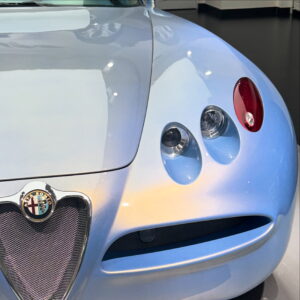
One of my favorite visits of the program was the Alfa Romeo Museum. Beyond the beauty of the cars, the design history was fascinating. I especially appreciated learning about a pastel-colored model from the early 1900s that was designed specifically for women. It had a slimmer profile and less width, details I hadn’t considered before but made so much sense once pointed out. We also learned about design failures, like a model with the engine inside the cabin, which led to toxic fumes when the windows were closed. It was a strong reminder of how critical functionality is in design.

In conclusion, it’s hard to capture everything I’ve learned in just one word or phrase. My time in Milan taught me to see design from a broader perspective, to understand how interior architecture connects with the greater world of design, and to embrace challenges, both in my work and in being far from home. I grew not only as a designer, but also as a person. I pushed myself to explore new places, connect with new people, and reflect deeply on the built environment around me.

This month will remain one of the most meaningful experiences of my life. While it came with long days and sore feet, it also gave me invaluable knowledge, inspiration, and memories. I now know that I want to continue studying and working in new environments that push me creatively and personally. Thank you, Milan, for being a home away from home. I’ll be back, hopefully sooner rather than later.

Assignment E:In Review

Civil engineers are traditionally trained to prioritize structural soundness, functionality, and cost-efficiency. These are essential elements in the field, forming the backbone of infrastructure and development. However, civil engineers often overlook the experiential and aesthetic qualities of the spaces they help create. Unlike designers, who focus on form, emotion, and user experience, engineers tend to reduce structures to technical necessities. Yet, buildings are more than beams and columns, they are spaces where people live, work, and connect. This gap between engineering practicality and design sensibility is one I’ve come to deeply recognize and aim to bridge. My time in Milan studying design opened my eyes to how engineering and design can coexist, and how thoughtful aesthetics and cultural context can elevate a project from functional to transformative.

Taking this design course helped shift my perspective on the kind of engineer I want to become. I’ve always had an appreciation for design, but I was held back by the assumption that engineers weren’t supposed to think that way, that beauty and structure had to be separate. Through this course, I realized those assumptions weren’t true. I was exposed to the minds of brilliant designers and architects, especially under the guidance of Professor Kate Catterall. Visiting the studios of visionaries like Cristiano Bottino and Giovanni Lauda revealed how design can incorporate cultural values, history, and personal stories into architecture, creating something that is both meaningful and functional. A pivotal moment for me was speaking with our guide in Como, who had an inspiring perspective on space and light. He made me see how those two elements, when used intentionally, can transform how people feel inside a structure. His insight pushed me to reflect on how engineering can also be poetic, not just practical. Encouraged by this interaction, I’ve decided to begin taking design courses next semester to further develop my creative skills and integrate them into my engineering practice.

Throughout the program, I had the chance to explore a wide range of buildings that struck a perfect balance between structure and art. Works by Carlo Scarpa, like the Brion Tomb, Negozio Olivetti, and Fondazione Querini, showed how raw materials, geometric cuts, and strategic openings can evoke depth and elegance. Scarpa’s ability to craft multiple visual perspectives from a single vantage point made me realize how thoughtful design can change how we experience space.

Bosco Verticale and the CityLife Center were also especially meaningful to me. Bosco Verticale’s integration of over 800 trees and thousands of plants into its structure is a bold example of sustainable, living architecture, a true fusion of nature and design. Meanwhile, the CityLife towers, with their sleek, leaning forms and futuristic aesthetics, challenged my previous notions of what structural design could be. Each project I encountered pushed me to think beyond my technical education and consider how structures can tell stories and inspire emotion.

Lastly, one of the most memorable moments of the trip was the Triennale Milano International Exhibition and seeing the Essential Homes Research Project by the Norman Foster Foundation. Which presented full-scale prototypes of compact, one-bedroom homes designed for displaced communities as well as p[people in substandard living situations. These structures aim to provide dignified, affordable living spaces for individuals affected by substandard housing conditions, particularly in emergency contexts. Projects like this reminded me why I chose civil engineering in the first place: to serve people and make their lives better. They also showed me that design and functionality are not mutually exclusive; in fact, the most impactful projects are those that fuse the two.

This experience has completely reshaped how I see my career and my role as an engineer. I now understand that engineering is not just about solving problems, it’s about imagining possibilities. I want to be the kind of engineer who challenges traditional boundaries, who isn’t afraid to innovate, and who actively brings design into the conversation. Moving forward, I want to create work that is structurally sound, socially meaningful, and aesthetically inspiring. My goal is to be a forward-thinking engineer, one who builds with both precision and purpose.

Week 3 (2025): Memoriale Brion – Danielle

I first saw the Memoriale Brion in my Architecture and Experience class this semester. I had never taken an architecture class before, and the language of buildings and their details was so unfamiliar to me. For the entire beginning of the semester, I was relying on feelings and gut reactions to guide me through the lectures and essays. The Memoriale Brion was one of the buildings that was so easy to feel and appreciate — the swoop of the tomb structure seems so protective, like everything there must be safe.

The colorful tiles on the underside of the tomb structure.
The levels of stairs at Memoriale Brion.

Seeing this building in person has only elevated my love for it. There were so many details, like the colorful tiling or stacked stairs, that I wasn’t able to see through photos in a Powerpoint.

In Review

Sitting in the green pastures of Villa Necchi’s garden, having just toured the restrained grandeur of its interior, and allowing both the warmth of the sun and rush of the gentle water to refresh my soul, I could not fail to realize that my sense of aesthetic beauty had finally been awakened. Though my accounting course of study had honed my ability to analyze details and their implications, it was not until this moment that I perceived I had been unintentionally training myself to think as a designer does. After every subsequent visit in Milan and the following excursions, I sensed that I was slowly being transformed to go beyond the mind I had so as to participate in the world as humans are meant to. Indeed, after three weeks of deep immersion in the fullness of Italy’s culture, my perspective on art and design has been refined; however, and much more importantly, this trip has reoriented my understanding of myself and reality. I was once blind, believing beauty was merely a matter of subjective preference, but the scales have fallen from the eyes of my soul, and I now see that it is an objective good that is indispensable for forming the human being and ordering society.

Upon my arrival, as I contemplated the myriad intricacies of this new culture, the first beauty vis-à-vis design I encountered was, unexpectedly, the beauty in the design of Italian life. Businesses open later to allow parents to walk their children to school, coffee and croissants are drunk and eaten in the café, meals are long and layered, and every interaction is infused with meaning. In a word, precisely because Italians are focused on community, contemplation, and tradition, they are experts in living fulfilling lives that are centered on those things which bear fruit in the soul. In contrast, America—unparalleled in its opportunity and abundance—is the land of individuality, efficiency, and rapid change. As I walked between Torre Branca and Torre Velasca, I saw the reconciliation between these seemingly contrasting ideas played out. Touching on both Naomi Fitzpatrick’s guest lecture and our Duomo guide’s notes, Milan is a city of layers, and its architectural wonders cannot be isolated from their historical past. Design, I learned, is a wonderful dance or dialogue between conservation and progression. Milan’s centuries of success result directly from a prudent approach of conserving what is good and lasting while simultaneously progressing where there is either room for growth or anything undesirable. Once I discerned this transcendent truth, it unlocked a new world of meaning. For instance, Fondazione Querini and Villa Necchi kept the art, furniture, and setting that had supported and sustained aristocrats and nobles. However, they each attached unique portions that provided a more profound insight into the stories they were conveying. Good design transforms its viewer, and what I experienced in Italy will not go forth in vain. Just as Milan conserves and progresses, I was moved by nearly everything I saw to progress and incorporate into my own life the slow, deliberate enjoyment of meals and communion with others. Meanwhile, the aforementioned values America holds up are also to be desired, and thus they ought to be conserved, too. The choice is not an either-or, but rather it is a both-and. As individuals, we should indeed work hard and take risks in the arena of business like Americans. Additionally, we should also take care not to ground ourselves in consumption, wealth, and fame: fleeting things which bring no true joy. Italy has found—and demonstrated to me—what the proper center of life should be: a gentle sharing life with our neighbors.

My meditation on culture was only the first step in my personal transformation abroad. Beyond creating a desire to properly order my exterior life, the designs I encountered led to an infinitely greater interior transformation. Standing before Da Vinci’s sketches at the Museum of Science and Technology, I faced another moment of clarity. The beauty that was condensed in a few deft strokes showed the relation and harmony between the parts of his machines and how they create a whole that tends towards a concrete purpose. Similar to my experience at Villa Necchi, I took this insight with me everywhere else I went. Suddenly, I began to see proportionality, balance, purpose, and relationship in every direction, and I now examined the Duomo, art in the Brera gallery, and furniture at Cassina in a way that was like feeding my soul a rich dessert. This initial insight led to the most important realization I had during my time in Italy: beauty is not subjective. Beauty is the result of the intersection of the intelligibility of a work and the work fulfilling the end it was created for; it is a relational, rational, and transcendent property of existence. If we are all honest with ourselves, we can recognize instinctually that Bach or the opera at Teatro alla Scala is more beautiful than random noise, or that Michaelangelo’s David is, objectively, more aesthetically pleasing than a child’s scribbles. If beauty were purely subjective, an instinct and shared agreement among people across time, space, and cultures that certain works of art are more beautiful than others would be inexplicable. What does explain this common recognition, though, is something deeper: beauty has structure, harmony, and purpose—and therefore an objective standard. To contrast this negatively, why was it that Fondazione Prada was the least stimulating exhibit to most students? I would argue it was because its lack of intelligibility and explanation of purpose left us unmoved; we sensed that there was no intersection between the attainment of an end and comprehensiveness. Thus, our shared sense that not all things are beautiful merely because someone calls it so points to an objectivity. When we adhere to that transcendent standard which we sense, we are free to create knowing that we are moving in the right direction.

As C.S. Lewis astutely notes, “the first demand any work of art makes upon us is surrender. Look. Listen. Receive. Get yourself out of the way.” By surrendering, I have been transformed to order my life to that which is true, good, and beautiful. Through objectively beautiful design, we can move others to surrender, thereby transforming them for the better. Therefore, it is of utmost importance to study and critique design, for the contemplation of beauty gives our souls wings to rise towards something even greater; to treat beauty as ornamental is to destroy our hope of progressing in the future.


Week 3 – Reflections from Milan – Isabelle Cloeter


My experience in Milan has helped me grow immensely, as both a designer and a student. I’ve explored places I never imagined visiting and now feel so eager to return one day, perhaps with family or friends, to share these unforgettable spots.

One of the most thought-provoking moments happened just yesterday at the Triennale. As I was walking through the exhibitions, a woman approached me and asked if I’d be interested in participating in a unique AI job interview experience. I agreed, not fully understanding what I was signing up for, and entered the interview space feeling a bit confused. What followed was even more unexpected, during the simulated interview, one of the AI-generated interviewers began steering the conversation in an uncomfortably sexual direction.

Although it was part of an experimental exhibit, it reflected a harsh reality: situations like this happen all too often in the professional world. This moment opened my eyes to a truth I hadn’t yet faced, how power dynamics can make job candidates feel vulnerable or unsafe. Coming from the more protected environment of high school and even college, it was a jarring but important realization. As I near the end of college and prepare for the real world, it made me pause and reflect on the kinds of situations I might face, and how I want to respond to them.

Despite the discomfort, I’m grateful for the experience. It challenged me to think deeply and critically about the world I’m stepping into, and that’s part of what study abroad is meant to do. Milan, thank you for being a home away from home. I’ve learned so much here, and I can’t wait to return one day and see how far I’ve come.

Assignment E

The image on the left is from May 27 in the Triennale Museum in Milan, Italy. The image on the right is from May 23rd at the Biennale Museum in Venice, Italy. I wanted to use these two images as a point of comparison into how these two museums were able to spread worldwide issues but create it into a design that invites people to read, to observe, and to spread facts. I think this was one of the major instances in which I understood all that design implies. It is not just fashion and the creation of something that serves a purpose, but it is something that can be used for absolutely everything in this case, the spreading of awareness while making it in a beautiful way that makes the visitor want to learn and to read and to take in the message. The use of fabric and embroidery to deliver a message, which was then used in a gallery/museum, is beautiful. These art pieces that are created in this manner, I believe, allow the viewer to take a picture and post it because they are appealing to the eye while serving a useful purpose.

This museum visit was on May 23rd in Venice, Italy, and it was the Fondazione Querini Stampalia. I think it has such beautiful and detailed interior design and architecture. The drawings, the details, and the colors it was all absolutely perfect and beautiful. Seeing this room filled with paintings and art and being able to compare it to the present day and reflect on how we were there earlier that same day made me realize how little but also how much these places have changed. Seeing a drawing made hundreds of years ago and comparing it to the real space today helps you understand time and the changes that come with it. A city may have the same architecture, and, theoretically, it is the same, but when you add new details and the influence of people and their evolution, the city takes on a whole new meaning. The design of this house, to me, was the best one we have seen. The art on the walls and the chandeliers added such an elegant but inviting touch to the interior decor.