The Italian Way!

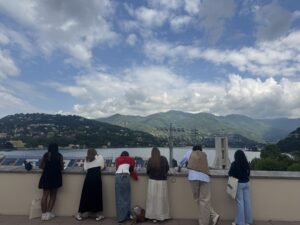
Starting the week off with our survival Italian lesson has prepared me to strive to adapt to the culture that I have had the opportunity to immerse myself in. I have even purchased a few books in Italian to give myself the best chance to learn the language. As the Italians do it, slowly but surely, I will get there! My week’s highlights were visiting the Rossanna Orlandi Gallery, sketching in Lake Como, and visiting Studio FM Milano.  Rossanna Orlandi was a beautifully done space; I could have stayed there forever. I was obsessed with the fact that nothing fit the same kind of vibe, but it all went well together. Every room was something different and funky, nothing like I’ve ever seen before – It was a pool of inspiration, and I feel so lucky to have had the chance to experience a space like this. Lake Como was also, of course, beautiful. My favorite part was when we were atop the Archivio Terragni, relished in the view, and sketched the Como stadium. I had never seen such a view, and being surrounded by new friends was a treat! Studio FM was my favorite part of the trip so far. Seeing cool, innovative work done by people in the same field as me is inspiring and has helped me solidify that I want to continue my design path, and that it all comes in time. 

These past ten days have been very eye-opening because I have a new appreciation for the “Italian” way of life. Things move much slower, and people are not living to work; they are working to live. As I’ve learned to slow down, I have also learned that things will happen, you have to be patient, and let them happen.

Milan week 2

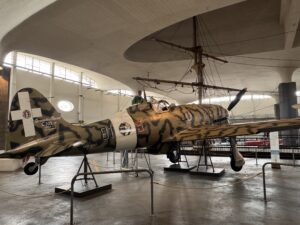
This week was really great. First off the day of the art gallery and museum of science was a very fun, and interesting day. I learned a lot about how many things emerged and grew which was very new to me. Seeing the first trains, planes, broadcast channels was fascinating.

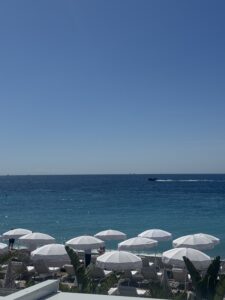
Lake como was beautiful. It made us want to explore a beach further and therefore we chose to explore nice and get to know a part of france since i had never been. This weekend was really relaxing besides the 4am wake up call and the semi creepy bus. Other than that nice made it for a super relaxing weekend. We explored the small casino and got to lay in the beach for about 4 hours having some spritz’s and piña coladas. The rocks made it hard to get in the ocean but the weather was beautiful and we all got a great tan. Just a note: my topic is graffiti and i observed nice and it had very minimal grafiti and street art was not very prominent either. I think it made the city look a bit classier and beautiful.

Week 2


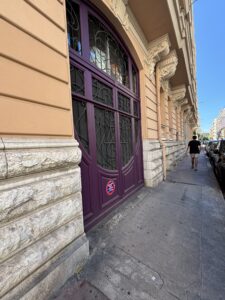
After living in Italy for about 10 days, I have come to see, and appreciate, both the culture and manner of treatment characteristic of Italy. This weekend, I traveled to Nice, France, and while here, I saw the start contrast between the French and Italian way of life. This difference, I think can be seen in the doors of each country. Many doors throughout Italy, I’ve noticed, are large, ornate, and wooden. Much like Italians, these doors have grand, beautiful facades, yet are humble and simple on the interior. The French door in the attached photo is also large and oranate—characteristics also present in Italian doors. However, the purple color provides a clue as to the French way of life. Purple, symbolic of royalty and pomp, is a color that can be used to describe French attitudes and—stereotypically—snobbery. Indeed, in my time here everyone I’ve interacted with has been kind, yet there seems to be no imitating of the simple warmth of Italy.

Week One in Italy – Isabelle Cloeter

This week, it finally hit me, I’m actually in Italy, studying abroad. It’s only been one week, but something about these past few days made it all feel real. There have already been so many highs and lows, moments of excitement and challenge, but I know this is a time in my life I’ll never forget.

This weekend was especially unforgettable. I had the incredible privilege of being in Vatican City during the inauguration of the new Pope, a once-in-a-lifetime experience. What made it even more meaningful was that Pope Leo is the first Pope from the United States, and he’s from Chicago, my hometown. Even more amazing, he’s a graduate of Villanova, the university attended by half of my family, including my sister. It felt like history was unfolding in front of me, and somehow, I was part of it.

The atmosphere in Vatican City was electric. The streets were packed with people joyful, emotional, hopeful, and excited. Walking into St. Peter’s Basilica for the first time left me speechless. The beauty and significance of the space gave me a feeling I can’t quite describe, but one I’ll carry with me forever.

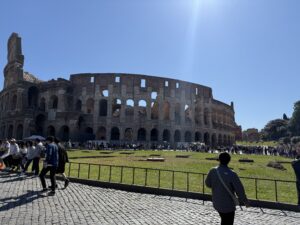
I also revisited the Colosseum, and this time, with a deeper understanding of its historical context. Seeing it again, with a new perspective, was incredibly powerful. And yes, after walking over 40,000 steps in one day to fit in all the sights, my legs are still recovering! But every step was worth it.

To share all of this with a close friend made it even more special. This first week has already left such a mark on me, and I can’t wait to see what the rest of this journey holds.

Week 2(05/12/25-05/18/25)

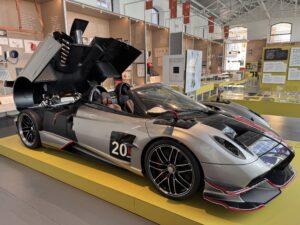
The creation of the Huayra Roadster BC was a result of scrupulous analysis and the critical approach the Pagani team took. Their effort was translated into innovation, invention, and exploration of unexplored paths to break new ground, by not following car trends and seeking to build timeless creations. The essence of the Huayra Roadster BC is exactly this: extreme, exuberant, and shaped by the hand line with the fundamental concepts of Leonardo da Vinci’s Art and Science. The car was created with the latest technologies derived from Pagani Automobili’s track experience and in accordance with key concepts of its DNA. It is an intuitive and easy-to-drive vehicle that is meant for the consumer to enjoy, as every detail from the exterior to the interior is unprecedented.

I found the girls!

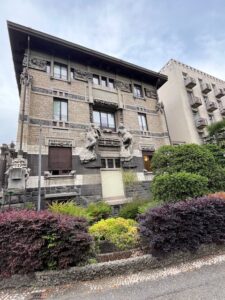
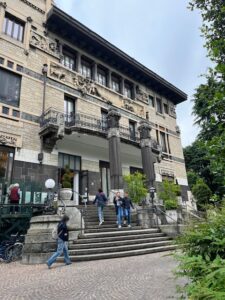
I found the naked ladies from the Palazzo Castiglioni at the Villa Romeo Faccanoni. They are at the health clinic where I was sent for chest x-rays yesterday!

Villa Romeo Faccanoni is “Considered the second most important of the buildings constructed by Giuseppe Sommaruga in Milan, after Palazzo Castiglioni, Villa Faccanoni was, at the time of its construction, an elegant example of residential architecture built in Art Nouveau style for a bourgeois client at the beginning of the last century”.

Week 1 Dominik Puente 2025

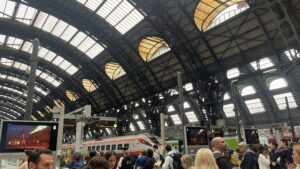
Coming here I knew it was gonna be a completely new experience, but I wasn’t expecting it to be this different. I began my journey at 6 am in Austin to head to New York City before going to Milan. I was so excited, even though it didn’t go perfectly as I planned. I left my jacket back in Austin’s airport but it turned out to be an excuse to buy a new hoodie for my little New York City adventure since I’ve never been there before. After, the plane to Milan was more than 8 hours long. I could not keep track of time since I had never been on a plane for that long either. I could not sleep the entire flight, I think the combination of excitement and nerves were too much, so I stayed awake watching movies. Finally, I arrived in Italy and was greeted by Emma holding a sign for us. I met a couple other girls, and we took the train together, which was another first for me. Those were my first glimpses of Milan. The building colors, the nature, graffiti, and the whole atmosphere was truly beautiful. Everything was so different from the US and at the same time it felt a little familiar to Mexico. I then arrived at Milano Centrale, which had a vibe that almost reminded me of Harry Potter, to take an uber to our hotel. During our ride I got to observe the city with closer attention to the details: the way plants hang out of almost every balcony, the size of the streets, the small shops and boutiques, and the beautiful architecture that characterizes this city. Everything Milan feels both big and small. I feel like I can take a train and navigate the entire city in 15 minutes, or take a 30 minute walk and be in a completely different neighborhood. I’ve already walked  more here in three days than what I walked in  a week back in Austin. Another highlight of this small week was seeing the Duomo for the first time. As we walked out of the train station, we saw it get taller and taller, it truly took my breath away. I also tried real Italian food, and I think it now has ruined all the possible pizzas, pastas, and gelatos I can find in the US. There is so much I’ve learned in these few days, but I can’t wait to keep learning more about this city, understanding its history and the impacts it had, discover its beauty and observe the beautiful mix between tradition and innovation. 

Milano Centrale, the first day we got to the city.

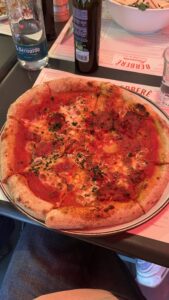
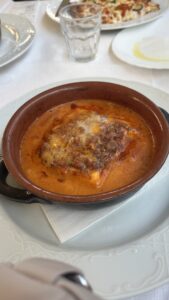
Some of food I had this weekend!


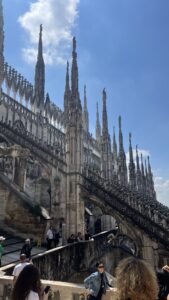
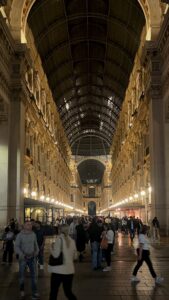
Roof of the Duomo and Galleria at night!

Week 1- first few days in Milan

These past few days marked my first time in Milan, and Europe in general. It has been really wonderful to experience the daily life that I have previously only read about or seen on tv- morning meals of coffee and croissants, cobblestone roads intertwining through beautifully detailed architecture, and an abundance of the world’s largest designer brands headquartered around me. I absolutely love getting immersed in a country where the main language isn’t English, and trying to slowly build Italian language into my daily interactions. It’s also great to be here with a group from UT because we can bond over similar experiences and we’re all figuring out the process of traveling/living here together.

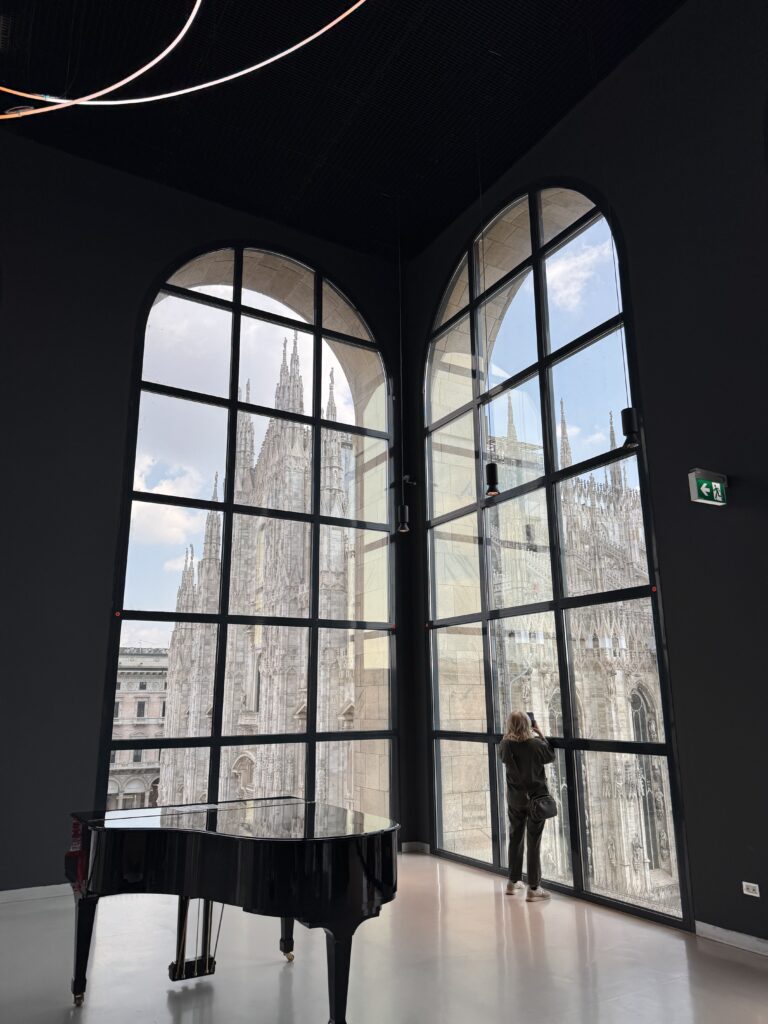
My first impression of Milan was that it was a city lying at the contrast of old and new- the two big sites we visited this past weekend were the Duomo and the Museo del Novecento, and I remember being shocked they were right next to each other; a Gothic medieval church from the 14th century and a modern museum dedicated to contemporary art. After that experience, I’ve started seeing this juxtaposition all around the city: Milan celebrates Italy’s vibrant history while pushing forward into the future of design. I’m excited for everything we’re going to see this upcoming week!

Museo del Novecento windows looking out into the Duomo

Week 1

This week has been busy since landing in Milano. Once I landed, after a less-than-restful 8-hour flight from JFK, I was immediately greeted by Emma. From there, we met another group of girls and traveled by train to Milan. The train was clean and easy, much different from many public transportation systems in the United States. The neighborhood in which the hotel was in was one that I appreciated. It seemed like a family-oriented, quiet, and beautiful community that was filled with mostly natives. Upon arrival, we saw a huge outdoor market with fresh food, bread, and various vintage clothing. Later, I explored the local cafes where I had a coffee and sat outside. Into the evening, I enjoyed some dinner while sitting outside at a local pizza restaurant known well in the area. My introduction to classic Milanese living was a clear depiction of the value of taking life slow and enjoying socializing.

Cadorna Station to Palazzo Castiglioni, Austin Component

Cadorna Station to Palazzo Castiglioni, Austin Component

Cadorna Station. Piazza Cadorna railway station, architect Gae Aulenti.

Cardona Station is a gem within the Ferrovie Nord Milano System. The station is one of Milan’s central railways and is located in Piazzale Luigi Cadorna and serves both regional and suburban train lines. Although the station has existed since the 19th century, its most distinguished moment was its redesign by renowned architect Gae Aulenti. It was initially known as Piazza Castello in the 1800s and served as a single-floor, small structure before further development in 1885 to accommodate increased passenger traffic. The original building was tragically burned down in 1943, much like the rest of the city. The structure that stands today was completed in 1955 through the work of Aulenti.

Aulenti’s modern redesign of the building favored the movement of pedestrian behavior and acts as an underground travel rail hub in one of Milan’s main squares. Some key renovations include the added canopies and shelters, which were supported by the eye-catching red columns, to add shelter for pedestrians and to reference the design of 19th-century train stations. In addition, the layout was redesigned to improve foot traffic within the station and incorporate new modes of transportation within the station, which included the metro lines M1 and M2, tram and bus routes, as well as the express railway line.

The functional nature of the project is contrasted with a colorful structure, named Needle, Thread, and Knot, which stands at the centre of the space, designed by Claes Oldenburg and Coosje Van Bruggen. The structure symbolizes Milan’s fashion industry and industrial innovations.

Aulenti was coined as “The Grand Dame of Italian architecture” for her trailblazing methods, which prioritized the arts as a whole and not just a hyper focus on architecture. She was one of the first women to gain prominence in the architecture sphere, rising to national and international recognition. 

Image 1: Cadorna Station in its modern-day context

Image 2: The station before its redesign by Aulenti


Image 3: Highlighting the flow of pedestrian traffic with a covered walkway and bold red columns

Image 4: The playful and symbolic sculpture (Needle, Thread, and Knot)  in front of the structure


Palazzo Castiglioni. Corso 47 Venzia (near Giardini Pubblici), architect Giuseppe Sommaruga

Palazzo Castiglioni is located at Corso Venezia 47 in Milan. It is a widely recognized architectural piece by Giuseppe Sommaruga and is thought of as the artistic manifesto of Milanese Liberty. The palace was constructed between 1901 and 1904 for Ermenegildo Castiglioni, a wealthy merchant. It was built in the Italian Art Nouveau style and intended to be a fusion of modernity and artistic innovation in the heart of Milan.

Giuseppe Sommaruga and his client, Castiglioni, traveled to England and France for references and were inspired by Hector Guimard, an Art Nouveau architect from France.

The building is set forth with a rustic stone base at the front and is juxtaposed with ornate details inspired by designs from the 18th century; the combination of natural and classical elements creates a distinct and striking exterior. The building’s innovation in its original design was met with critique and controversy from the public due to the nude statues that graced the main entrance. They had been placed to symbolize peace and industry, but were instead deemed scandalous, leading to their removal and replacement in the Romeo Faccanoni villa.

During World War II, the building suffered from damage and, unfortunately, lost its original furnishings as American forces occupied it. In 1957, the building was placed under the protection of the Italian Ministry of Cultural Heritage, protecting its cultural relevance. Years later, it was sold to the Traders’ Union of Milan and has since been adapted to be used as a practical office space. While some interior spaces were altered, key exterior elements remain intact, including the coveted facade, staircase, and select rooms. Today, the building is celebrated as a landmark for Milanese innovation and art nouveau style and stands on its own as Sommaruga’s innovative approach to architecture. Its unique design is continually used as inspiration for others and represents a significant period of transition from Milan’s traditional architecture.


Image 1: The front facade of Palazzo Castilogni, in modern times, still holds the majority of its original integrity in design

Image 2: The still-intact grand staircase graces the interior of the space


Image 3: The original front side of the building with the controversial statues framing the main doors

Image 4: The back facade faces the internal garden and has a more intimate feel, but it retains the elegance of the whole building.


Citations: 

Cadorna Station:

“Gae Aulenti: the works of the grande dame of architecture.” We Build Value, October 29, 2020. https://www.webuildvalue.com/en/infrastructure-news/gae-aulenti-works.html.

Sullivan, Mary Ann. “Piazzale and Stazione Cadorna.” Bluffton University. Accessed May 6, 2025. https://homepages.bluffton.edu/~sullivanm/italy/milan/cadorna/aulenti.html.

Castiglioni, Piero. “Cadorna Railway Station.” Studio Piero Castiglioni. Accessed May 6,, 2025. https://pierocastiglioni.com/en/architecture/buildings/cadorna-railway-station/#Cadorna%20Railway%20Station-2.

Museo Virtuale Ferrovie Nord. “Milano Cadorna.” Accessed May 6, 2025. https://museo.ferrovienord.it/en/header/notable-stations/milano-cadorna/.

Elkann, Alain. “Gae Aulenti.” Alain Elkann Interviews. May 28, 2016. https://www.alainelkanninterviews.com/gae-aulenti/.


Palazzo Castiglioni:

GAG Società Benefit https://www.gag.it/. “Palazzo Castiglioni Milan Italy  – Cariboni Group.” Cariboni Group, www.caribonigroup.com/en/projects/palazzo-castiglioni-milan-italy.


Pavia, Codex. “Casa Castiglioni” LombardyCultural Heritage, 2016, www.lombardiabeniculturali.it/architetture/schede/LMD80-00196/.

Zacevini, Gianni. “Palazzo Castiglioni: Il Simbolo Del Liberty Milanese – Divina Milano.” Divina Milano, 25 Oct. 2024, www.divinamilano.it/palazzo-castiglioni-il-simbolo-del-liberty-milanese.