fWhen I first started college, I didn’t expect to start independent research this early, but I’m glad it was through FRI. After completing UGS 303: Scientific Inquiry, I faced the daunting task of choosing a stream. The DIY stream stood out because it seemed to involve a little bit of everything ranging from 3-D printing to qPCR and making mobile apps. It simply seemed like an interesting stream to join.
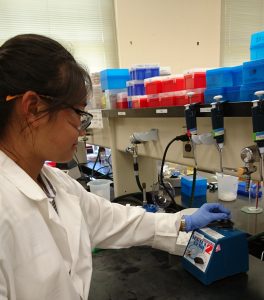
After being accepted into the stream, it was more than I expected, but in a good way. The course is structured like a walk-through tutorial with protocols given to us for us to complete the task at hand. It started by introducing proper lab techniques and continue to cover a vast amount of material most of it which I found quite interesting. My favorite one was the 3-D printing skill development where we got the chance to create anything we wanted. The toughest assignment for me was the coding aspect, but once I got it to work, it was the most satisfying feeling. The labs overall are demanding, but definitely doable. Though it is mostly self-taught, any questions could be directed at a mentor or any of your fellow classmates in lab. Though it does take a sizable chunk of time out of your week and sometimes if may feel like you live at lab, it is worth the investment. I can consider myself a scientist well versed in basic techniques with some knowledge in other fields.
My current project involves analyzing the historical data of Waller Creek, a creek that DIY has been monitoring over the years. I also continue to gather data from the creek though my weekly samplings. The goal of this is to understand factors affecting the creek and understand the trends of the bacterial levels over time. It’s interesting to see change, or in this case, the lack of change of Waller Creek over time and why it is this way. It’s a creek that runs right through UT and faces the problem of having high E.coli and enterococcus bacterium levels. The City of Austin has attempted to fix this problem by fixing the wastewater infrastructure and educating the public, but the effects are yet to be shown. It is found that faulty infrastructure such as with storm drains is the main cause of the high levels of bacteria. I hope that if any researcher in future generations of DIY take on this project, a more solid trend concerning Waller Creek can be found.
The DIY research stream is definitely one I would recommend to others. I have learned many valuable lab skills which can be put to use in many other lab settings. Not only that, the RE in charge of this stream, Tim Riedel, refreshing person to work with. He will give out advice on the lab if we need it, give us different viewpoints of where our project can go, and also life advice if we need it. On top of that, I’ve also gotten quite close to several of the other researchers in the stream, whom I now consider to be my comrade-in-arms after a solid year in DIY research stream.
Leave a Reply