I chose DIY Diagnostics because it combined two of my passions: medicine and innovation. The idea of creating a tool to improve the quality of life for people attracted me to the stream. Hearing about the various projects that ranged from corporate-funded initiatives to student-developed products and apps displayed a variety that made this stream standout from the rest. I’m a very hands-on person; I love building and designing different things with practical functions. DIY Diagnostics offered avenues for diagnostics from physical products to web and application development. When my friends or parents ask what I do in the lab, I simply say that I’m working on the cutting edge of public health technologies to increase healthcare accessibility, utility, and efficiency. Sometimes, I say that I just try a bunch of ideas until something works. Both things are true. Although I was a freshman, I was learning techniques and lessons to help me in research for professional, reputable laboratories.
I would consider myself a scientist and researcher. I conduct experiments and record data to find the answer to a question which makes me a scientist. And I search for the answer over and over again which puts the “re” in “research.” Being a part of this research community has taught me to try new things and approach problems from different perspectives. It has also linked me to supportive peers, mentors, and faculty that are willing to help with matters concerning not only research but everyday occurrences and academics.
To be honest, I was completely at a loss when I first began. I had never taken a computer science course and I knew almost nothing about code. However, the modules and instructions were so clearly delineated that it became easy to create functional apps and experiment with different combinations of code to create different applications. My success with the coding assignments has made me realize that I actually like coding and I am now pursuing a transcript minor in the Elements of Computing.
Some exciting diagnostics being worked on right now are the Parkinson’s project and the UV wearable. The Parkinson’s project focuses on using keystroke analysis on patients with Parkinson’s to develop a diagnostic that uses an ordinary keyboard to aid in early detection of Parkinson’s. If proven to work, it could open up a realm of possible diagnostics that are rooted right through laptops and could be potentially extrapolated to cellphones.
One of the big “aha” moments I had in this stream is that just because you don’t know what you’re doing, doesn’t mean you’re alone. My first semester in the lab was confusing. It was my first time in a research lab and although the protocols were written well, as a freshman, everything just seemed way over my head. Luckily, I was not alone. I’ve made some good friends in this stream; strong bonds of friendship that could have only been forged in the heart of confusion and the feeling of being completely lost. I learned that it’s okay to make mistakes and that the mentors are super helpful.
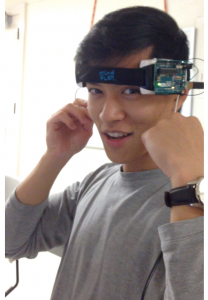
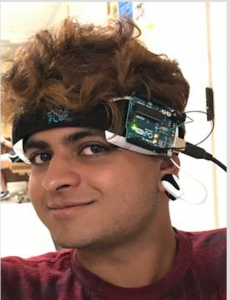
Almost every day is fun in DIY, however, two things stand out in my memory. One was the first semester: my friend and I would go to the lab in the morning when the lab was mostly empty and we would work with the radio on, sometimes singing aloud. We were used to having the lab to ourselves and sometimes forgot that other people come to the lab. Needless to say, we sometimes caught a few people staring at us until we realized our music was on or we were humming aloud. Another thing happened recently. I had to record my brainwaves while walking; thus, I have the Mindflex strapped to my forehead, and I walked up and down the hallway while cradling my computer in my hands to collect data. I caught a few snickers and weird looks, but it was all in the name of science.