• Skip to primary navigation
  • Skip to main content
  • Skip to primary sidebar
  • Skip to footer
UT Shield
The University of Texas at Austin Texas Center for Disability Studies Steve Hicks School of Social Work
  • Home
  • Visit our website
  • Community Map

Uncategorized

August 14, 2023, Filed Under: Uncategorized

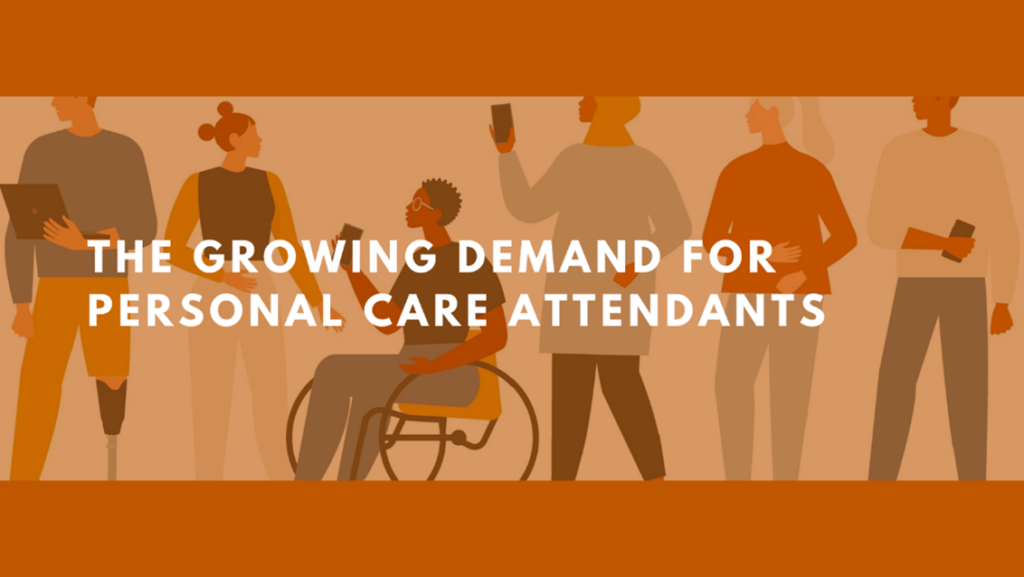
Exploring the Growing Demand for Personal Care Attendants

E4Texas Senior Outreach Program Coordinator

Kathleen Hernandez

As Texas experiences an aging boom and an increase in individuals with disabilities, the demand for personal care attendants has skyrocketed. These compassionate individuals play a vital role in helping people with disabilities or chronic illnesses maintain their independence and improve their quality of life. In this post, we will review the growing demand for personal care attendants and how the E4Texas program is making a positive impact in addressing this critical need.

The Growing Need for Personal Care Attendants:

Texas is at the forefront of an aging population, with both older Texans and elderly individuals from across the nation choosing the state as their home for their golden years. As residents age, their health may decline, necessitating assistance with daily living tasks. Individuals with physical disabilities may also utilize personal care attendants to support them in their daily routines, such as dressing, bathing, and transportation. These attendants empower individuals to lead fulfilling lives within their communities and contribute to society. According to the Bureau of Labor Statistics, employment of home health and personal care aides is projected to grow 25% through 2031, much faster than the average for all occupations.

Enter: The E4Texas Program

The E4Texas program helps address the growing need for personal care attendants by providing a structured career training track that equips students interested in a career as a personal care attendant with the necessary skills, knowledge, and experience to meet the demands of the role. Through classroom instruction, hands-on experience, and access to community partners, the program prepares students to deliver high-quality care and support to members in the community seeking care. By actively engaging with the community and fostering partnerships, E4Texas empowers students to find job placement and career advancement, ensuring a supply of qualified personal care attendants to meet the increasing demand in the field year after year.

Recruitment and Training:

The E4Texas program aims to attract people with or without a disability, who are over the age of 18, who have a high school diploma, and are employment-focused in the areas of Personal Care Attendant, Child Care Attendant, or Paraprofessional. Through targeted recruitment efforts and partnerships with community organizations, E4Texas encourages students to consider a career as a personal care attendant as a means of developing a more independent life with a rewarding role. The program highlights the flexibility and rewarding nature of this career, emphasizing the positive impact attendants can make in the lives for whom they care.

Conclusion:

As the demand for personal care attendants continues to rise in Texas, the E4Texas program serves as a community asset connecting students with the opportunity to fill an in-demand role. Students attending E4Texas are offered specialized career training in a growing field so they can develop marketable skills, and go on to lead a fulfilling, independent life in a career in which they can be proud. The program’s dedication to enhancing the workforce in this field is an important part of meeting the growing demand and improving the overall well-being of students interested in pursuing this career path.

To learn more about the E4Texas program, please visit our website or email kathleen.hernandez@austin.utexas.edu

August 7, 2023, Filed Under: Uncategorized

Texans have many educational credentials to choose from to begin a career. Here’s how to navigate them.

By María Méndez, The Texas Tribune

“Texans have many educational credentials to choose from to begin a career. Here’s how to navigate them.” was first published by The Texas Tribune, a nonprofit, nonpartisan media organization that informs Texans — and engages with them — about public policy, politics, government and statewide issues.

Sign up for The Brief, The Texas Tribune’s daily newsletter that keeps readers up to speed on the most essential Texas news.


From certificates and degrees offered by colleges to industry-recognized certifications and government-issued licenses, specialized credentials can help workers gain skills and higher pay.

And a traditional four-year degree is not the only option. More than half of jobs in the state require a credential higher than a high school diploma but lower than a bachelor’s degree, according to a report from July 2022.

Today, there are various pathways for Texans to get a credential and enter all kinds of jobs, from electro-mechanic technicians to medical assistants, aircraft pilots and human services workers. This can be through a college, an apprenticeship or a job training program offered by public and private colleges, companies and other organizations.

Federal, state and other financial assistance may also be available to help cover part or all of the costs for these educational or work programs.

How do you know which is the right pathway for you? Here are factors and resources to consider while deciding on a college or career program.

What are your options?

All credentials are meant to show a person’s competence in an area or field, but they can vary in value and purpose. Here’s a breakdown of what each type of credential typically means.

The programs through which you can earn credentials also vary. Here are some examples.

Associate degrees, certificates and workforce training: Associate degrees are typically two-year degrees, and an associate degree of applied science means it focuses on technical education.

Workforce training programs and certificates typically require shorter paths to attainment than associate degrees, and a workforce training program can lead to a certificate from an education institution or an industry certification.

Adults in job training programs may also qualify for help covering the costs of the program if it is approved by the Texas Workforce Commission. Qualifying for this assistance depends on income or other eligibility requirements.

Associate degrees and certificates are available at community colleges across the state and through private, for-profit and nonprofit institutions.

For example, the public Texas State Technical College offers degrees and certificates in many high-demand job fields such as cybersecurity, which can lead to an average salary of about $83,340 in Texas. The number of such jobs is expected to grow by 20% by 2030.

Its 2023 cybersecurity programs range in length from four to 20 months long and in cost from about $3,000 to $16,000. They allow students to study online on their own schedule.

Workforce training programs and certificates are also available for students with disabilities. For example, the University of Texas at Austin and Texas A&M University offer job training programs designed to accommodate students with disabilities and focus on jobs in caretaking or working with children. Learn more about programs for students with disabilities in our guide.

Apprenticeships: Apprenticeships give individuals the opportunity to learn and work toward a career, similar to an internship. But apprenticeships are typically longer than internships, include paid work and provide individuals with specialized skills and credentials. There are also registered apprenticeships recognized by the U.S. Department of Labor or a state agency that must also provide mentorship and a “portable, nationally-recognized credential within their industry.”

They can be offered by colleges such as Austin Community College, which has apprenticeship programs for technician jobs in the veterinary, health care and information technology fields. ACC also partners with companies that have apprenticeship programs such as Baylor Scott & White, Applied Materials, Samsung, Honda and Toyota.

For example, ACC works with Honda and Toyota to train auto technicians who can work on cars of those particular brands. The students can earn an associate degree in applied science and are sponsored by local dealerships, said Gretchen Riehl, associate vice chancellor for workforce education. And with Samsung, students interested in manufacturing get work experience while they pursue an associate degree in engineering technology, she said.

The programs require tuition, but financial assistance through grants or employer sponsorships may be available.

Apprenticeships can also be offered by companies on their own, unions, business associations, nonprofits and other organizations.

How to choose the best option for you

The payoff of a credential: Generally bachelor’s degrees have a greater payoff than certificates and associate degrees, but it depends on the area of study, according to research from Georgetown University’s Center on Education and the Workforce. Most bachelor’s degrees can take four years to earn, sometimes making them more expensive than other credentials, such as certificates and associate degrees, that often require less time.

In highly technical and in-demand fields such as engineering and computer technology, people with two-year associate degrees can earn more than people with bachelor’s degrees in lower-paying industries, said Martin Van Der Werf, director of editorial and education policy for the center.

“We find that about 20% of people with associate’s degrees earn more than half of workers with bachelor’s degrees,” Van Der Werf said.

Workers with certificates in engineering technologies out-earned those with certificates in other fields, with median earnings from $75,001 to $150,000. Workers with certificates in construction trades and other “blue-collar fields” also had median earnings as high as those with bachelor’s degrees in liberal arts and humanities — $40,001-$50,000.

But it’s also important to consider the shelf life of a credential, Van Der Werf said. A bachelor’s degree is seen as “more timeless.” Associate degrees and certifications often capture what skills are in demand at the moment, but, in rapidly changing fields, some shorter credentials may require more updating.

“In some cases, laws might change, regulatory things might change, and so the certification or the certificate that you’re earning, might be out of date three years from now,” he said.

You can try to gauge the relevance of a credential by talking to people in the industry, looking at the descriptions and requirements in related jobs and asking the leaders of a program how they keep up with the industry, Van Der Werf said.

Costs: Credentials like associate degrees generally cost less than a bachelor’s degree because they require fewer courses. But credential costs can depend on the program and financial assistance available.

For-profit colleges may market themselves for quick-turn programs, but programs at community and public colleges are usually more affordable, Van Der Werf said.

You may also be able to earn a credential while working in a field through an apprenticeship program, but apprenticeship programs can be harder to find in the U.S. and may have less flexibility or more requirements than a traditional college program, Van Der Werf said.

Your goals and needs: It’s helpful to see what jobs and credentials are in demand, but you should also consider your personal plans.

“People should really pursue what they’re passionate about,” Van Der Werf said. “When you’re given a choice between different career paths and seemingly similar sounding credentials, it pays to do some research.”

Van Der Werf said in such cases people should consider which credential or program is getting more traction in an industry. Looking at job demand by geography and time frame can also be helpful. For example, if you’re looking to settle down, you probably want a credential with more demand in the long run and in a particular area.

If you’d like to move, you may gain more from a credential that would also be in demand elsewhere. And if you’re willing to switch careers later on, you could still benefit from pursuing a career in a high-paying field, such as in oil fields, that may see less demand in the future, Van Der Werf said.

And exploring programs that offer credits or pathways for other degrees or credentials could help you more easily move up to a higher position or related field down the road.

How to get financial help

If you don’t have the resources to pay for college or a job training program, you may be able to get financial assistance.

The federal government provides financial aid for U.S. citizens with financial need pursuing an eligible degree program and, in some cases, certificates. This can include grants, which you usually do not have to pay back, work-study jobs and student loans. Here’s more information about requirements and the different types of financial aid. To apply, you must fill out a Free Application for Federal Student Aid, or FAFSA, form. For certificates, look at program details or ask program administrators if it is eligible for federal financial aid.

Texas also provides financial assistance for college through state grants and higher education loans. Undocumented immigrants or DACA recipients who graduated from a Texas high school and lived in the state for at least three years may qualify for in-state tuition and state aid. To apply, they must fill out a Texas Application for State Financial Aid, or TASFA, form.

There are also tuition waivers, tuition rebates, tax credits, and work-study and loan forgiveness programs (for teachers and public service employees) that may help qualifying individuals with college costs. Here’s more information on these forms of financial assistance from the Texas Higher Education Coordinating Board, which also offers low-interest loans for students completing degrees or certificates in certain high-demand job fields. Colleges and nonprofits may also have scholarships for different programs and qualifying students.

Financial assistance may also be available for certificates and job training programs approved by the Texas Workforce Commission, including programs designed to support people with disabilities.

“It sounds complicated and can be overwhelming. But there is money out there for students. There are a lot of opportunities, regardless of their age, regardless of the programs,” said Jaime Ayala, the college and career manager for Foundation Communities’ College Hub.

The College Hub helps Texans across the state navigate and apply for college and financial aid. Students may need to apply for financial aid as early as a year before beginning a program, so it’s important to begin the process early.

Historically, people could begin applying for state and federal financial aid in October, and the state’s priority deadline was Jan. 15. This year, the release of the FAFSA application has been delayed until December because of changes to streamline the form, so people won’t be able to apply for federal financial aid for the 2024-2025 academic year until then. But information and a preview of the changes to the form are expected to be shared ahead of time.

The Texas Higher Education Coordinating Board is looking at aligning the release of the TASFA with the new FAFSA timeline for students, according to an agency spokesperson. More information is expected to come after the board’s July quarterly meeting. So people applying to college and in need of financial aid, should also look out for possible changes to priority deadlines from the state and colleges. You can still apply for financial aid after the priority deadline, but more state financial aid may be available the earlier you apply.

People applying for both state and federal financial aid usually only need to submit the FAFSA form. To prepare for the rollout of the new FAFSA, Ayala said students and adults in need of financial aid should make sure they have a Federal Student Aid ID, which is needed to quickly apply and view their FAFSA information online, along with a secure password. Their account should also be tied to an email and phone number they can later access in case they need to reset their password. It’s also important for people to have their 2022 tax transcripts ready to apply as soon as possible, Ayala said. Students still claimed by their parents should also ensure their parents have tax documents and FSA IDs ready, he said.

You can find more information about the College Hub or make an appointment online to get help here.

Where to start looking

Still not sure about what career or industry you would like to pursue? You can learn and explore more through the following websites:

  • My Next Move
  • My Texas Future

The Texas Higher Education Coordinating Board’s website, My Texas Future has several resources to explore college and career options and apply for college programs in Texas, including connections with enrollment advisers. The board’s new website Tomorrow Ready Texas also provides tailored action plans for teens in grades 8-12 and their parents to prepare for college.

Texans interested in exploring certificates, associate degrees or another college degree can look at median wages by credential and institution through the Texas CREWS website in addition to federal wage and job demand data. The Georgetown Center on Education and the Workforce also reports data about the value of certificates and associate degrees.

You can search for apprenticeships through a college, a local job center such as Workforce Solutions or the Department of Labor’s website apprenticeship.gov.

You can also contact your local Workforce Solutions office to explore other job training programs and financial assistance. The Texas Workforce Commission has a list of approved job training providers and programs and more information on its resources. It also has directories of public community colleges and licensed private career schools to view options across the state.

You can also look at privately issued credentials in Texas through this database from Texas 2036, a data and research group, and the nonprofit Credential Engine.

Other resources

The following nonprofit organizations also help qualifying Texans pay for degrees or certifications:

  • Capital IDEA in Austin
  • Project QUEST in San Antonio
  • Capital IDEA Houston
  • Project ARRIBA in El Paso
  • VIDA in the Rio Grande Valley

This reporting was supported by the Higher Ed Media Fellowship, which is run by the Institute for Citizens and Scholars and funded by the ECMC Foundation.

Disclosure: Texas 2036, Texas A&M University and the University of Texas at Austin have been financial supporters of The Texas Tribune, a nonprofit, nonpartisan news organization that is funded in part by donations from members, foundations and corporate sponsors. Financial supporters play no role in the Tribune’s journalism. Find a complete list of them here.


This article originally appeared in The Texas Tribune at https://www.texastribune.org/2023/06/27/texas-guide-education-credentials/.

The Texas Tribune is a member-supported, nonpartisan newsroom informing and engaging Texans on state politics and policy. Learn more at texastribune.org.

July 31, 2023, Filed Under: Uncategorized

Unlocking Potential: How the E4Texas Program Empowers Students to Excel

E4Texas Senior Outreach Program Coordinator

Kathleen Hernandez

In a world where opportunities for individuals with disabilities are expanding, E4Texas stands as a beacon of empowerment. The program at the University of Texas at Austin is transforming the lives of students with and without disabilities, providing them with the tools, support, and resources they need to excel. In this post, we’ll explore how E4Texas is breaking barriers, fostering independence, and unlocking the hidden potential within each student.

Embracing Inclusion:

At the heart of E4Texas is the belief that every individual deserves the opportunity to thrive. The program creates an inclusive environment where students with disabilities can engage in educational and career-building experiences. By removing societal barriers and promoting a culture of acceptance, the E4Texas program empowers students to embrace their unique abilities and pursue their passions.

Building Skills for Success:

The E4Texas program goes beyond traditional academic instruction. It provides students with a comprehensive set of skills that pave a path to success in the workforce. From developing independent living skills to honing professional competencies, the program equips students with the practical tools they need to navigate real-life challenges. Through classroom instruction, hands-on training, and practical experiences, students gain the confidence to excel in their chosen career fields.

Navigating the Path to Employment:

One of the primary goals of E4Texas is to prepare students for meaningful employment. Recognizing the importance of career readiness, the program offers three specialized career training tracks tailored to the interests and abilities of each student. Whether it’s becoming a paraprofessional, a child care attendant, or a personal care attendant, the E4Texas program ensures students are equipped with the necessary skills and knowledge to excel.

Mentorship and Support:

The journey to success is rarely traveled alone! E4Texas provides students with invaluable mentorship and support throughout their journey. Mentors are available to offer students guidance, encouragement, and practical advice. These mentors (many of whom are UT-Austin students or E4Texas program alumni) play a vital role in helping students navigate challenges, set goals, and unleash their full potential. With a strong support system in place, students can overcome obstacles and achieve their dreams.

Celebrating Success Stories:

Behind every successful E4Texas graduate lies an inspiring story of perseverance and triumph. These success stories serve as beacons of hope, showing what can be achieved when determination meets opportunity. The program takes pride in celebrating the accomplishments of its students, highlighting their achievements, and inspiring others to follow in their footsteps. Through storytelling and testimonials, E4Texas spreads a message of empowerment and encourages others to embrace their own potential:

“Our grandson is a changed man. Thank you once again for the exceptional program E4Texas. The cute little lizards have grown into dragons, and baby they are on fire! Their lives, their families lives, and their community will never be the same. The confidence, the independence, their own significance and their can-do attitude could only be attributed to the program. Your work has positively impacted many lives. We are forever grateful!“

-Program Graduate Family Member

Conclusion:

The E4Texas program is a catalyst for change, transforming the lives of students and empowering them to excel. By fostering an inclusive environment, providing career training, and offering mentorship and support, the program opens doors to a world of opportunities. Each success story is a testament to the transformative power of the E4Texas. As we continue to break barriers, embrace diversity, and unlock potential, we pave the way for a future where individuals with and without disabilities thrive and succeed on their own terms.

To learn more about the E4Texas program, please visit our website or email kathleen.hernandez@austin.utexas.edu

July 26, 2023, Filed Under: Uncategorized

E4Texas Celebrating 33 Years of ADA and Advocacy at ADAPT of Texas

E4Texas Senior Outreach Program Coordinator

Kathleen Hernandez

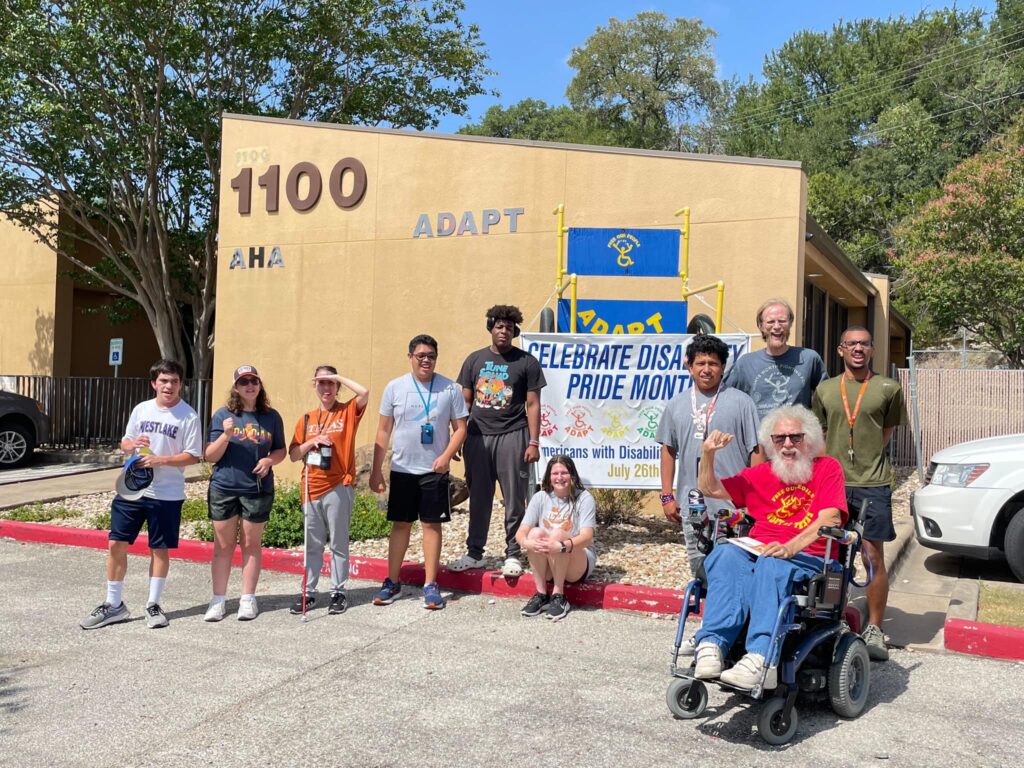
On July 26th, 1990, a landmark piece of legislation was passed that forever changed the lives of millions of Americans with disabilities – The Americans with Disabilities Act (ADA). Today, we celebrate the 33rd anniversary of this historic legislation. Fittingly, the E4Texas students embarked on a meaningful visit to ADAPT of Texas, a grassroots disability rights organization that has been at the forefront of advocating for accessibility and inclusion.

ADAPT, formerly known as “Americans Disabled for Attendant Programs Today” and “Americans Disabled for Accessible Public Transit,” has chapters in 30 states and Washington, D.C. The organization was founded in 1983 initially with the mission of making wheelchair-accessible lifts mandatory on public buses. Through their advocacy, including several protests and legal battles, ADAPT’s efforts were instrumental in securing this provision as part of the ADA’s passage.

E4Texas Students standing in front of the ADAPT of Texas sign

During their visit today, the E4Texas students learned more about ADAPT’s remarkable journey and their achievements in advancing disability rights. From the early days of demanding accessible public transportation, to their ongoing advocacy efforts, ADAPT has been a driving force behind positive change in the lives of individuals with disabilities, and a local opportunity for advocates to get involved.

The ADA has been a transformative piece of legislation, working towards equitable opportunities for people with disabilities in various aspects of life, including employment, transportation, and public accommodations. But we know the work is far from over. ADAPT continues to be a leading voice, fighting for disability rights, and promoting a society that embraces diversity and accessibility.

As we celebrate the 33rd anniversary of the ADA, today we also recognize organizations like ADAPT of Texas, whose dedication to advocating for disability rights have paved the way for a more inclusive future. The E4Texas program stands with these programs, reaffirming our commitment to creating a world where everyone, regardless of ability, can be Empowered, Educated, Employed, and EXCEL in life! 🌟🤝

#E4Texas #ADAanniversary #DisabilityRights #ADAPTofTexas #AdvocacyMatters #InclusionChampions #MakingHistory #UnitedForEquality #AccessibleWorld #DisabilityPride #SocialChange #InclusiveSociety

July 19, 2023, Filed Under: Uncategorized

Disability Pride Month: An Oportunity for Reflecting on the Historical Societal Exclusion of the Disability Community

E4Texas Senior Outreach Program Coordinator

Kathleen Hernandez

Disability Pride Month is not only a time for celebration and recognition of the achievements and contributions of individuals with disabilities, but also an opportunity to reflect on the historical struggles and societal exclusion faced by this community. Throughout history, the disability community has been subjected to prejudice, discrimination, and systemic barriers that have limited their participation in social, cultural, and personal spheres. Understanding this history of exclusion is an important part of our journey towards a more inclusive and equitable society.

Historical Exclusion and Discrimination: The exclusion of people with disabilities is deeply rooted in history. The eugenics movement gained popularity in the late 1800s to early 1900s, and promoted the forced sterilization of people determined to have “undesirable” traits–largely, people with disabilities. In 1907, Indiana passed the first eugenics law that made sterilization mandatory for “idiots” and “imbeciles” in state custody. Several other states followed suit with similar laws, even reaching so far as the Supreme Court (Buck v. Bell), allowing unethical sterilization practices to continue. Suprisingly, this Supreme Court ruling has never been overturned, and laws allowing forced sterilization still exist in 31 states plus Washington, D.C.

Segregation and institutionalization were also prevalent. In the past, individuals with disabilities were often confined to asylums, jailed, and otherwise separated from society. This lead to neglect, abuse, and isolation from mainstream society.

Challenging the Status Quo: In recent years, significant strides have been made towards breaking down these barriers and promoting inclusivity. Disability rights movements and advocacy efforts have raised awareness about the importance of equal rights, access to education, employment, and social participation for disabled individuals. Legislation, such as the Americans with Disabilities Act (ADA), has played a pivotal role in combating discrimination and improving accessibility.

However, the work is far from complete. Broader issues such as social exclusion, inaccessible infrastructure, unequal employment opportunities, and limited disability representation in the media continue to present barriers to equitable inclusion. It is our collective responsibility to address these challenges and fosters a society that embraces the diversity, societal contributions, and human rights of people with disabilities.

During Disability Pride Month, we reflect on the historical exclusion and discrimination faced by the disability community. By understanding this past, we can fuel our commitment to a brighter future– breaking down barriers, promoting inclusivity, and advocating for equal rights and opportunities. We celebrate the resilience and achievements of the disbaility community while reaffirming our dedication to building a more inclusive society that values the contributions and potential of every individual, regardless of their abilities. Together, we can create a world where disability pride is celebrated every day.

July 17, 2023, Filed Under: Uncategorized

Embracing Diversity and Empowering Students: The Power of Inclusion at E4Texas


E4Texas Senior Program Outreach Coordinator

Kathleen Hernandez

In a world that is still learning how to embrace diversity, it is essential to create spaces where everyone’s unique abilities and talents are celebrated. At E4Texas, we firmly believe in the power of inclusion and the transformative impact it has on students with disabilities. Here we will explore how the E4Texas program fosters diversity, advocates for equal opportunities, and creates an inclusive environment that empowers students to reach their full potential. Get ready to discover the power of inclusion within the E4Texas program!

Embracing Diversity:

E4Texas recognizes and celebrates the inherent value of diversity. Our program is enriched by students from various backgrounds, abilities, and experiences. We believe that diversity fuels innovation and fosters creativity. By bringing together individuals with different perspectives and strengths, E4Texas creates a vibrant and inclusive learning community where EVERYONE can thrive.

Providing Equal Opportunities:

At E4Texas, equal opportunities are at the core of our mission. We are committed to ensuring that students with disabilities have access to educational and career opportunities. Through our program curriculum, personalized support, and self-advocacy efforts, we empower students to overcome barriers and unlock their full potential. We pave the way for success and promote a society that embraces diversity.

Creating an Inclusive Environment:

Inclusion is so much more than just a buzzword at E4Texas; it is the cornerstone of our program. We strive to create an inclusive environment where every student feels valued, respected, and supported. Our classrooms are designed to accommodate diverse learning styles, and our instructors are trained to provide the necessary accommodations and support. We foster a culture of inclusivity, where differences are celebrated, and individuality is embraced.

Empowering Self-Advocacy:

Advocacy is a vital skill that empowers individuals to assert their rights and create change. At E4Texas, we empower students to become self-advocates, equipping them with the tools and knowledge to navigate the complexities of the workforce and society at large. Through workshops, mentorship programs, and even advocacy trips to the state capital, we foster a sense of agency and enable students to advocate for themselves and others. We believe that self-advocacy is a powerful tool that promotes inclusivity and drives real societal change for a better future.

Championing Diversity in the Workplace:

E4Texas understands the importance of promoting diversity beyond the classroom. We actively engage with employers and organizations to educate about inclusive hiring practices, and create employment opportunities for our graduates. Several program alumni have had the opportunity to become a part of our staff as mentors after graduation, creating change from within. By championing diversity in the workplace, we contribute to building inclusive and equitable communities that embrace the talents and contributions of individuals with disabilities.

Conclusion:

Inclusion is not just something to reach for; it is a core value that drives the E4Texas program at every turn. By embracing diversity, providing equal opportunities, creating an inclusive environment, and empowering self-advocacy, we foster an atmosphere where students with disabilities can thrive. Through our commitment to diversity and advocacy, we shape a future that is inclusive, accepting, and celebrates the unique abilities of every individual.

Join us on this transformative journey as we continue to champion diversity, empower students, and create a society where everyone has an equal opportunity to succeed. Together, we can build a world that embraces and celebrates the power of inclusion.

To learn more about the E4Program or apply, visit our website or email the E4Texas Senior Program Outreach Coordinator (Kathleen Hernandez) at kathleen.hernandez@austin.utexas.edu
July 12, 2023, Filed Under: Uncategorized

The Symbolism Behind the Disability Pride Flag: Embracing Diversity and Celebrating Inclusion

E4Texsa Senior Outreach Program Coordinator

Kathleen Hernandez

As part of Disability Pride month, here at E4Texas we wanted take a moment to dive into the symbolism behind the Disability Pride Flag. Designed to represent unity, strength, and the diverse experiences of individuals with disabilities, the flag serves as a powerful symbol of inclusion and acceptance.

The Origin and Evolution: The Disability Pride Flag was created by writer and activist Ann Magill, who aimed to raise awareness and break down barriers faced by people with disabilities. The flag has undergone revisions to ensure accessibility and inclusivity. Originally featuring zigzag lines, the design was modified to eliminate potential visual triggers for those with sensitivities, while maintaining its powerful message. The order of the colors is even intentional, meant to accommodate people with red-green colorblindness.

The Disability Pride Flag, created by Ann Magill
Image description: a “Straight Diagonal” version of the Disability Pride Flag: A charcoal grey flag with a diagonal band from the top left to bottom right corner, made up of five parallel stripes in red, gold, pale grey, light blue, and green.

The Meaning Behind the Colors: The flag’s colors hold significant meaning, representing different aspects of the disability community. The stripes are arranged diagonally to symbolize cutting across societal barriers. Each color represets a different kind of disability:

  1. Green: Signifies sensory disabilities, recognizing the diverse experiences of individuals with hearing, vision, or sensory impairments.
  2. Blue: Represents emotional and psychiatric disabilities, emphasizing the importance of mental health and well-being.
  3. White: Stands for non-visible and undiagnosed disabilities, acknowledging that not all disabilities are apparent and visible.
  4. Gold: Symbolizes neurodiversity, highlighting the unique perspectives and talents of individuals with neurological differences.
  5. Red: Represents physical disabilities, honoring the strength and resilience of individuals facing mobility challenges.

The flag serves as a beacon of hope and unity, reminding us to embrace the beauty of diversity and celebrate the accomplishments of individuals with disabilities.

Celebrating Disability Pride Month: During Disability Pride Month, let us stand in solidarity with the disability community, promoting understanding, and advocating for equal rights and opportunities. Let’s continue to promote inclusivity, challenge ableism, and create a world where everyone feels valued, respected, and empowered. We can raise awareness by displaying the Disability Pride Flag, sharing information about disability history and advocacy, and supporting organizations that champion the rights and well-being of disabled individuals. Together, we can build a society that recognizes and appreciates the immense contributions of the disability community.

July 10, 2023, Filed Under: Uncategorized

As demand for skilled workers rises in Texas, work-based educational programs see a resurgence

By María Méndez, The Texas Tribune

“As demand for skilled workers rises in Texas, work-based educational programs see a resurgence” was first published by The Texas Tribune, a nonprofit, nonpartisan media organization that informs Texans — and engages with them — about public policy, politics, government and statewide issues.


A warehouse manager in Waco went from earning about $9 an hour to earning more than $140,000 a year, thanks to an associate degree.

In College Station, a student with a developmental disability worked at an animal hospital through a college program tailored to her needs.

And in Austin, a call center worker was paid by her employer to go to college so she could be promoted to a medical assistant position.

In these instances, the students pursued associate degrees, alternative college programs and industry certifications that offer Texans the chance to expand their career options and their salary potential in a state hungry for more qualified workers.

[Texans have many educational credentials to choose from to begin a career. Here’s how to navigate them.]

More than half of jobs in the state require a credential higher than a high school diploma but lower than a bachelor’s degree, according to a report from July 2022. It’s one reason the state is aiming for 60% of Texans ages 25 to 64 to have a certificate or degree by 2030. But just 45% of Texans have the right training for these middle-skilled jobs.

These college and career programs are far more varied than they used to be. Today, Texans across the state are learning everything from computer-aided design and drafting to piloting aircraft through associate degree or certificate programs — and they’ll likely make more money because of it.

Career and technical education

[Texas colleges provide job training for students with disabilities. Here’s how to access it.]

Initiatives helping students to enter the workforce quickly aren’t new, but there is a new focus on equity. To better serve students, particularly those from underprivileged backgrounds, higher education leaders are moving to create shorter or earlier career and technical education opportunities that meet industry standards while offering high school and college students with pathways to bachelor’s and advanced degrees.

This is a marked difference from the history of vocational programs, in which students of color and women were often placed into high school job training classes that offered no pathway to college.

A movement to help all students go to college emerged in the 1990s, said Amanda Bergson-Shilcock, a senior fellow at the National Skills Coalition, a policy and advocacy organization. But with increasing awareness of student debt in the 2000s and greater interest among students and employers in technical education, vocational programs reemerged and evolved into what is now known as career and technical education.

Grounded aircraft sit inside the Maintenance Hanger where students learn to fix mechanical issues at the Texas State Technical College in Waco on Oct. 24, 2022.
Grounded aircraft sit inside Texas State Technical College’s Maintenance Hanger in Waco, where students learn to fix mechanical issues on Oct. 24, 2022. Credit: Evan L’Roy/The Texas Tribune

The rise of these programs partially stems from industries and jobs increasingly requiring specialized licenses or credentials, even if it’s not a college degree. For students, these programs are attractive because they allow them to get hands-on practice and, in some cases, paid work experience as they work toward a credential. This can be particularly beneficial for working adults or parents with less time and resources to seek a four-year degree, Bergson-Shilcock said.

Bachelor’s and more advanced degrees generally have a greater financial payoff, but people with two-year associate degrees and certificates in highly technical and in-demand fields, such as engineering technologies, can earn more than people with bachelor’s degrees in some lower-paying industries.

Texas has long invested in work-based education, but “that ramped up over the last couple of legislative sessions as the value of things like apprenticeships and other work-based learning opportunities became clear,” said Renzo Soto, a higher education policy adviser for Texas 2036, a nonprofit research organization.

Over the last decade, state lawmakers have largely emphasized career preparation in public schools and aligning school curriculum with college tracks and the workforce needs in each region of the state, Soto said.

During the regular legislative session, Texas lawmakers passed legislation to fund community colleges based on whether their students leave with a degree or credential that gets them a well-paying job or into a four-year institution. Right now, Texas State Technical College is the only Texas college that the state specifically funds based on the employment and earnings of its students and graduates, rather than based on the number of hours they are taught. The funding change is expected to go into effect in September.

Technical colleges and careers

In a room filled with rows of yellow robotic arms, students at TSTC’s Waco campus used computers to try to command the arms to read whether a black cutout in front of it was the right size and shape.

Manufacturers use such a process to ensure that the right bolt, screw or item is used to make a product. But this isn’t a factory. It’s a step toward high-paying jobs in manufacturing, production or warehouse operations.

More than two decades ago, Corey Mayo was a warehouse manager, earning about $9 an hour to support his wife and daughter.

“It just wasn’t cutting it for baby formula, diapers, food,” said Mayo, now 48.

So he enrolled at Texas State Technical College to study instrumentation and completed an associate degree in robotics. After more than a decade in the industry, traveling to manufacturing facilities to implement automated operations, he said he earned roughly $140,000 a year because of his ability to “fix anything in a short amount of time.”

“It’s because of everything that I learned here,” he said.

Now, as an instructor of robotics technology at TSTC, he’s helping other students enter a job that’s expected to grow by 12% in Texas while declining nationally.

And Mayo’s 23-year-old son, Dalton, is following in his footsteps and studying robotics technology. He too would like to enter a high-paying field.

Justin Meckle, a fourth-semester Robotics student at the Texas State Technical College in Waco, works on a troubleshooting assignment during class on Oct. 24, 2022.
Justin Meckle, a fourth-semester Robotics student at the Texas State Technical College in Waco, works on a troubleshooting assignment during class on Oct. 24, 2022. Credit: Evan L’Roy/The Texas Tribune
at the Texas State Technical College in Waco on Oct. 24, 2022.
TKTKT at the Texas State Technical College in Waco on Oct. 24, 2022. Credit: Evan L’Roy/The Texas Tribune
Jule Preiser, a fourth-semester Robotics student at the Texas State Technical College in Waco, works on a troubleshooting assignment during class on Oct. 24, 2022. Students were given no specific instruction - much like how you might be given a problem if out in the field - and tasked with finding a solution through their own problem solving skills.
Jule Preiser, a fourth-semester Robotics student at the Texas State Technical College in Waco, works on a troubleshooting assignment during class on Oct. 24, 2022. Students were given no specific instruction – much like how you might be given a problem if out in the field – and tasked with finding a solution through their own problem solving skills. Credit: Evan L’Roy/The Texas Tribune

First: Justin Meckle, a fourth-semester robotics student at Texas State Technical College in Waco, works on a troubleshooting assignment during class on Oct. 24, 2022. Second: A sign for the college at the entrance of Texas State Technical College in Waco. Last: Jule Preiser, a fourth-semester robotics student, works on an assignment. Credit: Evan L’Roy/The Texas Tribune

From left: Dalton Mayo, a fourth-semester Robotics student at the Texas State Technical College in Waco, stands with his father, Corey Mayo, who serves as the Lead Instructor for Robotics and Industrial Controls Technology inside their classroom on Oct. 24, 2022. Mayo decided to pursue a technical career path like his father.
From left: Dalton Mayo, a fourth-semester robotics student at Texas State Technical College in Waco, stands with his father, Corey Mayo, who serves as the school’s lead instructor for robotics and industrial controls technology in their classroom on Oct. 24, 2022. Mayo decided to pursue a technical career path like his father. Credit: Evan L’Roy/The Texas Tribune

Stories like theirs are not uncommon at the college, which hires instructors from its graduate pool and sees many families return to the college for its hands-on and fast-tracked programs. The 20-month-long program for an associate degree of applied science in robotics and industrial controls technology costs around $11,640, and a 16-month certificate costs $6,984, according to TSTC. The average wage for an electro-mechanic or robotics technician is about $50,630 in Texas and $60,570 in the U.S., according to federal data.

The college also offers programs for various job fields expected to continue growing, such as cybersecurity and aircraft pilot training.

The aircraft pilot training program is one of the college’s more expensive programs, but pilot pay is on the higher end with average salaries in Texas of more than $180,060 for airline pilots, copilots and flight engineers and $108,120 for commercial pilots. Tuition and fees for an associate degree in the program are $11,160, but the flight fees bring up the total to an estimated $89,260. Jobs are expected to grow by 21% for commercial pilots and by 14% for airline pilots and engineers in Texas.

The college also hires some of its graduates to serve as certified flight instructors while they work toward the required hours and ratings needed to work as a pilot in other roles.

“I’m already making back money and I’m already paying off my loans,” said Elaine Polster, a 22-year-old recent graduate who is now a certified flight instructor for the college. “If I went to a four-year school, it would be two more years until I did that.”

Associate degrees in applied science, which have a focus on technical education, and certificates are also available at community colleges across the state and through private, for-profit and nonprofit institutions. Examples of other public colleges include Alamo Colleges, Blinn College, San Jacinto College and Dallas College. You can find private technical schools through the Texas Workforce Commission’s directory. Financial aid, scholarships or other help may also be available for associate degrees and qualifying certificates.

You can also read more in our guide to college programs and financial aid.

A flight instructor speaks about the benefit of having the Redbird flight simulations for students at the Texas State Technical College in Waco on Oct. 24, 2022.
A flight instructor speaks about the benefit of having the Redbird flight simulations for students at the Texas State Technical College in Waco on Oct. 24, 2022. Credit: Evan L’Roy/The Texas Tribune
Students training to become pilots sit in class and watch a video about navigating runway terminology at the Texas State Technical College in Waco on Oct. 24, 2022.
Students training to become pilots sit in class and watch a video about navigating runway terminology at the Texas State Technical College in Waco on Oct. 24, 2022. Credit: Evan L’Roy/The Texas Tribune
The interior of a Redbird flight simulation at the Texas State Technical College in Waco on Oct. 24, 2022. Students training to become pilots are able to practice in the program without having to leave the ground.
The interior of a Redbird flight simulation at the Texas State Technical College in Waco on Oct. 24, 2022. Students training to become pilots are able to practice in the program without having to leave the ground. Credit: Evan L’Roy/The Texas Tribune

First: A flight instructor speaks about the benefit of Redbird flight simulations for students at Texas State Technical College in Waco. Second: Students training to become pilots sit in class and watch a video about runway terminology. Last: The interior of a Redbird flight simulator. Credit: Evan L’Roy/The Texas Tribune

Elaine Polster, a recent graduate of the pilot program and incoming Certified Flight Instructor, stands inside the Maintenance Hanger where students learn to fix mechanical issues on grounded aircraft at the Texas State Technical College in Waco on Oct. 24, 2022.
Elaine Polster, a recent graduate of the pilot program and incoming Certified Flight Instructor, stands inside TSTC’s Maintenance Hanger on Oct. 24, 2022, where students learn to fix mechanical issues on grounded aircraft. Credit: Evan L’Roy/The Texas Tribune

Apprenticeships

On a Tuesday morning in October, Nora Hernandez Mondragon practiced carefully placing patches on the chest, arms and legs of a classmate lying in a medical examination bed.

The patches, which connect to a tangle of 10 wires, require precise placement to record the heart’s electrical activity in an electrocardiogram, or EKG, to detect irregular heart rhythms and heart attacks.

It’s one of the many things she learned at the Austin Community College’s San Gabriel Campus in Leander over nine weeks. She also learned basic medical terminology and anatomy; how to check a patient’s blood pressure and vital signs; how to administer medicines, including through an injection; and how to draw blood — all without paying a dime.

“It’s the perfect situation,” said Hernandez Mondragon, a 34-year-old Austin resident who worked at a call center for Baylor Scott & White Health. “I get to go learn something and develop myself and still be making income for my family.”

Mallory French examines the results of an EKG that she performed at Austin Community College’s Leander Campus on Oct. 4. French and other students were participating in a healthcare apprenticeship program for Baylor Scott & White employees.
Mallory French examines the results of an EKG that she performed at Austin Community College’s Leander Campus on Oct. 4. French and other students were participating in a healthcare apprenticeship program for Baylor Scott & White employees. Credit: Jack Myer for The Texas Tribune
Jennifer Waldron, a Continuing Education instructor at Austin Community College, shows students where to put the electrodes when doing an EKG at ACC’s Leander campus on Oct. 4. The students were participating in a healthcare apprenticeship program for Baylor Scott & White employees.
Jennifer Waldron, a Continuing Education instructor at Austin Community College, shows students where to put the electrodes when doing an EKG at ACC’s Leander campus on Oct. 4. The students were participating in a healthcare apprenticeship program for Baylor Scott & White employees. Credit: Jack Myer for The Texas Tribune
Mallory French connects a lead wire to an electrode on Violet Fields’ left leg while doing an EKG at Austin Community College’s Leander Campus on Oct. 4. The students were participating in a healthcare apprenticeship program for Baylor Scott & White employees.
Mallory French connects a lead wire to an electrode on Violet Fields’ left leg while doing an EKG at Austin Community College’s Leander Campus on Oct. 4. The students were participating in a healthcare apprenticeship program for Baylor Scott & White employees. Credit: Jack Myer for The Texas Tribune

First: Mallory French examines the results of an EKG that she performed at Austin Community College’s Leander Campus on Oct. 4. Second: Jennifer Waldron, a continuing education instructor at Austin Community College, shows students where to put the electrodes when doing an EKG. Last: French connects a lead wire to an electrode on Violet Fields’ leg while performing an EKG. Credit: Jack Myer for The Texas Tribune

Nora Hernandez-Mondragon measures 21-year-old Violet Fields’ blood pressure during class at the Leander Campus of Austin Community College on Oct. 4. The students were participating in a healthcare apprenticeship program for Baylor Scott & White employees.
Nora Hernandez Mondragon measures 21-year-old Violet Fields’ blood pressure during class at the Leander Campus of Austin Community College on Oct. 4. The students were participating in a health care apprenticeship program for Baylor Scott & White employees. Credit: Jack Myer for The Texas Tribune

That’s because Hernandez Mondragon and her five classmates are part of a Baylor Scott & White apprenticeship. Through the program, employees can take an accelerated course at ACC and get hands-on experience to become medical assistants.

“Me being a mom, I would love to go to school but I don’t have the time or the money,” said Hernandez Mondragon, who is raising four children.

After completing the course and 160 hours of work in a clinical setting, Hernandez Mondragon and her classmates will work as medical assistants at Baylor Scott & White Health’s local clinics or hospitals for at least two years. The new job also comes with a pay raise, Hernandez Mondragon said.

Though this program serves Baylor Scott & White employees specifically, it’s one of a number of apprenticeships at ACC and across Texas.

In apprenticeships, individuals get the opportunity to learn and work toward a career, similar to an internship. But apprenticeships are typically longer than internships, include paid work and provide individuals with specialized skills and credentials.

Apprenticeships and pre-apprenticeship training programs can be offered by companies on their own, unions, trade associations, nonprofits and other organizations. Many apprenticeships focus on trades, but a number of programs are opening more opportunities in growing job fields like health care and tech.

Texans interested in an apprenticeship can look for one through a college, a local job center such as Workforce Solutions or the U.S. Department of Labor’s website, apprenticeship.gov.

Workforce training programs

“I’m locking the chair,” 22-year-old Sydney Hodge said as she practiced locking a wheelchair in place at the front of the classroom. Joe Tate, the class instructor, was sitting in the chair.

“Good. Remember, guys, communicate. The more communication, the better,” he told the handful of other students watching.

Then, Hodge helped Tate get out of the wheelchair, holding a gait belt around his upper waist and letting him place his hands on her shoulders for support as he slowly rose. The rest of the class clapped.

Hodge and her classmates were reviewing how to work as personal care attendants. Earlier that day, they discussed different types of bedpans and the organizations that support people with disabilities.

22-year-old Sydney Hodge, right, demonstrates how to use a gait belt, an assistive device used to transfer a person into or out of a wheelchair, on her teacher and E4 Youth program manager Joe Tate in the Biomedical Engineering building at UT Austin on Nov. 29, 2022. The students were part of a workforce development program at UT Austin called E4 Texas, an inclusive job training program open to students with developmental disabilities.
Sydney Hodge, 22, at right, demonstrates how to use a gait belt, an assistive device used to transfer a person into or out of a wheelchair, on her teacher and E4 Youth program manager Joe Tate in the Biomedical Engineering building at the University of Texas at Austin on Nov. 29, 2022. The students were part of a workforce development program at UT Austin called E4Texas, an inclusive job training program open to students with developmental disabilities. Credit: Jack Myer for The Texas Tribune

The class is part of the E4Texas program at the University of Texas at Austin. It prepares students for jobs as personal care attendants, child care workers or teaching assistants. The program is designed to be accessible to people with disabilities, but is also open to people without a disability.

The students also live on campus and get support from program staff to live independently and participate in the community, said Tate, E4’s program manager.

During the three-semester program, students take specialized classes at UT-Austin’s campus, audit other UT courses, volunteer and get work experience. Hodge and her classmate Ayala Montgomery, for example, have been helping care for elderly people as volunteers at AGE of Central Texas.

24-year-old Elaina Bautista volunteers at AGE of Central Texas in Austin, Texas on December 2, 2022. Bautista was part of a workforce development program at UT Austin called E4 Texas, an inclusive job training program open to students with developmental disabilities.
Elaina Bautista, 24, volunteers at AGE of Central Texas in Austin on Dec. 2, 2022. Bautista was part of a workforce development program at UT Austin called E4 Texas, an inclusive job training program open to students with developmental disabilities. Credit: Jack Myer for the Texas Tribune

At the end, students receive a certificate of completion and can get job certifications, but they do not get college credits.

The program also teaches students to advocate for themselves and others. That’s one of the things that drew Montgomery.

“I also wanted to help people that actually struggle with disabilities, like to let them know that ‘you’re not alone, and there’s many people just like you that struggle with the same things day to day,’” said Montgomery, a 20-year-old from Dallas. “I wanted to leave an impact.”

There are other job preparation programs, including for people with disabilities. And if a program is approved by the Texas Workforce Commission, qualifying students may get help covering the program costs.

Texans interested in exploring job preparation programs can learn more and view approved program providers through the Texas Workforce Commission or reach out to local Workforce Solutions centers.

College for students with developmental disabilities

After sending a quick email, Julia Gault turned to work on a PowerPoint presentation she was making for her class. She pointed to images of animals and skateboards on the slides.

“So this is like when I graduate, I want to work at a vet clinic,” she said. “I skateboard, so I put my skateboards.”

Sitting next to Gault during a study hall period at Texas A&M University, Callie Colgrove said, “I want to own my own bakery,” showing off her own PowerPoint. She’s Gault’s best friend and roommate.

The two met through Aggie ACHIEVE, the university’s program designed for students with intellectual disabilities or autism to live independently, experience college and prepare for jobs.

Through the interdisciplinary program, students can take select noncredit courses and physical education courses and participate in student life at A&M. The students have access to graduate assistants who help them navigate classes and live on their own.

Initially, students live on campus. They get a residential mentor who spends five to nine hours a week with them during their freshman year, said Heather Dulas, the program director. As juniors, the students move off campus and can live on their own, though many have chosen to live together as roommates or in the same apartment complex. At the end, students receive a certificate from the university.

The transition was an adjustment for Gault, like for any college student, but through Aggie ACHIEVE she learned how to navigate her schedule and chores, like doing her laundry. Now, she works at an animal hospital, she said, and Colgrove works in the kitchen of a hotel and has baked chocolate pies.

Effrosyni Chatzistogianni, an academic graduate assistant with the Aggie ACHIEVE program helps Matthew Philips, a junior in the program, during an office hours at the Texas A&M University campus in College Station on Nov. 15, 2022. Aggie ACHIEVE is a comprehensive transition program (CTP) for young adults with intellectual and developmental disabilities (IDD) who have exited high school.
Effrosyni Chatzistogianni, an academic graduate assistant with the Aggie ACHIEVE program helps Matthew Philips, a junior in the program, during an office hours at the Texas A&M University campus in College Station on Nov. 15, 2022. Aggie ACHIEVE is a comprehensive transition program (CTP) for young adults with intellectual and developmental disabilities (IDD) who have exited high school. Credit: Evan L’Roy/The Texas Tribune
Students walk to class on the Texas A&M University campus in College Station on Nov. 15, 2022.
Students walk to class on the Texas A&M University campus in College Station on Nov. 15, 2022. Credit: Evan L’Roy/The Texas Tribune
A list of available course to students in the Aggie ACHIEVE program at the Texas A&M University campus in College Station on Nov. 15, 2022. Students take one non-credit course per semester, as well as a Physical Education non-credit course, while they pursue their certificate.
A list of available course to students in the Aggie ACHIEVE program at the Texas A&M University campus in College Station on Nov. 15, 2022. Students take one non-credit course per semester, as well as a Physical Education non-credit course, while they pursue their certificate. Credit: Evan L’Roy/The Texas Tribune

First: Effrosyni Chatzistogianni, an academic graduate assistant with the Aggie ACHIEVE program, helps Matthew Philips, a junior in the program, during office hours at Texas A&M University in College Station on Nov. 15, 2022. Second: Students walk to class on the Texas A&M campus. Last: A list of courses available to students in the Aggie ACHIEVE program. Credit: Evan L’Roy/The Texas Tribune

Julia Gault, a junior in the Aggie ACHIEVE program, talks with another student during office hours at the Texas A&M University campus in College Station on Nov. 15, 2022.
Julia Gault, a junior in the Aggie ACHIEVE program, talks with another student during office hours on Nov. 15, 2022. Credit: Evan L’Roy/The Texas Tribune

Colleges and universities haven’t always accepted or accommodated students with disabilities, particularly those with intellectual and developmental disabilities, but there are now more options for these students.

Aggie ACHIEVE is one of four comprehensive transition and postsecondary programs in Texas. That designation allows students with intellectual disabilities to receive federal financial aid and learn or work along with students without disabilities. Houston Community College, Texas A&M University-San Antonio and the University of North Texas also have comprehensive transition programs.

These programs range in length, admission and costs. For example, Texas A&M’s program admits about 10 students per year and costs over $30,000 per year because of on-campus housing required for the first two years, program fees and a lack of state aid for the non-degree-seeking students.

There are also other programs and options for students with disabilities to audit courses at public or private colleges, and scholarships or other assistance may be available to help students cover costs. You can read more in our guide to college and job training programs for students with disabilities.

This reporting was supported by the Higher Ed Media Fellowship, which is run by the Institute for Citizens and Scholars and funded by the ECMC Foundation.

Disclosure: Baylor Scott & White Health, Houston Community College, San Jacinto College, Texas 2036, Texas A&M University, University of Texas at Austin and University of North Texas have been financial supporters of The Texas Tribune, a nonprofit, nonpartisan news organization that is funded in part by donations from members, foundations and corporate sponsors. Financial supporters play no role in the Tribune’s journalism. Find a complete list of them here.


This article originally appeared in The Texas Tribune at https://www.texastribune.org/2023/06/27/texas-career-technical-education/.

The Texas Tribune is a member-supported, nonpartisan newsroom informing and engaging Texans on state politics and policy. Learn more at texastribune.org.

July 5, 2023, Filed Under: Uncategorized

Celebrating Disability Pride Month: Empowering Voices, Embracing Diversity

E4Texas Senior Outreach Program Coordinator

Kathleen Hernandez

July is a special month here at E4Texas; it’s Disability Pride Month! This July, we hope you’ll join us in taking a moment to honor the achievements and contributions of individuals with disabilities, while thinking of new ways to promote inclusivity, acceptance, and the rights of people with diverse abilities. At E4Texas, we join the global community in recognizing the significance of this month and the importance of creating a world that values and embraces all individuals, regardless of their abilities.

Banner for Disability Pride Month that says "July is disability pride month" with a smiling female pushing smiling a male in a wheelchair, and a beagle at his feet.
Banner for Disability Pride Month

Embracing Diversity

Disability Pride month provides us with an opportunity to celebrate the unique perspectives and talents that individuals with disabilities bring to our society. It is a time to challenge stereotypes and advocate for equal opportunities in all aspects of life. At E4Texas, we firmly believe in the power of diversity and strive to create an inclusive environment that fosters personal growth and empowers our students to reach their full potential.

Empowering Voices

Throughout Disability Pride month, we celebrate the voices and stories of individuals with disabilities. Their experiences, triumphs, and challenges serve as a source of inspiration and remind us of the resilience and strength within each person. Through our programs, we empower our students to share their stories, advocate for their rights, and become agents of change in their communities. We encourage open dialogue, understanding, and respect, ensuring that their voices are heard and valued.

Promoting Awareness and Education

July also serves as an opportunity to raise awareness about disability-related issues and promote education. All year long, we work on organizong and attending outreach events, workshops and classes, and discussions that address topics such as accessibility to post-secondary education, advocating for disability rights, and the importance of creating inclusive spaces. By engaging with our students and the wider community, we foster understanding and compassion, breaking down barriers and promoting a more inclusive society.

As we celebrate Disability Pride month, we invite you to join us in recognizing and celebrating the diversity and accomplishments of individuals with disabilities. Let us work together to build a world where everyone is included, respected, and empowered. At E4Texas, we are committed to providing support, education, and opportunities to our students, ensuring they have the tools they need to thrive and make a positive impact. Together, let’s embrace disability pride and create a more inclusive and equitable future for all.

July 3, 2023, Filed Under: Uncategorized

E4Texas 2023-24 Move-In Day: Embracing New Beginnings and Learning Opportunities

E4Texas Senior Outreach Program Coordinator

Kathleen Hernandez

This past Saturday marked an exciting milestone for the E4Texas program for our students: Move-in Day! Students met E4Texas staff at Almetris Duren Residence Hall to check into their dorms, move in all their things, and participate in new student orientation. Move-In Day was a time of nervous anticipation, excitement, and the beginning of a transformative journey that will take place over the next year. With summer semester classes commencing today (Monday, July 3rd) we are thrilled to embark on this educational adventure alongside our students.

Creating a Home Away from Home

Move-In Day is about more than just settling into dorm rooms; it’s about greeting our students, welcoming them into the official start of the program, and creating a supportive and nurturing environment that feels like their home away from home. Our dedicated team has worked diligently to ensure that every student feels welcomed, comfortable, and supported throughout their time in the program. From coordinating room assignments, to addressing any accessibility issues as they arise, to providing resources for academic and personal success, we strive to create a warm and inclusive community that fosters growth and independence.

Preparing for a Summer of Learning

With the start of the summer semester, our students are ready to dive into a variety of engaging classes and immersive experiences that will build a solid foundation for their upcoming semesters. The curriculum is designed to empower our students with the knowledge, skills, and confidence needed to navigate various aspects of independent living successfully. From learning how to develop their morning routines and navigate to class, learning their way around the kitchen to independently prepare their meals for the day, familiarizing themselves with the online platforms on which many of their assignments will be submitted, and developing many other practical life skills to foster personal growth and self-advocacy, this semester is filled with invaluable opportunities for learning and self-discovery.

Building Lifelong Connections

Move-In Day not only marks the beginning of a new academic journey, but we hope it also marks the beginning of life-long friendships and connections. With only 11 students total this semester, our program provides a unique oportunity for the E4Texas students to really get to know each other well over the next year, forging bonds that extend beyond the classroom . Through group activities, shared experiences, and community engagement opportunities, we cultivate an environment that encourages collaboration, empathy, and mutual support.

As our students settle into their dorms and prepare for the summer semester, we are filled with excitement and anticipation for the transformative experiences that lie ahead. Move-In Day signifies the beginning of a new chapter, and it’s our hope that this chapter will one filled with growth, learning, and empowerment. We are honored to be a part of our students’ journey and look forward to supporting them as they embrace the challenges and triumphs that await. The summer at E4Texas holds endless possibilities for personal and academic growth, and we are confident that our students will make the most of every opportunity that comes their way!

  • « Go to Previous Page
  • Page 1
  • Page 2
  • Page 3
  • Page 4
  • Go to Next Page »

Primary Sidebar

Recent Posts

  • Class of 2027’s First Semester at E4Texas
  • Faces of E4Texas: Get to Know Some Students and Staff
  • The E4Texas Summer Adventure
  • E4Texas Internship Spotlight
  • E4Texas: Embracing a New Semester Full of Opportunities!

Footer

  • Email
  • Facebook
  • Instagram
  • LinkedIn

UT Home | Emergency Information | Site Policies | Web Accessibility | Web Privacy | Adobe Reader

© The University of Texas at Austin 2026