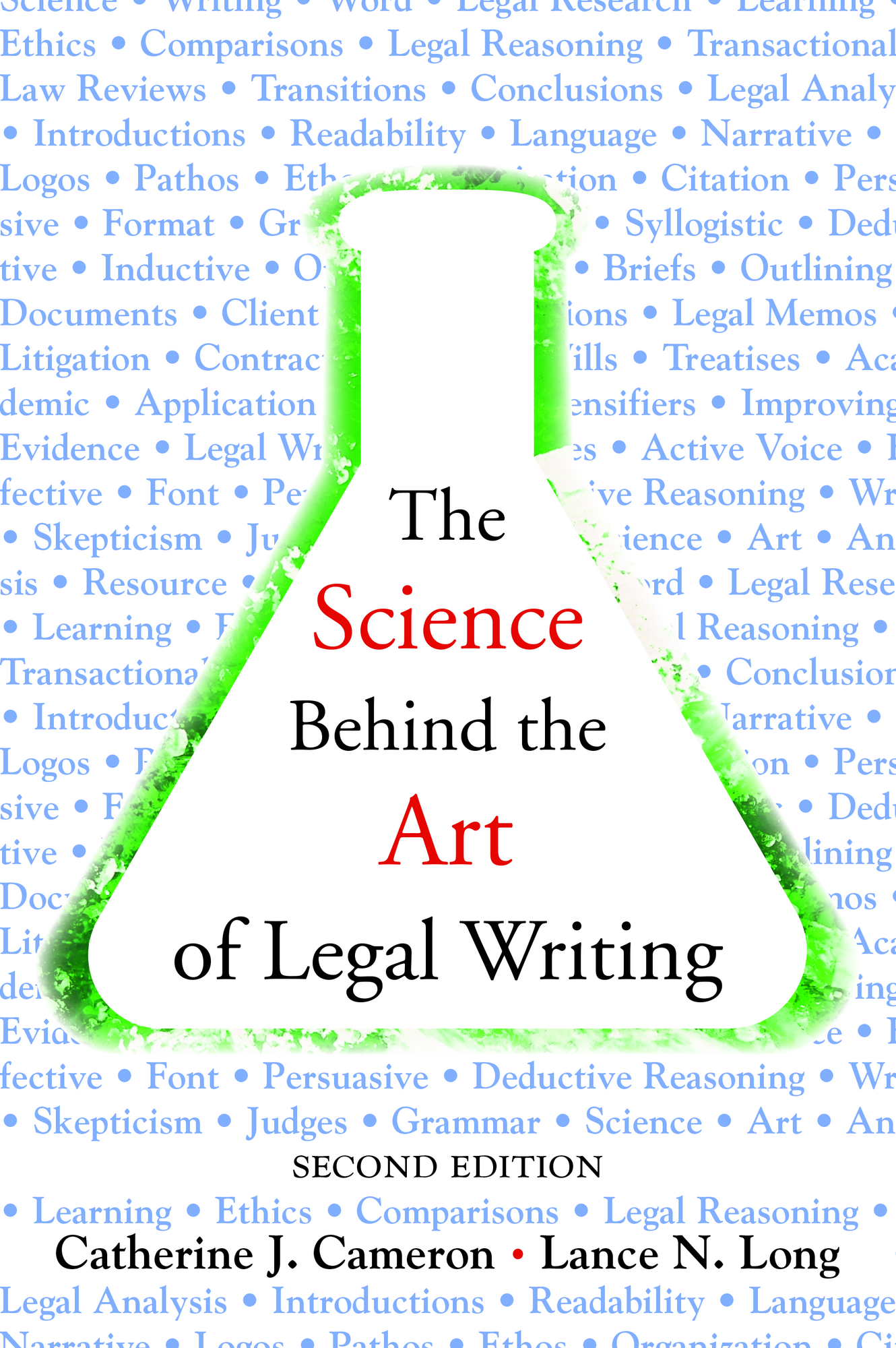
The Science Behind the Art of Legal Writing

I highly recommend The Science Behind the Art of Legal Writing, an excellent book by Catherine J. Cameron and Lance N. Long, which just came out in a second edition. They’ve taken some truisms and common teaching  points from legal writing and done the research to see if those truisms and teaching points can be validated with science. For example—

  • Does format matter?
  • Why is passive voice so hated?
  • Citation—does anybody really care?

They also address—

  • macro- and micro-organization
  • the use of narrative
  • readability and plain language
  • what persuades and what doesn’t

It’s easy to read and full of good advice.

Writing knowledge is like an onion

Level 0 writers think nothing of writing:

  • The lawyer that argued the case …

Level 1 writers have learned enough to believe that one must always refer to a person with personal pronouns (and never with that or it), and so they write:

  • The lawyer who argued the case …

Level 2 writers have looked up this topic and read enough reliable sources to know that there is no such rule, that using that for a person is a widespread and historically common usage, and that it’s primarily misguided sticklers who try to prohibit it; so they go ahead and write:

  • The lawyer that argued the case …

Level 3 writers believe that enough misguided sticklers are in their reading audience that it’s worth conforming to the nonrule to avoid creating the even the mistaken impression of an error; so they write:

  • The lawyer who argued the case …

Level 4 writers have enough confidence in their own writing credibility that they focus on producing clear, readable prose in their own voice; they don’t manipulate the prose to conform to nonrules enforced by misguided sticklers; I don’t know what they would write. 

Legal Writing Nerd: Be One

Saxon-Romance Persuasion

This post discusses two techniques for creating memorable, persuasive prose, which I discovered in Ward Farnsworth’s forthcoming book, Classical English Style. By the way, how’re you doing at spotting Saxon and Romance words? Here’s Quiz 3: name the Saxon alternative for each Romance verb: cogitate, emancipate, imbibe, inundate, masticate (answers at the end).

In persuasive writing, some judges prefer Saxon words:

  • “[The best advocates] will master the short Saxon word that pierces the mind like a spear . . . .” Hon. Robert H. Jackson, U.S. Supreme Court.1

Another example:

  • “A healthy respect for the robust Anglo-Saxon appeals more than does the Latin . . . .” Hon. Wiley B. Rutledge, U.S. Supreme Court.2

We can take advantage of this preference with two persuasive-writing techniques that combine Saxon words with Romance words—relying on differences in tone, formality, and force. The two techniques are the Saxon Restatement and the Saxon Finish.

The Saxon Restatement. With this technique, you state a proposition using primarily Romance words and then restate it using primarily Saxon words (or vice versa). Abraham Lincoln did it in his House Divided speech:

  • “I do not expect the Union to be dissolved; I do not expect the house to fall.”3

Lincoln essentially says the same thing twice: with Romance words (union, dissolve) and then Saxon (house, fall). He names lofty concepts and then brings them down to earth, creating a forceful, memorable couplet.

Winston Churchill did something similar in a famous speech:

  • “I have nothing to offer but blood, toil, tears, and sweat. We have before us an ordeal of the most grievous kind.”4

Here Churchill reversed the pattern, starting with Saxon (blood, toil, tears, sweat) and reiterating with Romance (ordeal, grievous). The real, physical sacrifices are named and then connected to the abstract concepts.

I’ve created examples for modern legal writing by modifying text from appellate briefs:

  • The jury justifiably relied on the photographic evidence because images are unable to prevaricate; pictures cannot lie.

Here, image, able, and prevaricate are Romance; cannot and lie are Saxon. The lofty legal concepts are made concrete. Another example:

  • Albrecht’s only obligation under the order was to remunerate the seller for the vehicle she purchased—to pay for what she bought.

The Saxon Finish. With this technique, you state a single proposition, but after beginning with Romance words, you finish with Saxon. Oliver Wendell Holmes did it well. Here are two examples from his dissenting opinions—the Saxon Finish is italicized:

  • “If in the long run the beliefs expressed in proletarian dictatorship are destined to be accepted by the dominant forces of the community, the only meaning of free speech is that they should be given their chance and have their way.”5
  • “[I]f there is any principle of the Constitution that more imperatively calls for attachment than any other it is the principle of free thought—not free thought for those who agree with us but freedom for the thought that we hate.”6

Holmes builds up to a big idea with Romance words; then he states the idea with Saxon words. The result is a forceful wrap-up.

I’ll give it a try:

  • Petrolco asks this court to affirm the trial court’s interpretation of section 216(b) so that punitive damages are grafted onto the text—an interpretation that produces an entirely different class of remedy from mere legislative silence. Petrolco asks too much.
  • The drug would be located in the deceased’s system only under illicit conditions because having the drug is against the law.

Granted, these techniques are used most often used in speech. Still, you should add them to your toolkit for persuasive legal writing. They constitute sophisticated rhetorical devices—they are tools of plain English.

Quiz answers: cogitate/think, emancipate/free, imbibe/drink, inundate/flood, masticate/chew

____

[1] Collected in Bryan A. Garner, Judges on Effective Writing: The Importance of Plain Language, Mich. B.J. 44–45 (Feb. 2005).
[2] Id.
[3] Quoted in Ward Farnsworth, Classical English Style (forthcoming).
[4] Id.
[5] Gitlow v. New York, 268 U.S. 652, 673 (1925) (Holmes, J., dissenting).
[6] United States v. Schwimmer, 279 U.S. 644, 655 (1929) (Holmes, J., dissenting).

Saxon & Romance Words, part 2: Contract Drafting

Get the book: Legal Writing Nerd: Be One

The last post introduced a way to think about plain words versus fancy ones: sometimes it’s the difference between words of Saxon origin and words of Romance origin. As a refresher, and to set the stage for this post’s focus, try this quiz. For each Saxon-named animal, give the French (Romance) name for the type of meat: chicken, cow, deer, sheep, pig. (Answers at the end of the column.)

Now let’s discuss contracts and other binding legal documents. They often contain Saxon-Romance pairs:

  • agree and covenant
  • cease and desist
  • due and payable
  • hold harmless and indemnify
  • sell and convey
  • will and testament

Why?

During the 1200s, French became the primary language of the law in England. In the 1400s and after, English began to replace French as the language of the upper classes. (History lesson omitted.) Hence the Saxon names for farm animals and the Romance names for their meat when served—as seen in our quiz.

English also began to replace French as the language of the law. Thus, as explained by David Crystal in The Stories of English, legal scribes often had to decide what words to use when “French and English each provide a copious supply of relevant items.”1 Often they didn’t choose—they used both.

As Crystal puts it, “Old English goods and Old French chattels resulted in Middle English legalese, goods and chattels.”2 Sometimes the pairs were synonyms, sometimes they were subtly different, and sometimes they were paired out of “stylistic habit, perhaps fostered by their undoubted rhythmical appeal in oral performance.”3

Many of these doublets persist today, as we saw in the pairs listed above. We also see triplets:

  • give, devise, and bequeath
  • ordered, adjudged, and decreed
  • right, title, and interest

Old legal language isn’t necessarily bad legal language, so how should legal drafters address these doublets, triplets, and longer strings? My advice here relies on my preference for plain, direct words and on the expertise of Kenneth Adams in his Manual of Style for Contract Drafting.4

First, do enough research to decide whether the doublet, triplet, or string contains words that differ in meaning or whether they’re true synonyms. (Sources to consult: Adams’s Manual of Style, Garner’s Dictionary of Legal Usage, and Black’s Law Dictionary.) If they’re not true synonyms, decide which meanings you intend and keep only the words you need.

If you have true synonyms, do your best to pick one word that conveys your intended meaning and delete the others. For example, in most contracts, sell and convey can be shortened to sell. If you intend separate actions—selling the item and then conveying the item to the buyer—then separate provisions requiring the seller to both sell the item and deliver it would be better.

What about the stock judicial phrase ordered, adjudged, and decreed? Certainly it’s harmless as is, but it would also certainly be harmless to shorten it to ordered.

And this monster is still sometimes used with security interests: grant, assign, convey, mortgage, pledge, hypothecate (what?), and transfer. Adams says it can be shortened to grant.5

To those who say that the extra words are harmless, so there’s no reason to excise redundancies, I can say only this: you’re mostly right. But litigation over the Romance-Saxon phrase indemnify and hold harmless gives pause. Some courts say they’re synonyms, while others say they’re not.6 Ultimately, a knowledge of Saxon-Romance pairs might help you streamline and improve your contracts.

(Quiz answers: chicken/poultry, cow/beef, deer/venison, sheep/mutton, pig/pork.)

Wayne Schiess’s past Austin Lawyer columns are collected in a book available on Amazon.com: Legal Writing Nerd: Be One.

_____

  1. David Crystal, The Stories of English 152 (2004).
  2. Id.
  3. Id.
  4. Kenneth A. Adams, A Manual of Style for Contract Drafting 6-7 (3d ed. 2013).
  5. Id. at 7.
  6. Id. at 292-93.