
By ADELA PINEDA FRANCO
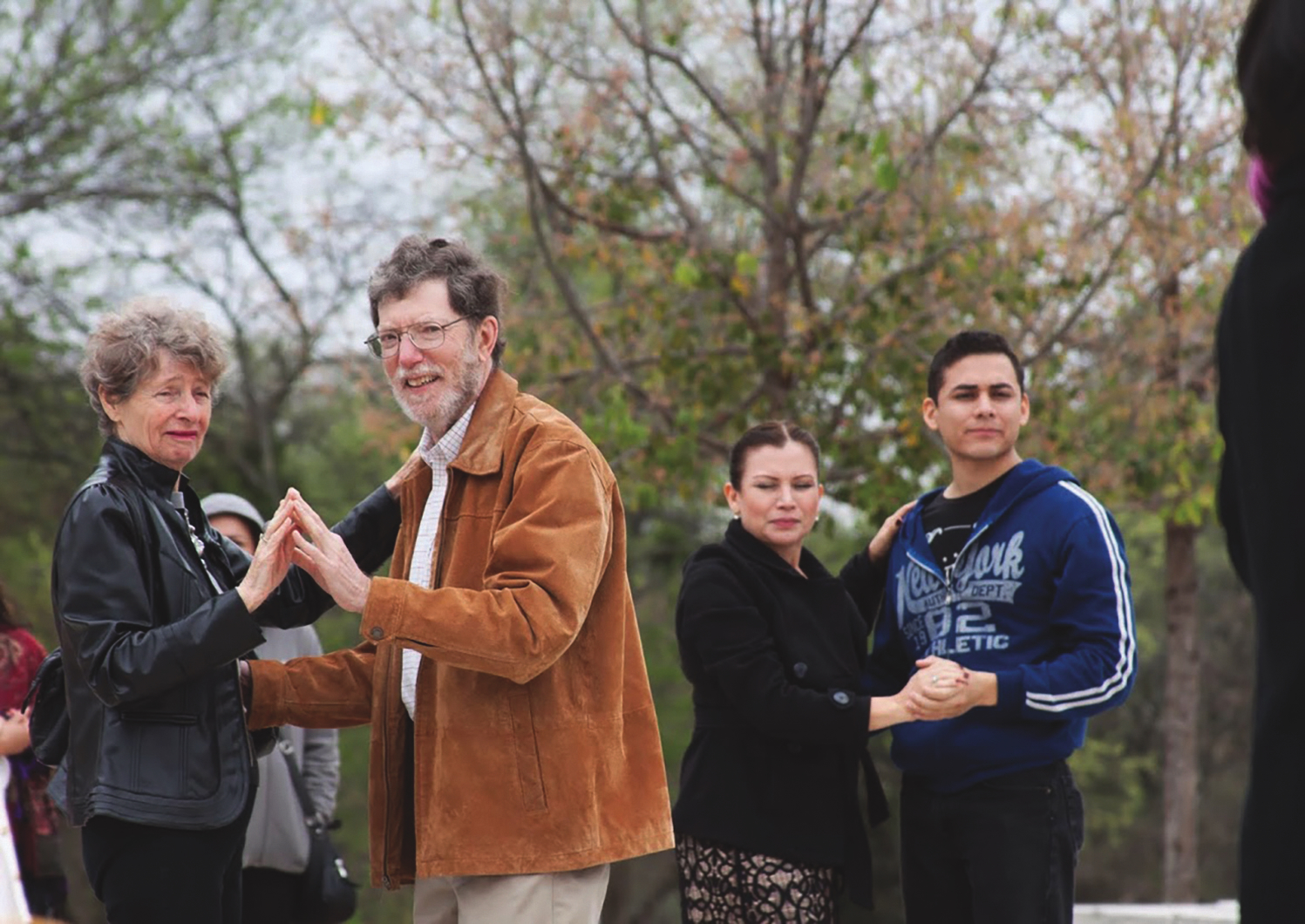
THERE IS A PICTURE of Dina Sherzer dancing with Joel Sherzer that endures as a shared memory among those who knew them. Joel looks straight at the camera with a complicit expression, as if inviting us to join the dance, while Dina looks past the camera, her smile small and self-conscious. This image captures a life of joy, love, vitality, and the shared affinities of a couple whose common goals leave a lasting legacy in the communities that surrounded them.
I did not have the privilege of interacting with Joel in depth upon my return to UT in 2021. He was already retired and in declining health. However, I was glad to learn that LLILAS, the institute I was hired to lead, had been supported by Joel and Dina Sherzer for many years. The impressive Archive of the Indigenous Languages of Latin America (AILLA) and the broader work it represents in linguistics and anthropology, bear Joel’s mark as a founding figure and a leading researcher in the field.
Dina and Joel met in graduate school, at UPenn, and even though they came from different cultures and chose distinct academic careers (Joel, an American anthropological linguist; Dina, a French scholar specializing in modern Francophone literature and cinema), they shared the basic principles that drove their intellectual lives. In the late 1960s, they traveled together to engage with the Cuna people (now known as Guna), and in 1972, they published Literature in San Blas: Discovering the Cuna Ikala, where they put forward a joint framework composed of literary/semiotic categories and the anthropological principles of fieldwork. Joel’s last book was also a collaboration with Dina (and with Yolanda Lastra): Adoring the Saints: Fiestas in Central Mexico (2009).
Dina’s career as a literary scholar was forged against the backdrop of cultural and literary theory, which had the French scene as an essential hub of activity: structuralism, semiotics, and poststructuralism, but also the influence of Jakobsonian linguistics and the Prague circle. Her dissertation, which became her first book—Structure de la trilogie de Beckett: Molloy, Malone meurt, L’Innommable (1976)—attests to Dina’s rigorous training as a formalist, with careful attention to Beckett’s trilogy and a broader conceptual interest in the way writing becomes a self-reflexive act. Cinema, Colonialism, Postcolonialism: Perspectives from the French and Francophone Worlds (1996), a volume edited by Dina that compiled essays by renowned critics, became a pioneering contribution of the way French cinema came to terms with its colonial past.
I met Dina in the 1990s, when I was a graduate student at UT in comparative literature. She taught a class on theory, where the rigor of French structuralism and poststructuralism met the critical analysis of culture and society through readings from what is now labeled the Global South. Dina’s lectures were a space for lively conversations among students coming from many countries, each bringing a different intellectual tradition. This experience has stayed with me.
I was able to re-encounter Dina when I returned to UT in 2021, and over five years I developed a friendship with her. I was always struck by her fierce determination to make her life enjoyable after the passing of her beloved Joel. She traveled to faraway lands for her own pleasure, but she also joined collective efforts that filled her days, not with the routine of a lonely widow, but as someone who kept working alongside others. One such effort was her volunteer work with Dress for Success, an organization that helps women escape the cycle of poverty by giving them access to professional attire, a fitting cause for Dina, who never stopped being an elegant French lady. Yet, Dina’s elegance was not the product of snobbery, which is always based on a relentless drive toward novelty; she rarely bought anything new. Her elegance was a by-product of the care she gave to those cherished pieces, which she made last.
The same instinct applied to her relationships with people: an ability to relate to others without impatience or transnational haste; the ability to exchange experience, the way one loses track of time weaving a story. Dina was, indeed, an elegant, intelligent woman with a heart of gold and an adventurous spirit.
My last dinner with her took place only a few weeks before her passing. She was overflowing with excitement, planning her next trip, an occasion for learning, and for meeting people in places she hadn’t yet been.
Her sudden death is tragic, but the story of her life shines through.
Adela Pineda Franco is director of LLILAS and Joe R. and Teresa Lozano Long Professor of Literature and Cultural Studies in the Department of Spanish and Portuguese, University of Texas at Austin.