
By P. SALOMÉ VALDIVIESO
I FIRST ARRIVED at San José de Mashpi in 2018. After a three-hour journey from the Mitad del Mundo monument in Quito, we left the paved roads behind to venture deep into the cloud forest. The croaking of frogs, the sighting of an armadillo in the middle of the road, and torrential rain welcomed us. Back then, I was part of a group attending a retreat. Seven years later, I returned to Mashpi, this time with the intention of understanding the conservation efforts taking place in the region. I held a deep admiration for the activism dedicated to protecting this territory; from the United States, I had been following the social media campaigns advocating for its preservation. Much has changed since then; during my master’s studies, I had the opportunity to get to know the local community more intimately—their aspirations, their dreams, and the tensions that often arise surrounding conservation efforts.
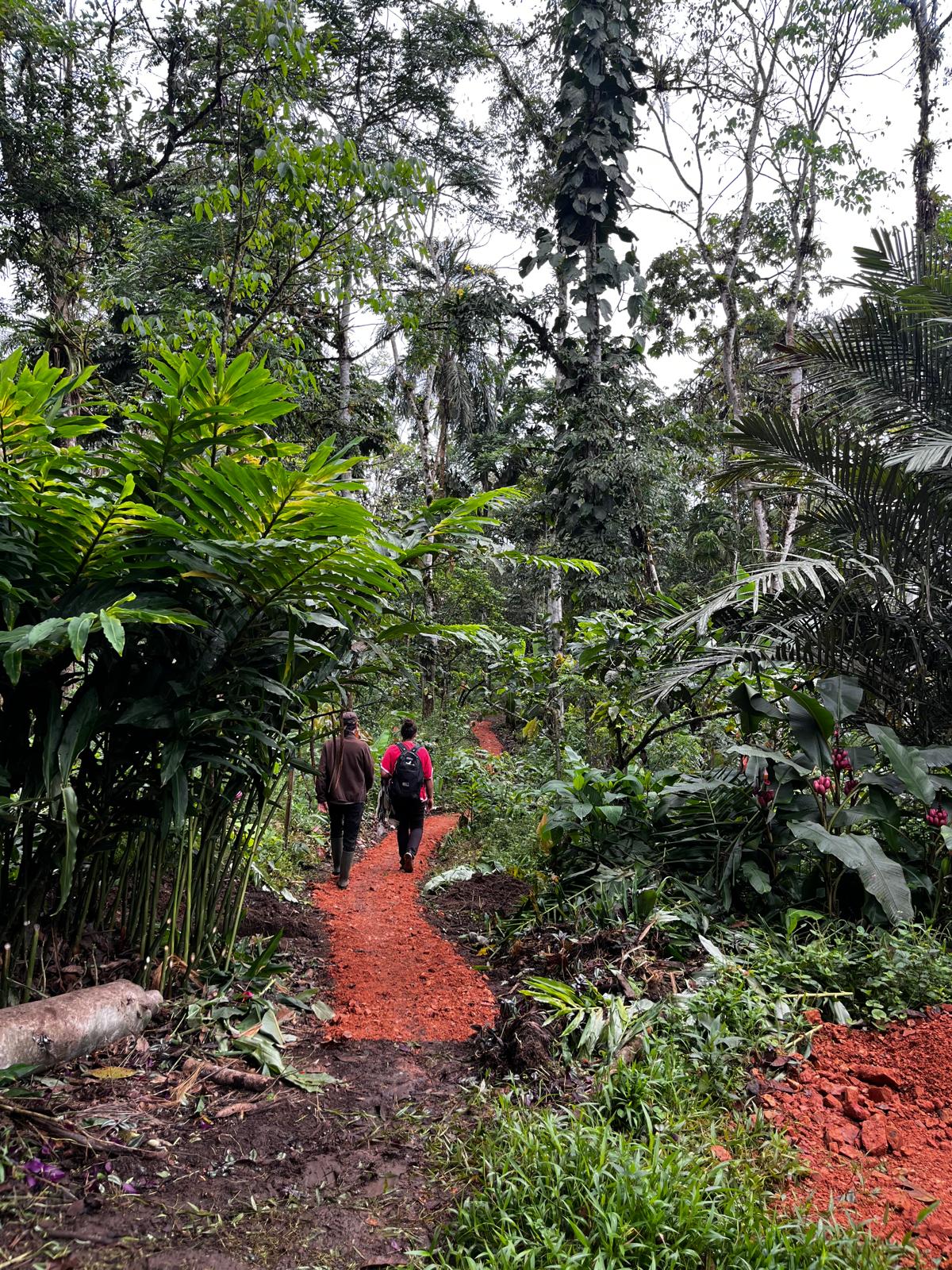
San José de Mashpi, or Mashpi for short, is a small community situated at the intersection of the ecoregions of the Chocó—tropical cloud forests stretching from Panama through Colombia and arriving to Ecuador, up into the Andes, where high mountains border the Amazon. Due to its unique geographic location, the Chocó Andino region features microclimates that support its abundant biodiversity. Since the designation of the Chocó Andino as a UNESCO Biosphere Reserve in 2018, conservation has become a topic of debate among its eight parishes.
The region further gained national and global visibility in 2023, when a referendum banning new mining concessions in the reserve garnered 68 percent of the vote. Despite the referendum, twenty-six mines continue to operate in the region. In the Chocó Andino, metallic mining, particularly gold extraction, threatens rivers not only through territorial expansion, but through sedimentation, deforestation, and chemical contamination. These processes pollute watersheds, fragment forest habitat, and endanger both wildlife and the human communities that depend on these rivers for drinking water, food production, and daily life. Environmental organizations are demanding that state authorities take control to halt mining activities—particularly in the Laguna, Malimpia, and San Vicente rivers, which flow through the Mashpi area and serve as habitat for critically endangered or threatened species, such as the spectacled bear, the crystal frog, and the black-breasted hummingbird.
Oliver is a member and founder of many of these environmental organizations, including the Frente por la Defensa del Chocó Andino, an alliance between urban and rural dwellers; the Red de Bosque Escuelas, a network of forest schools located throughout the reserve; and Quito Sin Minería, a collective of organizations that campaigned to protect the Chocó Andino during the 2023 popular consultation. He moved to Mashpi in 2009 and since then has organized a group of local private reserve owners to create the Sendero Ecológico de Restauración Piemontano de Mashpi (SER).
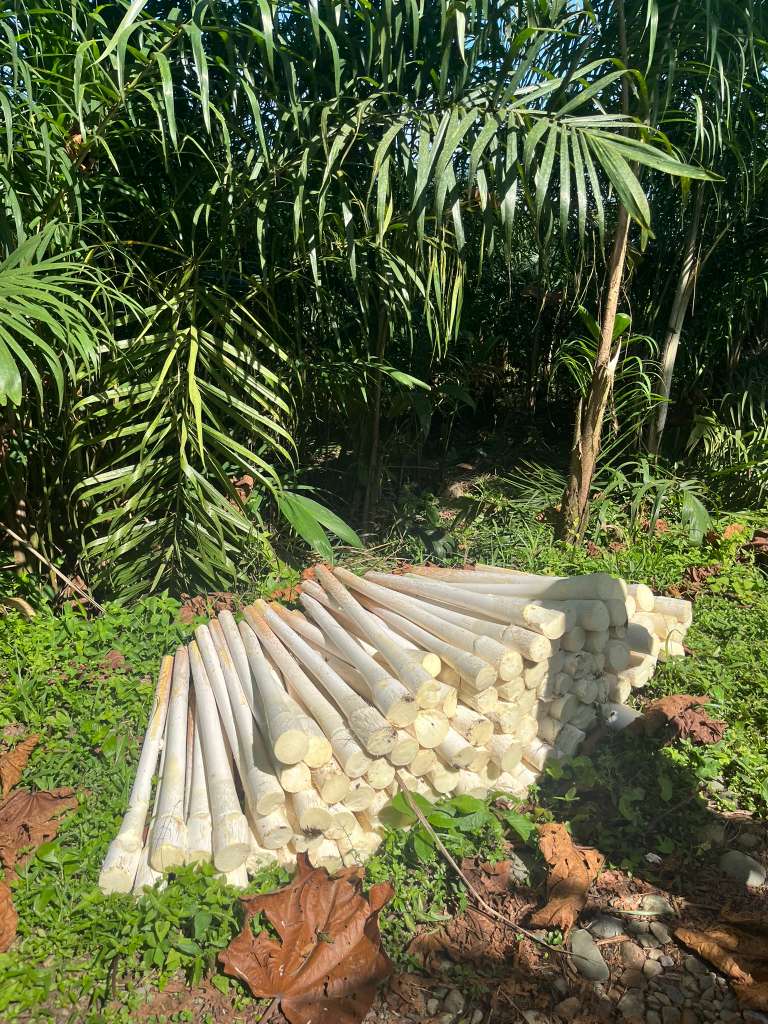
Subsequently, the SER has become an initiative of young landowners in Mashpi, who established a two-kilometer trail for the use of reserve visitors. The trail runs through five farms (Pambiliño, Mashpi Shungo, Chontaloma, Viva Foresta, and Yakunina). Together, the farms cover 108 hectares within Mashpi, 84 percent of which are dedicated to reforestation. The remainder are used for agricultural production and lodging. SER’s members engage intentionally in agroecology, sustainable tourism, or nature-based education as an alternative to monocultures, mining, and cattle raising—invasive economic practices that harm the ecosystem. Among the new agricultural practices they implement on their farms are analog forestry with shade crops, riparian forest restoration, native species recovery, diversification of forest product uses, sustainable water management, and enrichment of production systems. The reforested trail has become a space that welcomes domestic and international students to learn about restoration and habitat conservation in the Chocó Andino.
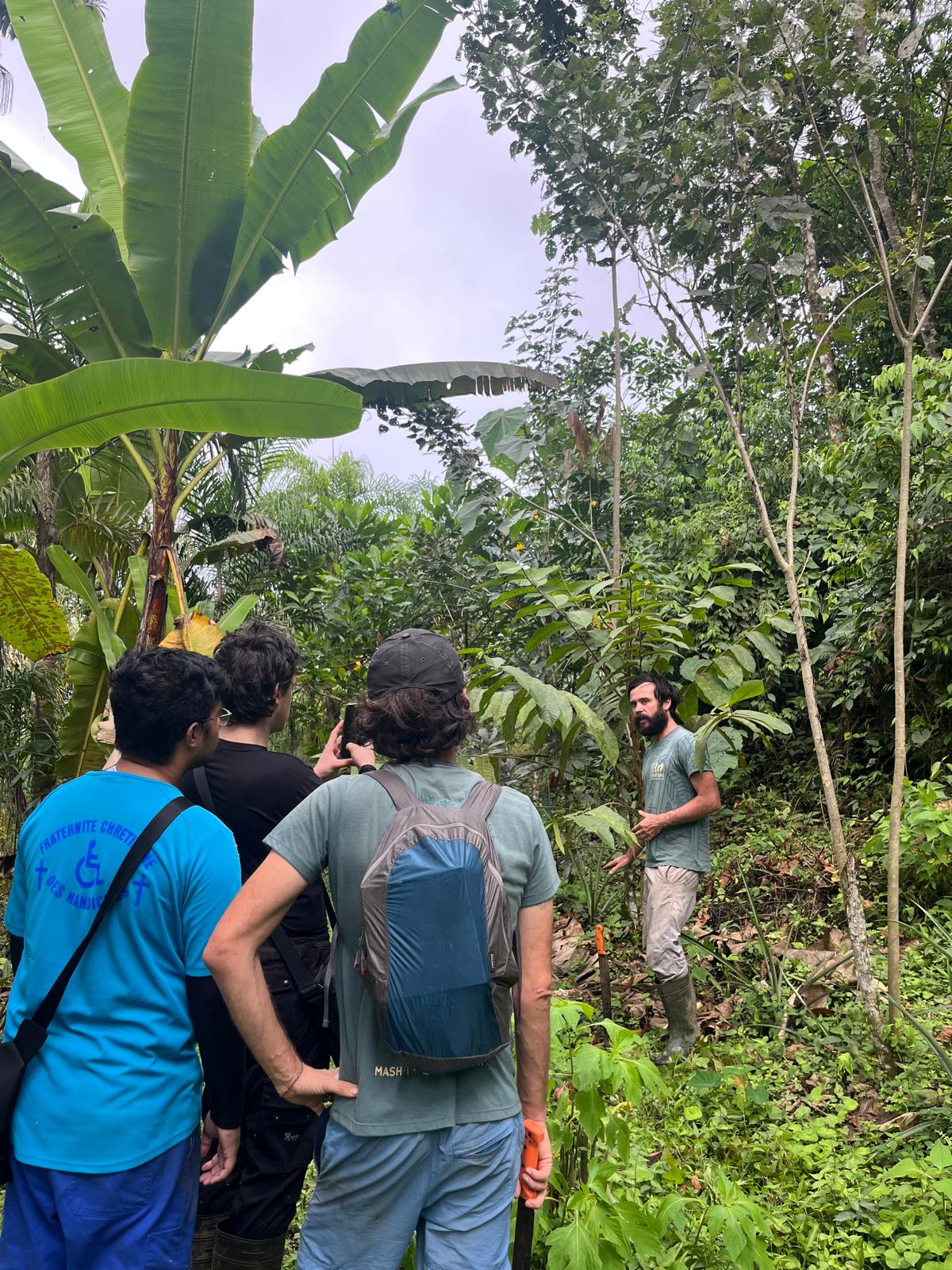
According to Arturo, owner of Chontaloma farm and SER member, the collective’s long-term vision is to “recover and strengthen the ecosystem services of this little piece of land we are taking care of, so that threatened or locally extinct flora and fauna can thrive again.” An example of SER’s successful restoration efforts is the increased sighting of Cebus aequatorialis (Ecuadorian capuchin), a species of monkey that is critically endangered due to deforestation. In our interview, Arturo also emphasized that SER’s agroecological production continues to expand, ensuring an eco-friendly, steady food supply while promoting healthier and fairer products than those on the market, thereby making the collective’s conservation efforts financially sustainable.
Challenges to Conservation Efforts
SER’s farms are established as “private reserves,” affiliated with the National Corporation of Forests and Private Reserves of Ecuador. During my time in Mashpi, I quickly realized that conservation efforts were not easily adopted by everyone in the community, despite their success in implementing ecological practices and financially sustaining their farms. A central tension is the Ecuadorian state’s limited involvement in the everyday governance of reserves.
The state’s minimal role echoes trends observed across Latin America,1 where neoliberal reforms since the 1990s have relegated environmental governance to nonstate actors. In this context, private reserves act as both protectors and regulators, blending ecological stewardship with property rights. This delegation of conservation responsibilities creates contradictions: on the one hand, reserves halt deforestation and preserve habitats; on the other, they reproduce exclusionary land tenure logics. For example, people with insufficient capital depend on foreign investment that comes with a series of eligibility requirements, such as a minimum income. Access to state resources requires legal title to the land. This dual role positions members of SER as both allies and antagonists in community struggles for ecological justice. These insights underscore that conservation is always a political project that reorganizes territory and belonging. In this sense, the “commons”2 becomes a contested field whose management involves advancing sustainability while simultaneously negotiating the fractures generated by conservation.
In an interview, Oliver explained that without resources, roads, or effective public policies, nature conservation remains, in practice, an inaccessible privilege for many:
The state does very little to strengthen sustainable land management. Conservation is a right, but there are no mechanisms to support those rights. It’s terrible! . . . There are invasions; there are no park rangers for every square kilometer or anything like the law establishes. So, imagine: How can the state expect one person to protect an area the size of the Mashpi micro-basin? It’s absurd!
Oliver believes that in the absence of concrete state action, caring for the territory from within the territory becomes essential.
This care, however, is costly, and must always be negotiated among community members who envision different ways to manage the common natural resources. Economic disparities, historical land dispossession, and unequal power relations shape these different visions of ecological management. Although SER has implemented programs that reduce dependency on extractive industries, these alternatives are often only accessible to people with economic and social capital. In Mashpi’s parish, 83 percent of the population do not have their basic needs met.3 For instance, electricity is scarce, especially during times of drought, and the nearest health center and high school are at least an hour away.
Hence, mining, monoculture, and cattle ranching have continued to be major sources of income for families within Mashpi and the wider reserve. Yet, since environmental efforts have attempted to better implement ecological regulation and oppose mining activities in the area, these leaders, including Oliver and other members of Quito Sin Minería, have become targets of threats and legal complaints.
The Perils of Anti-Mining Activism
In an interview for Youtopía Ecuador, Yuli Tenorio, an attorney for the Frente Anti-Minero por la Vida, el Agua y la Naturaleza, highlights legal proceedings initiated against leaders in Pacto (a neighboring Mashpi town) involving charges ranging from the “disruption of public services, trespassing on private property, and intimidation, to sabotage and property damage.”4 In the same interview, Delia López, leader of the Frente Anti-Minero, states: “there are 35 of us who have been criminalized. We have been persecuted for being leaders. If we walk along the roads, vehicles [belonging to mining companies] drive right up alongside us; they intimidate us and make us feel unsafe.”
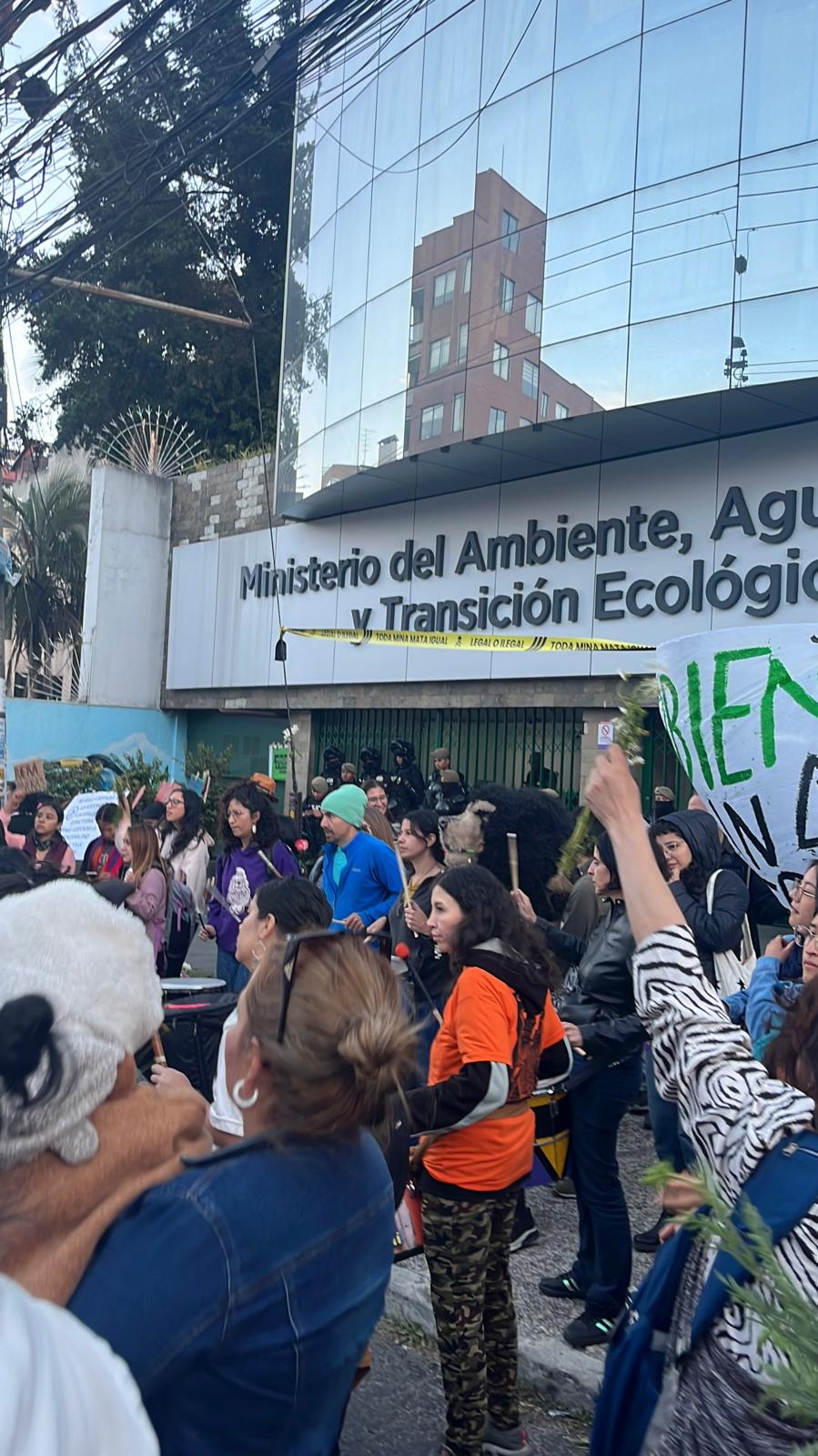
These statements echo accounts from environmental leaders I interviewed in Mashpi and the wider Chocó Andino. Both human rights and environmental defenders have been accused of criminal activity and subjected to persecution by the state in different forms. According to a Human Rights Watch report,5 since September 19, 2025, the National Financial and Economic Analysis Unit (UAFE)—a government body in charge of preventing financial crimes—has ordered the freezing of bank accounts of various Indigenous and environmental leaders and organizations. These decisions were made while the groups were protesting the government’s decision to eliminate diesel subsidies, to close the Ministry of Environment, Water and Ecological Transition, and to greenlight mining projects in protected areas in the country like Esmeraldas and Azuay.
The new “Transparency Social Law,” approved in August of 2025, allows the UAFE to freeze accounts without a court order when it identifies “objective, serious, and verifiable indications” of suspicious operations.6
The freezing of bank accounts paralyzed the work of several nongovernmental organizations, halting educational and environmental protection programs.7 Civil society organizations voiced their opposition to these measures in protests against the government of Ecuadorian President Daniel Noboa on several occasions. A pivotal opposition moment occurred during the campaign against the proposed Constitutional Referendum and Popular Consultation in November 2025.8 Fearing that Noboa would revoke established constitutional rights to nature and rights to prior consultation, organizations took to the streets for several days preceding the voting period.
In an interview, E., a member of Quito Sin Minería, reflected on the effect of government’s persecution against the collective:
So, those are their tactics, you know? Those games they play . . . freezing bank accounts, those methods of intimidation. . . . [O]ne way or another, they really do take a toll on activism; they really do affect the people who are out in the streets day in and day out. Because, beyond the fact that the riot police are already physically beating the living hell out of you, you also have to shoulder the burden of all this other stuff—stuff you’re becoming increasingly aware of the deeper you get involved. A lot of people start losing hope; and once you lose that hope, you start seeing the bleakness of it all—you fall into despair, you get hit with anxiety, you break down crying. You feel utterly powerless—like there’s absolutely nothing you can actually do to change things.
Despite the intimidation and fear felt by defenders of the Chocó Andino, others in the collective see this difficult moment as a reason to believe even more strongly in the importance of their shared work. One of the oldest members, V., reflects:
The only thing that manages to sustain you, in some way, is the group—the sheer act of just keeping on doing the work. . . . Sometimes, you simply can’t stop—you just have to keep pushing ahead. And you tell yourself, “Alright, we’re going to keep moving forward”—but we’ll do it in the best way we possibly can.
As I reflect on my time doing fieldwork in the Chocó Andino, I watch from afar how environmental activists and community members within the reserve keep pushing against government measures to expand mining. Two months after our interviews, in February 2026, Ecuador’s National Assembly approved the Organic Law for the Strengthening of the Strategic Mining and Energy Sectors,9 which promotes mining and energy infrastructure expansion. This legislation has drawn criticism for relaxing environmental controls and accelerating the issuance of licenses in protected regions.
E. spoke to me about the news over the phone, saying: “Here we are once again facing the emergency measures the government imposes to accelerate mining extractivism. It seems never-ending. But that is exactly how it goes—and that is exactly how we grow stronger.”
As the struggle for environmental protection continues, I have realized that, in the Chocó Andino and other national natural reserves, conservation is not merely an environmental practice but a field of political contestation where the relationships among the state, territory, and community are being reconfigured. ✹
Originally from Riobamba, Ecuador, Salomé Valdivieso earned her master’s in Latin American Studies from UT Austin in May 2026. She will begin a PhD program in anthropology at UT in the fall. She was a top 15 finalist for the Premio Nuevas Plumas USA (2025) and won first place in the Enrique Fierro Creative Writing Contest (2026). Her writing, published in Revista Anfibia and academic journals, bridges research and narrative to explore territory, everyday politics, and political imagination.
Notes
1. Charles R. Hale, “Resistencia Para Que? Territory, Autonomy and Neoliberal Entanglements in the ‘Empty Spaces’ of Central America,” Economy and Society 40, no. 2 (2011): 184–210.
2. Scholars like Linebaugh and Fournier have also adopted the term “commoning” to emphasize that the commons should be viewed not as a fixed object or resource, but as an active and ongoing process, highlighting the practices and social relations involved in managing shared resources. See Peter Linebaugh, The Magna Carta Manifesto: Liberties and Commons for All (University of California Press, 2009), and Valérie Fournier, “Commoning: On the Social Organisation of the Commons,” M@n@gement 16, 4 (2013): 433–453. management-aims.com/index.php/mgmt/article/view/4020.
3. Xavier Basantes, “La falta de servicios básicos también afecta al Chocó Andino,” Youtopía Ecuador, Aug. 16, 2024.
4. Youtopía Ecuador, “Ecologistas exigen frenar la minería en el Chocó Andino,” August 20, 2024.
5. Human Rights Watch, “Ecuador: El gobierno congela cuentas bancarias de organizaciones,” December 9, 2025.
6. Presidencia de la República del Ecuador, Ley Orgánica de Transparencia Social. Tercer Suplemento No. 112, Registro Oficial, Quito, Ecuador, 2025.
7. “Gobierno ecuatoriano congela las cuentas bancarias de Fundación Alianza Ceibo,” Amazon Frontlines, October 14, 2025.
8. “Ecuador: Organizaciones rechazan controvertida Consulta Popular y referéndum, y denuncian la represión,” Via Campesina Español, November 20, 2025.
9. Asamblea Nacional del Ecuador, “Asamblea aprueba Ley Orgánica para el Fortalecimiento de los Sectores Estratégicos de Minería y Energía.” Accessed April 27, 2026.