
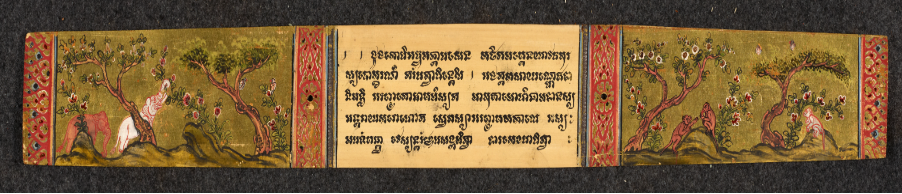
by Harsha Gautam
While early Buddhist texts have survived in several languages and scripts, Pali is the language of the most complete collection of early Buddhist texts, known as the Tipitaka (‘three baskets’). With the reputation of the “word of the Buddha,” the Pali canonical texts have been preserved by the Theravada Buddhist tradition for over two millennia. My doctoral research focuses on early Buddhism with emphasis on the Pali canonical literature and early Buddhist art. My dissertation, entitled, Buddhist Others and Other Buddhists: Religious Identity-formation and Agency in early India, covers the period between c. 500 BCE – c. 300 CE in South Asia and examines religious actors other than the Buddha and the monks. My project studies subject-formation and the processes of “othering” within the early Buddhist monastic order and when it engages with society at large. The extent of this “othering” is measured by the agency each subject can assert vis-à-vis the apex authority or hegemony. Building on textual, visual and epigraphic sources, my dissertation explores the power dynamics between the different subjects, locates the agency of those who are or seem to be either subordinate or peripheral to the authority and/or the hegemony, and notes instances of subversion of that authority. By investigating the religious narratives in the Pali Vinaya – monastic law codes (with a few comparisons with other Vinayas) and sections of the Sutta Piṭaka, as well as in the early Buddhist art, I examine six subjects in three pairs in the three chapters of my dissertation: Buddhist nuns and students (novice monks and nuns); brahmins and lower-castes; and serpent-king deities and the wheel-turning monarchs.
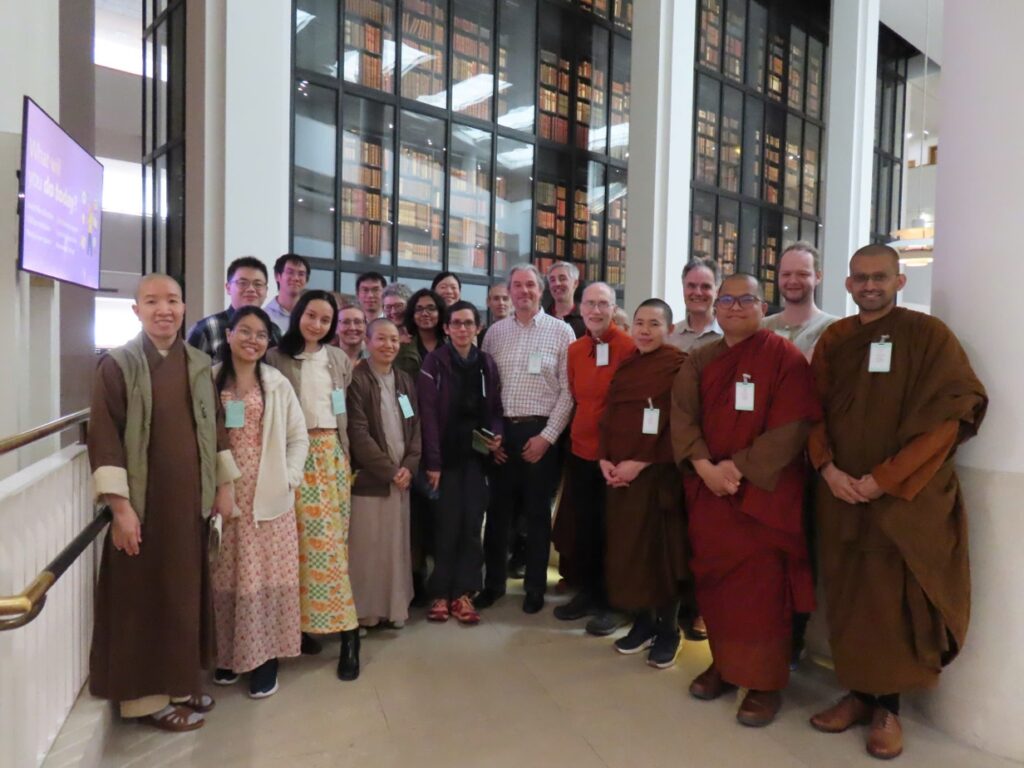
Established in 1881 in the United Kingdom, the Pali Text Society (PTS) has played a pivotal role in the examination, compilation, and publication of editions, translations, and scholarly works on Pali literature. Since its founding, the Society has made substantial contributions to the advancement of the study of early Buddhism. In the summer of 2025, the Society organized the Pāḷi and Aṭṭhakathā: Advanced summer school in reading canonical Pali texts with their commentaries. The intensive course was led by the Profs. Rupert Gethin, Petra Kieffer-Pülz, and Martin Straube, the society’s current President, Honorary Secretary, and Research Fellow, respectively, at the University of Bristol in the United Kingdom. Following the success of the previous summer school, which attracted 25 participants from diverse backgrounds—including male and female monastics, lay disciples, and both senior and junior scholars of Buddhism—the PTS expanded its initiative by focusing on manuscripts for the 2026 summer school, hosted by the British Library. For this intensive manuscript workshop, only 20 scholars from around the world were selected. These included scholars from Cornell, Universität Leipzig, Oxford University, The Courtauld Institute of Art, among others, as well as monastics from Sri Lanka, Thailand, Myanmar and India.
While all manuscripts are in Pali, they are written in various South and Southeast Asian scripts, primarily Burmese, Thai (Tham, Khom, and Khmer), and Sinhalese. The British Library currently holds hundreds of Pali manuscripts from Myanmar, Thailand and Sri Lanka. While many commentaries on the canonical and post-canonical texts remain untranslated, a comparative analysis of the manuscripts, even on the canonical literature, has often yielded interesting insights and revealed oversights during the initial compilation. I had the valuable opportunity to attend both of these summer schools.
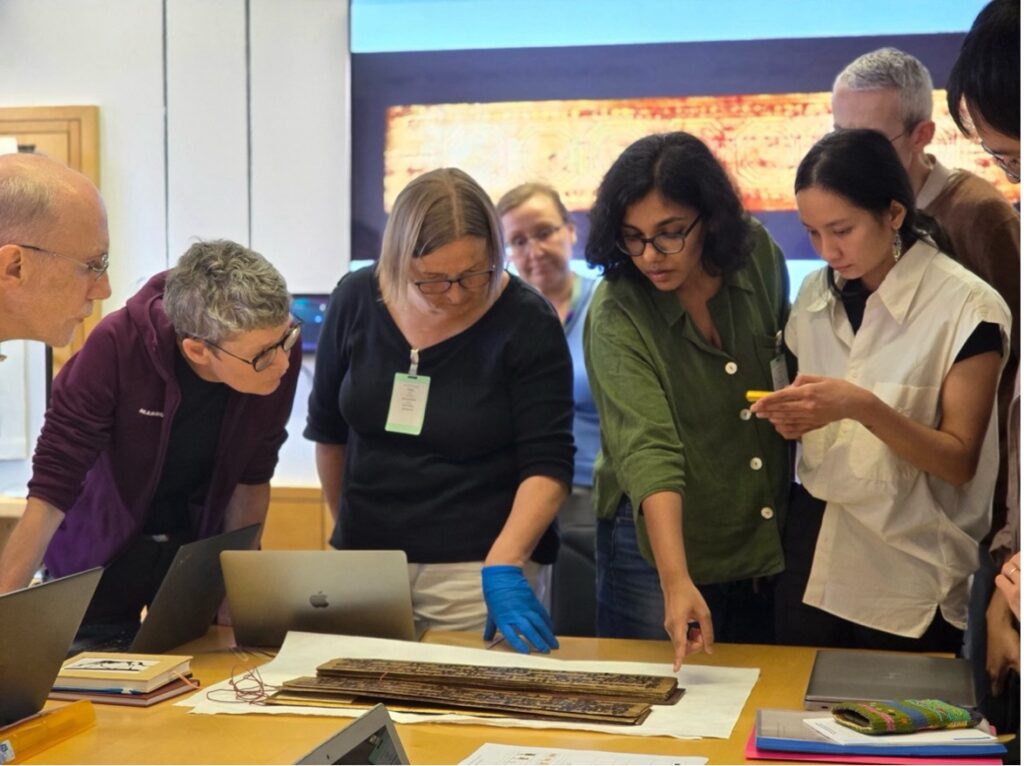
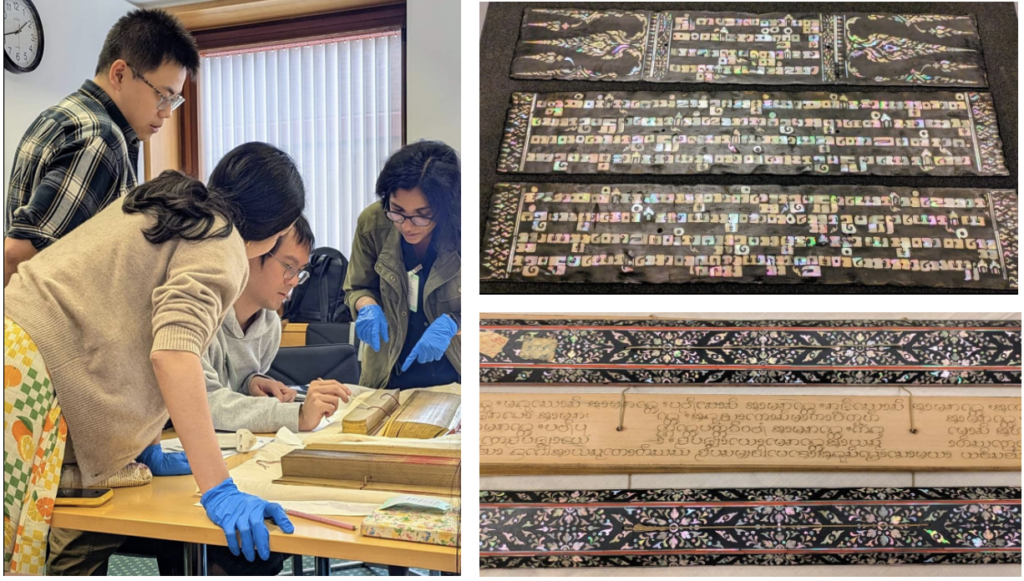
The 2026 workshop provided me with direct experience working with manuscripts on monastic law codes. During the initial two days, I had the valuable opportunity to study highly ornate Burmese Kammāvācā manuscripts alongside the distinguished Vinaya scholar Dr Kieffer-Pülz. These texts outline the procedures mandated by Buddhist law for conducting monastic ceremonies, such as ordinations and robe presentations. Both topics are examined in detail in the first chapter of my dissertation, “Buddhist Others”: Agency of the Nuns and the Students in the saṅgha.We examined the legal acts related to ordination in three different scripts. Two manuscripts originated from Northern Thailand and were written in the Lanna Tham script, while the third was a Burmese manuscript in the Tamarind Seed script, a decorative, square form of the standard Burmese script.
The workshop over the next few days focused on the texts containing the previous life-stories of the Buddha, under the supervision of Dr. Straube. He used three different manuscripts in the Khom-Thai, Khmer and Burmese scripts to examine a section of the Vessantara-jātaka with the participants. On the final day, the President of the PTS and a leading scholar on Buddhist thought and philosophy, Prof. Gethin, read the Saccasaṅkhepa-vaṇṇanā with the group. The text is a prominent Pāli sub-commentary which expands the concise five-chapter compendium of Abhidhamma (texts that deal with Buddhist philosophy and psychology).
While I was only familiar with the Burmese script prior to the summer school, the workshop gave me the opportunity to read and engage with other scripts, especially the Khmer script, for which I led a few sessions on both reading and translation on days 2 and 3. In the process, I learnt to identify idiosyncrasies in different manuscripts. This has broadened my horizons in dealing with other manuscripts for my future research on the ordination of monastics.
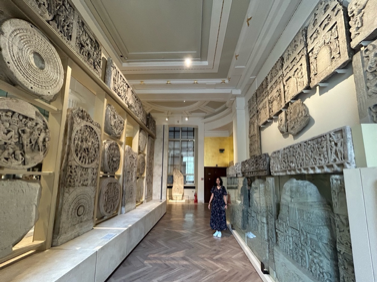
In the week after the manuscript workshop, I spent time re-analyzing the Amaravati collection at the British Museum. This collection is an important source material for my third chapter, “Other Buddhists”: Agency of the Nāgarājas and Cakkavattis, which investigates serpent-king deities and wheel-turning monarchs, respectively, within the Buddhist cosmology. Both of these subjects feature heavily in the visual narratives depicted on the “Great Amaravati Stupa,” which was first discovered and excavated by British colonial officials and surveyors in 1797, who subsequently transferred a large collection of the reliefs to the British Museum.
As a final-year PhD student, the field grant enabled me to re-examine critical aspects of my research by consulting manuscripts under the guidance of leading scholars and experts. Returning to the British Museum to study artefacts from Amaravati, following my semester-long fieldwork in Amaravati and neighboring sites, allowed me to address oversights in my initial research at the Museum, which had been conducted before I had visited the sites in India.
Harsha Gautam is a 2025-26 Dissertation Fellow of the ACLS/Robert H.N. Ho Family Foundation Program in Buddhist Studies and a PhD Candidate in the Religions in History track in the Department of Religious Studies at UT Austin.