Within the span of two weeks, audience members attending UTNT (UT New Theatre) can experience five different worlds; five different groups of characters with goals and challenges; five unique locations, from far-away lands to a secluded abbey to a raucous senate floor. These five stories explore the human condition, relationships and community. We spoke with each of the playwrights to dig deeper into the themes and storylines of each play, on stage February 26-March 8, 2026.
A Tale for Home by Chih-Ching Chester Tsai
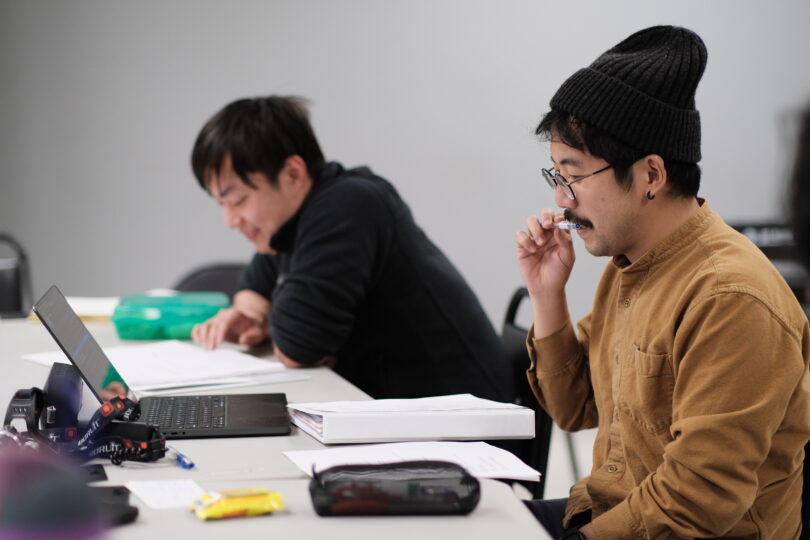
Chih-Ching Chester Tsai: [A Tell for Home] is an exploration of the idea of home, absence and belonging. It is set on this island that is far away from America. It follows two girls, Lynn and May, who [are] digging under a mulberry tree, in search for stories, history and memories.
The play started with a very simple question, “Where are you from?” Which I was asked a lot since I got here to America. So whenever I said, “I’m from Taiwan,” my brain would immediately go like, oh, what does that mean to people? And what does that mean to me personally?
You know, when, when you arrive in a new country, you would just have this feeling like, “Oh, I can reinvent myself totally, actually.” But can you reinvent where you are from? That is why I wanted to write this play, to explore these ideas from different perspectives.
The question that the play is asking is: how do we construct the idea of home? That is a huge part of our evolving identity. Nowadays it’s kind of common for us to leave home, to travel, to relocate or even migrate. So what does home mean to those who leave? And this play also wants to shift the focus to: what does home mean to those who return, and what does it mean to those who stay?
Ordinary Time by Kaia L
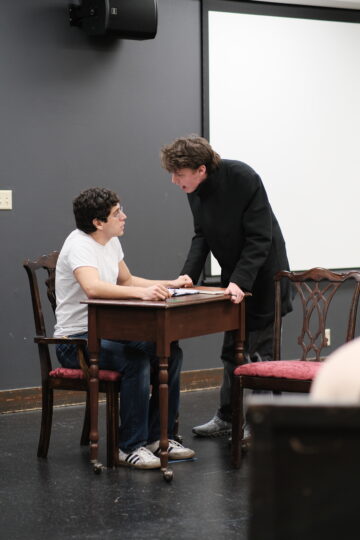
Kaia L: [Ordinary Time] is about a small community of Catholic monks in England. And the play follows them as they go throughout their day, and they wake up to find that one of their brothers has disappeared. They spend the play trying to figure out what has happened to him and how they should respond to it.
This play explores themes of community, collective versus individual responsibility, justice and forgiveness.
A few years ago, I stayed with some Catholic monks in England. I lived where they lived, and I ate the food they ate, and I attended the services they sang. I loved it there, and I really admired the brothers there. And so this play came from that.
Vulturine by Matt Thekkethala
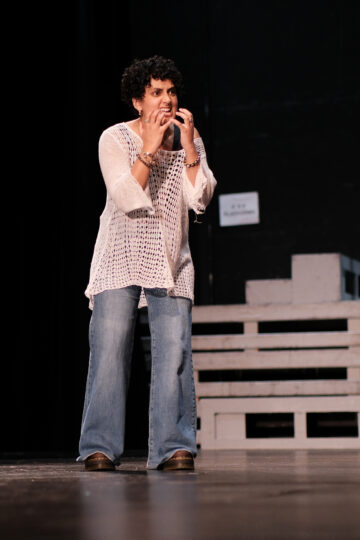
Matt Thekkethala: Vulturine is about an aging father and his son who travel to a far away land, where the father plans to receive a sky burial, which is a real ancient ritual from Zoroastrianism where vultures eat your dead body.
I was inspired to write this play because I recently discovered that in South Asia, where I trace my heritage, the population of vultures collapsed by 99.5% in the past 40 years. And you know, we live in a world where we’re bombarded with disturbing facts and figures like this every day… I wrote this play because I wanted to take a moment to grieve and bear witness to the critical endangerment of vultures at our hands and the possible end of this spiritual symbiosis that we shared with these creatures.
Vulturine explores death in many of its forms: dying loved ones, dying relationships, dying ecosystems and dying ways of life. But it navigates these themes through absurdity and humor.
Diet of Worms by Nick Hart
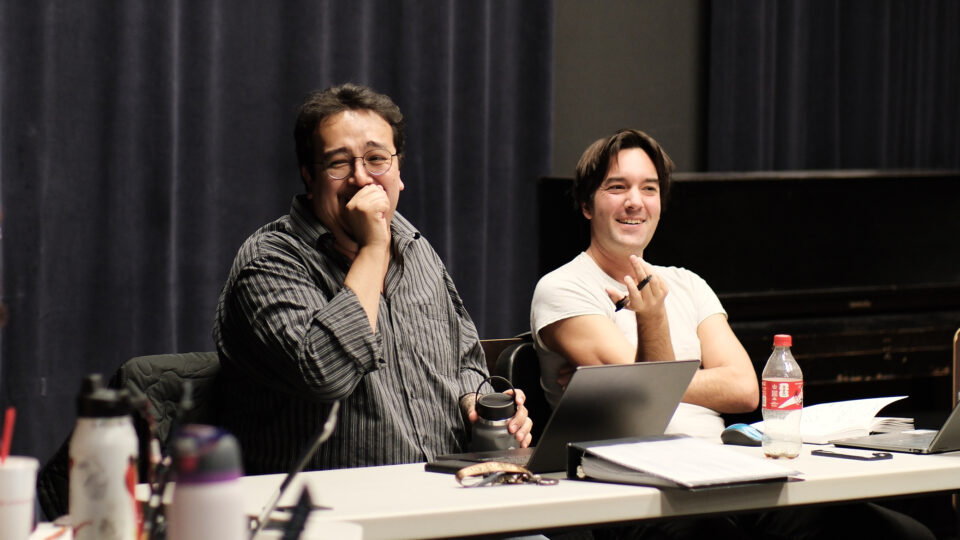
Nick Hart: [Diet of Worms] is about a group of United States senators, and they are meeting at midnight to attempt to reconcile a budget.
What inspired me to write this play is I actually was interested in trying to write a play for as many human beings that could be on stage as possible; there was an attempt to write a play for 50 characters. [Also,] I think for my whole life [I have] watched United States Senators perform a sort of theatre for cameras and for their party or an opposite party. And I saw theatre in that, some of it great, some of it terrible. And I wanted to write a play with that in mind.
I think [Diet of Worms explores] themes of individuality or lack of [individuality] when working within a group and when attempting to find consensus. I think performativity or virtue signaling while in a group and what that means for the group or for individuality — I think those are things I’m exploring [in this play].
The Jans (reading) by Adithi Chandrashekar
Adithi Chandrashekar: In The Jans, five revolutionaries come together to save the lesbian identity.
The Jans was born from a discussion between Professor Lisa Moore and author Justin Torres, about Torres’ terrific book, Blackouts. The novel’s originating point of inspiration was a monograph called “Sex Variants: A Study of Homosexual Patterns,” which showcased interviews originally conducted by a lesbian researcher, author and activist named Jan Gay. During the talk, Torres shared that Jan Gay’s work was taken from her and misappropriated, and said “I don’t understand why no one has written about Jan Gay.” It was a bug in my ear and I started reading everything I could about Jan Gay. With a focus on shedding light on lesbian life and the many ways queer women lived in the world—married to men, single and alone, in cities, in the suburbs, in rural communities—Gay interviewed over 300 women in Western Europe and New York, and sought to publish a 70,000+ word monograph containing the interviews. However, her publisher told her she needed medical validation of the work to proceed. A partnership with the medical community was formed, but Gay eventually lost control over her work…and with it her mission to make plain the diversity of queer women’s lives.
Countless women have lost the rights to, or credit for, their work throughout history, and Jan Gay’s loss, in particular, devastated me. This play explores that devastation in its own way. The Jans examines that history through the eyes of a scrappy group of modern day counter-culture renegades who ask for the help of their audience to save lesbian identity…if they deem it worth saving.
The Jans explores identity politics, lesbian history, friendship and camaraderie and a community’s will to survive.
UTNT (UT New Theatre)
February 26-March 8, 2026
Oscar G. Brockett Theatre and Lab Theatre
TICKETS
Written by Sydney Pattillo