Access to Counsel: A Corollary to “The Production of Precarity” within the US Immigration System

By Elizabeth Schmelzel

Leah Rodriguez’s work, “The Production of Precarity: How US Immigration ‘Status’ Affects Work in Central Texas” offers a comprehensive breakdown of the relationship between immigration law and precarity for immigrants in the United States, drawing on cases from Central Texas to illustrate those dynamics. Rodriguez points out that “[t]o the extent that immigrants’ precarious work is tied to their US immigration status, which is so often dependent on the will of Congress, the Executive administration, regional immigration judges, asylum officers, and countless administrative, bureaucratic actors in between,… immigration law works to create precarity.” If we want to confront and ameliorate immigrants’ precarity, she argues, law reform is critical. Rodriguez points to several possibilities for change—eliminating the codification of “discretion” and “deserving” migrants in immigration law and lowering barriers to securing driver’s licenses, among others. Yet even if law and policy shifted, creating more opportunities for immigrants to secure status or maintain work permits, immigrants will need assistance in asserting their rights. That reality is why the provision of attorneys for low-income immigrants would radically confront precariousness.

As it stands, very few categories of people have the right to a free attorney in the United States. Under the Sixth Amendment, it is only a criminal defendant that has a constitutional right to be represented by an attorney during trial. People caught in the immigration system, however, are accused of violating civil, not criminal, law. Therefore, while they can hire an attorney on their own, either with their own money or by securing the help of legal non-profits, immigrants do not have the right to appointed counsel at the government’s expense. This is true no matter what the stakes of an immigration case might be, from completing a relatively straightforward DACA application, to adjudicating a protracted and complicated asylum claim which could determine whether someone is deported. What this means is that indigent asylum seekers, who may have fled torture, who do not speak English, and who are unfamiliar with immigration law, are forced to represent themselves. Egregiously, this includes children, who, under American asylum law, can be forced to represent themselves in proceedings to determine whether they will be deported.[1]

We know that access to legal counsel secures better outcomes for immigrants, and assuages the government’s concerns about immigrants absconding to avoid court hearings. Detained immigrants are more likely to be released on bond if they have an attorney, and immigrants of all kinds are more likely to be successful on the outcome of their substantive immigration case if they are represented.[2]  One recent study shows that a full 93% of non-detained immigrants showed up to court when they had legal representation.[3] By comparison, only 32% of non-detained immigrants representing themselves attended required court hearings.[4] Thus, when considering Rodriguez’s proposed solutions for ameliorating immigrant precarity, the importance of access to counsel should not be overlooked. The question, of course, is whether there is the political will (and fiscal space) to incorporate free legal representation into the American immigration system. Perhaps not now, given the shameful political rhetoric around immigration in 2018. But as Rodriguez points out, maybe there could be, provided that well-informed readers, armed with data and facts, continue engaging in the art of persuasion “in the United States Congress, in the workplace, or around the dinner table.”

[1] American Immigration Council, “Children in Immigration Court: Over 95 Per Cent Represented by an Attorney Appear in Court.” Available https://www.americanimmigrationcouncil.org/sites/default/files/research/children_in_immigration_court_0.pdf. Accessed 20 June 2018; Loreilei Larid, “Immigration Children Begin Appearing in Court Without Lawyers or Parents,” ABA Jounral. Available: http://www.abajournal.com/news/article/children_separated_from_parents_begin_appearing_in_court_without_lawyers_or. Accessed 29 June 2018.

[2] Ingrid V. Egaly and Stephen Schaefer, A National Study of Access to Counsel in Immigration Court. 164 U. Penn. L. Review. 1, 69-70; 57-59 (2015).

[3] Id. at 73.

[4] Id.
3 Reasons Why We Need Critical Feminist Theory More Than Ever in the Age of Big Data

by Inga Helgudóttir Ingulfsen

8 NOV 2017

This post is a follow-up to Helgudóttir Ingulfsen’s paper “#RefugeesNotWelcome: Making Gendered Sense of Transnational Asylum Politics on Twitter”, which was published in the Rapoport Center’s Working Paper Series in 2016 (available here). That paper was also the winner of the Audre Rapoport Prize for Scholarship on Gender and Human Rights (2016), and was responded to by Courtney McGinn and Reina Wehbi in the piece “Are Refugees Really Not Welcome?

In the age of Big Data­­—when Silicon Valley “tech bros” are busy convincing us of the merits of machine learning, and the US president pretends to govern while flirting with his white supremacists followers on Twitter—I make the case for why we need critical feminist scholarship now more than ever.

  1. Gender is at the Core of Xenophobic and Nationalistic Discourses

In December 2015, I was in my third semester of graduate school at New York University. Concerned about the rising tide of xenophobia (little did I know how much worse it would get), I wanted to look at online discourses about immigration and was interested in applying a feminist lens to the research. I typed #Refugees and #RefugeesNotWelcome in the search bar on Twitter and what I discovered was so dense with explicit sexist and misogynistic imagery and language that a few months later it amounted to a 120 page thesis.

My dataset revealed conversations littered with images of young white women covered in blood – supposed European victims of rape perpetrated by male immigrants from Muslim-majority countries. Twitter users from the US, Europe, and Japan alike portrayed the flow of refugees crossing the Mediterranean to Europe as a carefully calculated Muslim invasion of Europe, threatening to destroy Western civilization. The Twitter users employed powerful gendered language and imagery to construct a binary opposition between ‘Us’ – the White, Western, Enlightened community – and ‘Them’ – refugees, particularly Muslim refugees, construed as threats to the racial and cultural preservation and physical safety of the Western community.

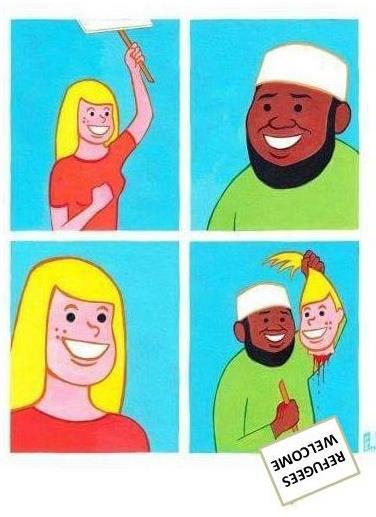
Ironically, Enlightenment ideas – civil and political rights, feminism, freedom of speech – were used to justify fundamentally illiberal immigration and integration policies. The appropriation of feminist ideas was a prevalent strategy among the Twitter users I studied. These strategies are fraught with contradictions. The Twitter users call for the protection of both Western and Muslim women against the supposed violent nature of Muslim men, while consistently attacking what they see as hypocritical liberal and multicultural feminists, framed as naïve traitors of the Enlightened White community. The below meme from my dataset is one example of this strategy, accompanied by the following tweet: “RT@……….: The perks of multiculturalism #refugeesnotwelcome”.

(Image 8: Dataset 2 tweet 120)

  1. Feminist Research as a Tool to Understand and Combat Xenophobia

The realization that gender is instrumentalized in nationalistic and xenophpobic narratives is not new. Feminist scholars like Cynthia Enloe and Nira Yuval-Davis have been arguing as much since the 1980s. However, feminist studies of gender and nationalism have tended to be primarily based on interpretation of elite discourses or political statements. The vast amount of data produced by the billions of social media users around the world represents a new opportunity to develop more rigorous and empirically driven feminist studies of xenophobia. Social media are not just accessible pools of data that can be sampled for quantitative studies of social interactions; they are just as interesting for the richness and detail of the data produced by their users. Images, memes, and videos are combined with text commentary, providing detailed insight into how an individual user constructs a narrative and the types of visual and rhetorical tools employed to support that narrative. Knowing whether hashtags like #RefugeesNotWelomce, #Rapefugees or #WhiteGenocide are trending is not as valuable as understanding how each user justifies a narrative that frames male Muslim refugees as violent or racially inferior. If we want to combat xenophobia we have to understand what makes xenophobic narratives powerful and why they resonate with particular groups of people. Rather than counting hashtag use and “likes,” we need to delve into the stories behind the hashtags. Feminist discourse analysis is a powerful tool to do just that because gender binaries are key organizing principles behind these stories.

  1. Feminist Scrutiny of Algorithms: Exposing Patriarchal Bias in the Big Data Universe

My study, published in 2016, highlights why we should be careful to mine Facebook and Twitter to study public sentiment: social media users differ from the general population in multiple ways, and the algorithms that structure information on social media are built to generate profit rather than organic conversations and interactions. Returning to the topic now, I see that my study failed to explore in detail a critical component of algorithmic bias – the ways in which gender and race biases are themselves integral to the structure of online information and interactions. Scientists have revealed how “machine learning algorithms are picking up deeply ingrained race and gender prejudices concealed within the patterns of language use.” The data that is used to train algorithms is after all generated by humans. One study found algorithms have adopted implicit biases commonly detected in psychology experiments: “[t]he words “female” and “woman” were more closely associated with arts and humanities occupations and with the home, while “male” and “man” were closer to math and engineering professions.” How might for example, Twitter’s algorithms have learned these types of implicit gender biases and how could those in turn be helping to make certain (gendered and racialized) content more prominent?

Phrases like artificial intelligence, Big Data, and machine learning give off a false aura of objectivity that can lead to fatal misrepresentations and uses of the data generated by social media users. I have witnessed first-hand how policy-makers can be seduced by Big Data’s false promise of objectivity. Participating in a meeting on Big Data and evaluation hosted by the Rockefeller Foundation and attended by UN evaluation officers and data scientists, algorithmic bias was not adequately addressed and Twitter was presented as a promising source of information on public sentiment. UN Global Pulse – the UN’s Big Data Initiative – was the main proponent, and several of their projects make use of social media data for perception studies. Presenting my findings to the data and research team at UN Women, I warned of the algorithmic biases in social media data and argued for extreme caution in using Twitter data to track public sentiment or perceptions on gender.

Feminist scholars would make ideal methodological foot soldiers in the battle to discount false narratives of Big Data objectivity, as feminist epistemology is inherently critical and skeptical of any tradition that lays claim to objective truth. We need more strong feminist voices like Soraya Chemaly to counter the corporate spin of Silicon Valley “tech bros.” We should ramp up investments in initiatives like the Women’s Media Center’s Speech project and the Algorithmic Justice League to begin to construct a more just and inclusive internet.

Inga H. Ingulfsen is a Research Analyst in Global Partnerships, at Foundation Center and graduated from NYU’s Center for Global Affairs in May 2016 with an MS in Global Affairs, specializing in gender, immigration and peacebuilding.

Oscar Night Winners Bring Human Rights Issues Center Stage

by Briana D. Perez

1 MAR 2017

On a night usually reserved for celebrating Hollywood elites, human rights violations around the world were featured front and center in several winner’s acceptance speeches. Especially in the categories that celebrated international achievement in filmmaking, winners did not hesitate to make strong statements in support of inclusion, tolerance, and peace.

Iranian filmmaker Asghar Farhadi won the Oscar for best foreign language film for “The Salesman.” Farhadi, however, was not in attendance to accept his award. In a statement, read by Iranian-American astronaut Anousheh Ansari, Farhadi denounced President Trump’s immigration executive order, saying, “My absence is out of respect for the people of my country and those of other six nations who have been disrespected by the inhumane law that bans entry of immigrants to the US.” The statement concluded, “Dividing the world into the ‘us’ and ‘our enemies’ categories creates fear.” Before the broadcast, the five directors nominated in the best foreign language film category released a joint statement, where they denounced “the climate of fanaticism and nationalism we see today in the US and some many other countries.”

In the best short documentary category, “White Helmets” took home the statue. The 40-minute short focuses on Syria’s civil war and a volunteer rescue group working in rebel-controlled areas of the country. When director Orlando von Einsiedel accepted the award, he called the audience to stand and applaud to show their support for the Syrian people and an end to the six-year long war. A cinematographer who worked on the film, Syrian Khaled Khatib, was barred from entering the U.S. and could not attend the awards ceremony.

These two big winners, however, were not the only ones to discuss politics from the stage. Italian-born Alessandro Bertolazzi dedicated his award for Best Makeup and Hairstyling to “all the immigrants.” Presenter Gael Garcia Bernal specifically addressed President Trump’s proposed border wall, saying, “As a Mexican, as a Latin American, as a migrant worker, as a human being, I am against any form of wall that wants to separate us.” In addition, several stars, including Lin-Manuel Miranda and Ruth Negga, wore blue ribbons to demonstrate support for the American Civil Liberties Union.

In a statement that encapsulated the overall mood of the evening, Academy President Cheryl Boone Isaacs pronounced, “Tonight is proof that art has no borders, art has no single language and art does not belong to a single faith.”

Briana D. Perez is a J.D. student at Texas Law, Rapoport Center Fellow, and a member of the 2016-2017 Working Paper Series Editorial Committee.