Child Labor Among Syrian Refugees: A Closer Look at the Coercive Effects of Lebanon’s Refugee Policies

By Aaron Burroughs

Child labor among Syrian refugees in Lebanon is exceedingly present and, unfortunately, ordinary. An estimated 180,000 children are working in Lebanon, 3 out of 4 of which are from Syria [1]. The conditions faced by children forced into child labor in Lebanon are harrowing, even by adult labor standards. In a survey conducted by the International Rescue Committee [2], over two thirds of Syrian children engaged in child labor are forced to work six days a week, over half of them work up to ten hours a day, and one in four work between 11 and 15 hours each day. These children, as young as six years old, typically work under dangerous conditions, with 60% of the children surveyed saying they have faced some form of violence in the course of their labor. Child labor that falls below certain minimum age requirements is a violation of fundamental human rights inscribed in the Convention on the Rights of the Child [3] and the International Labor Organization’s Minimum Age Convention [4]. At the domestic level, labor under the age of 16 that “harms the health, safety or morals of children” or prevents the child from pursuing an education is illegal in Lebanon [4], but the prohibition is largely unenforced [5]. While a formal prohibition on child labor is a crucial first step, to fully confront the issue, there must be a reckoning with the complex set of legal and social exclusions that create the conditions under which child labor among refugee populations occurs. To truly protect the rights of Syrian refugee children, Lebanon must ensure employment opportunities for Syrian refugees of working age and fair access to resources and services, easing the coercive economic conditions that necessitate child labor within refugee households.

The harsh reality is that many families in Lebanon, especially refugee families, are forced to rely on the income of their children to sustain even a minimally acceptable livelihood. In many cases, children are the main or sole source of income for households, due to restricted job opportunities and exclusionary legal statuses for adult refugees [6]. While child labor is harmful to a child’s development and a violation of human rights, it may be a family’s last lifeline.

It should go without saying that life for Syrian refugees in Lebanon is extraordinarily difficult. An estimated 1.5 million Syrian refugees reside in Lebanon, a country with a population of only 4.4 million people [6]. 76 percent of refugee households are living below the poverty line and 58 percent are living in extreme poverty [7]. Receiving a work permit outside the sectors of agriculture, cleaning, and construction is virtually impossible [15], leading 92% of economically active Syrian refugees to work in informal sectors where they are paid less than minimum wage and deprived of social protections [14]. The economic precarity of refugee livelihood in Lebanon produces and sustains an epidemic of refugee child labor.

The international human rights regime has worked to eradicate violations of the rights of children and refugees. Lebanon’s refugee policy, however, is vague and insufficient. The state is not a party to any international refugee conventions[9], leaving absent a national framework for refugee rights [10]. Domestic legislation regarding Syrian refugees does exist and is instituted on an ad hoc basis. However, the Lebanese government avoids the term ‘refugee’ as this entails binding legal actions, and, instead, refers to Syrian refugees as ‘displaced’ [14]. We should understand these actions as tactics by the Lebanese government to evade any obligation to provide refugees permanent residence or tailored services. Aside from the stress mass inflows of people into the country would place on the economy and the country’s resources, Lebanon’s fragile sectarian balance is threatened by foreigners, refugees or otherwise. The inflow of Palestinian refugees in Lebanon after the Arab-Israeli War in 1948, for example, is often cited as a prominent cause of the Lebanese Civil War (1975-1990) [16]. Overt anti-refugee sentiment is held by the government and many Lebanese citizens, making any issue regarding refugees both highly politicized and provocative. Lebanon’s vague policies act as a barrier to refugee integration and protection, working (unsuccessfully) to deter migrant flows and to avoid checks on the government’s treatment of refugees.

In May of 2015, Lebanon suspended the registration of Syrian refugees by the United Nations High Commissioner for Refugees (UNHCR), effectively abolishing the right to asylum as a legitimate reason for entry. The UNHCR registered about one million refugees since the start of the Syrian Civil War, but an estimated 500,000 more Syrians were not able to register [11]. Subsequently, the government established a sponsorship system for unregistered individuals to obtain legal residency status. The sponsor may be a friend or family member, but oftentimes, sponsors exploit the dire circumstances of Syrian refugees, selling sponsorships at a steep price or sponsoring them for employment purposes, creating highly coercive sponsor-refugee relations akin to indentured servitude. The phenomenon of Syrian refugees facing mistreatment and abuse from their employers who extort their labor with threats to cancel their sponsorship is well documented [12]. Additionally, many refugees cannot afford the $200 residency fee also imposed on them by the government, however, and continue to reside in the country illegally [12]. Evidently, the Lebanese government has prioritized erecting obstacles for Syrian refugees to maintain their livelihood over abiding by international law.

Hundreds of thousands of Syrian refugees in Lebanon without legal status remain vulnerable to deportation [13], which is why many adult Syrian refugees have resorted to sending their children to work and limiting their own movement and visibility [12]. Employers prefer to hire Syrian children because they are forced to accept far less pay than an adult and will complete more strenuous labor than any “Lebanese boy who wants to do this work” [5]. While unauthorized work by a refugee adult can result in deportation due to heavy policing and constraints enforced upon them [8], refugee children engaged in labor are much less likely to attract retaliatory penalties from the state.

It bears mentioning that the contribution of refugee child labor serves to benefits Lebanon’s economy, and consequently the government has no true incentive to stop it. Refugee child labor avoids the political uproar of refugees competing for jobs with citizens. It helps local Lebanese businesses, both formal and informal, function at a low cost. At the same time, refugee families are able to scrape by instead of being forced to resort to petty crime or violence to sustain themselves. The rights of the children, of course, are subordinate to these concerns, and the best interests of the child fall by the wayside. For Lebanon to genuinely eradicate refugee child labor, it would have to stop treating adult Syrian refugees as a security concern and, instead, as human beings with rights, skills, and dignity, as well as recognize their productive potential to bolster the Lebanese economy. It must create opportunities for adult refugees to participate lawfully and equally as legitimate participants in the labor force. The formalization of the economy and refugee integration of the workforce have the potential to stabilize host economies and improve conditions for all workers [14]. Additionally, the government should offer financial support and services to families whose primary wage earner is unable to work due to injury or illness. Alternative development strategies must also be implemented. The creation of special economic zones that grant work permits to refugees can foster refugee business and sustainable livelihoods, although they must be highly regulated to avoid labor exploitation and must be carefully framed so as not to legitimate and foment nationalistic and anti-refugee sentiment. Greater financial support from the international community is crucial to providing these opportunities through grants and loans and investment, as well as greater resettlement of refugees by countries like the United States. Once employment opportunities are made for refugees to earn a living wage, only then can children graduate from working in the streets to working in the classroom.

Bibliography

  1. UNHCR, Child Labor in Lebanon, unhcr.org, accessed November 6, 2018, https://data2.unhcr.org/en/documents/download/.
  2. International Rescue Committee Europe, “New survey reveals extent of hardship and abuse experienced by Syrian children working on streets of Lebanon,” rescue-uk.org, accessed June 20, 2018, https://www.rescue-uk.org/press-release/new-survey-reveals-extent-hardship-and-abuse-experienced-syrian-children-working#Fullsurvey.
  3. UNICEF, “FACT SHEET: A summary of the rights under the Convention on the Rights of the Child, unicef.org, accessed Jun21, 2018, https://www.unicef.org/crc/files/Rights_overview.pdf.
  4. Republic of Lebanon Ministry of Labor, “Guide of Decree 8987 on Worst Forms of Child Labour,” ilo.org, accessed November 3, 2018, https://www.ilo.org/wcmsp5/groups/public/—arabstates/—ro-beirut/documents/publication/wcms_443273.pdf.
  5. Lisa Khoury, “Special report: 180,000 young Syrian refugees are being forced into child labor in Lebanon,” vox.com, accessed June 20, 2018, https://www.vox.com/world/2017/7/24/15991466/syria-refugees-child-labor-lebanon.
  6. Human Rights Watch, “Growing Up Without an Education,” hrw.org, accessed June 25, 2018, https://www.hrw.org/report/2016/07/19/growing-without-education/barriers-education-syrian-refugee-children-lebanon.
  7. UNHCR, “Survey finds Syrian refugees in Lebanon became poorer, more vulnerable in 2017, unhcr.org, accessed June 24, 2018, http://www.unhcr.org/en-us/news/briefing/2018/1/5a548d174/survey-finds-syrian-refugees-lebanon-poorer-vulnerable-2017.html.
  8. Sima Ghaddar, “Lebanon Treats Refugees as a Security Problem – and It Doesn’t Work,” tcf.org, April 4, 2017, accessed August 15, 2018, https://tcf.org/content/commentary/lebanon-treats-refugees-security-problem-doesnt-work/?session=1. .
  9. Library of Congress, “Refugee Law and Policy: Lebanon,” loc.gov, accessed June    21, 2018, https://www.loc.gov/law/help/refugee-law/lebanon.php
  10. United Nations General Assembly, Convention Relating to the Status of Refugees, (G.A. Res. 429 (V), 1951).
  11. Human Rights Watch, “Lebanon: New Refugee Policy a Step Forward,” hrw.org, February 14, 2017, accessed June 27, 2018, https://www.hrw.org/news/2017/02/14/lebanon-new-refugee-policy-step-forward
  12. Human Rights Watch, “Lebanon: Residency Rules Put Syrians at Risk,” hrw.org, January 12, 2016, accessed June 27, 2018, https://www.hrw.org/news/2016/01/12/lebanon-residency-rules-put-syrians-risk
  13. Human Rights Watch, “Lebanon: Events of 2016,” hrw.org, accessed June 27, 2018,  https://www.hrw.org/world-report/2017/country-chapters/lebanon.
  14. Diana Essex-Lettieri et al., Refugee Work Rights Report: The Syrian Crisis and Refugee Access to Lawful Work in Greece, Jordan, Lebanon and Turkey. (Oakland: Asylum Access, 2017), http://asylumaccess.org/wp-content/uploads/2017/09/Middle-East-Refugee-Work-Rights-Syrian-Crisis.pdf.
  15. Rasha Faek, “Little Hope of Jobs for Syrians in Lebanon and Jordan,” al-fanarmedia.org, February 25, 2017, accessed August 15, 2018, https://www.al-fanarmedia.org/2017/02/lebanon-jordan-syrians-face-bleak-employment-future/.
  16. Maja Janmyr, “No Country of Asylum: ‘Legitimizing’ Lebanon’s Rejection of the 1951 Refugee Convention,” International Journal of Refugee Law 29, no. 3 (2017), https://academic.oup.com/ijrl/article/29/3/438/4345649

Aaron Burroughs served as an undergraduate intern with the Rapoport Center for Human Rights and Justice in Spring and Summer 2018. He now resides in Amman, Jordan.
3 Reasons Why We Need Critical Feminist Theory More Than Ever in the Age of Big Data

by Inga Helgudóttir Ingulfsen

8 NOV 2017

This post is a follow-up to Helgudóttir Ingulfsen’s paper “#RefugeesNotWelcome: Making Gendered Sense of Transnational Asylum Politics on Twitter”, which was published in the Rapoport Center’s Working Paper Series in 2016 (available here). That paper was also the winner of the Audre Rapoport Prize for Scholarship on Gender and Human Rights (2016), and was responded to by Courtney McGinn and Reina Wehbi in the piece “Are Refugees Really Not Welcome?

In the age of Big Data­­—when Silicon Valley “tech bros” are busy convincing us of the merits of machine learning, and the US president pretends to govern while flirting with his white supremacists followers on Twitter—I make the case for why we need critical feminist scholarship now more than ever.

  1. Gender is at the Core of Xenophobic and Nationalistic Discourses

In December 2015, I was in my third semester of graduate school at New York University. Concerned about the rising tide of xenophobia (little did I know how much worse it would get), I wanted to look at online discourses about immigration and was interested in applying a feminist lens to the research. I typed #Refugees and #RefugeesNotWelcome in the search bar on Twitter and what I discovered was so dense with explicit sexist and misogynistic imagery and language that a few months later it amounted to a 120 page thesis.

My dataset revealed conversations littered with images of young white women covered in blood – supposed European victims of rape perpetrated by male immigrants from Muslim-majority countries. Twitter users from the US, Europe, and Japan alike portrayed the flow of refugees crossing the Mediterranean to Europe as a carefully calculated Muslim invasion of Europe, threatening to destroy Western civilization. The Twitter users employed powerful gendered language and imagery to construct a binary opposition between ‘Us’ – the White, Western, Enlightened community – and ‘Them’ – refugees, particularly Muslim refugees, construed as threats to the racial and cultural preservation and physical safety of the Western community.

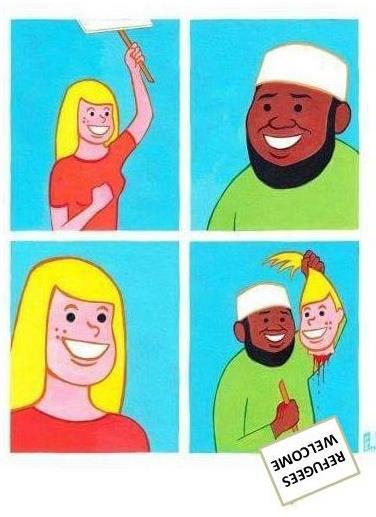
Ironically, Enlightenment ideas – civil and political rights, feminism, freedom of speech – were used to justify fundamentally illiberal immigration and integration policies. The appropriation of feminist ideas was a prevalent strategy among the Twitter users I studied. These strategies are fraught with contradictions. The Twitter users call for the protection of both Western and Muslim women against the supposed violent nature of Muslim men, while consistently attacking what they see as hypocritical liberal and multicultural feminists, framed as naïve traitors of the Enlightened White community. The below meme from my dataset is one example of this strategy, accompanied by the following tweet: “RT@……….: The perks of multiculturalism #refugeesnotwelcome”.

(Image 8: Dataset 2 tweet 120)

  1. Feminist Research as a Tool to Understand and Combat Xenophobia

The realization that gender is instrumentalized in nationalistic and xenophpobic narratives is not new. Feminist scholars like Cynthia Enloe and Nira Yuval-Davis have been arguing as much since the 1980s. However, feminist studies of gender and nationalism have tended to be primarily based on interpretation of elite discourses or political statements. The vast amount of data produced by the billions of social media users around the world represents a new opportunity to develop more rigorous and empirically driven feminist studies of xenophobia. Social media are not just accessible pools of data that can be sampled for quantitative studies of social interactions; they are just as interesting for the richness and detail of the data produced by their users. Images, memes, and videos are combined with text commentary, providing detailed insight into how an individual user constructs a narrative and the types of visual and rhetorical tools employed to support that narrative. Knowing whether hashtags like #RefugeesNotWelomce, #Rapefugees or #WhiteGenocide are trending is not as valuable as understanding how each user justifies a narrative that frames male Muslim refugees as violent or racially inferior. If we want to combat xenophobia we have to understand what makes xenophobic narratives powerful and why they resonate with particular groups of people. Rather than counting hashtag use and “likes,” we need to delve into the stories behind the hashtags. Feminist discourse analysis is a powerful tool to do just that because gender binaries are key organizing principles behind these stories.

  1. Feminist Scrutiny of Algorithms: Exposing Patriarchal Bias in the Big Data Universe

My study, published in 2016, highlights why we should be careful to mine Facebook and Twitter to study public sentiment: social media users differ from the general population in multiple ways, and the algorithms that structure information on social media are built to generate profit rather than organic conversations and interactions. Returning to the topic now, I see that my study failed to explore in detail a critical component of algorithmic bias – the ways in which gender and race biases are themselves integral to the structure of online information and interactions. Scientists have revealed how “machine learning algorithms are picking up deeply ingrained race and gender prejudices concealed within the patterns of language use.” The data that is used to train algorithms is after all generated by humans. One study found algorithms have adopted implicit biases commonly detected in psychology experiments: “[t]he words “female” and “woman” were more closely associated with arts and humanities occupations and with the home, while “male” and “man” were closer to math and engineering professions.” How might for example, Twitter’s algorithms have learned these types of implicit gender biases and how could those in turn be helping to make certain (gendered and racialized) content more prominent?

Phrases like artificial intelligence, Big Data, and machine learning give off a false aura of objectivity that can lead to fatal misrepresentations and uses of the data generated by social media users. I have witnessed first-hand how policy-makers can be seduced by Big Data’s false promise of objectivity. Participating in a meeting on Big Data and evaluation hosted by the Rockefeller Foundation and attended by UN evaluation officers and data scientists, algorithmic bias was not adequately addressed and Twitter was presented as a promising source of information on public sentiment. UN Global Pulse – the UN’s Big Data Initiative – was the main proponent, and several of their projects make use of social media data for perception studies. Presenting my findings to the data and research team at UN Women, I warned of the algorithmic biases in social media data and argued for extreme caution in using Twitter data to track public sentiment or perceptions on gender.

Feminist scholars would make ideal methodological foot soldiers in the battle to discount false narratives of Big Data objectivity, as feminist epistemology is inherently critical and skeptical of any tradition that lays claim to objective truth. We need more strong feminist voices like Soraya Chemaly to counter the corporate spin of Silicon Valley “tech bros.” We should ramp up investments in initiatives like the Women’s Media Center’s Speech project and the Algorithmic Justice League to begin to construct a more just and inclusive internet.

Inga H. Ingulfsen is a Research Analyst in Global Partnerships, at Foundation Center and graduated from NYU’s Center for Global Affairs in May 2016 with an MS in Global Affairs, specializing in gender, immigration and peacebuilding.

“Are Refugees Really Not Welcome?”

by Courtney McGinn and Reina Wehbi

2 MAR 2017

#RefugeesNotWelcome: Making Gendered Sense of Transnational Asylum Politics on Twitter by Inga Ingulfsen is the winning paper of the 2016 Audre Rapoport Prize for Scholarship on Gender and Human Rights, an interdisciplinary writing competition organized by the Rapoport Center for Human Rights and Justice. In 2017, Ingulfsen wrote a follow-up article to #RefugeesNotWelcome  addressing why critical feminist scholarship is now more important than ever.

In this piece, Ingulfsen creatively uses new methodologies to explore the “contentious landscape of asylum politics” by analyzing the gendered discourses used by Twitter users who tweet with the hashtag #refugeesnotwelcome. In doing so, Ingulfsen unveiled that Twitter users justify refugee exclusion by imaging themselves as a “White Western Enlightened community” in binary opposition to refugees, who are deemed threats to their community. This process of binary construction is inherently gendered due to the fact that refugees (specifically Muslim refugees) are often depicted as barbaric, violent men who frequently objectify, abuse, and oppress women.

In the beginning, Ingulfsen gives insights into the evolution of contemporary asylum politics through history, statistics and a comparison of attitudes of different western communities towards asylum and immigration. She also showcases the increasing challenges faced by both refugees and asylum regimes who are sometimes unable to accommodate the large influx of migrants.

Since Twitter today serves as a platform for the “global flow of real-time reactions and opinions” worldwide, Ingulfsen sheds the light on users’ different patterns of behavior. She describes the mainstream pattern as “unequal participation” because the majority of the content on Twitter is produced by a small group of opinion makers who shape the public discourse. The majority of Twitter users disseminate the material through “re-tweeting” what that small group of opinion leaders have to say. Throughout her argument, Ingulfsen reflects on the impact of such a course of online activity on the refugee crisis.

Ingulfsen then explores the gendered discursive strategies employed by Twitter users who ‘imagine’ refugees as ‘not welcome.’ Her research methodology focuses on analyzing English-language tweets with the hashtag #refugeesnotwelcome, guiding the reader into the steps of her analysis process. To explain her findings, Ingulfsen presents a set of tweets that perceive the Muslim migrants as culturally different, barbaric, and oppressive; thus justifying their exclusion. In the end, Ingulfsen stresses on the importance of deconstructing anti-immigrant rhetoric.

This piece comes at a very troublesome time for refugees and immigration in general. Recently, President Trump signed an executive order to keep refugees and immigrants from seven predominantly Muslim nations out of the United States for a specified period of time. Refugees and immigrants were banned from entering the country for 120 days. The countries affected are Iran, Iraq, Syria, Sudan, Libya, Yemen and Somalia. Even more daunting is the fact that the White House Chief of Staff, Reince Priebus, said more countries could be added to Trump’s order in the future.

Although green card holders and individuals with valid visas were supposed to be excluded from the ban, that was not what actually played out. As reported by CNN, some travelers who were in the air when Trump signed the order were not able to enter the country when they landed. Some were detained and others were sent back to the country of origin. The confusion of who was included or excluded from the travel ban came from the fact that career homeland security staff were only allowed to see the final details of the order on the day it was signed by Trump. In the following days, airports struggled to adjust to the new directive. [1]

Although presidents have broad power in shaping immigration policy, many deem this executive order as unconstitutional based on its discriminatory nature. On its face, the order does not discriminate on the basis of religion or even mention Muslims. The Supreme Court of the United States has held that a facially neutral law may still be deemed unconstitutional based on the discriminatory intent of that law. In regards to Trump’s intent, Professor Corey Brettschnieder from Brown University stated the following:

[A] closer look at the executive order’s origins makes clear that it is a direct assault on the fundamental constitutional values of equal protection and religious freedom. How do we know this? Because Trump’s adviser, former New York Mayor Rudy Giuliani, told us so.

Interviewed on Fox News on January 28, Giuliani explained how the administration’s immigration policy morphed from one that was obviously unconstitutional to one that is more subtly so. Host Jeanine Pirro asked, “Does the ban have anything to do with religion?” In response, Giuliani said, “When [Trump] first announced it, he said ‘Muslim ban.’ He called me up, he said, ‘Put a commission together, show me the right way to do it legally.’” “It,” in this case, of course, is a ban on Muslims. Giuliani’s admission is a textbook case of drafting an order in a way that avoids overt declaration of animus against a religious or ethnic group, while retaining the motive and much of the effect.[2]

Similarly, lower courts have already shown their resistance. In New York, a federal judge granted an emergency stay for citizens of the countries included in the ban and ruled they cannot be removed from the U.S. Similarly, in Boston, federal judges ruled officials cannot detain a person on the basis of Trump’s executive order.[3] In Washington, a federal court issued a stay, which stopped detained travelers from being sent back to their home country. After the 9th Circuit Court of Appeals heard oral arguments over whether to lift the temporary halt to the travel ban, the three judge panel unanimously held that the travel ban will remained blocked.[4] Although there has been great opposition to the Trump Administration’s actions thus far, things look far from over. On February 9, 2017, in response to the 9th Circuit’s decision, Trump took to Twitter per usual, stating, “SEE YOU IN COURT, THE SECURITY OF OUR NATION IS AT STAKE!” Trump is expected to issue a replacement order in the near future.

Instigated by anti-immigration xenophobic rhetoric, hundreds of cases of hateful harassment or intimidation have been reported during the month after election day.[5] Hate speech and bias-related incidents took place on streets, schools and groceries.[6] According to CNN, overall reported hate crime rate spiked 6% since the elections. However, the actual rate could be higher since the majority of incidents go unreported.[7]

Due to today’s current issues, Ingulfsen’s emphasis on the importance of deconstructing anti-immigrant rhetoric could not be more appropriate. Inga Ingulfsen’s presented her research to the data and research team at UN Women. You can view the complete published paper here.

Courtney McGinn is an LLM student at Texas Law, concentrating in Human Rights and Comparative Constitutional Law, and member of the 2016-2017 Working Paper Series Editorial Committee.

Reina Wehbi is a Fulbright grantee from Lebanon currently pursuing her LL.M in Human Rights and Comparative Constitutional Law at the University of Texas at Austin. She graduated with an LL.B from the Lebanese University in Beirut.