
Power electronics enables the efficient conversion and control of electrical energy and serves as a key driver of technological advancements across a wide range of applications, including: 1) high-performance computing (e.g., processor power delivery), 2) biomedical devices (e.g., medical imaging power supplies), 3) renewable energy utilization and clean energy transition (e.g., solar inverters, wind turbines, and green hydrogen production), 4) transportation electrification (e.g., electric machine and drives, fast-charging infrastructure for electric vehicles, electric power systems in electric aircraft) and 5) grid modernization (e.g., grid-forming inverters, DC microgrids, and battery energy storage systems).
To create the most compact and efficient power converter, it is essential to use the most energy-dense passive components and best-performance switching devices available. Traditional designs of power converters primarily utilize magnetic components (i.e., inductors and transformers) for energy storage and power transfer. Our group explores a hybrid switched-capacitor (SC) approach to power electronic system design, which leverages the superior energy storage capabilities (up to 1000x) of capacitors compared to inductors while simultaneously benefiting from the improved figure-of-merit (FOM) of low-voltage switching devices over their high-voltage counterparts. This perspective change creates unparalleled opportunities for achieving higher-performance power conversion.
We pursue challenging problems in which high-performance power electronic systems are essential to achieving higher efficiency, smaller size, lower weight, faster response, reduced cost, and improved reliability. Through innovative academic research, we strive to drive strategic technological progress and contribute to a more sustainable future.
Research Thrust 1
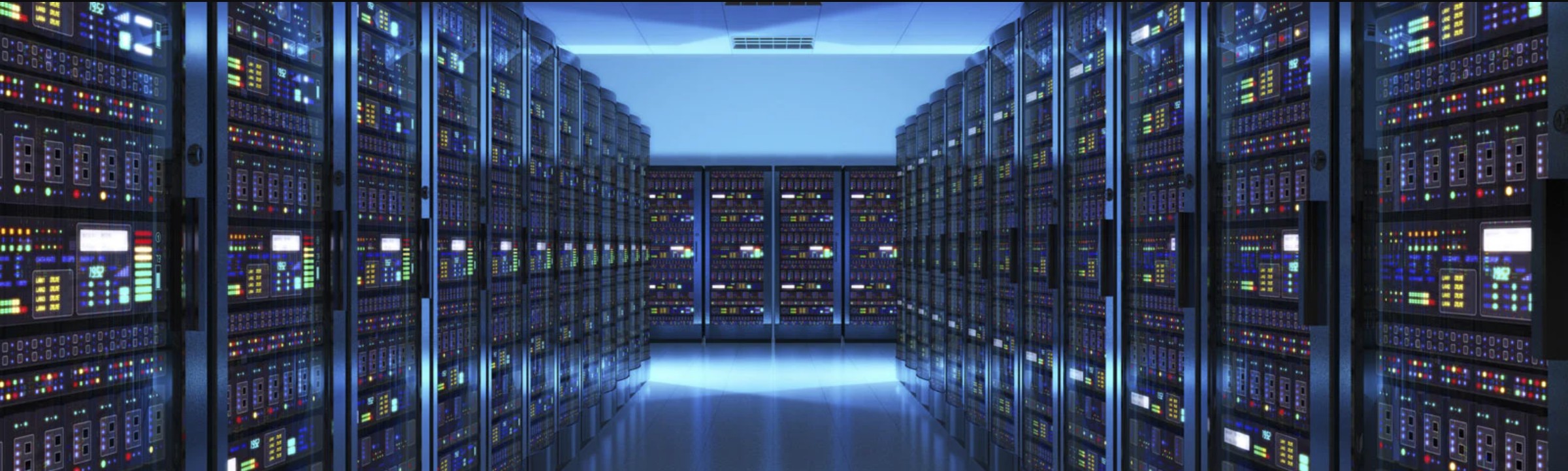
Data Center and Processor Power Delivery
48 V to Point-of-Load Vertical Power Delivery for High-Performance Processors
Over the past five years, the rapid advancement of generative artificial intelligence (AI)—including large language models and image generation models—has significantly increased computational demand for high-performance data center processors, such as graphics processing units (GPUs), tensor processing units (TPUs), central processing units (CPUs), and application-specific integrated circuits (ASICs). This demand has, in turn, led to a substantial rise in processor power consumption. Fig. 1.1 illustrates the exponential growth in the thermal design power (TDP) of NVIDIA’s data center GPUs. As shown, the TDP of these GPUs has tripled over just four years, increasing from 400 W in 2020—the year OpenAI introduced its GPT-3 large language model—to 1200 W in 2024.
Our group develops innovative power delivery solutions for high-performance AI processors—spanning both discrete and integrated levels—through improved circuit topologies, novel magnetic designs, advanced control techniques, cutting-edge integration and packaging technologies, and electrothermal co-optimization.
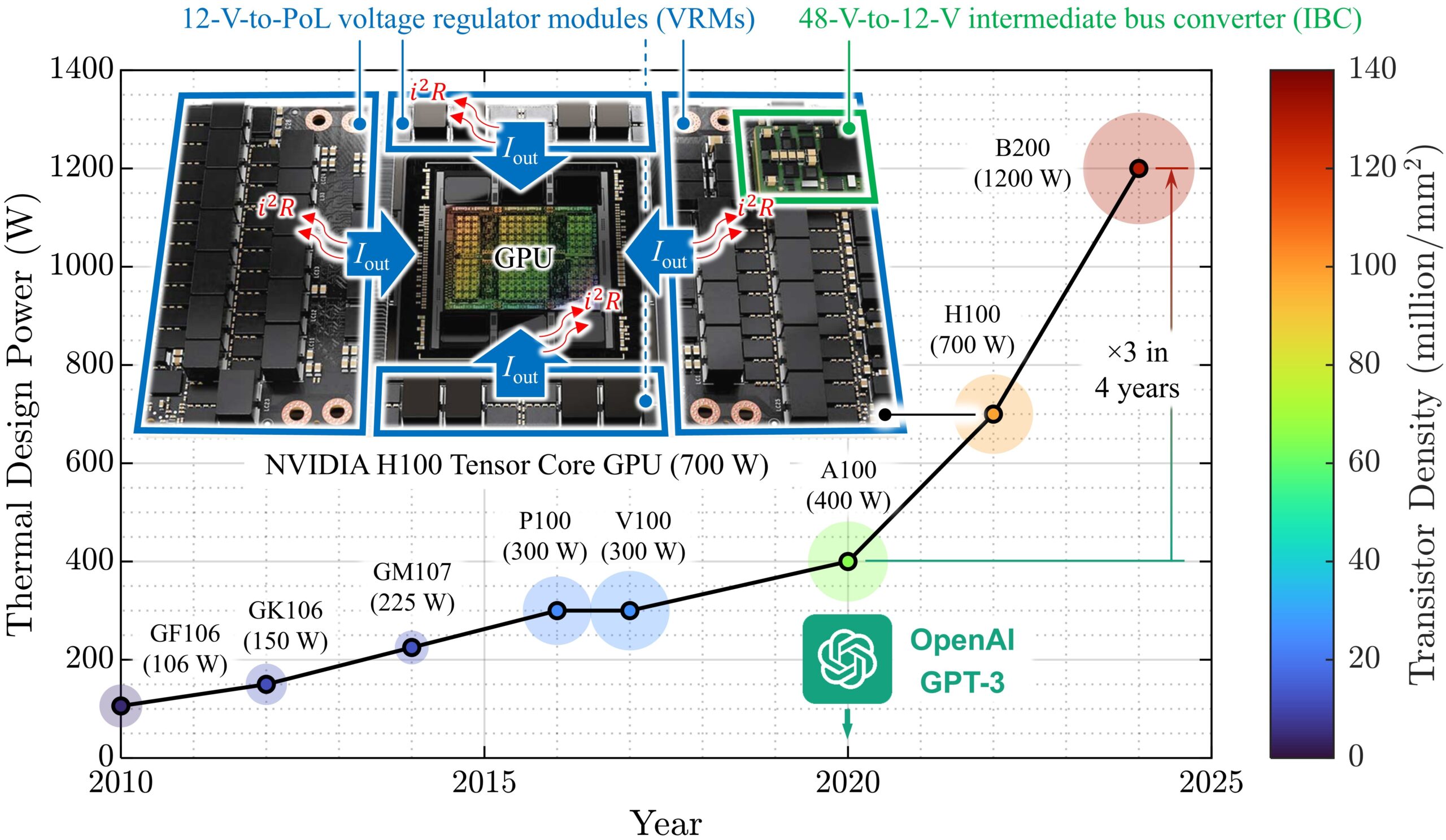
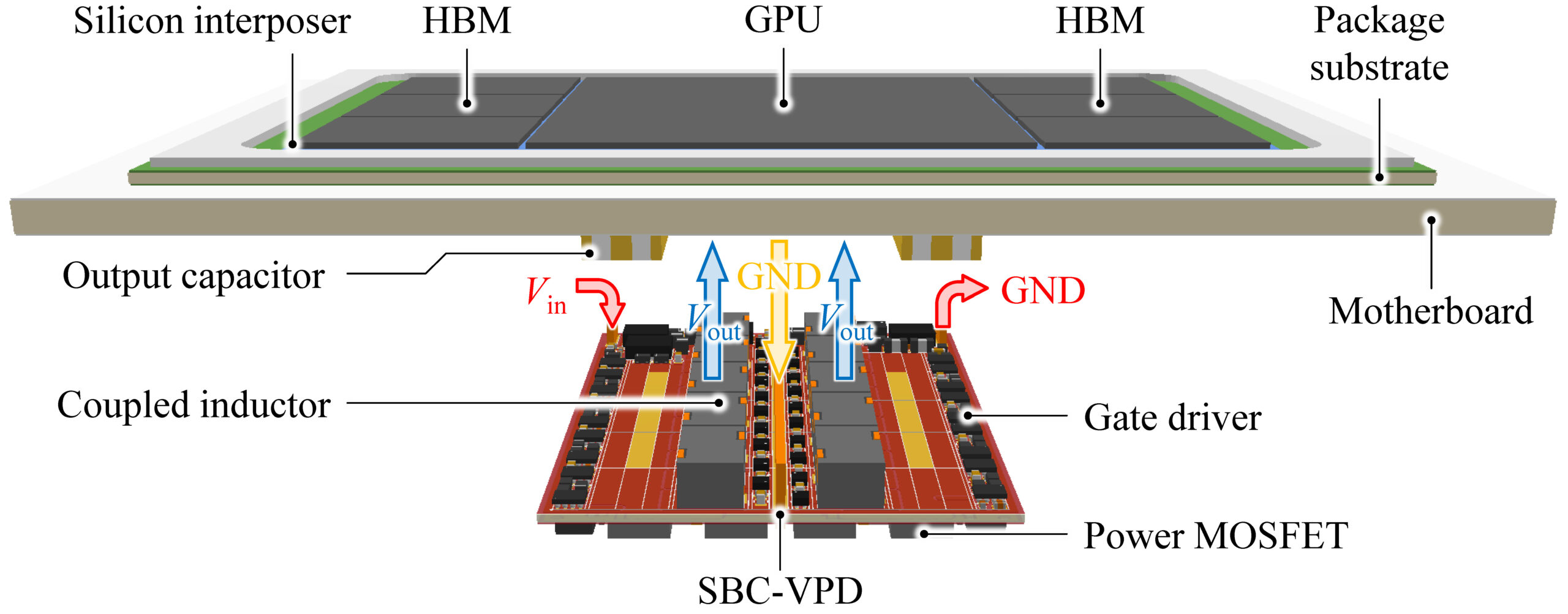
Fig. 1.1 (Left): Exponential increase in the TDP of NVIDIA data center GPUs. The image of the NVIDIA H100 Tensor Core GPU illustrates the existing two-stage LPD architecture.
Fig. 1.2 (Right): 3D rendering of the proposed dircect 48-V-to-PoL solution for GPU vertical power delivery (switching bus converter, SBC).
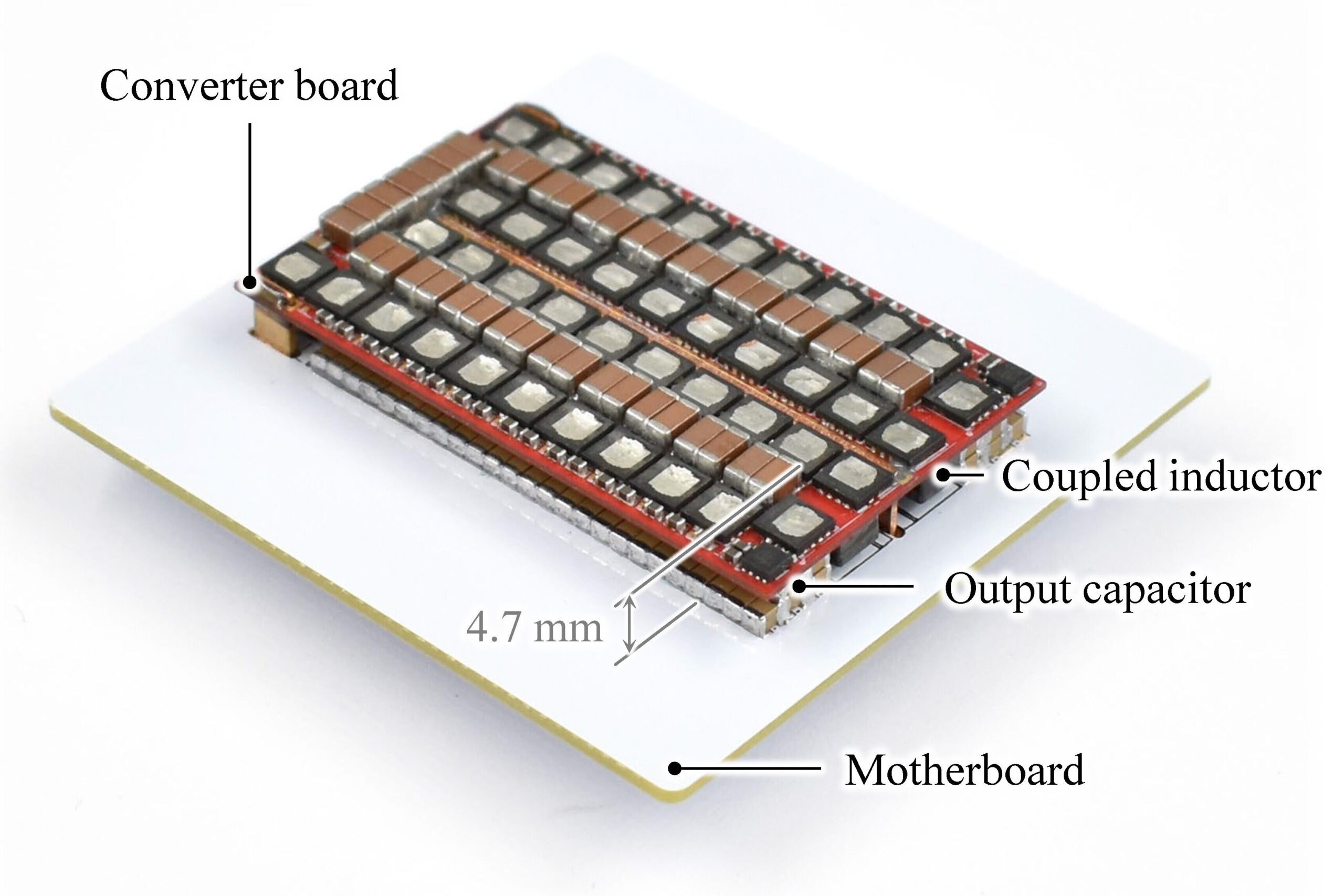
Fig. 1.3: Hardware prototype.

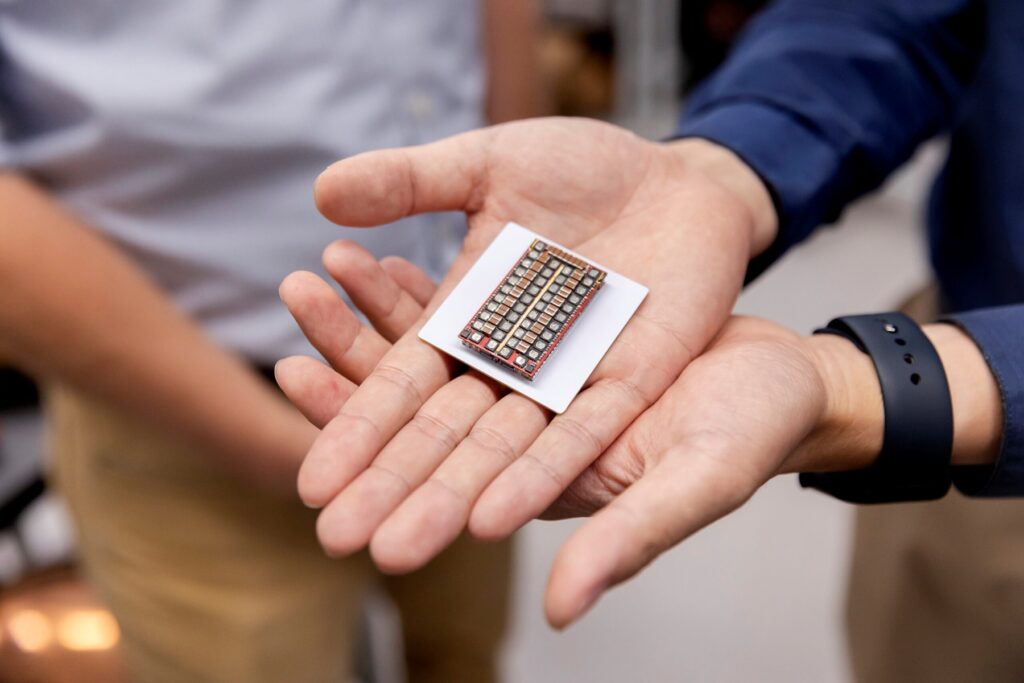
Fig. 1.4: My Ph.D. advisor, Professor Robert Pilawa-Podgurski, and I holding the hardware prototype (2024).
Higher-Voltage Rack Data Center Power Delivery Systems
Compared to conventional data centers, which typically require less than 10 kW per rack, the rack-level power consumption in modern data centers for AI applications is more than 10 times higher, exceeding 100 kW. As the power consumption of AI processors continues to grow, it is projected that the rack-level power demand of future data centers could reach 1 MW, which will represent another 10-fold increase if this projection comes true. At such high power levels, re-architecting the current rack power delivery system with a higher bus voltage is inevitable, as the power distribution losses (i2R conduction losses) on the bus can be reduced quadratically with an increased bus voltage. Therefore, the industry has started increasing the bus voltage from 48 V to 800 V, which necessitates more than a sixteen-time larger step-down ratio for bus-to-chip voltage conversion.
Research Thrust 2
Energy Storage, Electric Transportation, and Grid-Tied Systems
Research interests: data center energy storage, electric vehicles and fast-charging infrastructure, renewable-energy-powered electrolysis of water for green hydrogen production, etc.
Renewable Energy-Powered Electrolysis of Water for Green Hydrogen Production
Hydrogen is a clean, sustainable fuel with versatile applications—including fuel cell transportation, chemical production, and electricity generation—that is suitable for long-term storage and regional transport. When integrated with renewable energy, hydrogen can, on the one hand, be produced with significantly lower greenhouse gas emissions and, on the other hand, address the challenges of renewable energy intermittency, making it a competitive option for decentralized renewable energy integration, storage, and utilization. Despite its simple design and low cost, the current approach of using a single grid-tied rectifier per electrolyzer stack lacks the flexibility to independently optimize the performance of the grid-tied rectifier and the electrolyzer power supplies, or to individually track the optimal operating point for each electrolyzer stack. Therefore, a more flexible and intelligent alternative remains to be explored.
For more information about our future research directions, please contact Prof. Zhu.

Research Thrust 3
Multidisciplinary Scientific Research and Emerging Applications
Research interests: specialized power electronic systems for magnetic resonance imaging (MRI), biomedical devices, long-distance wireless power transfer (WPT), AI-assisted modeling, design, and control of power electronic systems, etc.
Applications in Emerging Areas and Multidisciplinary Scientific Research
Our group is exploring emerging applications that can benefit from advances in power electronics. For example, capacitor-based power converters are inherently more suitable for integration than conventional inductor-based solutions. Leveraging advanced on-chip capacitor technologies, the hybrid switched-capacitor (SC) approach can enable significantly higher-performance power management integrated circuits, including integrated voltage regulators for processors and edge AI hardware. We are also interested in applying advanced power electronics to biomedical systems and medical imaging, where specialized power supplies are critical—for instance, in magnetic resonance imaging (MRI). Another promising area is portable and Internet-of-Things (IoT) devices, where compact size and low weight are essential. By exploiting the higher density of capacitors relative to inductors, hybrid SC converters will open up new opportunities for device miniaturization and weight reduction.
For more information about our future research directions, please contact Prof. Zhu.