AI Live Reflection

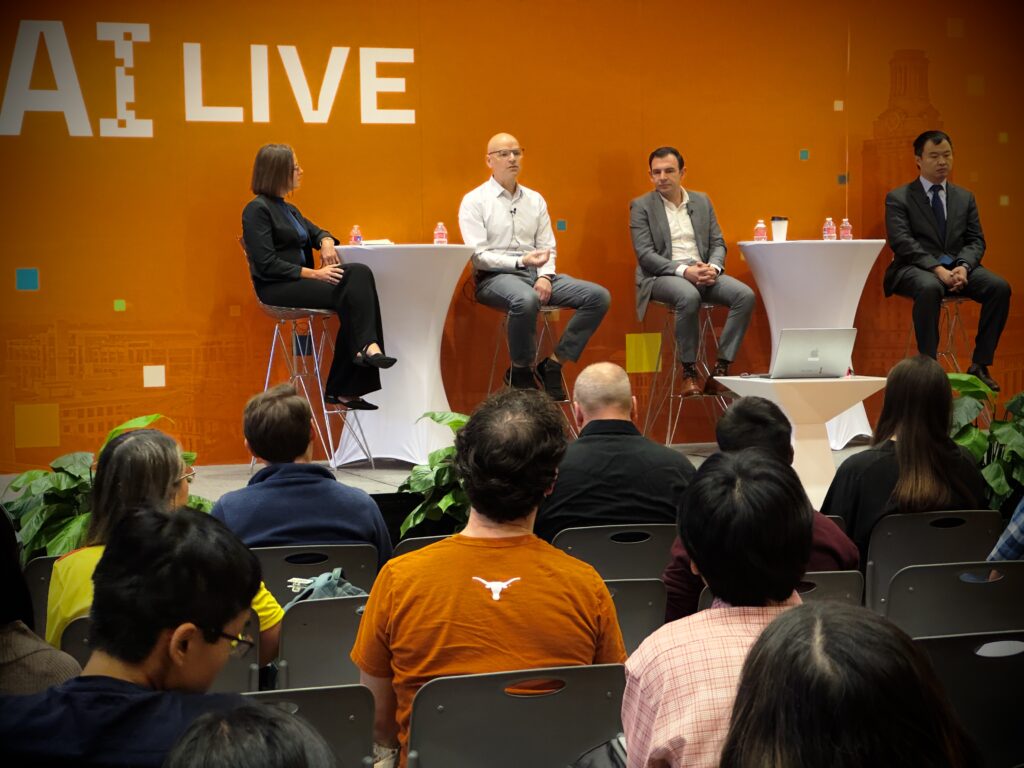
Reflecting on the AI Live event hosted by the College of Natural Sciences at UT Austin last week, I am struck by the sense of community and collaboration that permeated the event. The gathering was a testament to our collective curiosity and commitment to exploring the vast potential of artificial intelligence within our unique context. I applaud Dean David Vanden Bout, Melissa Taylor, and the entire team that made this event a true celebration to cap off the Year of AI at UT.

One of the most memorable moments for me was witnessing the enthusiasm of the students. During Sal Kahn, founder of Kahn Academy, spoke the excitement was palpable as students waited in the hall to get in. It is a reminder of the thirst for knowledge and the drive to be part of discussions that will define our future. It was inspiring to see such a diverse group of individuals come together, united by a shared interest in AI and its implications. I loved his personal reflection on his journey to bring knowledge to everyone, everywhere. It was a reminder of the power of the Internet and its ability to create impact at scale.

Sal Kahn speaking.

The event itself was a tapestry of learning opportunities, spanning various tracks from research to health to ethics. It was a celebration of how AI intersects with different facets of our lives and how it can be harnessed to address complex challenges. The sessions were not just informative but also deeply engaging, sparking conversations that extended beyond the scheduled times.

What stood out to me was the collaborative spirit that defined the event. It wasn’t just about the presentations or the panels; it was about the interactions and the shared insights. The AI Live event was a microcosm of what we strive for in our roles – fostering an environment where innovation thrives through collaboration and where every voice can contribute to the dialogue.

Looking back, I am reminded of the importance of creating spaces where ideas can flourish and where the community can come together to explore new frontiers. It really reminded me of the early days of my career and the events we held at Penn State. Those small gatherings that turned into the TLT Symposium where we would routinely host over 500 faculty and staff to discuss innovations in the use of technology to support teaching and learning is what specifically comes to mind. The AI Live event, like the TLT events from PSU, was more than just a symposium; it was a celebration of our collective potential and a glimpse into the future we are building together. It reinforced my belief in the power of community and the incredible things we can achieve when we come together with a shared purpose.
Is it Possible to Embrace a Common Digital Platform?

In today’s fast-paced academic and professional environments, our ability to effectively leverage technology is more important than ever. As a campus community, we have an opportunity to take a transformative step forward by embracing a shared approach to digital tools, specifically through the adoption of Microsoft 365 (M365). This is not simply about using software—it’s about creating a consistent, collaborative, and accessible framework for how we work together.

I talk about the notion of Digital Dexterity quite a bit, but I don’t think I have ever really defined it from my point of view. I see it as the ability to adapt to new technologies and workflows to achieve our goals. For faculty, it means enhancing teaching and research capabilities. For staff, it means streamlining workflows and improving service delivery. At its heart, digital dexterity empowers all of us to innovate and collaborate effectively in support of our shared mission.

In my mind, achieving this goal requires alignment. I am not one to be prescriptive, but when I look around campus, I see a need for us all to be ready to commit to a common set of tools and practices to really move our collective digital dexterity forward. By consolidating our efforts, we can reduce fragmentation in the tools we use, simplify training and support, and ensure that everyone has access to secure, reliable, and accessible technology. Oh, and we would save the university a lot of money.

Coming together offers more than just productivity — it is a platform that enhances:

  • Workflow Efficiency: Integrated tools like Teams, SharePoint, and OneDrive enable seamless transitions from ideation to execution.
  • Collaboration: Whether across departments or with external partners, we have to fosters dynamic, real-time collaboration.
  • Consistency: A shared platform standardizes how we work, reducing confusion and promoting best practices.
  • Security: Built-in compliance features protect our data and ensure alignment with institutional policies.
  • Accessibility: Tools like Immersive Reader and real-time transcription services empower all users to engage fully, regardless of ability.

Moving toward a common approach is a decision we must make together. It’s an opportunity to rally around a shared vision of digital transformation that serves teaching, learning, research, and productivity. By committing to a common platform, we can focus our resources on training and support, ensuring that every member of our community feels confident and capable in using these tools.

I recognize that change can be challenging, but it is also necessary. As we embark on this journey, we will ensure robust training, accessible resources, and ongoing support. Together, we can create a culture where technology serves as a foundation for creativity, connection, and success.

I am inviting every member of the campus community to join us in moving closer together in the use of the tools we pay for within our larger ecosystem. This is not just a technical shift but a cultural one—a commitment to collaboration, innovation, and a shared future. If anyone out there wants help in moving forward with a platform shift within your organization, please reach out!

September 2024 Updates from the Office of the CIO

As we continue to innovate and improve our services at the University of Texas, I am thrilled to share some of the significant accomplishments and updates from our recent initiatives. These efforts reflect our commitment to enhancing the student experience, optimizing our operations, and staying at the forefront of technology.

New Q-drop Form Launch We are excited to announce the launch of a new Q-drop form and workflow on September 12. This new system standardizes the process for students to withdraw from classes after the census date, making it more efficient and user-friendly.

Fall 2025 Undergraduate Applications For Fall 2025, standardized test scores will once again be required for applications. Additionally, we have introduced Early Action, reduced the number of short answer questions, and implemented a new waitlist process to streamline the application experience.

Data Center Migration We are pleased to welcome UTMB as a new regional customer in our data center. This migration will help reduce operating costs and free up budget for other important projects.

UT Directory Modernization The UT Directory is undergoing a significant upgrade from a Perl interface to a Python framework. This modernization effort will improve maintainability and performance, ensuring a better experience for all users.

ID Card Modernization Our ID Card Center is also being modernized to enhance efficiency, reduce wait times, and transition functionality off the Mainframe. These improvements will benefit students, faculty, and staff alike.

Digital Accessibility Center We are establishing a Digital Accessibility Center to address accessibility issues, expand captioning services, and comply with new ADA regulations by April 2026. This initiative underscores our commitment to inclusivity and accessibility for all members of our community.

AWS Connect Implementation University Health Services has successfully implemented the first AWS Connect queue, with plans to expand further. This implementation will save costs and increase our internal expertise in cloud-based solutions.

These accomplishments would not have been possible without the hard work and dedication of our ET team and all of our partners. Thank you for your continued support and collaboration.

AI Platforms, Products, and Features

Bear with me, I am going to just do some outloud thinking. I want to make sure I get my thoughts down on leveling the vocabulary around the AI explosions happening around us. What are the differences between AI platforms, AI products, and AI features and why each has a critical role in our strategy.

I believe in an enterprise as large and diverse as ours, an AI platform will provide the foundation. In my mind, platforms are flexible, scalable, and built for creating custom solutions. They give us the ability to develop, integrate, and innovate on top of a common framework. I believe that investing in a campus-wide AI platform that serves as the bedrock for much of what we’re doing across research, teaching, and operations is the right thing to do. It’s the engine that drives AI innovation and allows the community to participate at scale to create solutions tailored to unique needs.

Visual representation of the UT.AI platform.

Then there are AI products like M365 Copilot. Copilot enhances collaboration, improves workflow, and helps us get more out of the underlying Microsoft 365 platform we’ve already embraced. An AI product is standalone, one that fits into a larger AI strategy. It exists above or adjacent to our platform, enhancing daily operations while complementing the custom AI solutions we’re building.

Finally, there are AI features like Apple Intelligence, which come baked into devices like your iPhone. These are the quiet, background AI capabilities that make your user experience more intuitive and personalized. But by themselves, they’re limited in scope—enhancing specific tasks rather than transforming entire workflows.

The strategy that I am envisioning begins with a platform approach. It gives us the power to drive true innovation and adoption by the community. Providing a common platform does not preclude us from also investing in AI products like M365 Copilot, bringing in vertical solutions that can serve parts of the university. The platform is our foundation for building and adapting AI to meet the diverse needs of our students, faculty, and staff. By leveraging one platform at this level, it allows us the greatest chance to innovate, grow our internal expertise, and control our long-term success.