Tag Archives: AI

UT Sage and Social Learning

Most leadership development in a technology organization looks the same. A workshop, a cohort, a facilitator, a shared reading, ninety minutes on the calendar. I have run these and I have sat in them. The thing that almost never happens in that room is someone saying out loud that they do not understand the reading. Senior people especially will not do it. The cost of admitting confusion in front of your peers is higher than the cost of nodding along, so people nod along, and the conversation stays at the altitude where everyone is safe.

Over the past few weeks I have been designing a set of self-paced learning labs for Enterprise Technology. Each one pairs a foundational text with a translation into our work and a set of practice moves. The first is Wenger on communities of practice. The second is Roy Pea on distributed intelligence, which asks how intelligence travels through a system rather than sitting in any one head. The third is David Weinberger’s Small Pieces Loosely Joined, which opens on the difference between the Hoover Dam, where every dependency was planned in advance, and the Web, where almost nothing was and whose designers chose it that way. All of these readings and associated insights have been key ingredients when I have taught my Disruptive Innovations class that my good friend and colleague, Scott McDonald, and I co-designed back in my Penn State days.
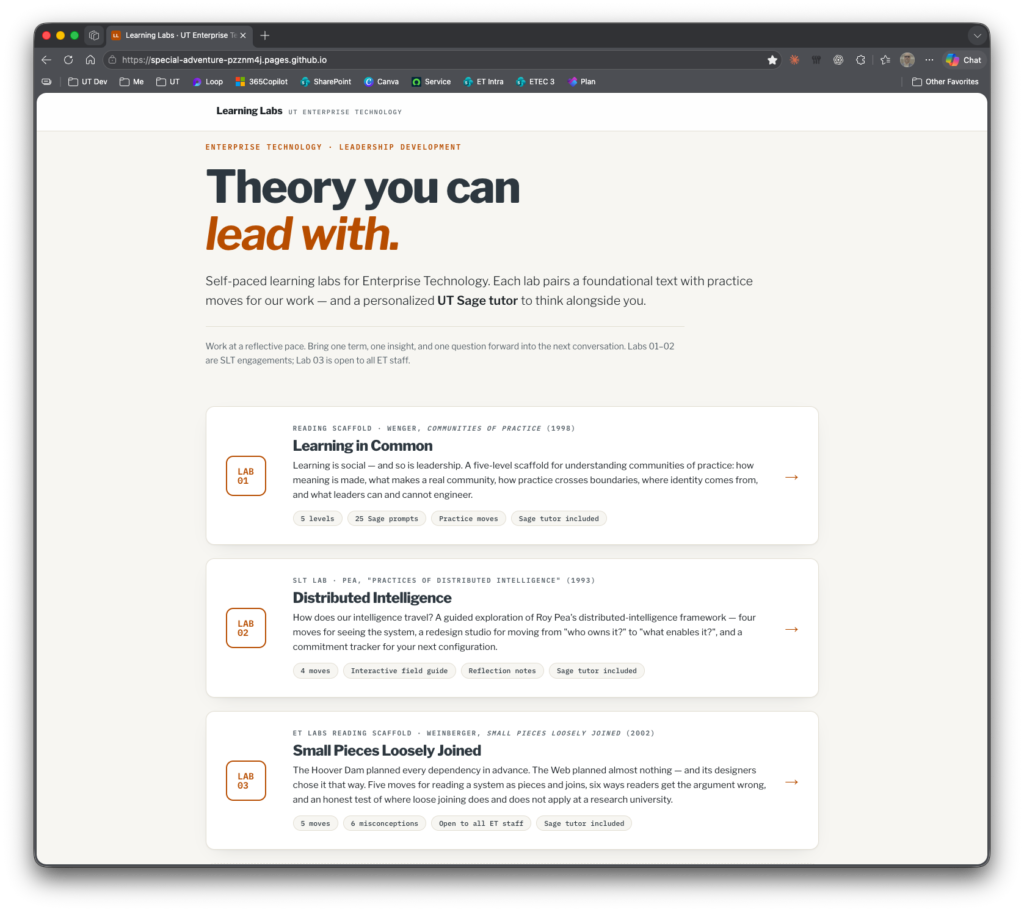
Screenshot of the ET LEarning Labs showing three labs.

The interesting part to me is that I have finally figured out a compelling use for AI within the flow of instruction that seems to work. Each lab also ships with its own UT Sage Tutor. That is the piece I want to share, because it is doing something I did not fully anticipate when I started.

The Office of Academic Technology and Enterprise Technology partnered to build Sage at UT for course tutoring. An instructor uploads their materials, Sage builds a tutor scoped to that course, it lives inside Canvas, and it teaches Socratically rather than just handing over answers. It has been available campus wide since last fall and it works really well. What I did here was point that same capability at something else entirely, which is leadership development for our own staff.
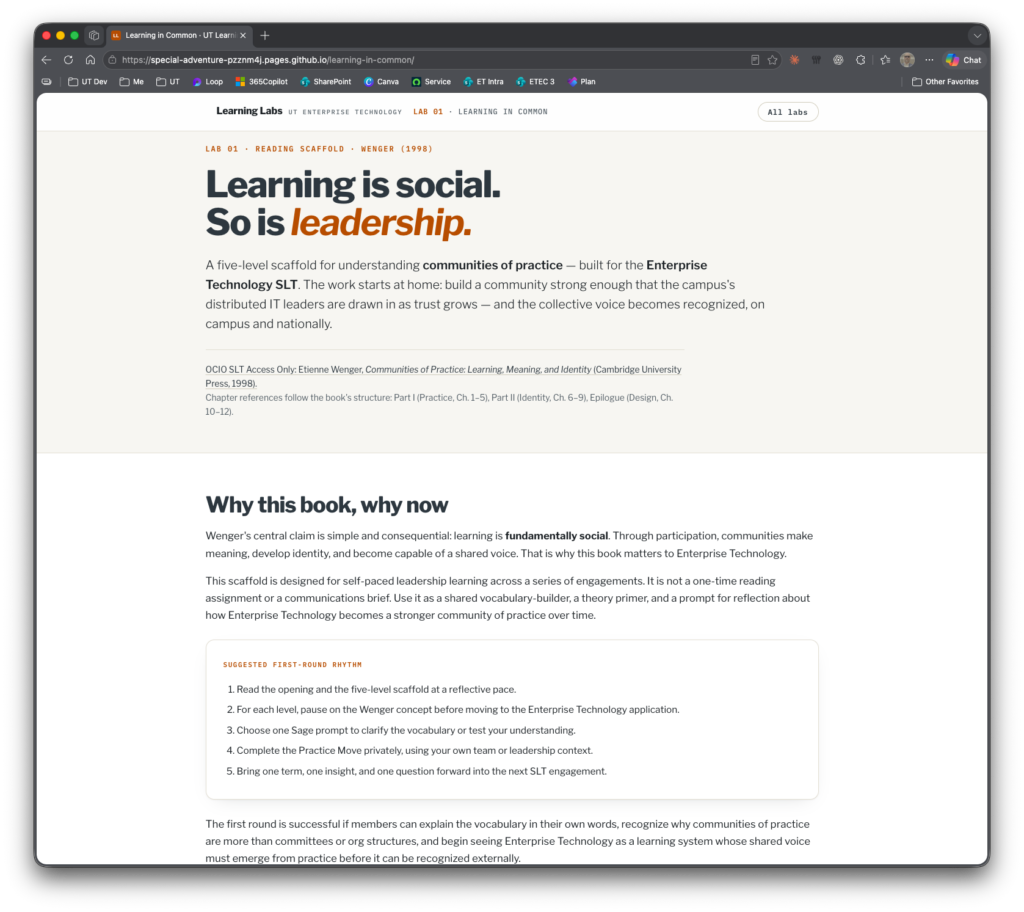
Screenshot of ET Learning Lab showing the Wenger example

The tutors in these labs are trained on at least two things. The first is the source text, so the tutor can genuinely discuss Wenger or Pea rather than gesture at them. The second is a large document I assembled by scrubbing our own website, everything Enterprise Technology says publicly about who we are, how we are organized, what we believe, and what we run.

That second corpus is what makes it work in the context of ET. A tutor trained only on the reading can tell you what a community of practice is. A tutor that also knows our org chart, our governance bodies, our service portfolio, and our stated values can help you work out whether the thing you have been calling a community of practice at UT actually is one.

So each lab runs two scaffolds at once. There is a public one, the text and the structure and the practice moves, which everyone in the lab shares and can argue about together. And there is a private one, the tutor, where you can be exactly as confused as you actually are. No cohort, no facilitator, no assessment, nobody watching. You can ask the question you would never ask in the room. The private scaffold is not a retreat from the social one. It is what makes the social one possible, because the confusion gets worked out first, and what people carry into the group conversation is an argument instead of a nod.
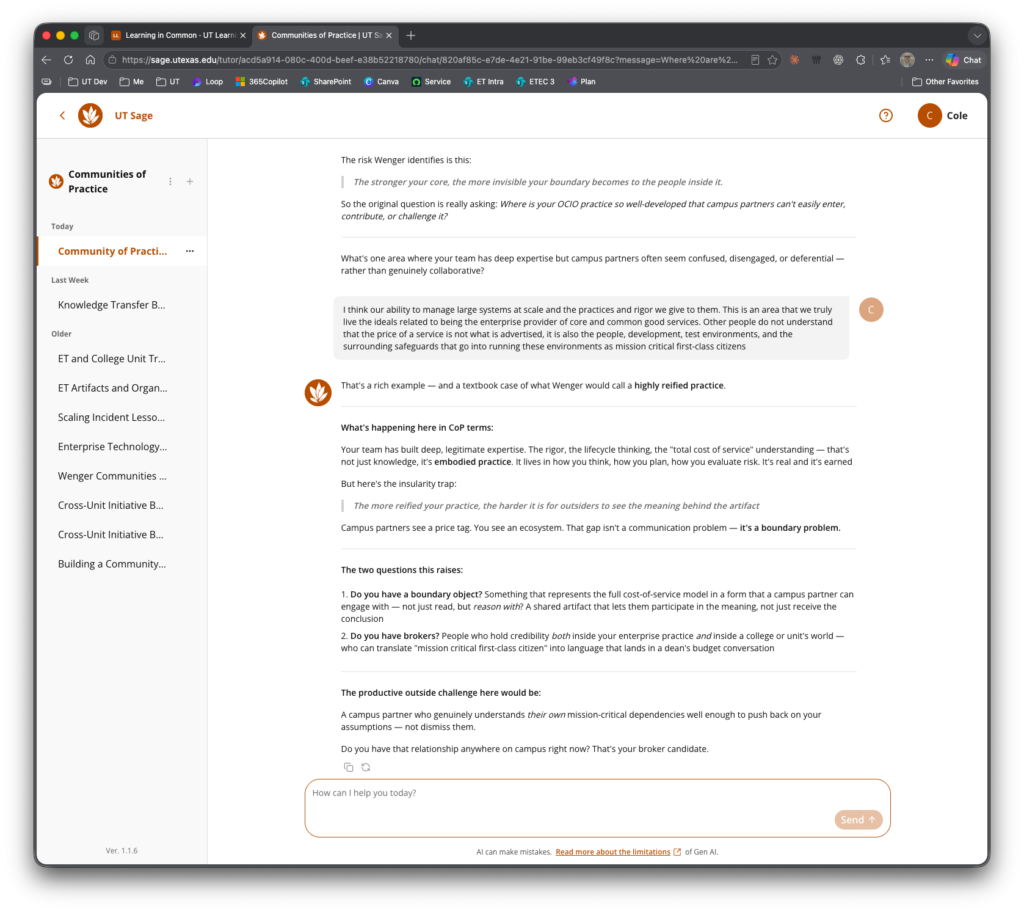
Screenshot of Sage showing an active learner chat.

I have shared this with about a dozen people so far, and everyone is blown away by the conversations they can have with the Sage Tutor. What comes back to me is not “I read the Wenger text.” It is a specific argument about whether one of our teams is a community of practice or just a reporting line. If Wenger tells us learning is social, then that is the conversation I was hoping for.

The labs are built in combination with Claude Code and are published to GitHub Pages inside our own enterprise GitHub organization, gated so that only the people we have granted access can read them. Within each learning scaffold there are one button copy starter prompts that a learner taps and is taken to Sage to start a conversation. The number of conversation screenshots I got last week was very cool.
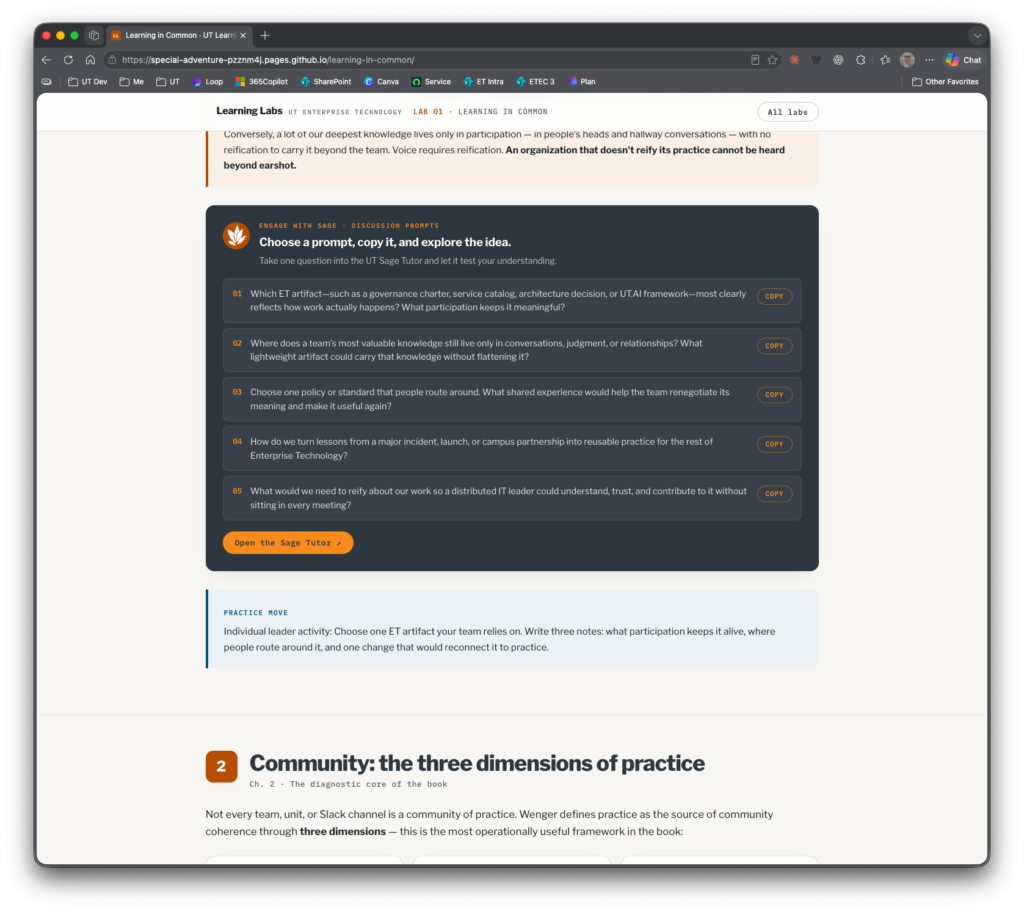
Screenshot of the learning scaffold showing the Sage prompts.

After building the first two tutors I noticed I was repeating myself, so I built a front end plugin for Claude that walks a designer or instructor through the steps of building one. It asks for the real learning objectives before anything else, pushes for outcomes you could actually observe a person demonstrating, and keeps pulling the designer back toward grounded pedagogy before a single line goes into a prompt.

Most of us build a tutor by describing the personality we want and hoping instruction falls out of it. This works the other way around, and it turns out the instructional design is what makes the tutor good, not the prompt craft. I was surprised how easy it was, and more surprised by how repeatable.

When people ask me how AI is disrupting education, I now have a real-world example of how to move AI into the learning process rather than around it. I have known for a couple of years that using AI responsibly actually makes me understand the problems I am trying to solve in a deeper way. Why? Because learning is a social endeavor, and Sage is the closest thing I have found to a colleague who has read everything and still wants to hear what you think.

If you are a UT Austin campus member and want to try this out or talk more about these ideas, drop me a comment or hit me on Teams.
Organizational AI Enablement

Last March I attended my first Kung FU AI advisory board meeting. I walked away feeling way out in front, we had contracts in place with Microsoft, OpenAI, and Anthropic for campus to safely consume the best of the emerging AI market. It was a classic “if you provide it, they will come” approach. Fast forward to March of 2026 and I walked away from the same annual meeting with a different feeling: that we have let the early momentum slide.

What I listened to as I sat and looked around the room were CTO, CEO, COO type people not talking about procurement wins or what they were thinking about AI, but instead about how they spent much of the year activating and enabling their IT organizations to be AI-first in their decision making. The intentional adoption of AI to drive impact was more important than early wins and “low hanging fruit.”

I left that meeting feeling a different kind of urgency, one that was aimed directly at enabling the teams that make up Enterprise Technology. One of the first things I did was schedule an all day retreat with the ET senior leadership team. Mario and I sat down and laid out the sketch of how we wanted to approach the SLT and built a framework that was meant to challenge each of us. The challenge was to come to a place where we would take a very intentional turn and focus on internal adoption, diffusion, and enablement.

That is a hard turn for an organization that spends nearly all of its time looking out across campus. We have rightly focused on campus adoption, diffusion, and enablement while often times leaving ourselves behind. What I learned from the advisory board meeting was that the only way to grow outside of ET is to first grow inside ET.

With that in mind we walked into our retreat and declared that that day was Day Zero of ET’s intentional AI adoption and enablement practice. We each made commitments. We also addressed the outcomes of our first ET AI Use Survey, where we learned that our staff were reluctant to adopt AI for reasons we hadn’t considered: environmental, ethical, and uneven tooling concerns dominated the results. It was an opportunity for us as the leadership team to square our organizational expectations and commit to focusing significant effort inside ET to enable success for all of campus.

Today we sent a strong message to the ET staff that they have the support and commitment from their leaders to bring us all into the world of AI to improve our own work, support campus, and to challenge ourselves to rise to this moment. My favorite part of the memo reads:

ET’s core values are not a backdrop to this work. They are the reason for it. We exist to advance the university’s digital ecosystem so the Longhorn community can learn, discover, and succeed. That mission requires us to develop our people, engage our campus partners, build an organization that is agile enough to act on new opportunities, measure our progress honestly, and enhance the technology environment for teaching, learning, and research. AI is the most consequential technology shift of our time. Sitting it out is not an option that is consistent with who we say we are. 

In the coming weeks and months there will be lots of ongoing conversations, training, and events designed to enable our teams. We have AI Enablement workshops starting next week that will bring all of our teams up to a baseline with both OpenAI and Claude. We have made the SLT commitments available to every member of Enterprise Technology and we will deliver. We have another AI in a Day event planned that will allow our staff to hear directly from the audiences we serve across campus to spark ideas and new partnerships. And we will culminate this calendar year with an event designed to bring our AI champions together in an ET Build event that will focus on deepening our skills and using them to solve our own problems of practice.

All of this is designed to get us to a point where we can begin to work with our campus partners in new and exciting ways. This means understanding what the offices of the CFO, COO, Advancement, Student Affairs, Legal Affairs, and all the others struggle with — challenges that can be augmented by AI, agents, and workflows. The focus inward is intentional and we believe it will be the unlock we need to continue our AI leadership in higher education.

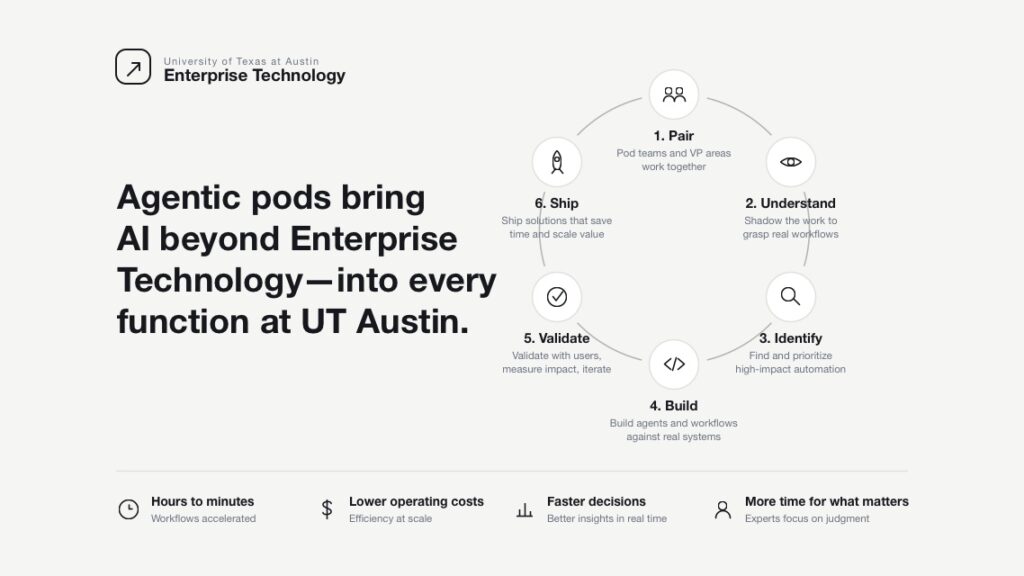
Future state of Enterprise Technology Agentic pods.

As our teams grow their skills in AI, we will pair with offices across campus to create “agentic pods” to move our enablement work to them. The method itself isn’t new; it is simply an evolution of the tooling and practices we are all familiar with. When the UT.AI Studio fully launches, we will be able to augment our teams with our AI Student Builders and further expand impact. I am grateful to be at a place that demands to be on the forefront of discovery and we get to be part of that journey in a very meaningful way.

The Self-Healing Campus Concept

I was in a meeting with Microsoft executives this week talking about AI adoption, roadmaps, what comes next, the usual choreography of these conversations. And I found myself saying something I hadn’t planned to say: We are going to use AI to create a self-healing campus.

I want to try to explain what I meant because from what I am seeing emerge in the marketplace is nothing short of revolutionary. But I have to start somewhere that might seem like a detour: with a platform, and with institutional responsibility. Because the self-healing idea only works if the foundation is built right and building that foundation is the hardest part of the work.

Universities are complex institutions. We hold sensitive data about hundreds of thousands of people. We have federal compliance obligations, privacy commitments, accessibility requirements, and a duty to protect the identities and records of our students, faculty, and staff. Any vision of AI-powered self-service that ignores those realities isn’t innovation, it’s shadow IT with a new name. The history of higher education IT is full of well-intentioned workarounds that created breaches, compliance gaps, and technical debt of their own.

So before the self-healing can happen, someone has to build the environment that makes it safe. That is what we are doing at UT Austin with UT.AI.

UT.AI is our attempt to build a common AI environment where the institutional protections are not an afterthought — they are the foundation. Data protection, privacy, accessibility, security, and institutional identity are baked in from the start, so that everything built on top of it inherits those guarantees by default. The goal is not to restrict what the community can do with AI. It is to make it possible for them to do more, safely.

With that foundation established, here is the idea that excites me. Tools like Claude Code, GitHub Copilot, and OpenAI Codex are making it possible for people who are not professional software engineers to build working software. A procurement officer who understands the byzantine logic of a university purchasing workflow can now describe what they need and have a running application in an afternoon. A researcher who has spent twenty years building expertise in a domain can translate that expertise into automation without waiting for IT to prioritize their ticket. The knowledge that has always lived in people’s heads, contextual, accumulated, irreplaceable, can now be turned directly into tools.

This is significant. But it isn’t the part that struck me most. What if you don’t have to wait for an institution to build the interface you need? What if you just describe it — and it appears?

Here’s the thought that hit me: if I can open Claude Code and describe a web application and have it built in front of me, then I am one step away from a world where I experience the web entirely on my own terms. Not the interface someone else designed for me. Not the portal IT built three years ago that nobody has the budget to modernize. My interface. The one that surfaces exactly the information I need, in exactly the format I want, through a gateway I described in plain language.

Think about what that means for a university. We have decades of accumulated technical debt — systems built for a version of the institution that no longer exists, interfaces designed around assumptions about how people work that stopped being true years ago. Every year, IT organizations like mine make triage decisions about what gets modernized and what stays on life support. We do the best we can. But the backlog is real, and it grows faster than we can address it.

The traditional answer is more resources, better prioritization, smarter governance. All of that still matters. But agentic AI introduces a different answer: what if the community doesn’t need us to fix all the interfaces, because they can make their own?

A faculty member who needs the grants management system to present data in a specific way shouldn’t have to wait for a system modernization project. They should be able to describe what they want — “show me my pending awards grouped by sponsor, sorted by close date, exportable to a format my department administrator can actually use” — and have that view rendered for them, connected to the underlying data, without touching the legacy system at all. The underlying system doesn’t have to change. The interface layer becomes personal, ephemeral, generated on demand.

This is what I mean by self-healing. Not that the old systems get fixed. But that the community builds around them, over them, through them and in doing so, the debt stops mattering the way it used to. The pain point that drove the ticket to IT gets resolved by the person who felt it, in the moment they felt it, using tools that are already available.

The interface layer becomes personal, ephemeral, generated on demand. Technical debt stops mattering the way it used to.

But here is why the platform layer is not optional. Every one of those personal gateways needs to know who you are, what data you are authorized to see, and how that data can be used. It needs to meet accessibility standards so that the self-service future is actually available to everyone, not just the technically confident. It needs to enforce the same privacy and security guarantees that govern every other institutional system. Without a common platform that provides those things by default, “self-healing” becomes “self-inflicted harm at scale.”

UT.AI is our attempt to thread that needle. Build the platform first; with institutional identity, data protection, privacy, accessibility, and security as non-negotiables. Then open it up so that the community can build on top of it, around it, through it. The freedom is real, but it is freedom within a responsible envelope, not despite one.

At UT Austin, we are already investing in the tools and infrastructure that make this possible. Through a year of UT Spark we have learned that going alone at the platform layer isn’t enough, through the AI Studio we are launching this fall, through the agentic capabilities we are putting in front of our community. This concept forces us to shift in how we think about what IT is for.

We are not just in the business of building and maintaining systems. We are in the business of enabling people to do their best work safely, equitably, and in ways that hold up under scrutiny. If agentic AI means that more and more of that enabling happens through description rather than deployment, through personal gateways rather than institutional portals, then our job is to make sure the foundation is solid enough that the community can build on top of it without putting themselves or the institution at risk.

That is a campus that heals itself. And I think it is closer than it looks.

February ‘26 ET Leadership Updates

I’m excited to share two leadership updates that position us better to be a leader in AI innovation while strengthening our commitment to teaching, learning, accessibility, and digital adoption across campus.

Mario Guerra Jr. Promoted to Associate Vice President, AI Platforms & Innovation

Mario Guerra Jr. will transition from Director of Enterprise Learning Technology into a newly created role as Associate Vice President for AI Platforms & Innovation.

In this role, Mario will build and lead UT.AI Studio, our flagship AI innovation program that brings together enterprise platform development, student talent cultivation, and strategic corporate partnerships. This promotion recognizes Mario’s vision and leadership in emerging technologies and reflects our commitment to moving with urgency and intention in advancing AI across the university. Mario will oversee:

  • AI Platform Engineering: Enterprise AI platforms serving the UT community, including UT Spark, UT Sage, Microsoft 365 Copilot, and custom AI agents
  • UT.AI Academy: A student talent development program training more than 100 students annually through industry certifications and real-world project experience
  • Corporate Partnerships: Strategic relationships with technology partners, including our anchor partnership with Dell Technologies

Under Mario’s leadership, we will continue to distinguish ourselves as a national leader in higher-education AI—not only by deploying technology, but by transforming how we teach, learn, conduct research, and operate as an institution.

New Role: Associate Vice President, Enterprise Initiatives & Instructional Technology

This AVP will lead our technology-enabled learning ecosystem while driving digital adoption across campus and overseeing major, cross-cutting institutional initiatives. The role brings together instructional technology, accessibility, learning environments, and enterprise program execution under a single strategic leader.

This AVP will be responsible for:

  • Instructional Technology Solutions: Canvas LMS, instructional tools, faculty engagement, and teaching innovation
  • Digital Accessibility Services: Accessible course design, universal design for learning, and inclusive pedagogy
  • Learning Spaces & Educational Environments: Technology strategy for classrooms, learning spaces, and active learning environments
  • Digital Adoption & Campus Dexterity: Building faculty and staff fluency with Microsoft 365, Canvas, AI platforms, and learning technologies
  • Enterprise Program Execution: Leading major CIO-sponsored transformation initiatives that span organizational boundaries

Critically, this AVP will partner closely with Mario and the UT.AI Studio team to translate AI platform innovation into faculty- and staff-facing programs, training, and support, ensuring our AI investments result in meaningful, scalable adoption across campus.

WHY THIS MATTERS

Artificial intelligence is transforming higher education at an unprecedented speed. This leadership realignment reflects our commitment to lead that transformation with both bold vision and responsible execution.

By establishing focused executive leadership for AI platforms and innovation and for instructional technology and digital adoption, we ensure each area receives the strategic attention, resources, and accountability it requires.

Mario’s elevation to AVP recognizes the critical importance of AI to UT Austin’s institutional future. The creation of a second AVP role ensures we continue advancing excellence in teaching and learning, while strengthening digital fluency, accessibility, and adoption across campus.

These are deliberate investments in our ability to:

  • Serve more than 50,000 students
  • Enable faculty innovation at scale
  • Position UT Austin as a national model for AI in higher education

WHAT’S NEXT

The new Associate Vice President for Enterprise Initiatives & Instructional Technology position will be posted on February 4.

We are seeking a relationship-driven leader with:

  • Deep instructional technology expertise
  • Experience as an Associate Vice President, CIO, or Deputy CIO
  • A strong track record in digital adoption and change leadership
  • A passion for faculty engagement and inclusive learning environments

I’m grateful to Mario for his leadership and vision, and excited about the future we are building together. Please join me in congratulating him on this well-deserved promotion.

Reclaiming Time and Elevating Our Work

Over the past six months, we’ve been working closely with colleagues across the university to better understand how Microsoft Copilot is shaping our day-to-day operations. While much of the attention around these technologies focuses on novelty or experimentation, what we are seeing and hearing is something more practical and powerful, it is creating time.

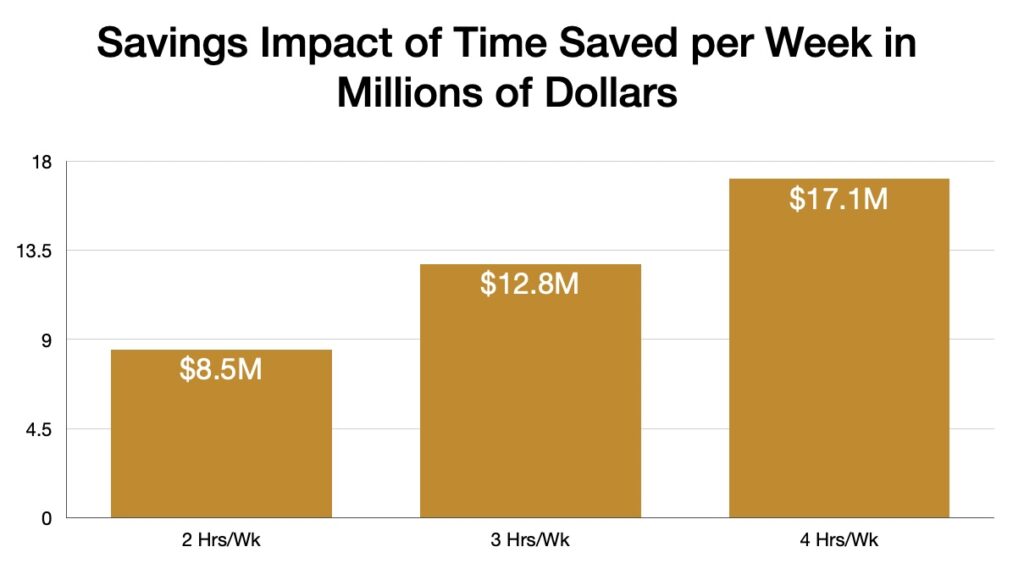
Using our workforce data as a baseline, we know the median annual salary at UT Austin is and what that equates to as an hourly wage. From there, it’s not hard to observe the potential for measuring impact. If each of our active 2,296 Copilot license holders, nearly all of whom are in administrative roles, saves just two hours a week, that represents $8.5 million in regained value annually. At three hours, it rises to $12.8 million. Four hours brings the total past $17.1 million. What our community of users is telling us is that they are using these tools to recapture no less than two hours of time back each week.

Those are big numbers, and they get your attention. But what excites me isn’t just the financial story, it’s the operational one. Every reclaimed hour represents capacity. That’s time that can be redirected away from repetitive tasks and toward higher-value work. It means more space to think critically, connect meaningfully with our students, colleagues, and the community focusing on advancing the mission of the university.

Graph showing dollar amount of savings based on time saved with Copilot.
Screenshot

Before I get a ton of hate mail for conflating actual savings for reclaimed time, I will admit that these types of calculations don’t tell much of a real story. But if you dig right below the skepticism and start to think about how nearly all of our time is divided across dozens of micro-tasks each day, finding low level opportunities to recapture some it can mean quite a bit. Today it is happening here and there with a tough email that we need to write or respond to, or in summarizing a new piece of legislature, to do a quick review of a contract, or any of the other things we all do each day in support of the university. Now think of all of that in the aggregate and you can begin to see how much time can actually be saved. And in my world, where I am trying to fit more work into every single moment, this matters.

We often talk about innovation in terms of new tools, but the real innovation here may be how we choose to use the time we’re getting back. AI can’t simply be about doing things faster, it must also be about creating the breathing room we need to elevate our work and to think differently about what’s possible. What I am looking for are stories that come from the community where our AI tools are saving you time, opening new thinking, or impacting current practice in ways that allows you more space to breathe, think, and engage more broadly.