The exhibition is a project of the XXI International Exhibition Triennale Milano 2016, hosted by Pirelli HangarBicocca. It’s about 30-45 minutes away from our apartments here in Milan if you take the metro and walk a little ways.
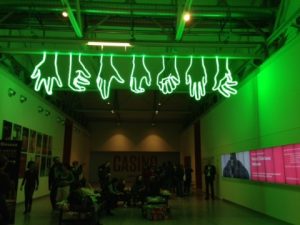
When you walk in, you’re immediately greeted by a large, neon-green sign that says “Welcome” (pictured below), and just beyond the sign was the second exhibit we visited.
“Welcome”
First, however, we went to a cirque-styled Triennale exhibition where we flew (well, it was more of a glide), were blinded by lights, thrown into complete darkness, and went through many optical illusions. We had to wear green wristbands in order to fly, and the second I was strapped in I was ready to go. They only let us “fly” around about 4 times, but it was well worth it. It goes almost painfully slow, but it makes you observe your surroundings, the other objects in the room, and the people down below.
The second exhibition is titled “Architecture is Art”.
Exhibition #2
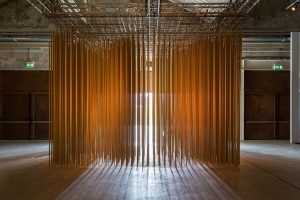
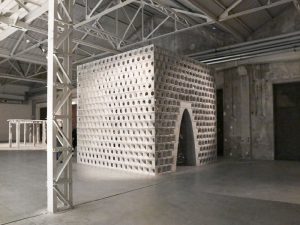
We were deafened by hanging, ringing poles as we walked in. Then we sat on top of garbage like the trash we are. It was less interactive, but the pieces were still incredible to walk through and experience, including the piece pictured below:
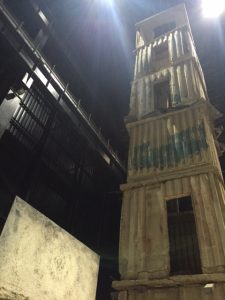
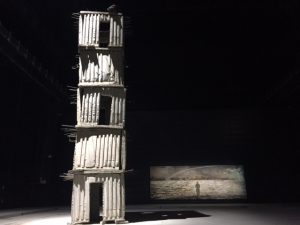
Lastly, we went around the building (took a little while to find it) to get to another exhibition that’s a permanent piece. It consisted of 7 towers and a few canvas pieces, and the massive towers were made of lead and concrete and various objects. The tone completely shifted inside the room: it became ominous and almost suppressing.
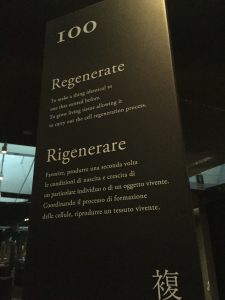
Andrea Branzi and Kenya Hara. PreHistory Exhibit. Another great designer that inspired me on this trip was Andrea Branzi, extremely sad that I missed his talk, but hopefully, I was able to understand his message. His 100 power verbs took me into an unexpected journey—from our dark ages into this new technological age. The creation of our survival tools only marks the beginning of what the human hand can create. It can design many wonderful artifacts, but it can also destroy… if allowed. I loved that the ending element was not a glimpse into the future, but rather a conscious decision to investigate the past. To organize, become aware and REGENERATE the past for progress … “just like the way life begins.” The exhibition electrified me to investigate my past to better prepare for the future. To grasp from my ancestors all the elements that strengthen cultural values for the betterment of society and humanity.
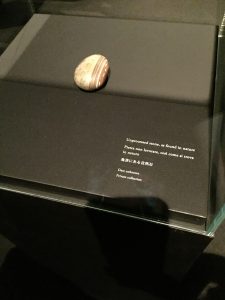
From the 100 verbs, there were a few key words that captured my attention. 1). Exist – “To believe that things are. The universe is. And people are.” This was visually, represented by an unprocessed stone. This caught my attention as this was my initial inspiration to the jewelry pieces I designed for my workshops. I guess, this is an intuitive form that is embedded in all of us, yet we have ignored.
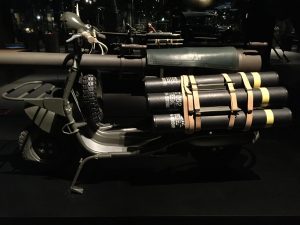
Powerful. 2). Hold – “to grasp things with finger and thumb. Hand engages a stone. Stone encounters hand.” Although, I didn’t like that this stone was an axe, I did appreciate that the stone provided a grip—in my opinion, a form of security or power. My project seems to have intuitively connected to a primitive desire or need to hold on to an object in one’s hand. We just have to learn to listen to our inner desires. This is where I found Branzi’s work amazing. The word chosen to describe the object gave me chills. The definition was powerful—although, it was a working tool, Branzi decided to use the word DESTROY. Granted the tool displayed was a “working tool” to work the land or to capture a prey (or destroy for one’s benefit). He strategically chose the word Destroy because it was created to destroy a living thing or breakdown a landscape. I had to take a moment to inhale this particular information.
(This image was under “Annihilate”, but it clearly represents a stronger definition for destruction.
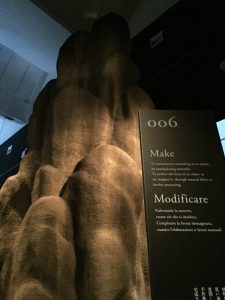
3). Make – Interestingly enough, Branzi chose to place the word MAKE sixth from the list. I would have thought, this would have been third on the list, but he decided the affect of the hand destroying a living creature was more important than the creation of something. Fascinating. Make – “To manufacture something as we desire. By manipulating materials…”
Branzi then took me into a rollercoaster of a journey from varying sounds to visuals of progression and darkness of regression. The background music generated some apprehension at certain points, at others it gave me hope. I happened to notice the heartbeat sound as I reached the “religious” section or the next key word that caught my attention 4). Worship – “to offer prayers, conscious of the great power beyond human control.” Although, the music brought some uneasiness, the visuals and definition brought me comfort. There were other keywords that captivated my attention such as Cultivate, Share, Love, Learn, Navigate, Build, Observe and Think, but the main takeaway from this exhibition for me was to wake-up, acknowledge the past and become aware of technology rather than be consumed by it or its politics.
Listen and wake-up to your true nature. … just like the way life began!
The Triennale exhibition has compounded a deeper and better understanding of political and critical art and design for me. I find myself drawn to works that have political and/or philosophical statements. The deeper, more ambitious projects seem to draw me in, especially the ones that take a moment to comprehend. The two major projects that captured my attention were Andrea Branzi’s project and now, Anselm Keifer. Both Branzi and Keifer are new discoveries for me. I had never heard of either artists, but I have quickly become a fan. They both make political, personal and philosophical work. Formally, the works speak in a quiet, aesthetically pleasing mode. It takes a moment to discover the hidden treasures.
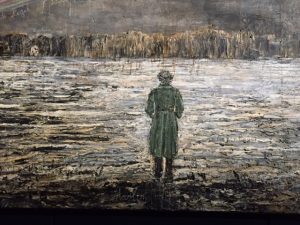
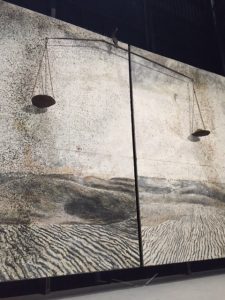
Having just returned from Germany, I immediately connected to Kiefer’s work, which I had never experienced or seen before, I automatically connected to his work through the reinterpretation of Germany. Although, the theme for this particular exhibition was “The Seven Heavenly Palaces”—which spanned across a broad spectrum from Melancholia to Magnetico, the pieces hold remnants of post-war (post-apocalyptic) Germany. The towers stood high, powerful (in an authoritative manner, waiting to be seen, yet a bit unsure of themselves and off-balanced, almost ready to collapse. It allowed for the viewer to take from them as they wished. The empty rooms and broken elements added to the darkness and unbalanced isolation. The paintings added to the desolation—dark, contained, but well-balanced. The Alchemie was my favorite piece—drawn by the balancing scales. They clearly represented the positive and negative of life, space and time. The scales were balanced by Salt on one side for sterility and Sunflower seeds on the other for fertility. At the end of the walk opposite the entrance on the back of the room across a long, wide path, you were presented with a solitary man staring at a sunset or maybe, his life—this new apocalyptic world that has dismantled the old has problems, but the individual has a vision. But is it his vision? Is he there by choice? Has he been awaken to the realities of war or to the realities of peace. The man is surrounded by the names of great philosophers that have seemingly opened a path (represented by the rainbow above the man) for him. Does this mean that the path can only be brought through learnt knowledge? Has he been set free by shared knowledge? Or has he set himself free through self-recognition and self-awareness or is he merely in a meditative space? … as he is floating on water.
Happily admiring the darkness and light of the exhibit. There is a light at the end of a tunnel which seemingly came through knowledge, meditation and self-awareness.
Monica Castiglioni’s little jewelry boutique near Piazza Garibaldi was one of the most memorable trips from last week. The store is hidden in a residential-looking area, wedged between buildings: quite hard to find unless you’re really looking for it.
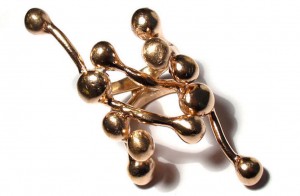
The jewelry in the store were all custom designs by Monica Castiglioni whose main medium of work is bronze and wax. There were two main types of jewelry on showcase in the store: her bronze coral-like collection, and the 3D printed jewelry.
The consultant at the store explained that Monica was inspired by fractals for the coral-like design. Incidentally I was quite infatuated with fractals for two whole years of my life, so I genuinely peed a little when I heard Monica Castiglioni understood the appeal. She uses the lost wax technique to create the bronze models. The permanent mold is made out of silicone, so the designs can be replicated, but considering the soft quality of silicone, no copy is really ever the same. All unique.
Bronze coral reef-like ring inspired by fractals
The consultant also told us about the properties of the bronze used. The casts are 100% bronze so the material reacts quite easily to different bodies, atmospheres, and maintenance techniques. The oxidization of the bronze also adds to the uniqueness of each piece. Since the bronze also reacts to body oils and pH, there is a very personal and contact based relationship between the wearer and the jewelry. I though this was a rather ingenious was of strengthening the relationship between consumer and material possession, and making her creations a little more valuable and personal to her customers.
This also changed my perspective on how i view oxidized jewelry. Typically it indicates impure quality of the material used in the creation of the piece. Monica Castiglioni flipped the tables here and actually used what degrades the value of most jewelry as valuable. If nothing, the prices clearly indicate just how much they’re worth.
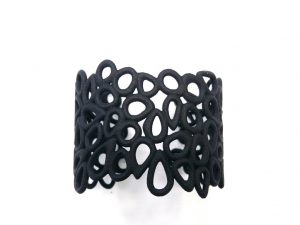
Her other set was the newer collection of 3D printed jewelry. Monica Castiglioni apparently prefers to work hands on, so with her 3D creations, she didn’t actually create digital renditions, but used her bronze and silver models as prototype designs, and left the rest to the digital experts. The pieces we looked at, a variety of bracelets and one long chainlink necklace, seemed very brittle and delicate, but the material is surprisingly pliable and allowed for the hand to slip in and out easily.
3D printed bracelet.
Beautiful jewelry, and fascinating methods of creation.
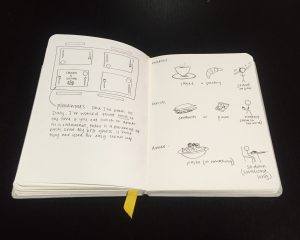
As I have moved along through Milan and through my sketchbook, I have continued to observe the table and patterns that occur during mealtimes. One thing I have enjoyed noticing is the relationship Italians have with each mealtime. I have been able to see options for food for each meal and different behaviors regarding how and when they are eaten.
Breakfast for instance is not typically as big of a meal as it can be in the US. The people I have observed in the morning either do a grab and go with a pastry or stand at the coffee bar as they throw back their tiny coffees. This might have something to do with the fact that most of my observations are taken on business days, but I think it is true that traditionally, breakfast consists of coffee and something small in Italy. Now of course under the same circumstances in the US I would argue there is a large number of people who stop for coffee and a pastry in the morning before work. But even on the weekends, it seems that breakfast is not a leisurely event.
Another difference that I’m sure everyone notices right away in Italy is that there is no coffee to go. Yesterday I did see a to go cup in a coffee bar in the train station, but that was quite a rare siting. Like I said, most people who order coffee here stand at the bar as they order it, the barista makes it, they drink it: all in under 5 minutes.
Since, I began my journey in Milan, I started recording and documenting a variety of sounds, patterns, and textures of the city and beyond. I’ve drawn, watched, experienced, but mostly listened. Listened to birds chirping, people conversing, and performers performing … it all adds to the fabric of a city. Most sounds blend into each other, but at times, you will hear something that captures your attention. Here is a rough sampling of sounds, not yet a choreographed compilation, but rather a taste of what has captured my attention and expanded my experience in Milan and other cities abroad.
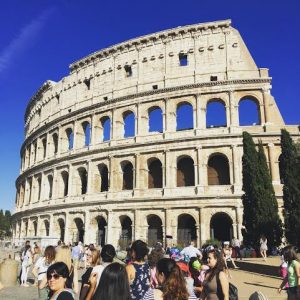
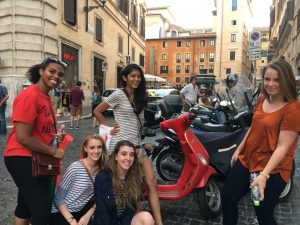
This weekend I was lucky enough to have the chance to travel to Rome with my classmates! I felt apprehensive about travelling to Rome because I knew the city is notorious for pickpockets. Thankfully, my trip was nothing but pleasant. The first stop on our agenda was the Coliseum. We were granted entrance fairly quickly and spent a couple hours walking around the inside as well as making a stop by the columns right next to us. We briefly ran home to freshen up before heading back out for dinner. On the way to dinner we ran into the Trevi Fountain, which was one of the biggest attractions in Rome that I wanted to visit. The girls and I took turns taking pictures and throwing coins in the fountain and then went to dinner. The next morning we had a late start because we were up fairly late watching the Lizzie Mcguire movie together. Our next conqest was Vatican City! I cried a bit inside St. Peter’s Basilica. It was a beaitiful and spiritual experience that I will never forget, I only wish my parents had been with me. After the Vatican we walked around the shops and went to the Pantheon. Rome was absolutely magical and I’m so happy that I was able to spend a weekend there.
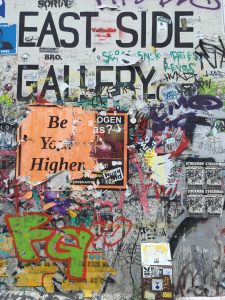
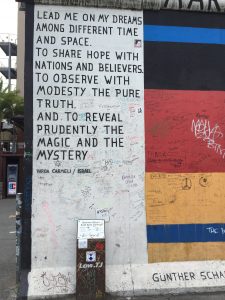
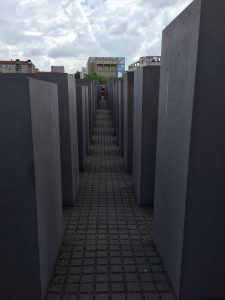
Traveling to other countries has definitely been a great experience—from sounds and smells to actions and sentiments—not only have the people been friendly, they have also been welcoming and easy to converse with (in a limited sense of the word). Every encounter has been helpful. If Milan made great progress due to its struggles, so have the German citizens. Not only did the Jewish people suffer during the Natzi Reich, but so did the German population. And at times, it was felt … every memorial, every wall, every step, every remembrance. I can’t even begin to comprehend or imagine how it must’ve during that time. Yes, communities did get destroyed and many, many (millions and millions) of people lost their lives, but communities were built. Support systems did rise, and many did try to overthrow the Reich—both within and out. But Many, many lives were lost during the process.
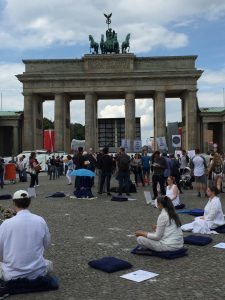
Now, they have overcome and thrived. The energy, the passion and the eagerness is visible through the community. There was music at every other corner, couples dancing on the streets, couples being affectionate towards each other and many just enjoying life at the park. There were also people meditating at the gate, others protesting next to the meditators, and others performing on the streets to entertain. All respecting each others’ space. And the food, the food was … delicious! From Currywurst to Vietnamese to Indian to middle-eastern food, everything was different, but sensational. If diversity manifests itself through the food then, Germany is gleaming with it. I heard Spanish, Dutch and I don’t know how many more different languages in the city. The people have definitely embraced diversity. If the structure for diversity in a city is based on its food then, the German people have spoken and have embraced a new era. Needless to say, my opinion is based on first impressions, I truly don’t know the true structure of the city, or if all people embrace this new form of living. But, I do hope many people have welcomed and embraced each other. The sense for life and love has truly become the fabric of the city, in my opinion. Of course, there is still poverty, homelessness and struggles, but everyone has an energy that can only be experienced and not explained or written about.
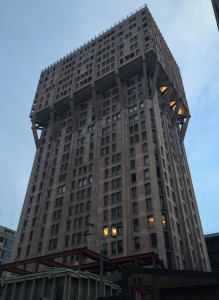
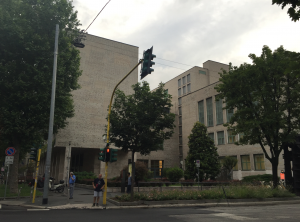
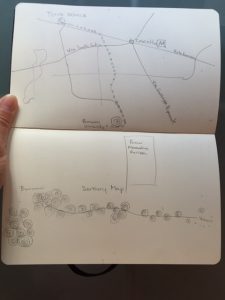
This past week, we started our mapping the city project. We did our first walk on Tuesday afternoon, we discussed our experience on Wednesday afternoon and did our second walk on Thursday afternoon. The first walk was exhilarating, new streets, new finds, and new experiences. We had two quite different buildings and although one was finished much later and was built during the modernist era, it felt much older than the other. We had the Bocconi University (economics) and the Torre Velasca Tower. We started with the oldest section of the Bocconi building and walked our way to the newer portion of the University and onto the Velasca Tower. The most noticeable part of the entire experience was the energy and activity level of the walk. We went from an over hyper area where there was excitement, life and lots of energy to an almost non-existent lifestyle. The tower’s energy was completely draining. We originally thought that it was due to the time we arrive to the area, but we encounter the same energy during rush hour on Thursday afternoon. Granted the building is under construction, but the energy of the building was felt onto the community. It seems that the Velasca tower although, a modernist designed had too many fascist memories embedded onto it. The medieval inspired design only added to the tension and it weighed on the community.
Torre Velasca
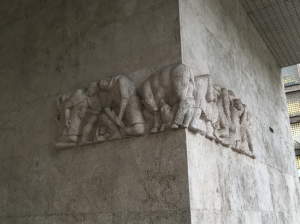
Bocconi University – outside view
Bocconi University – close up
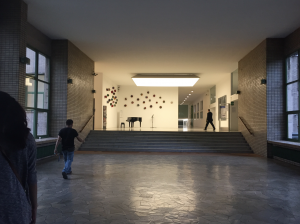
Bocconi University – inside view
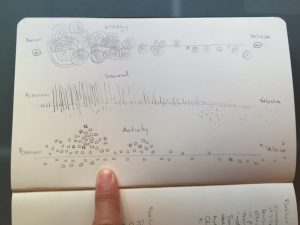
We decided to focus on the sensory aspect of our walk—not only ours, but the community’s, as well. We noticed the the energy and the sound levels varied from one point to the next. The University lifestyle definitely added to the heighten activity levels. The energy was positive and it vibrated through the students around the building. We, the four of us, wanted to become part of it. The varying textures of students added to the neighborhood. Below is a sample of the sounds, movements and energy I felt as I was walking in the area. You will notice that my energy levels went down as we reached our final destination point. The Velasca building definitely had some remnants of the fascist movement, although not intentional, it was felt … by me.