Alessi

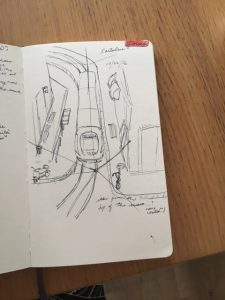
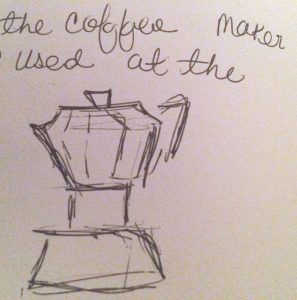
From workshop, to industry, then a design company. There is something so innately wonderful (to me) about the story of Alessi, the company and the family. Going from a workshop to an industry is already a fairytale dream, but to then go from an industry to design company, a company that values and encourages design is exciting. I don’t know much about the adult world, but what I have learned from watching my sister work for a corporate company that functions like an industry is that failure is not an option and is viewed as dead weight. What I gathered from Alessi is that innovation will inevitably bring failure, or flops as it was put, but that is completely fine for a company focused on design. Also, that success does not mean to rest on one’s laurels. Within the Alessi family, Alberto knew they could do and be something more than just the hotel and restaurant appliance people, even after having his first major contribution to the company be a flop. His confidence to fund himself when no one else would because he believed in his own with is admirable at the least. Now I am not naive enough to think that everyone who works hard and takes risk will end up like the Alessi family but I do believe that this type of dedication to your craft will generate opportunities that will allow you to achieve goals that exceeded your former expectations. Sketch - Alessi

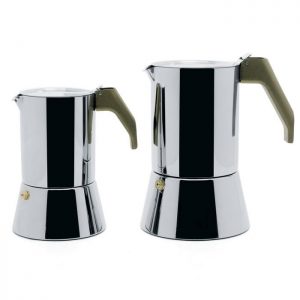
I think what I will best remember Alessi for during my stay in Italy is the Moka!

Castiglioni

Towards the end of this week, I felt like I went to heaven. Don’t get me wrong, I have loved everything up until now but the joy others get from standing in beautiful cathedrals I get from seeing the evolution of a soap dispenser (I know, kind of weird). I was so intrigued by the Castiglioni family and the idea the form follows function. But Achille Castiglioni’s approach to ambiguous objects was, for a lack of better words, totally awesome! It also acted as a reminder that innovation and productivity can be fun and a little ridiculous. Not only that but work does not have to be behind a desk 24/7. Castiglioni went out to random places, observed forms, evaluated its purpose, and then said to hell with that I have another idea. And although Castiglioni did not care about the aesthetic of the final form as much, there is something very cyclical about finding objects that have a definite form and function, or so the creator must have thought, and giving it a new function with a slightly altered form. Similar to the class conversation about what is a chair and the predetermined expectations when using the word “chair,” this constant redefining of objects is one of the most creative things I have ever heard of.

Making Sense of Rationalism

Me, being a very visual person, I was almost intimidated by the reading about Rationalism. I kept rereading the lines trying to make sense of the words. But now, having seen examples in person, the text no longer are just words on a page but a word puzzle that, in my opinion, is a good representation to describe the movement. In Italian Rationalism, Rationalism was described as a double paradox. The first being summed up in a phrased mentioned in the book, “new archaic age,” and the second being a building’s form “both timeless and universal, at the same time creates a specific response to a particular place.”  Keeping in mind that the text mentioned that there is not a clear explanation of Rationalism, this post is an attempt to deconstruct the paradoxes and to find my own definition.

Starting with the second paradox, “a building’s form ‘both timeless and universal, at the same time creates a specific response to a particular place,’” my interpretation of this is functionalism. A great example is Adalberto Libera’s elementary school he designed. His basis of design was fulfilling the needs of the school and recreating the city wall that once existed. Other than the interior layout design to maximize space, light, and communication efficiency, there literally would be no explanation for the design of the exterior of this same building if it would have been moved to some other location. Continuing with this line of thinking, the timelessness would be the reinvention of the city wall. The only connection I can think of to the “universal” mentioned is the similarity to the modern movement that was growing in popularity not only within other nations but also overall shown in the coming century. Once again, in response to creating a specific response to a particular place, the objective of this building was heavily influenced by its location (also a modern movement concept of creating dialogue with a space). Even with the same goal in mind, this school would most definitely have looked different if the location of the school had been changed.

Now for the first paradox,“new archaic age,” I do believe this goal may have been one of the reasons the movement did not do too well. The book describes this as “primitive values [being] heralded by the modern machine civilization.” Favoring neoclassicism and roman styles, rationalism wanted to revamp a style whose values include organic shapes and realism with a modern (avant-garde, I might add) style that values geometric, rigid, and abstract forms. Ambition for modern times, but probably too out there for the 20’s. Terragni’s Novocomum is a prime example of the disconnect between the two styles. As mentioned on our tour, the building was not received well and many had to fight for its survival. Undeniably a beautiful design, the best metaphor I can think of to use as a personal layman’s reference is that  it is like writing an amazing paper about the wrong topic.

As a general conclusion for the two paradoxes, a small excerpt from Italian Rationalism best describes not only the architecture but the movement.

“The architecture enters the town as if ‘entering a foreign land’; and yet it does enter, at the cost of expressing a sort of amazement at its own presence.”
Milan in Action

13332823_10154977023774126_8947521666616717423_n 13394175_10154977078824126_3795089715318140012_n

It’s been two weeks now and I finally feel like I’ve taken Milan by the horns; Longhorn horns, specifically. I’ve traveled throughout Milan and felt what it’s like to wander home on the bus without someone there that speaks Italian. It’s been a scary and flustering ride, but also a fun one. I’ve been able to see so many sites in such a short time and really dive into the culture and feel of the city as seen by a native Italian as well as my own eyes of being a native born Texan.

One interesting part of the culture I seem to have picked on fast is how to ask for gelato. I know that I want a coppa and that I want a size piccolo. I also know the main flavors I will be asking for are cioccolato and vaniglia. I’m not sure if it’s because I’m constantly asking for gelato of if it’s because ordering gelato seems to happen in the same way as opposed to a restaurant, which may be different.

I’m also glad for the two classes of Italian we did manage to take. I’ve been able to pick up words and phrases that many Italians say and not feel out of place. One that always seems to stand out is the allora. Every Italian does seem to say this and it’s very apparent that the teacher that taught Italian would always say it as well. This phrase confuses and interests me. Everyone says that it’s meant as a filler of speech, but to be honest, it makes very little sense. Does it mean okay? Does it mean the same as how in English we say, “umm” or “well”? I’m not quite sure and each time I hear it, I feel the need to listen closely to those speaking and figure out where the context is. Context is a very important aspect of understanding a language a person doesn’t know and getting around a country that speaks the language said person doesn’t know.

As I was riding the tren, train in Italian, I managed to overhear the loud speaker through my headphones and listen to them explain that there would be a delay and that we wouldn’t begin departure again until 13:15. I then waited and went back to listening to my headphones when again, minutes later, I heard over the loud speaker “tredieci treinta” and realized that they had extended our delay for another fifteen minutes. After hearing this fact, the Italians around me all made a very loud and exhausted sigh. It was great being a part of the joke and knowing that our tren wouldn’t be leaving soon, and I was even happy that we all shared in this exhaustion together.

Overall, it’s been an interesting stay so far and I’m excited to learn more Italian and really embrace the culture in a way I’ve never experienced before.


Alessi

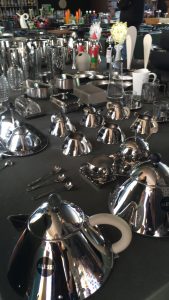
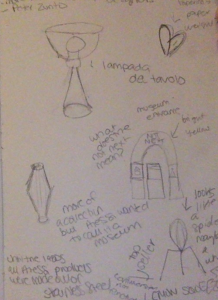
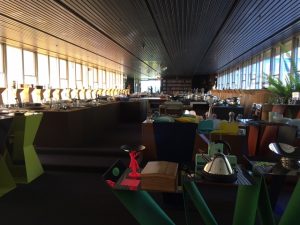
I’ll be honest, until I started taking this course I had never heard of Giovanni Alessi or his company. After doing some research I was under the impression that Alessi was similar to an Italian Ikea. I was completely wrong. When we walked into the Alessi Museum I felt like I was in an inventor’s laboratory. I saw objects I would have never been able to imagine in my wildest dreams. Impressed would not begin to describe the way I felt. A few different items that caught my eye included the giant yellow arch in the front of the museum with the words “NOT NEXT” written on the top of it, a heart shaped paper weight, and a lemon squeezer.  As silly as it sounds, I LOVED the lemon squeezer. It looked like a spider and I wasn’t entirely sure what it was until the guide explained its function to us. I really like the idea that Alessi features the work of over 200 different designers. Not only does that supply a plethora of ideas for new objects , but it gives a large amount of emerging designers an opportunity for work. I’m grateful for this course, because I’m not entirely sure If I would come across the Alessi company if it wasn’t for this class!

Screen Shot 2016-06-12 at 8.50.08 PM
Notes/Sketches I took at the Alessi Museum

Boutique Window Displays

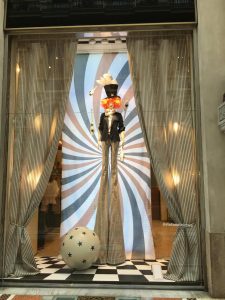
When I heard one of our main projects for this course was going to involve sketching I immediately felt uneasy. Drawing has never been my forte and I tried figuring out what subject I wanted to focus on before arriving in Milan; however, I did not have any luck. The first day we arrived in Milan we were walking around the Galleria when suddenly a store window display caught my eye. The display featured a normal sized female mannequin, but with extremely long pinstripe flared pants. The woman sported fiery red hair, a top hat, a blazer, and was in the process of juggling bowling pins, creating a circus-esque themed window display. This was not the typical window display I’m used to seeing, so I couldn’t help but feel excited and inspired. It was then that I decided I wanted the focus of my sketchbook to be on boutique window displays.


The Boutique Display the Inspired my Sketchbook

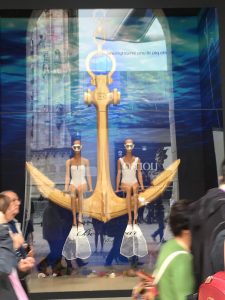
I believe it was last Wednesday that we went on a walking tour around the Duomo and the Galleria. This was the perfect opportunity for me to walk around and sketch and find inspiration. We encountered various stores including Stella McCartney, Prada, Chanel, Ermanno Scervino and Salvatore Ferragamo. My personal favorite window display was the of Ermanno Scervino’s. The display had an aquatic theme with two mannequins sporting white swimsuits sitting on a golden anchor.


unnamed-1
Ermanno Scervino Window Display


I had a difficult time sketching the mannequins because they were sitting down. I think that’s my biggest frustration. The ideas I have in my mind do not translate well onto paper. I’ve seen the illustrations of other girls in our class and I feel like they are leaps and bounds ahead of me skill-wise. One of the biggest reasons I chose to major in textiles & apparel merchandising rather than textiles & apparel design was because I did not feel I was creative or talented enough for design. Sometimes I do feel discouraged, but I believe that my sketching skills are starting to progress with each sketch I do. I recently sketched the window display from an Alexander McQueen store and I don’t think it looked half bad! I think I was able to really capture the pattern of the dress and the ruffles at the bottom of the garment.

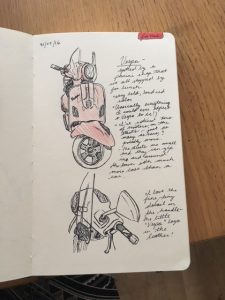
I originally felt like I was limited to sketching window boutiques, but as of yesterday I received the confidence to sketch other objects too, such as some of the appliances from the Alessi museum. My sketchbook may not be as professional as some of the other students, but I believe it’s a work in progress and that practice really does lead to perfection. I’m excited that I’m going to be able to take something back and show my family and friends what I’ve been up to!

Post WWII Interior Design

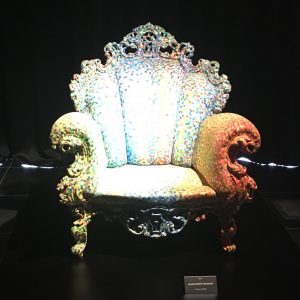
This week I wanted to concentrate on my visits to Museo del Design 1880-1980, and Bar Luce, which is part of Fondazione Prada. While visiting the Museo del Design, I was instantly drawn to Alessandro Mendini’s Poltroon di Proust. This chair was part of the “Made in Italy” movement after WWII. This time period was a “wide diffusion” of artistic experimentation and youth protest which created a new creative energy in Italian Design. Mendini’s “Proust” chair, became a series of redesigns in which Mendini took inspirations from structures and detail of past designs in furniture and design history. The actual structure of this chair was modeled from a Neo-Baroque style chair, and the exterior upholstery is hand-painted, using similar impasto brush strokes from the Impressionists. Mendini perfectly tied the ideas from specific art time periods to help create the radical design movement of post war in Italy.

A few days later I visited Bar Luce at Fondazione Prada. The exterior buildings of the Fondazione Prada is very minimal, and physically walking to the location feels like you are in the middle of nowhere in Milan, with the surrounding area being less developed and is much less populated. The closest comparison I can think of is the contemporary work of Donald Judd in Marfa Texas. At the Fondazione Prada is a bar and cafe called Bar Luce, which was designed by an American film (Raised in Houston) director Wes Anderson. The moment you walk in the bar, you have left the overwhelming feeling of vast contemporary art to a cafe that is modeled after post World War Two Milan. This was were I noticed the similarities of the design from Mendini’s work from the “Made in Italy Movement” and theme of combining old ideas with current times. Bar Luce has a vaulted ceiling, and the upper section of walls display architectural and decorative motifs from the Galleria Vittorio Emanuele. The interior design and furniture are modeled after classical cafe aesthetic from the 1950s to 1960s. The aesthetic and appearance is pushed in new ways creating this time warp that takes you back five decades. The color of the branding is light diner pink, and there are different hues of olive and army greens and yellows that make the pink branding pop. There is a giant record jukebox, several pinball style games that are still in the same appearance as the rest of bar. There are tables, and you can also walk up to the bar and get a quick coffee or drink standing, but also have the option to sit back and enjoy.

In summary I liked both views of the different interpretations of classical post WWII Milan.