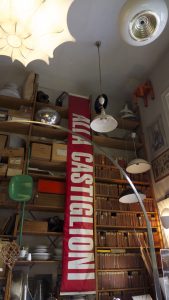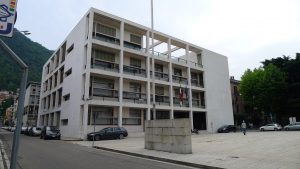
Giuseppe Terragni’s Casa del Fascio in Como on June 9, 2016. Light, contextual and complex in ways other fascist era buildings were not.
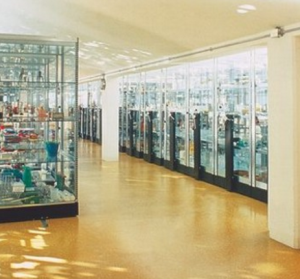
Part archive, part repository, part museum. This is a place where design process documents, prototypes, experiments and production pieces co-exist.
http://www.alessi.com/en/company/museum
Films on Alessi desigers:
http://www.artfilms.com.au/Search.aspx?SearchQuery=Design+Interviews
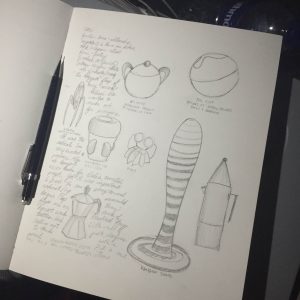
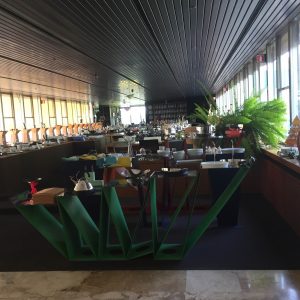
We were welcomed into Alessi’s large arrangement of items, arranged from the newest, the nicest, and the contemporary ‘pop’ items in the back. These items were what is currently available in their store. What showed us the truer story of Alessi were the stories placed in their upstairs ‘museum’. This museum was out of the ordinary, no name tags, no pedastals. Instead the shelves were full of un-launched projects and designs. In this way, we were told, each object had a greater depth of struggle and of story.
We were shown the Bomb teapot, a rejected Mendini vase, and Stark’s famous lemon squeezers (or non-squeezers what have you). Yet my favorite story of all was that of the collaboration between Alessi and artists, specifically Salvador Dali. Their collaboration (to serve art + design to the lower class at an affordable price) would eventually become what Alberto Alessi would later call the biggest flop of his career. The complex nature of the projects increased their production costs and decreased the interest of the ‘common’ man. This being said, we were reminded that although this project was a flop, it was a revolutionary idea that set Alessi apart. Through this endeavor they proved their willingness to take risks and be innovative, two actions necessary for good design.
The greatest notion I received is that flops are evidence of honest work. Flops are the spice of design. Without them innovation is impossible, and design would remain stagnant.
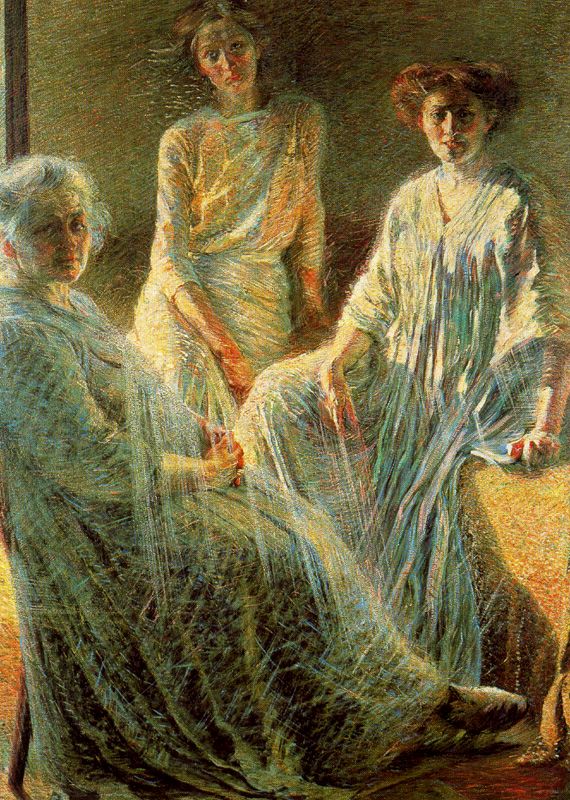
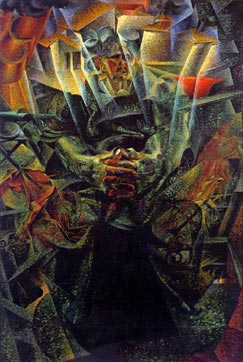
I picked two paintings from the Palazzo Reale exhibition on the work of Umberto Boccioni. In my opinion, these two paintings, “Three Women” and “Materia,” are pivotal moments in Boccioni’s evolution into a Futurist painter.
In the first painting, “Three Women,” Boccioni starts to play with movement in the image through his painting methods. You can see the short and rapid brush strokes that energize and bring to life the light in the painting. This is one of the first works of his that begins to show signs of moving towards a more abstracted way of painting. The caption next to the painting describe it as “extraordinary luminous energy” with “glowing colors.”
In the second painting, that stood out to me, “Materia,” Boccioni really embraced the abstracted form. This is a painting of his mother, which used as subject material a lot. This painting again, reference light. There is an aura of light that surround his mother in the painting. Most of the painting uses darker colors, but then there is a bright pop of light around her head. The background of the painting seems to resemble a factory and city life. This really speaks to the Futurist Manifesto, which is enthralled with mechanical and industrial processes.
Umberto Boccioni was and is the key and arguably most important artist of the Futurist period. This was quite evident due to the fact that there was one entire gallery at the Palazzo Reale dedicated to his work and several pieces by him at the Novecento.
The ideals of the Futurists seemed rather entitled and exclusive but the artwork is amazing nonetheless. One of their central pillars was the use of speed and motion. There are also many references in his work to cubism and the work of Picasso.
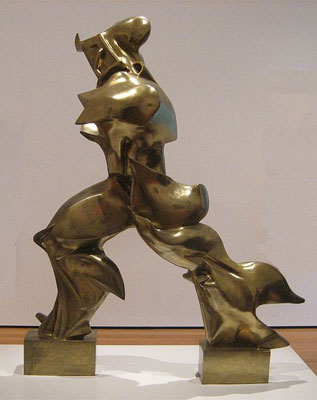
Boccioni’s most famous piece Forme uniche della continuità nello spazio (1913) is a sculpture that combines multiple forms created by a man in stride. It’s a three dimensional rendition of what cubists created in the form of painting. This piece magnificently captures the futurist ideals of portraying speed and motion, as is very apparent. The texture and form are a more subtle hint at the chaos and “war” that the Futurists are so taken up with.
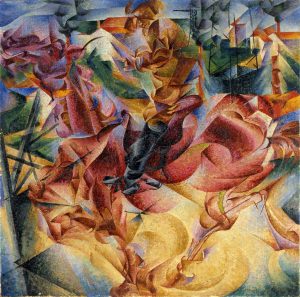
Elasticità (1912) once again by Boccioni also employs the Futurist elements of motion and chaos. The picture evokes a sense of urgency through the use of contrasting colours, the overlapping lines of the figures blending together to create one amorphous form. Circular shapes that create undulating contours add to the motion of the piece. There is also a similarity between cubist abstraction and the portrayal of motion in Boccioni’s piece.
Both these pieces utilize human figures to embody the Futurist principles, but incidentally use traditional forms of travel. The man in the sculpture is using the age old mode of transportation, walking, while the painting is of a man on horseback. Both modes are common for the time, but not the new and upcoming technologies that the Futurists aspired to embrace and embody.
~Saniya
The Alessi Factory is owned by the Alessi family, and they create and produce household appliances and utensils. They model their work after a variety of styles, but the key components are functionality and aesthetic.
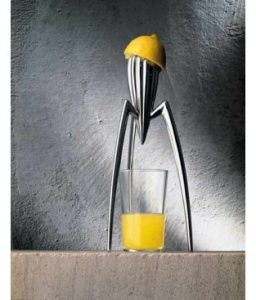
From the 1990s-onward, Alessi products have become associated with the “designer” world. That means, they take ordinary products and tools and execute them at “high design”. Such as the Juicy Salif that created much controversy. Besides its odd shape, many questioned its’ functionality – many thought it was produced more as a design object rather than a functional tool to actually be used.
The firm began as a small workshop, and it was founded in 1921 by Giovanni Alessi. The company started with wooden or metal materials for general household objects. Alessi started with producing a wide range of tableware items in nickel, chromium and silver-plated brass. Over the years they have changed the materials they use to keep the products at a high quality but within a budget-friendly range.
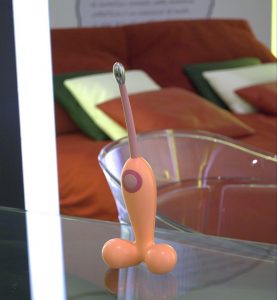
The company also incorporates 100+ artists with over 200+ projects constantly in progress. The projects vary from revamping the older models to creating completely unique products; each unique to the artist(s) – much like Alessi himself.
This week we walked countless steps throughout the city, however, the majority of the walking took place throughout various museums and exhibitions within Milan. One of these exhibitions was held at the Palazzo Reale and featured works primarily from Umberto Boccioni, an influential Italian artist who helped shaped the style of the Futurism Movement in the early 1900s.
While the exhibit displayed various pieces of Boccioni’s work, the ones in which movement were more noticeable seemed to catch my attention the most. His work all conveyed emotional connections and stories, however, the movement that was captured within his later pieces (more futuristic) seemed heavier in emotional response and comprehension. Although I admired all of the pieces, I was captivated and intrigued by one particular painting and sculpture on display at this exhibit.
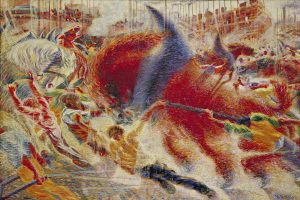
‘The City Rises’ (1910) is a painting by Boccioni that captures the movement and growth of a modern city during the time period. And although dark and full of movement, there seems to be an appreciation of the direction the city is taking and an encouragement of continuing to support the modern city. There seems to be a horse that is uncontrollable within the environment and the people are working together to reclaim order, which can be seen as struggle to achieve a greater end goal, as well as a shift in levels of importance between nature/ animals and futuristics visions of the urban environment.
The second piece of work that intrigued me the most was the iconic sculpture, Unique Forms in Continuity of Space (1913). This bronze sculpture of a man, who seems to be of machine-like qualities, exemplifies the movement that many of Boccioni’s paintings had captured. Although made of metal and full of well-defined sculptural lines, this sculpture seems to be capturing movement in a second of time with a fluidity incomparable to that of the two-dimensional paintings. Although this piece was created a few years later than the painting, ‘The City Rises’, I believe there is a similar notion of wanting to continue moving forward and exploring the possibilities for the modern world.

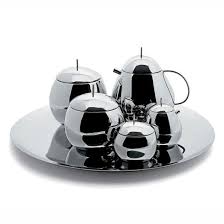
Having the opportunity to visit the Alessi museum today was an absolutely wonderful experience. As one of the handful of students in this group who posses no prior knowledge about the inner workings of design, it was lovely to see the process and intensive commitment involved in creating beautiful pieces. My favorite piece we saw today was most definitely the tea pot set made out of metal. I was absolutely in love with the story our guide told us, she described how Alessi specifically created this set in order to impress his future father in law. I also admired how many of the household items Alessi created all seem to deviate from the standard norm of what typical household products should look like (including the tea pot set). Each item had a certain charm and individuality that just seemed to enhace their use through their physical beauty. On a separate note, the town of Omega was also incredibly stunning. The contrast of the beauty of the household items as well as the stunning alps within the town just seemed to be a dreamlike experience. It almost makes one wonder if natural elements played some small role in the creation of these designs even through their contemporary style. Even the addition of the waterfall in the entrance seems to hint at this possibility.
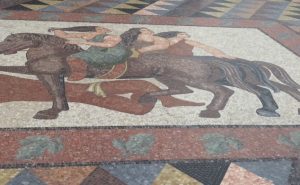
Upon our arrival in Milano, I was not confident in where my attention would be focused. Being primarily interested in architecture and the urban environment, I felt that may attention could be focused on an array of things in the city. However, one of the first things that caught my eye was the various forms and patterns of ground covering throughout the city.
Milan is obviously a very historic and artistic city, which I believe encourages the array of ground coverage and flooring that I have observed thus far. The first eye-catcher, in my opinion, was at The Duomo and Galleria adjacent. The patterns are simple and geometrical, not extravagant or bright, but they seem to add an appreciated element around and within these spaces in my personal opinion.
I was hesitant to be completely focused on flooring and ground coverage throughout the duration of our trip for the sketchbook assignment, however, after more exploration around Milan, I felt assured in my decision. The flooring found on the ground floor of the main Triennale event was more extravagant and slightly more colorful, yet it too had a primary element of geometry and spacial definition. This flooring has been one of the less geometrical flooring patterns that I have come across, however, it utilized the same mosaic tiling that can be seen throughout the city and its surroundings.
So far, my sketchbook is an array of geometric patterns and mostly neutral colors, however, I believe the consistency within the array is an important observation that has been documented. Although many flooring patterns have had similar structures/ designs, each space is unique and intriguing for their own reasons. I hope to continue my observations across the city and its surroundings over the next two weeks to further document unique patterns and consistencies throughout the city.