Chandeliers of Milan

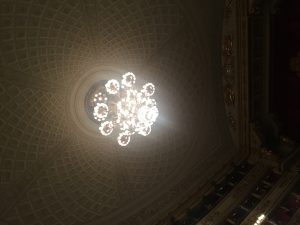
Chandelier, La Scala Theater

For my sketch book, I have been drawing and detailing the numerous lights within the Milan. From the contemporary lights installed with museum and stores, to the draped chandeliers found within Villas, Milan serves as an incredible canvas to the multitude of lights hidden within the city. One of my favorite pieces that we have seen so far is the Stunning chandelier that was the centerpiece of the La Scala theater near the Duomo. This chandelier was massive, and is also perfectly suited to be placed within the theater. Complemented by the lavish interior, the crystals and glass formations were enhanced by the gold detailing within. In my sketch, something I noticed while recreating this ornate piece (this was also a theme I noticed while drawing other chandeliers), was that how the effect of making the chandelier look proportionally impossible is the purpose of creating an ornate piece dedicated to lighting.
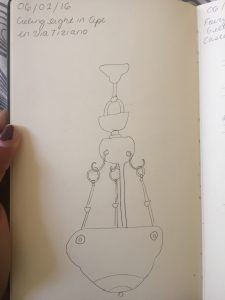
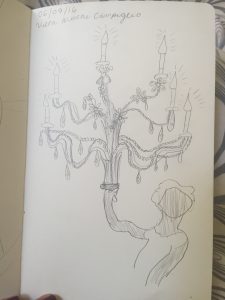
IMG_8298IMG_8299

In Villa Necchi, there was an abundance of lighting that offered a variety of juxtapositions between the stereotypical grandiose chandelier as well as more contemporary versions of a chandelier as well. Regardless, these pieces each possessed the quality of seeming almost weightless, an impossibility that results in the magnificent result of being awe stricken by floating crystals illuminated by light. In the Villa, there was a definite contrast between the crystalized chandeliers and the versions of chandelier that are focused more on metal adaptations of the same form. Regardless, these pieces each had the same effect within a room; achieving the feeling of being apart of the weightless appearance of the chandelier. The most unique piece within the villa was a chandelier that appeared to be modeled after some sort of sea plant. It seemed tentacle like, and was perhaps formed using glass or crystal. An interesting effect occurs due to the concentration of the light bulb within the chandelier, drawing central attention to the base of the fixture and slowly dimming out the effect towards the ends. Interestingly enough, others thought that this chandelier bared no similarity to sea weed, and instead saw a different type of flower in its appearance.
Art in Fascism

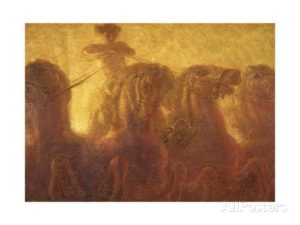
In a nutshell, fascism is the political form of government which is most closely tied to the infamous Italian dictator, Benito Mussolini whose reign stretched during WWII. It is believed that the word for this type of government is derived from the Latin word Fasces, which means “unit”. In ancient Rome, Fasces was most closely related to the idea of an axe surrounded by rods. The symbolism of the unity and power behind Fasces is an ideology that can be seen throughout a multitude of ancient and contemporary Italian media. In Gaetano Prevati’s Chariot of the Sun, these references can be identified within various motifs within his piece.

gaetano-previati-the-chariot-of-the-sun-or-triumph-of-commerce-1907

Of course, as all totalitarian rulers do, art is exclusively used in its various and specific forms of style and imagery as a tool to express ideas of absolute power. This piece by Prevati is a perfect example of this, demonstrating not only the literal imagery of power and control, but also using mythology in order to emphasize a divine characteristic and the “necessity” of absolute power. A direct reference to the myth of Helios can be found in this painting, specifically through the use of the image of the chariots and the use of golden color in order to highlight a sun like quality to the piece. Through this, the major theme that can be seen is the correlation between unity and power; while one wields the reign, the group is able to glide forward through the total control of one individual. Summing the very essence of the ideology that drives the purpose of fascism.

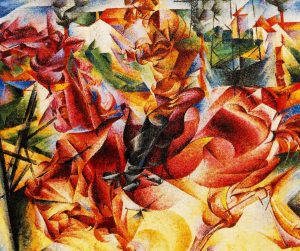
Umberto Boccioni, Elasticity
Similarly, Elasticity by Umberto Boccioni possesses similar elements to Chariot of the Sun. Through using cubist form, Boccioni creates a variety of shapes and patterns that also reference the sense of unity and power. Similarly, to a Rorschach test, every individual is able to conceptually pick out a unique feature from this painting. For me, I immediately recognized patterns that could be related to images of sails on ship as well as images of what appears to be laborers working on a field. Regardless of what image one picks out from the entire piece, there is one common theme laced throughout; that everything within the painting is strictly controlled. Everything within the piece is incredibly similar, only deviating between the use of lines and color throughout. In terms of unity, the coherence of color and shape are a direct reference to this regardless of individualistic forms. In turn, this directly creates the reference to power; everything within the image is strictly controlled through its boundaries of lines and curves.

Cavallino Treporti

image1
View from dinner at Trattoria Laguna

This weekend was quite the adventure! My roommates and I decided to to take an overnight trip to Venice. We had absolutely no idea that Venice was so huge, so when we booked our air b&b we tried to just book a place in an area that looked central to everything. Well, when we got off the train in Santa Lucia, we discovered the place we were staying was on a completely different island called Cavalino Treporti. It took two fares to get to Cavallino. I was freaking out because I had no idea where we were going and I had wanted to experience the touristy parts of Venice, such as taking a ride taking a ride in a gondola or walking around St. Mark’s plaza. That did not happen. After around two hours of sitting in a fare we finally made it to Cavallino, but we were still nowhere close to our air b&b. We thought we would try and walk towards the general area of where we were staying. After 30 minutes of walking and still not being where we needed to be, we broke down and asked for help from someone who worked at a convenience store nearby. She had never even heard of the street of where we were staying. Thankfully, we got in contact with the owner of the house were were staying in and she gave us explicit instructions and were finally able to find her. I would say the entire trek to get to where we were staying probably took around five hours. I was exhausted and it was the first time I wished I was back home in Texas. I just wanted my parents to tell me what to do and where to go. We rested for a little while and then decided to try and salvage the rest of the night by going out to eat at a really nice restaurant called Trattoria Laguna. Trattoria Laguna was incredible! I ordered a pizza with salmon on it, and I tried mussels for the first time, so that was interesting! The entire time we were looking out at the water and it was incredible. The chef asked us where we were from and when we said “Texas” he laughed so hard and asked us how on earth did we find Cavallino. Cavallino is not a tourist town and is very low key. It may not have been the exact part of Venice I wanted to see, but it was very unique to see how Italian life really is. My attitude quickly changed back to being thrilled to be in Italy. I absolutely love it here and I am glad that we were able to experience something different this weekend!

Milan and Me

13344595_10154976961109126_6116435027447921305_n 13413117_10154976787884126_1554150531995715066_n

I was always told how busy New Yorkers are or how fit Austinites seem to be, but I’ve never experienced the level of busy or fit that seems to be buzzing deep in Milano. Milan has the same feel almost as a New Yorker with individuals rushing around every corner and the most active individuals I’ve ever seen jogging or walking dogs and staying fit. Their lifestyle would seem to be unhealthy with lots of carbs in their diet and many meals (second meal, entree, etc.), but they are all so small and fit it’s amazing. I’m also shocked by the level of interaction I’ve had with Milano’s people. I’ve lived in Austin five years, but I was never asked as many questions as I was when I was walking around Milan. Every turn someone is speaking to me in Italian and pointing in some direction. In each case, I’m not only confused but also almost sad that I can’t lend my voice to them or help them in any way I can.

So far, Milan has been a shocking but delightful experience. The people here seem to be welcoming and I haven’t in any way felt like I wasn’t treated fairly, even though I’m an American. The one bit of experience that I feel I don’t quite enjoy is my lack of voice. I feel that even simple tasks of ordering food have become a giant game of hand signals and prayers that the person in front of me speaks English. I honestly wish I knew Italian. I think that would make this entire journey a thousand percent more enjoyable and enriching if I could really appreciate and speak to the people in their own language. Even though this is a minor setback, I’m thankful for the CA’s that have been extremely helpful and are constantly watching and making sure we find our way. Without their help, I think I would have ended up lost or ordering something I shouldn’t have at a restaurant.

Even through all these different culture norms and newfound experiences, I think the most enriching has been seeing the different structures that are present throughout the city. In just Milan’s backyard is the Duomo and the Last Supper, enriching products of history that will forever enrich and bring value to this magnificent place. I think back to my hometown and even Austin and can’t find anything near as beautiful or as timeless as these structures and the art present in Milan. I love the technology that is present in Austin and the ever present start-up culture, but I can’t help but find a deep respect for what’s present in Milan and how it’s survived the test of time. I hope that by the end of this trip I can understand how large the world really is and how small Austin and my hometown seem to be in the expanse of it.

Cultura to Cultura: Milano in one week

It’s amazing that a city so robust, so full of energy and so completely different than the US has made me feel right at home. In one week, I have enjoyed a rollercoaster of emotions from happiness to exhaustion to invigorating peace. The fabric of the city has ignited a wonderful texture into my life. Culture differences, yes, of course. Communication barriers? Definitely. Wayfinding difficulties? Always. But somehow, I have found solace and liberty within these boundaries. These experiences have made me embrace the Italian Spirit—in a state of struggle, beauty arises. The contradictions of the city have taken over the monotonous. The blending of the old and new, the ugly and the beautiful, the unfinished with the polished unexpectedly creates a landscape that could only happen organically over a long period of time. The materials of the past become more beautiful as they sit next to new. The Duomo, for example, stands grand next to a shopping mall and above an underground transportation system. Though, they all have different functions, they all fit in nicely together, while the congestion of the city only adds a melodic motion to theterrain. The realization that all these fragments are but harmonious music notes adding rhythm to the city makes me love the city even more.

I am overwhelmed by how much information we have covered and processed in one week—from Divisionists to Fascism to Futurists back to art nouveau. Most of it I didn’t know, some I did. Either way, it has made me appreciate art history and architecture even more, but also made me appreciate the present. Feeling a paradox of my so-called privileged life. Got me thinking … could I have been a great designer in those times? … if I were a working class dreamer? … if I did not have access to a certain amount of wealth? This also got me thinking, these past moments and fragments in time have generated our current state of affairs. Although, most architects and designers were being critical of certain aesthetics and political movements, they were not aware of the environmental impact of their products. They were, however, embracing the small businessman, the craft maker, the hand-work designer and local materials, which reflect the current movement across the globe. Milan did not have to shift in production thinking because they were already locally-minded, they have done so for hundreds of years. Those were and are Milan’s blood vessels. In contrast, the United States has just now (in the last few decades) started reconsidering the art of small.

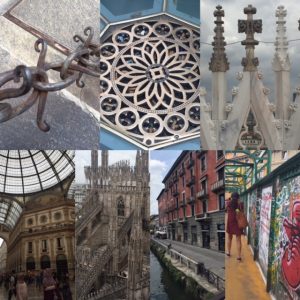
Visually, the city, is full of beautiful textures.IMG_6698

Blog 1, Week 3 – Milan Mapping Project

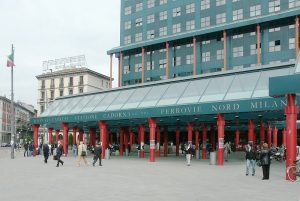
Point A: Cadorna Station <-> Point B: La Scala (E.T.A. 20 mins.)

We are in the process of creating a powerpoint showcasing the panoramic view of the intersections, then details focusing on the footwear of everyone we pass; also, we focused on the architectural structure and how it changes between each location.

For example, closer to La Scala, the buildings become older and more gothic-themed, and the people on the streets and on bikes are better dressed than those near Cadorna. Most likely, these are people who work in the older, more prestigious buildings near La Scala, and the ones near Cadorna are travelers or work in the shops in and around the city, so they have less reasons to “dress-up”.

Cadorna Station
Cadorna Station, Point A

The walk is roughly 15-20 minutes, and it’s quite lovely. The streets are nicely shaded, and the shops that line the walkway are intriguing. There are, however, less lovely areas on this walk. For example, there are quite a few areas of construction and a few instances of homelessness. 

The focus is primarily on the social aspect such as how do the people we pass change between locations (shoes and attire, for instance), how does the sidewalk and building facades change, is it walker friendly, etc.?

La Scala
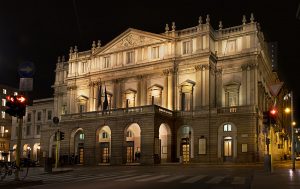
La Scala Theatre, Point B

Boccioni’s Futuristic Influence

Italian art is never so simple as to be solely for the aesthetic; Italian artists have set trends, sparked movements, undermined governmental control, and allowed the oppressed to seek redemption. The avant-garde movement of Futurism allowed Italian artists to celebrate and publish works that elaborated the notions of urban modernity and technology. Artists wanted to rid themselves of the old (old style, old works, old ideals and culture), and they wanted to embrace the beauty of modern light.

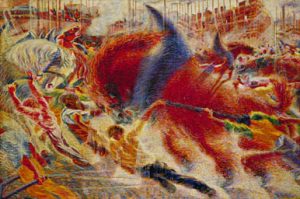
One of the greatest artists to have accomplished such advances in art is Umberto Boccioni. Not only were his paintings renowned but his sculptures paved the way for modern design and art. As a principle contributor to the revolutionary aesthetic of the Futurist movement, Boccioni created significant pieces that sparked the fire he needed to progress. This ideal behind the Futurist movement is evident especially in his “The City Rises” piece (depicted below).

Considered to be one of the first Futurism paintings
The City Rises is considered to be one of the first Futurist paintings by Boccioni; as the city rises, the fires of the revolution consume it.

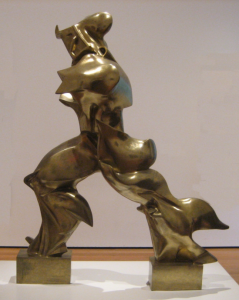
Another incredibly influential piece at the time was another work done by Boccioni; however, it is 3-dimensional rather than the 2-dimensional pieces of his canvas work. Boccioni was frustrated by the lack of movement in his canvas pieces, so he wanted to create a work in motion. Thus, he created a more effective way of expression in his famous work “Unique Forms of Continuity in Space (1913)” (depicted below).

This piece captures the essence of a figure in motion, rendered in a way that conveys an effortless grace and movement.

These two works of art were key components in the advancement of Futurism. Despite his short time working in Futurism, Boccioni made grand strides with his works, and they helped shape the “future of Futurism”. The ideas of embracing and romanticizing labor and movement are evident in modern pieces that were influenced by previous works such as these.

First Week in Milan

My first week in Milan has come to a close, and I cannot believe it! We have done so much already, but there is still so much to do.

Milan is a beautiful city. Everything around me has some sort of history, compared to back home where buildings are still somewhat new, or at least from the last century. Everything is so much more compact here than in Texas. We are used to open spaces and being able to see for miles and miles, but here, looking out the window, all you see is more buildings. I guess it would be similar to living in a large city like New York as well. I am still getting used to such tight spaces. For example, the grocery store! I am used to a large superstore like HEB back home. But here, the store is about as big as my Austin apartment. It is like one long aisle that wraps around like a snake in this itty-bitty building. The stores still have the same type of food, just fewer options than we are used to. Also less junk food or processed food. It almost reminds me of shopping in a gas station store size-wise that is.

Milan also has a really well designed public transportation system. They have so many options! There are trams, trains, buses, and an underground metro! I think Austin could take a hint from Milan. The metro system is very easy to navigate. I understood how to get around on the subway in my first week! Now, that’s saying something, especially since I cannot read or speak Italian. We did have help the first few days, though. Compared to Milan, Austin’s public transportation system is lacking. We only have buses, that sometimes run on schedule, but usually not. We have a rail line, but only one, and it only connects the suburbs to the city center. The people of Milan know how to get around, in my opinion.

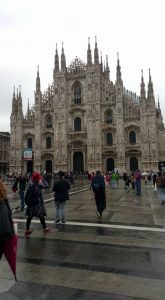
I think one of my favorite things about being in Milan so far is that the history just kind of pops up and surprises you. You don’t have to go looking for things because the city was built around the historical landmarks. Like the Duomo for example. Just sitting in the city center, is this massive cathedral! These buildings of importance are not built far from the center of the city like in the US. One reason is that they were usually the first landmarks of a city, rather than added on later. Another reason is that Italy is much smaller than the US and does not have room to space out things. But I love that I can be walking down a street and BAM! History is in my face.

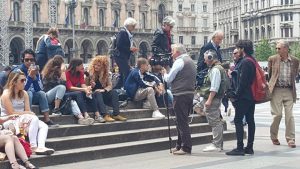
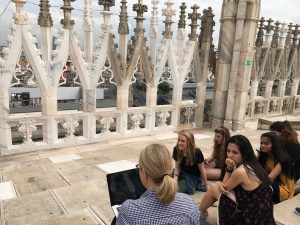
Class on top of the Duomo! A lecture about Futurists.


Transportation Differences in Italy

Trains

Trains: are they a necessity or a nicety? Would it be easier to catch a cheap flight or take the drive? Trains were one of the first modes of transportation, so it makes sense that one of the oldest countries holds fast to traditional ways of travel. Trains are especially important to those trying to travel within Italy. Not only is the view spectacular, but many trains travel rather quickly. For example, a train from Milan to Venice is only a two and a half hour ride and around 120 euros.

Great price, great time, and great view.

Metro

Much like every major city, public transportation in Milan is essential. The metro with its multicolored tracks and easily navigable stations remind one of the monotone and hectic station New York City.

After only living in Italy for a short week, the metro has actually become one of my favorite modes of transport. It is easy to use thanks to our metro cards, convenient due to the many stops and stations, and fast moving – transporting both civilians and businessmen alike on a daily basis. Not to mention, it too is a fairly inexpensive way to travel the city.

Tram

I have never ridden a tram before this trip; however after the initial jolt of unease while boarding, i realized it is essentially no different than the bus system. Just know your stop. And take a buddy. Or two.

Buses

Speaking of above ground transportation, the buses are possibly the most confusing of them all. The names of the stops are in small print or not visible at all to the rider. Also, the view of the beautiful city is so awe-inspiring that you can become very distracted and miss your stop completely. Unfortunately, that has happened more than once in the span of three days.

Unlike the buses in Austin, the bus schedule and numbers are fewer and farther in between. Despite having a full month to understand this foreign system, i will most likely stick to the metro.

Taxis/Cars

Finally, the streets of Italy are winding and highly confusing especially to a foreigner like myself. Taxis and other vehicles pull up and even park on the sidewalk; they also drive in insane circular turnabouts all across the city. Although driving in the city may give me a panic attack, Italian drivers and natives are surprisingly calm and cautious. From squeezing between trucks to parking on the sidewalk, cars in Italy have a unique sense of driving that is brand new to me.

Cars aren't often the most popular mode of transport, but the few on the road are small and fast.
Cars aren’t often the most popular mode of transport, but the few on the road are small and fast.

Americans wouldn’t be able to handle this.

With so many ways to get around the city, your best bet is to find what is most comfortable, whether it’s by bus, metro, or your own two feet. For now, I will stick to walking to the metro station.

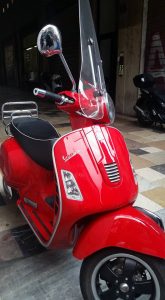
Mopeds are frequently used for single riders trying to get around the city faster.

First Impressions

IMG_7449

One of the first things one notices when arriving in a new destination is the stylization of the architecture within the city. Geographical similarities within Milan is abundant, and this is a fact that is can be seen as soon as one first steps foot into one of the many districts within Milan. For me, what seemed to stand out the most within the architecture within Milan was how many of the apartment complex’s share three dominant characteristics; quaint, close-knit, and colorful buildings can be found on nearly every street and corner. More specifically, what is most notable about these buildings is that fact that although they may appear to be synonymous in their makeup, they each possess unique traits that define their individuality. This is something I noticed as soon as I entered my apartment within the city.
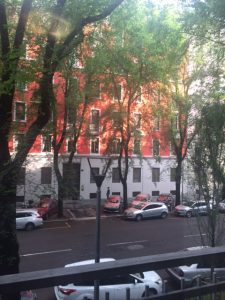
From my building, I have an incredible view of a bright red toned apartment that can be seen across from my room. I spent a few minutes analyzing its features in comparison to other buildings I saw upon my arrival. Although one may carry the notion that these apartments may look incredible pre-planned and fixed, further analysis shows definite evidence that each building carries unique features that solidify their individuality. For instance, the building across my apartment is notably plain in contrast to a few others on my street. This building is designed with plain windows (consisting of a modest white frame), simple lines, as well as quaint details such as lighting fixtures. However, what makes this building stand out is its rich, red toned surface that catches the eye. While a building may appear the be deceivingly rich in its appearance, this is merely a mirage that occurs due to specific color choice. Incredibly simple buildings can be transformed through the use of paint.
This is a theme that can be seen in a variety of other structures within Milan as well. On a tangent, something that is also notable is the use of iconic or more notable buildings in order to draw attention to less prevailing structures. I was most aware of this in the district around Duomo, where a variety of shops and quaint stalls can be seen throughout the area. All of these stores were greatly enhanced in structure and presentation due to the fact that they were all adjacent to the most iconic structure within Milan. Ironically enough, in comparison to the similar buildings that can be seen throughout Milan, the Duomo is the most unique in its style and construction. The Duomo’s own institution of individuality against the identical features within the city testifies the capability of uniqueness to prevail in popularity regardless of the style that may appear to be commonplace.