
By SANTIAGO MUÑOZ-ARBELÁEZ
In December 2025, friends of LLILAS gathered to honor benefactor Joe R. Long and to view a selection of rare and ancient pre-Columbian objects donated to the institute by Mr. Long and his late wife, Dr. Teresa Lozano Long. The event, titled “Gold, Feather, and Form: Ritual and Representation in Ancient Colombia and the Andes,” was a celebration, marking a quarter-
century since the Longs’ transformative gift to the Institute of Latin American Studies at UT Austin ushered in a new era of promise under a new name. During the gathering, Professors Santiago Muñoz-Arbeláez (History) and Astrid Runggaldier (Art and Art History) delivered brief remarks to contextualize both the collection of objects and, more generally, the value of physical collections for university teaching. This text summarizes Professor Muñoz-Arbeláez’s talk.
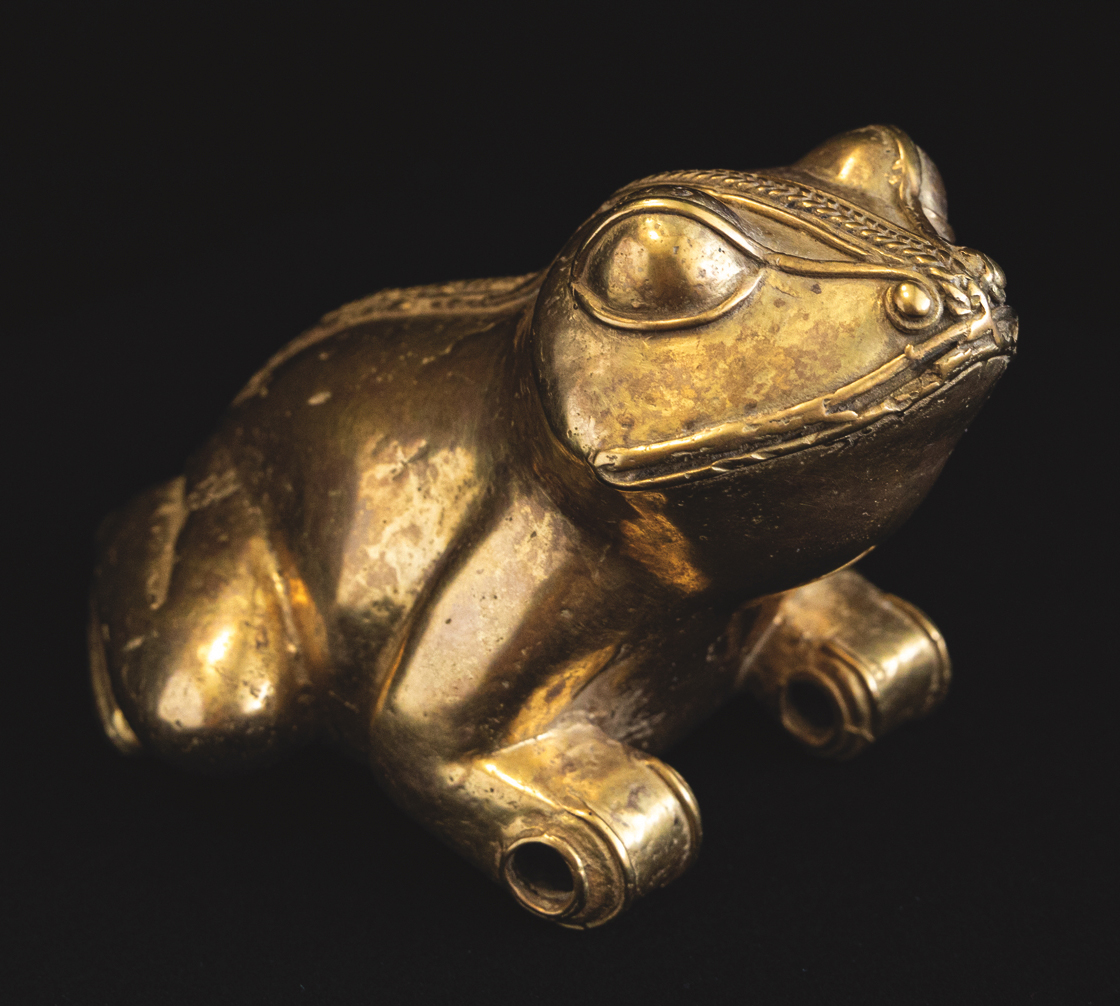
The objects housed at LLILAS were crafted by Indigenous peoples living in the territories of what today is Colombia. At the time of these objects’ creation, the area was a unique site of geographic and ethnic diversity that extended over three different ranges of the northern Andes, inter-Andean river valleys, and the coasts of the Pacific Ocean and Caribbean Sea. The collection encompasses creative and skilled representations of human and animal figures, including frogs, birds, and snakes. Some of these objects were meant to be displayed in homes, public spaces, or on the human body (as necklaces, nose rings, or earrings); others were to be buried, hidden, or concealed from general sight. All of them reveal incredible technical sophistication and artistic creativity. The work and care that went into their production shows that they were meaningful objects, highly appreciated by the people who made them and held them.
Unfortunately, we do not know much about the meanings of these objects for the many peoples that made and used them, as they have undergone many different stages of plunder. Beginning in the early sixteenth century, Spanish conquistadors and colonial officers took these objects to be pagan idols. They pursued campaigns to confiscate items of worship, desecrated graves, and went to great lengths to obtain golden objects to then melt them and take the gold for their own profit. Later efforts to preserve and display these figures brought many surviving pieces into major public collections, such as the Gold Museum in Bogotá. Yet, much of the archaeological context has been lost and many pieces possess only vague regional identifications and loose chronologies.
This is even more the case in the context of the ethnic and geographic diversity of the Northern Andes and septentrional South American coasts. Some archaeologists have termed this region the Intermediate Area, suggesting that it was part of a larger cultural area between the Inca and Aztec empires characterized by its decentralization, and by the absence of states and empires. Despite the lack of a cohesive, centralized political system, this region has long been the site of extended trade routes that nonetheless flowed across ethnic boundaries and connected populations. Gold and golden pieces were part of the lively networks of exchange that moved from the lowlands to the highlands, along with feathers, shells, cotton, coca, and other objects, to be traded for commodities like salt and woven textiles.
Amid this startling diversity and decentralization, the lack of precise identifiers, dating, and contextual information makes it difficult to remark on the individuality of the pieces—to say who used them and why. While we do not know much about their specific contexts, scholars have made significant contributions by elucidating the production processes by which these items came to exist. Indigenous artists produced golden pieces through a complex, multilayered process. Artists first built an accurate model of the figure using beeswax, which served as the basis for a clay mold. Once the mold was set, artisans gently heated it to melt and remove the beeswax, then poured in molten metal (often a combination of gold and other metals, such as copper), which took the shape of the initial mold. The removal of the beeswax gives this technique its name: lost-wax casting. When the metal cooled to solid, the maker broke the clay mold to remove the piece, then cut, hammered, adjusted, and polished the metal, giving it its final shape. This resulted in a shiny, vivid figure. Some scholars posit that the technique itself, and the use of beeswax, constituted a meaningful practice.
Many of the motifs were associated with the visual and symbolic language of shamanism: a ritual practice in which spiritual guides would often transform into another being and take its point of view. Some scholars believe that shamans associated the radiance of gold with fertility and semen, and established connections between its color and shine with the sun. The repeating images of birds and frogs in the figures are allusions to the sun and moon, the former reflective of light and the sky and the latter shadows, darkness, and earth.
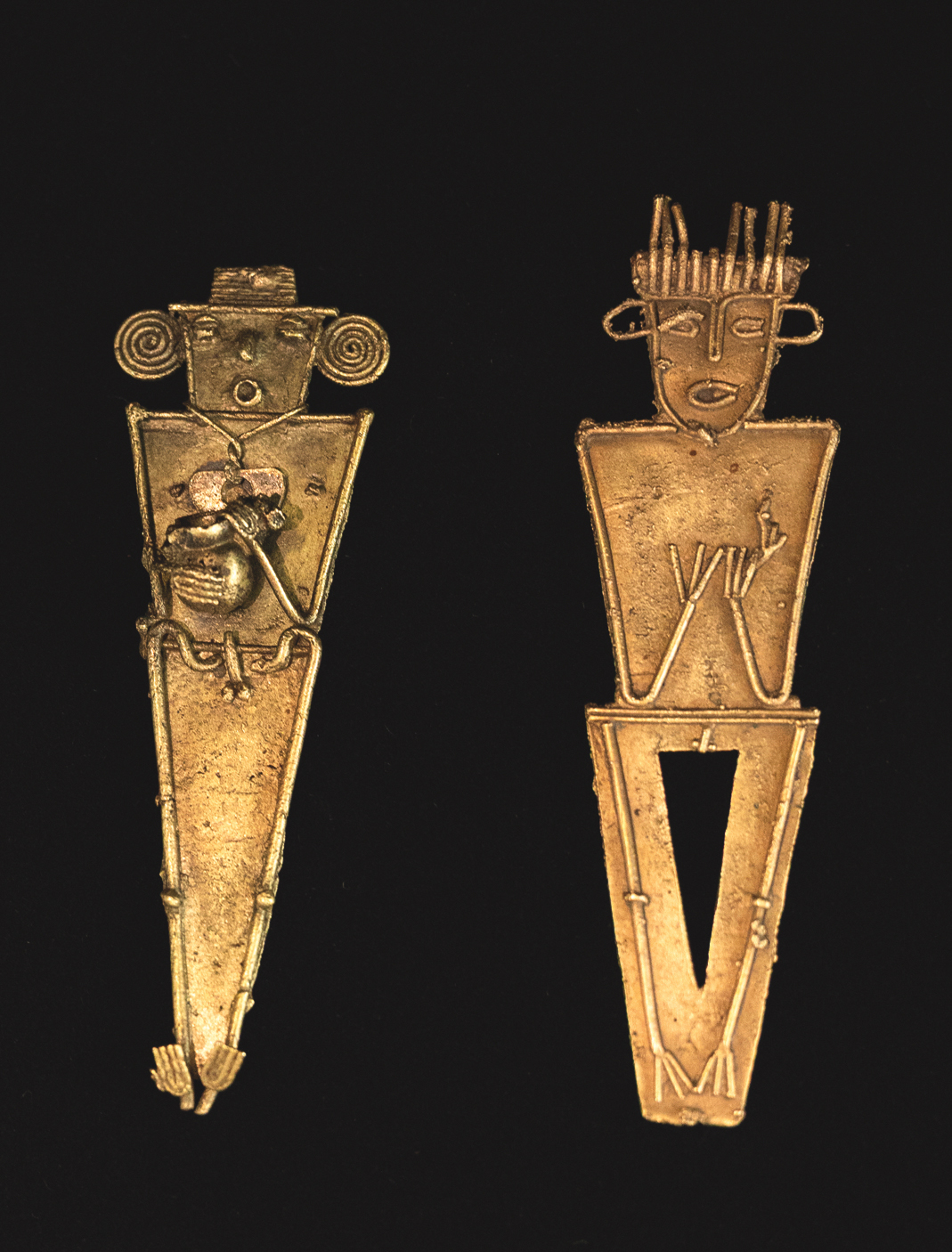
A notable exception to this pattern are the human-shaped figures, called tunjos. These enigmatic objects were produced in volume by the Muiscas, who did not appear to give much importance to sheen, color, or style. Rather than being exhibited in public spaces or being appreciated for their visual characteristics, tunjos were often hidden, left in ceramic containers in hilltops or caves, with emeralds, clay figures, textiles, and other valuable goods.
While many questions about these relics from the South American past cannot presently be answered, the LLILAS collection is a testament to the remarkable and interconnected visual and material cultures of the many Indigenous peoples who inhabited northern South America prior to the arrival of Europeans. ✹
Related reading from Astrid Runggaldier: Time Travel: University Collections Make the Past Come Alive