
by Janic Aguirre
On August 14, Unchained.Art Contemporary Gallery in Downtown Austin, in collaboration with the Center for Shamanic Education and Exchange launched an exhibit titled, threads & patterns: living indigenous art of the americas. The exhibit features Wixárika yarn paintings, Shipibo-Conibo tapestries, and Kogi woven bags. Based in Santa Fe, NM, the Center is a nonprofit dedicated to the perpetuation of “shamanic wisdom, culture, practice, and traditional ways of life of Indigenous people worldwide.” They operate projects in Colombia, Peru, Costa Rica, Guatemala, and Mexico, supporting the construction of religious architecture, language conservation, apprenticeship programs in schools operated by and for local communities, and the sharing of spiritual knowledge across Indigenous groups. Mary Olivar, secretary for the Center, attended the event and provided commentary on the activities and symbolism of the exhibit. Threads & patterns was the first collaboration between the art gallery and the Center. The exhibit runs from August 14 to August 28.
On August 14, I had an opportunity to visit the opening reception during which I spoke with Olivar, Unchained.Art Contemporary Gallery owner and director Christina Hiltscher, and several patrons. Olivar, who maintains connections with the artisans and Indigenous communities, shared stories and literature detailing the importance and symbolism of the displayed art. In the case of the Wixárika yarn painting from San Luis Potosi, the artisans sew their pieces without prior planning. Instead, influenced by medicinal plants and high-tempo music, the artisans produced cohesive colorful images, each with spiritual and cosmological significance. A recurrent motif among several displayed pieces is a multi-color square, called the “ojo de dios,” or “the eye of god”—reminiscent of the creation story in which the Great Grandmother Takutsi Nakawe created the earth and divided the cosmos into five directions (the fifth direction being the center).
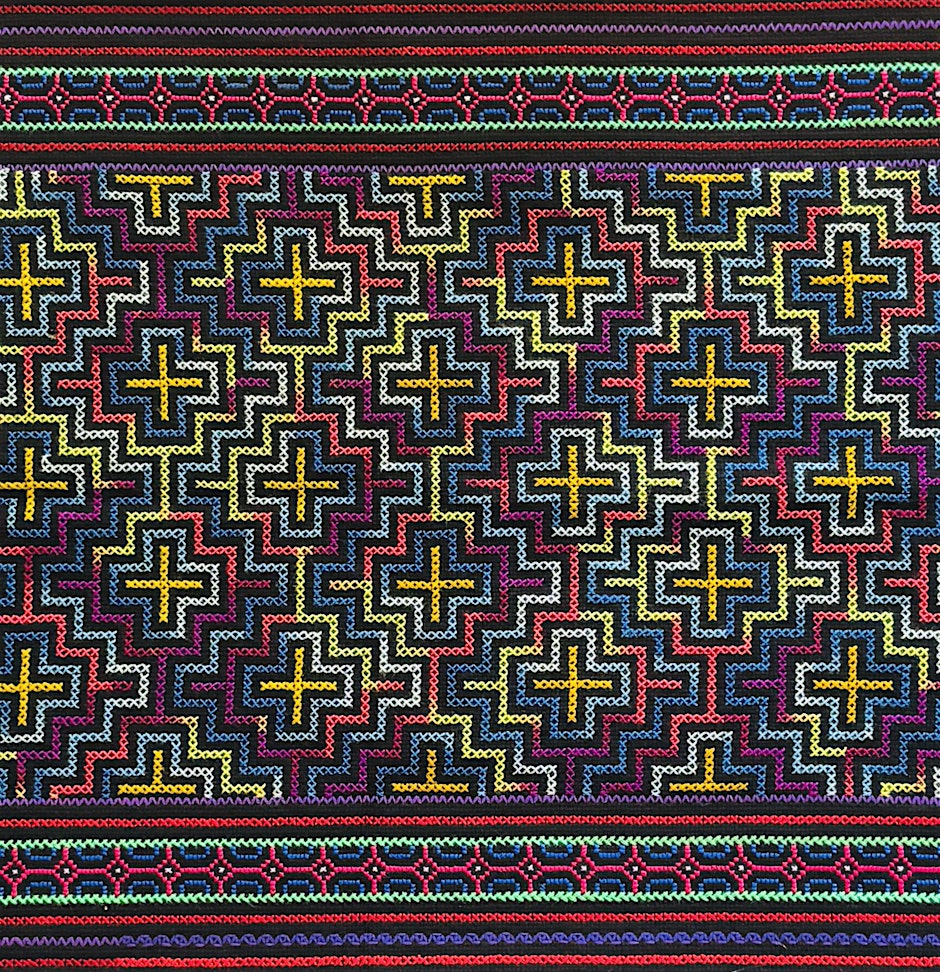
A common theme in both the Wixárika and the Shipibo art in the exhibit is the centrality of medicinal plants as a subject. On most of the exhibit’s Wixárika yarn paintings, artists articulated the peyote plant, a sacred psychoactive plant used in ceremonies and pilgrimages, at the center of their canvas. Similarly, among Shipibo tapestries featured in the exhibit, the midpoint of these pieces has iconography of banisteriopsis caapi, of which the vines are an ingredient for the psychoactive drink ayahuasca (also known as yage). Traditionally, among the Shipibo, the healer or médicos consumed ayahuasca. Drinking the concoction enabled the médicos (also known as onaya) to receive healing songs known as “icaro.” Within Shipibo cosmology, each plant has a spirit that communicates with and allows onayas to perform rituals and sing icaros. The presence of psychedelic plants at the center of these artworks may represent how peyote and caapi occupy a significant role in the spiritual life of Shipibo medicine and knowledge creation.
The exhibit attracted patrons from various walks of life—local artists, regulars and friends of the art gallery, and individuals who had experienced the use of psychedelic plants and participated in healing ceremonies. Indeed, one individual remarked how the geometric patterns on the Shipibo tapestries reminded him of his experience undergoing rituals led by an onaya in both Latin America and United States. He described how kené, the rigid, somewhat right-angled design on Shipibo tapestries, perfectly encapsulates the dissonant music he heard participating in those rituals. Healing and spiritual practices alternative to the predominant traditions of the West attracted this interlocutor to the Shipibo tradition—to threads & patterns: living indigenous art of the americas.
It has been sixty-three years since Beat Generation writers William S. Burroughs and Allen Ginsberg published the Yage Letters and popularized spiritual practices and healing in South America. Influenced by Burroughs and Ginsberg’s account of interacting with Indigenous groups in the Amazon rainforest and ingesting ayahuasca themselves, many denizens of the West traveled to Latin America to experience the drink’s healing properties—a phenomenon sometimes called “ayahuasca tourism.” Decades of tourism from Western audiences influenced the spiritual traditions of groups that utilize ayahuasca. Ganaele Langlois argues that Shipibo art, as a living and breathing form of communication, undergoes changes as a response to Western audiences (158-159). For Langlois, the introduction of new artistic practices—pictorial representation of plants and animals on kené textiles and t-shirts with kené patterns—is not the consequence of a Western cultural “invasion,” but rather the expression of Shipibo agency to adapt their practices to market forces. These changes, according to Langlois, serve as a means to bridge the cosmological gap between Shipibo and Western worldviews. Some of the Shipibo pieces displayed in threads & patterns demonstrate this new cosmological outreach.
Market forces from the West influence Indigenous spiritual practices, and ironically, it is also market forces that may alleviate concerns regarding the survival of Indigenous cosmologies. As the Center highlights, communities face difficulties facilitating the transmission of ancestral knowledge to a younger generation that may prefer Western modernity and its language. Some artisans from the communities that the Center serves sell their artwork as a means of sustaining their families and educating their children. Thus, in light of this never-ending “great transformation” in which market forces continue to further influence social and spiritual aspects of human life, collaboration with Indigenous communities in maintaining local knowledge and practices may prove significant in ensuring these traditions live.
Janic Aguirre Fukuno is a PhD student in the Department of Religious Studies at UT. Janic is interested in the archaeology of ancient Mesoamerican religion.