Students in my Preservation Science and Practice course are finding that their final paper is unusually timely this year. Their assignment is to write a Request for Proposals (RFP) for a preservation storage facility. An RFP describes the details of a project for an audience of prospective vendors or contractors. Here, the students describe their imagined ideal preservation storage space for architecture and engineering firms that might wish to bid on the work. Students get to show off everything they’ve learned throughout the semester while they practice a skill they’ll need in the field: introducing preservation concepts to a non-specialist audience.
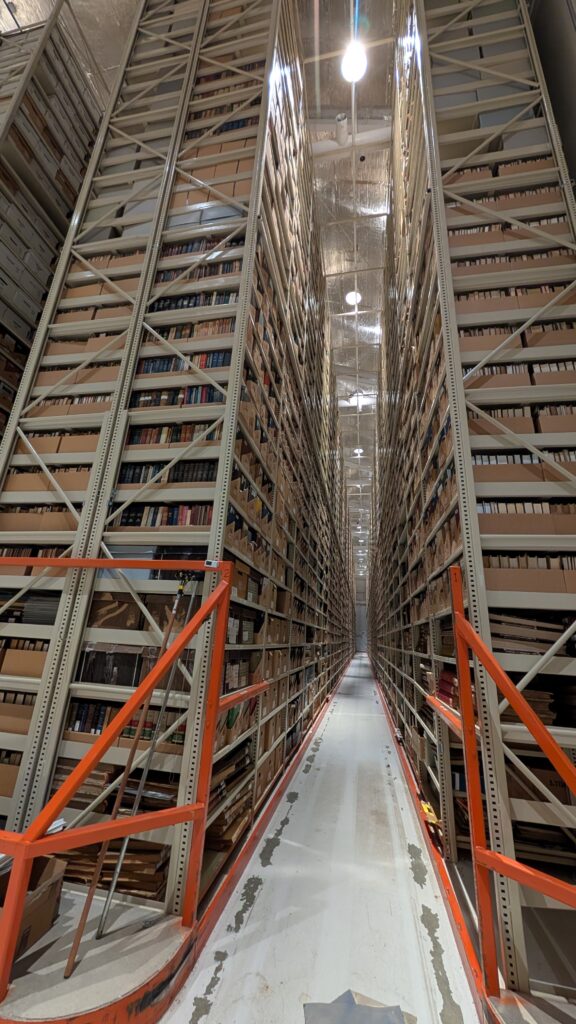
High-bay storage at UT’s Collections Preservation and Research Complex is accessed with a cherry-picker when books are requested on campus.
Meanwhile, students don’t need to look far to find two new preservation storage facilities nearby! UT Libraries has recently completed construction of the Collections Preservation and Research Complex, a cold, high-density storage addition to the previous Library Storage Facilities. Here, high-bay storage maximizes capacity, while cool and dry conditions maintain preservation standards for various campus materials.

Architectural rendering of the Texas State Library and Archives Commission’s Archival and Records Storage Facility
And at the Texas State Library and Archives Commission, ground has been broken for a new State Archival and Records Storage Facility north of Austin. This facility promises at least 25 years of collections growth capacity, with preservation storage conditions, a conservation lab, and digitization services.
Congratulations to our local institutions for their planning and investment in the future of their collections. At the iSchool, we’re preparing our students to manage projects like these as they enter their careers.