Plants in Urban Life!

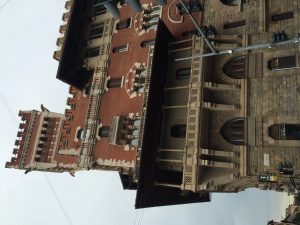
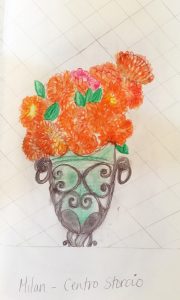
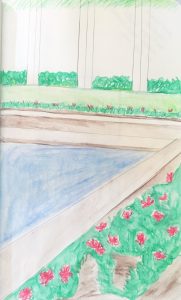
I wanted to focus my sketch notebook on vegetation in urban life across Italy. The climate in Italy is amazing, allowing so many flowers and plants to flourish, and that immediately grabbed my attention. With most of the streets of Milan covered in centuries and new architecture, I expected there to be much less plant life similarly to when traveling to New York. This was actually a surprise, but the more you look at most apartments and buildings there are vertical gardens, and lots of mini squares hidden within the developed space of Milan. They are interesting to look for because most much of the plant life is hidden or high up above. There are also several plants that are found back at home in austin like Jasmine for instance. Plant life is also a prime way Italians can also decorate and customize their living spaces and differentiate what their balcony or square looks like from their neighbor and house located near them. These few drawings I have included are all different spaces. One is a private pool to a house that was built by an architect that we discussed in class. Another one of the sketches was a vase that I walk past every few days that has bright orange and warm colors. The last picture is of a balcony that had intricate details with small yellow flowers

.sketch3sketch2sketch1

week two : alessi

Processed with VSCO with p5 preset

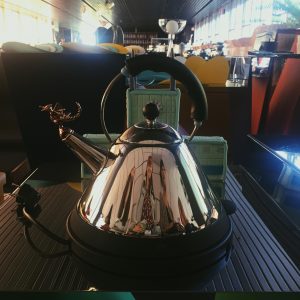
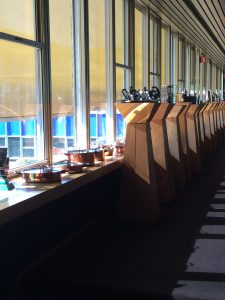
Walking into Alessi, you immediately know you are walking into a place full of creativity and history. From the colorful, quirky hallways to the enormous showroom, the Alessi factory is the home of so much design and so much inspiration. As a company, Alessi follows suit with a popular tendency of Italian design: fusing design with art and architecture.

Seeking out designers from all different backgrounds, they open themselves and their customers up to diversity in their products: in the way they are viewed, contextualized, prototyped and produced.

Alessi has the noble goal (in my opinion) to not only make things that are efficient and functional but that are exciting and pleasing! They want people to get excited about buying a lemon juicer or a coffee maker. Alberto Alessi, when he transformed the company to focus on design, knew that those everyday, “common” objects are a part of a life, family and home. They need to satisfy not only functional needs but those of poetic and emotional needs as well. That kind of thinking is the way that I would like to think of all design. Not only in the context of my sketchbook or prototypes but in the way it interacts with the world and becomes a part of someone’s life.

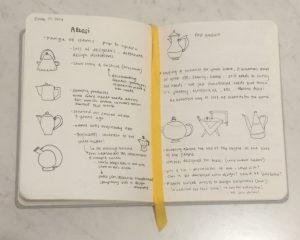
With my focus being on the Italian relationship with the table, meals and food, seeing the different approaches to gadgets used in the kitchen and restaurants gave me more insight into that relationship and how it can be effected by products such as those from Alessi.

IMG_7354

Alessi

For a company, creating an attractable consumer good can mean a whole new game. Alessi, a design company producing everyday items for household and kitchen supplies, dates to as long as the 1920s. A firm that began with Giovanni Alessi creating objects out of wood and metal, now is remembered by its design element that his son, Carlo Alessi, brought into. During the 1970s, Alberto Alessi is also responsible for collaborating with famous designers such as Castiglioni, Sapper, Mendini, and Sottsass. It was during this time that having a design element in mass production was necessary. When visiting Alessi this past week, a sense of attraction could be felt from every corner. Seeing a mere household item, such as a spoon so charming with its shining and smoothly curved element, brought amazement just viewing at it. Even sighting items such as the strange looking lemon squeezer, made me realize the importance of inspiration. Even though in market some items don’t work so well, by still having inspiration and the willingness to create anything, everything can be possible. Old elements can be transformed for new items to be created. Even today, Alessi continues to follow the same pathway through designing appealing objects for consumers to utilize and I’m grateful to have received the opportunity to visit this company.IMG_5951IMG_5946

Achille Castiglioni

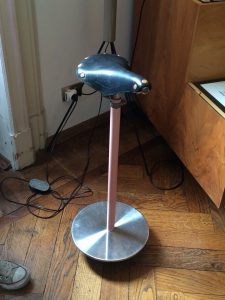
As a designer, Achille Castiglioni, never failed to impress viewers. Walking into his studio and seeing a flat silver object turn into a drinking glass on the go, brought an immense admiration of his work. Just hearing that Castiglioni worked and lived entirely in his studio, explained the dedication that he gave for his work. Though Achille grew up in a household of artists and architects, he did manage to mark his own name in the design industry. In his studio, various items were found that were inspired by various events, individuals, and other objects. Furniture, lamps, and everyday items for kitchen were discovered in his studio. One particular lamp that I remember seeing was one inspired by his wife. As she loved to read but would leave the lights on at night for reading, Achille designed a penguin shaped lamp that had only three pieces. Additionally, he designed a bicycle shaped sit and placed it next to a telephone so conversation duration is short due to discomfort caused by the bicycle sit. With many of the objects as eye-catching as these two objects, it can be concluded that Achille was indeed a curious man with a curious mind. IMG_5837 IMG_5824

sketchbook : week 2

I’m so pleased that I have finally gotten over the initial hump of generating content for my sketchbook. In the first week I was thinking too hard about how I wanted to set it up or how neat I wanted it to be but once I stopped caring about it being perfect, all of the visual thoughts I was having starting flowing out onto my pages.

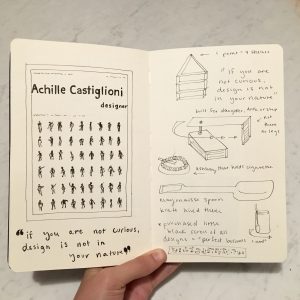
Castiglioni’s studio really kick-started my creativity because there was SO MUCH to sketch and I really wanted to remember all of the ingenious inventions I was seeing. Some of his devices were a challenge to illustrate because they had dual functionality, such as “cow-milking belt” or the tiny swinging desk he built for his daughter. I’ve been enjoying utilizing arrows to demonstrate how things work.

FullSizeRender (3)

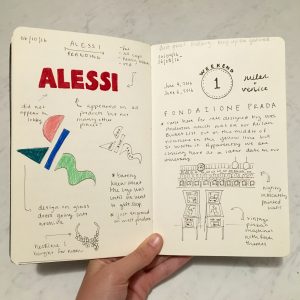
Since I finally narrowed down my focus on branding, I started to pay attention to my surroundings much more. For example, when we went to Alessi, I was completely unaware of their logo for the entire duration of the tour. The first time I realized that they use heavy red typography as their logo was when I stepped into the gift shop. I found it interesting that they paid attention to the branding in the gift shop and neglected the factory.

FullSizeRender (4)

On the other end of the spectrum, a few of us went to the Fondazione Prada in Milan to check out Bar Luce which has extremely consistent branding. Bar Luce was designed in part by Wes Anderson which made complete sense upon walking into the cafe. The interior was minimalistic to an almost surreal extent with pale pinks and greens lining the walls and ceilings. The logo was plastered on all of the menus, mugs, and coasters. Everything matched and was perfectly placed, much like how the scenes appear in his movies. I had fun making notations of my observations, it made me feel like I was really taking in the whole experience.

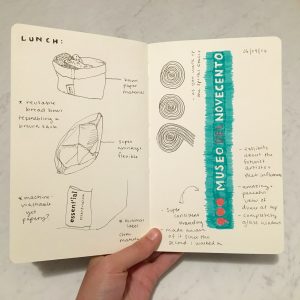
I fell in love with the branding of the Museo del Novecento so that was a great opportunity to use my new Stabilo pens in my sketchbook! All of the coloring was very consistent and the graphics were minimal. It is interesting to see the big museum brands juxtaposed with the small pieces of branding I come across from day to day such as a breadbasket label I stumbled upon at lunch one day. At first I was attracted to the design of the basket which was a machine-washable paper bag material. Upon closer inspection I realized I really admired the label and that ended up taking up a whole page in my sketchbook. The lesson is to always keep my sketchbook in hand so I am ready to sketch when I least expect it.

FullSizeRender (2)


Study of Boccioni

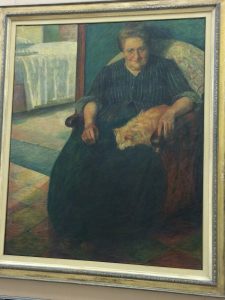
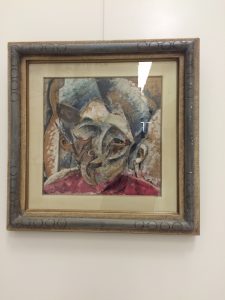
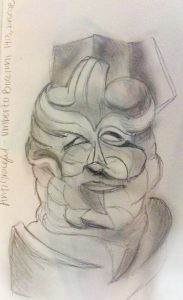
One piece I wanted to focus on is Antigraceful by Umberto Boccioni, which happens to be a bust of his mother from 1913. This sculpture is one of the first sculptures that emphasizes his rejection of past and present art canons. There was this quote that Boccioni stated “We must smash, demolish, and destroy our traditional harmony, which makes us fall into a gracefulness created by a timed and sentimental cubs.” This sculpture was part of Palazzo Reale’s Umberto Boccioni: genius and memory exhibition. This sculpture emphasizes a drastic change from his older work that was very traditional of the time. He painted dozens of rationalists/impressionist paintings and studies of people/portraits. It is tempting to assume that this work was influenced by some of Pablo Picasso’s work, but it could vice versa. The cubist portrait emphasizes his mothers features such as her eyes and nose, but in a way makes each of the wrinkle lines change in different directions.

In the class reading over the past week in the book Made in Italy, there is this quote on futurism and design: “In the words of Merjian, “Rather than use design as bulwark against industry, the Futurists were the first avant-gardists to collapse such distinctions so radically or at least to call for their collapse.” Befitting, perhaps, a movement glorifying war, futurism can be said to have inaugurated Italian design’s age of extremes, by bringing together modernist aesthetics and the material culture of industrial society.” Boccioni is an excellent example of Italian artists of the futurism movement, changing the process and work of his art.

In the drawing and sketches of Contre-Jour in 1910, is also one of his first examples of taking a step back from what he has created in the past, and changed his concepts to a more futuristic approach with the more crazy details than the image looking more like a portrait from the past.

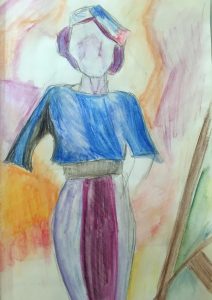
A later painting I wanted to learn more about is called “Study of a Woman with Houses”, by Boccioni. This painting still uses pastels similar to the impressionists but it starts to have more of a cubist futurist aesthetic. I read theFuturist manifesto at the Museo 900, where this painting was located, “ All things move, all things run, all things are rapidly changing a profile is never motionless, before our eyes but constantly appears and disappears.” This painting shows how the light and shapes are frequently changing, and to form compositions with more rigid lines than to make the work perfectly organic and alive.umberto boccioni 1milan2

week two : boccioni

Umberto Boccioni only lived to be 34 years old, yet he is known to be the “principal artist of futurism.” This speaks to how the vast amount and quality of his work and how high he is held especially by the city of Milan.

Being able to walk through his beginnings allowed for a better understanding of Boccioni’s work and process. Due to his worldly travels as a young man, he was able to study under some great European artists and try out many different styles and techniques to help shape his career.

three women

One work of his that I was drawn to at the Boccioni exhibit is “Three Women,” a portrait that was done at the dawn of futurism. Categorized as a divisionist work, Boccioni’s brush strokes are done in a way so that you can see the individual colors instead of there being a gradient between them. This piece is a good example of the transition from divisionism to futurism because you can see Boccioni begin to focus more on the lighting in the women’s hair and dresses instead of the actual women. The strokes that are meant to be rays of light coming in somewhat take the focus away from the women.

the-drinker

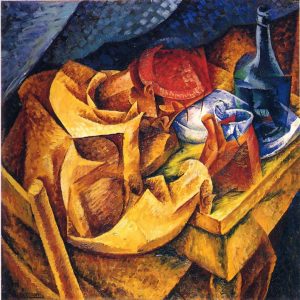
This painting, “The Drinker 1914,” was done at the height of futurism for Boccioni. Compared to the portrait above, the brush strokes are much more pronounced, the lighting is even more dramatic, and the color is more intense and vibrant. Unlike much of his earlier commissioned work, this painting is an observation of Boccioni’s, not something he is getting asked to paint by a patron. The man featured is not really the focus at all. Boccioni has also broken down the painting into shapes and colors, leaning towards some inspiration possibly from Pablo Picasso.

boccioni : week 2

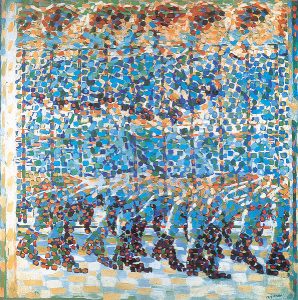
This week we visited two museums in the heart of the Duomo area of Milan. The first was an Umberto Boccioni exhibition at Palazzo Reale and the second was the Futurism wing at the Museo del Novecento. I chose two peices from each museum that I thought captured the essence of Futurism in similar ways. The first is the classic scultpure by Umberto Boccioni, “Unique Forms of Continuity in Space”, that depicts a man in motion. With the growth industrialization and the machine age, the futurists were obsessed with the idea of movement. Motion manifested itself in transportation and the general mechanization of products used in everyday life. When we headed over to the Museo del Novecento, I stumbled across a painting by Giacomo Balla that featured shapes similar to those on the sculpture. This painting features Giacomo’s daughter running on a balcony. He chose to represent the motion by repeating the shape of her body over and over again. I thought it was interesting to see a similar concept fleshed out in two dimensions versus three dimensions. I can imagine this style being radical at the time because not only were people being exposed to new style, but they were also having a whole new industrialized world thrust upon them which was probably overwhelming.


'Unique_Forms_of_Continuity_in_Space',_1913_bronze_by_Umberto_Boccioni
“Unique Forms of Continuity in Space”, 1913, Umberto Boccioni
fut_069
“Bambina x Balcone”, 1912, Giacomo Balla


week two : castiglioni

IMG_7350

This visit, hands down, was the highlight of my week. In all honestly, I had no idea who Achille Castiglioni was until a few weeks ago. Now I am obsessed with him: the way he brought a certain wit into every one of his projects, his seemingly controlled hoarding of funky objects, his fearlessness to dive into any and all challenges, and his beautiful and chaotic studio space.

One thing I kept hearing and witnessing during our visit was Castiglioni’s practice of “shape follows function.” I find it so easy to run head into a project with a focus on how the end product will look. I know that this is wrong, and seeing it worked out in so many of his designs really helped me digest why function should be a designer’s first thought. I want to begin studying the world as he seemed to. Looking at everything and every situation as a potential place to step in and make things a little better, make things run a little smoother. One way in which Castiglioni seemed to do this is by making things minimal. If you don’t need to complicate things, don’t!

Not only did I love ogling at all Castiglioni created and collected, but I learned so much in the hour we spent in his studio. Not only about him, his process, and his design philosophies (all wonderful by the way) but about myself as a designer. I tend to want to put myself in a box. I’ve spent the last two years trying to figure out how to label myself. I want to be able to say, “I am a graphic designer,” or “I do brand design,” or “my focus is in user interface design.” Not that these things are bad, but something I’ve begun to notice on this trip is that I do not need to set up camp in a certain genre of design. Massimo Vignelli, the man who designed the New York subway signage, said that “if you can design one thing, you can design everything.” I want to live my life as a designer with that saying as my mantra. Castiglioni came running wherever a need popped up: whether it was a massive arching lamp, a mayonnaise jar knife or a bike seat chair. I think he believed that he could design anything and everything. So if it’s good enough for Castiglioni, it’s good enough for me.

Processed with VSCO with g3 preset

Processed with VSCO with c1 preset

alessi : week 2

It seems as though after the conclusion of every one of our design outings, the latest is always dubbed “my new favorite”. This could not be truer for our visit to the Alessi factory. As we approached Alessi by bus, we wound through the mountains and small scenic towns. Near the entrance, we crossed a bridge with water running under it which we later learned powered the entire factory when it was founded in the early 20th century. We were swiftly greeted by our enthusiastic tour guide who led us through the Alessi “archives”, which were huge, moveable vaults that contained everything that Alessi has ever produced. The mere organization of it all was something to be marveled. I can’t describe how moving it was to be able to see and handle the prototypes and objects designed by the fathers of Italian design such as Ettore Sottsass, Richard Sapper, Achille Castiglioni, Alessandro Mendini, Aldo Rossi, and Philippe Starck. I got a ton of sketchbook content from this tour because it was all so fascinating. Next we headed to the Alessi store right across the bridge where we were tempted by all of the beautifully designed products. I’m excited about my purchase that is Mario Trimarchi’s ‘Fiato Sul Collo’ necklace, which is part of his highly successful line of products that feature many rectangular pieces converging together. I can’t wait to see what will be my next favorite trip!

IMG_3814       MT11_19472