
By Rebekah Besserman, Undergraduate in the UT Plan II Honors Program and Government Department
Zdravo! If you had told me one year ago that I would be interning in Skopje, North Macedonia, this summer, I never would have believed you. I always admired North Macedonia’s flag when taking map quizzes, but beyond that, I didn’t know much about the country yet. After studying the politics and constitution of North Macedonia and the greater Western Balkans region for an entire semester, I was ready to immerse myself in the culture and the work at National Democratic Institute this summer.

At NDI, I was placed to work with the Integrity Driven Communities project, which aims to strengthen anti-corruption measures at the local and municipal levels across the country. This was a perfect fit for me as it aligned well with the project I conducted during the spring semester on Roma ethnic minority political representation on the local level in North Macedonia.
The independent project I am currently working on (in collaboration with fellow Embedded Scholar Sid Dasari) focuses on barriers to and methods for youth engagement and participation at the local level. Looking comparatively at countries such as Poland, Slovenia, and Croatia, which have already joined the EU, we have been assessing different citizen participation mechanisms that may be applicable to NDI’s work across municipalities in North Macedonia. We spent our first few weeks familiarizing ourselves with NDI’s current work and local anti-corruption initiatives.
On one of our very first days, we got to sit in on a presentation for the Swedish and Swiss ambassadors on a survey of the public perception of corruption in the country. Since the very beginning, we have been immersed in the work of an international NGO – how NDI works together with international partners, state agencies, civil society organizations, and local governments.
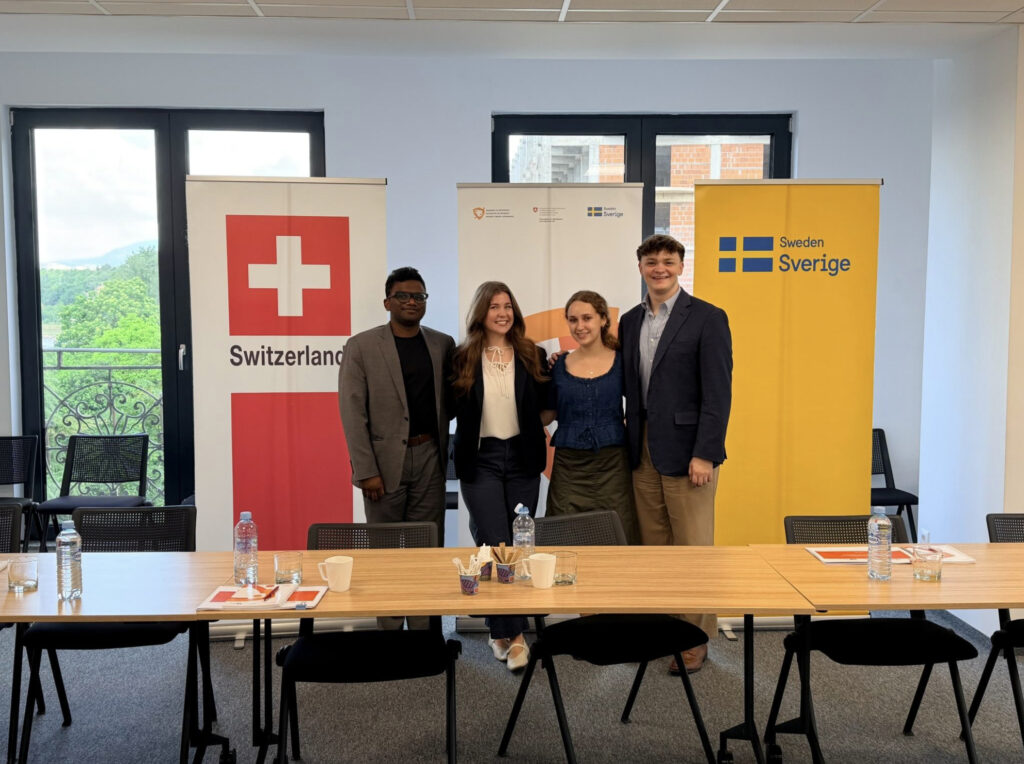
After jumping into research in the first week, throughout our time here, we have had the chance to meet with many of NDI’s partners in the Integrity Driven Communities project to learn more about their work and the current landscape in North Macedonia regarding civic engagement and youth participation. We have also been able to attend and assist at many events that NDI has planned and hosted for the month of June. Last week, we attended a workshop held for members of the youth wing of the majority party in the government. This was especially insightful as we got to talk to politically engaged young people (like us!) and hear about their concerns regarding national and local-level politics.
Later that week, Sid and I got to accompany our coworkers to have a meeting with the Agency for Protection of the Right to Free Access to Public Information. Here, we got to see firsthand how NGOs such as NDI work with the government and how dedicated the Agency was to strengthening transparency and good governance initiatives.
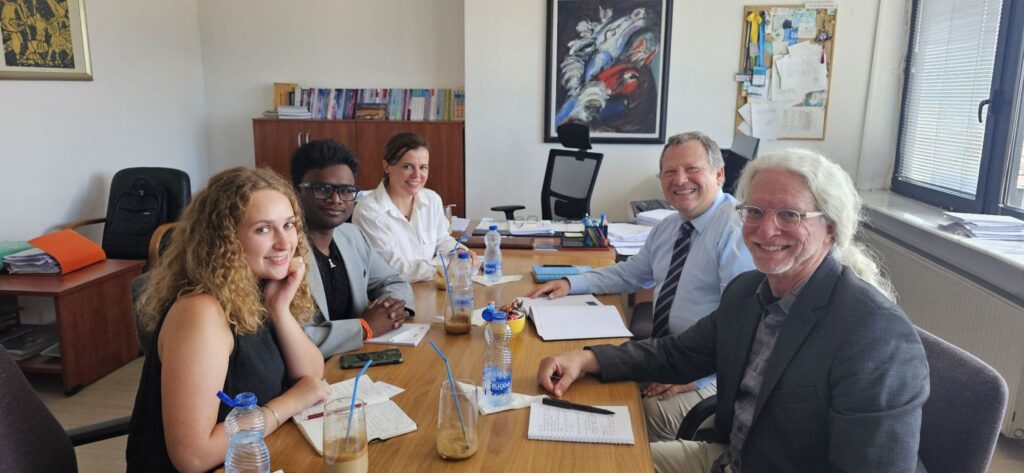
Though I am still working on completing my research, I have learned so much so far. It has been incredible to learn from so many different people and organizations across the city and the country – from government officials to civil society leaders to professors – they have all offered a different and unique perspective that has helped to shape our understanding of local civic engagement and anti-corruption. I came into this project knowing that I was interested in youth and minority participation. From all of these meetings and discussions inside and outside the office, I have learned that local civic engagement is a much more complex issue than it seems at first glance. Participation in local policymaking must be viewed through an intersectional lens: what works for one group of people might not work for another. Many different approaches should be considered to involve different age groups, ethnicities, genders, and language groups.
But, don’t worry, we have been up to plenty more than just working! Outside of the office, the other interns and I have loved exploring the city of Skopje. We have thoroughly enjoyed the rich and flavorful food – especially the shopska salad, kebab, and baked beans, or tavče gravče. I have most enjoyed getting to explore the museums in the city center and walk around our neighborhood, Debar Maalo, which is filled with restaurants, cafés, and lots and lots of cats!
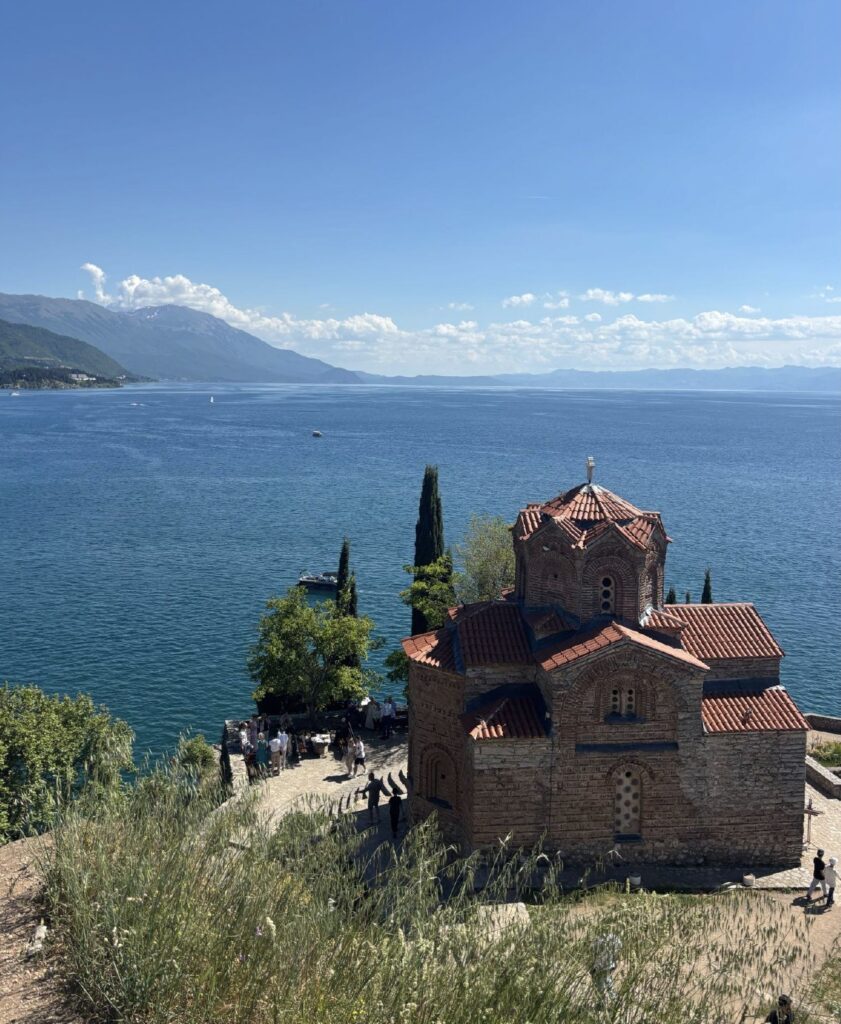
We have also taken a few weekend and day trips. One weekend, we spent time in Lake Ohrid, swimming, visiting historical churches, and eating fresh trout from the lake. Last weekend, we took a day trip to Kruševo, one of the highest-altitude towns in the Balkans. I wanted to visit specifically to see the Ilinden Memorial, also known as the Makedonium. The Makedonium is a “spomenik,” which literally translates to “monument” or “memorial.” These spomeniks, massive, abstract, and futuristic structures, were built across Yugoslavia throughout the 1960s to the 1980s. They are meant to memorialize Partisan resistance forces and the victims of Axis occupation during World War II.
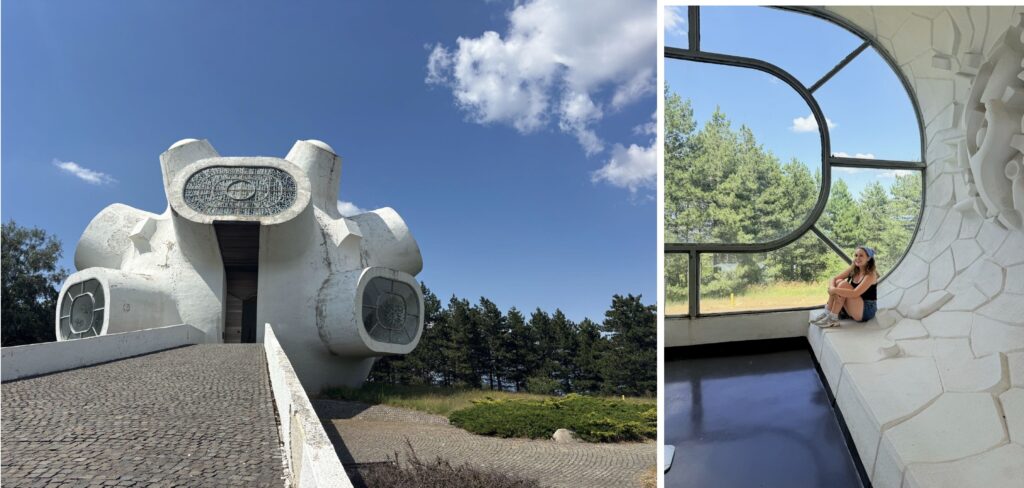
I had been reading about the Yugoslavian spomeniks for a while, so seeing the Makedonium in person was an experience like no other. The exterior reminded me of an abandoned spaceship or a heart valve. The four stained-glass windows – one green, one yellow, and two blue – held me captivated. At first, I imagined them to represent the seasons, but the guard told me they were instead meant to represent the diversity of the people of North Macedonia.
North Macedonia has a long and beautiful history, which I have had the pleasure of learning more and more about each day. I am interested in how states navigate difficult pasts and complicated memories – how they form national identities and culture through policy. The work here at NDI has shown me just that. The dissolution of Yugoslavia left North Macedonia with the complex task of navigating a multi-ethnic society. Following the Ohrid Framework Agreement in 2001, sweeping local government structures were created to balance ethnic representation in education, cultural institutions, and municipal governments. Still, municipalities lack the fiscal and infrastructural resources to facilitate community participation methods. NDI helps to close this gap – helping to build institutional integrity and empower civil society on the local level to combat corruption and strengthen democratic practices, ultimately providing the foundations for a new culture and collective memory of democracy.
My experience with UT Embedded Scholars and the National Democratic Institute has been incredible. I feel so lucky to learn so much from my coworkers at NDI and my fellow Embedded Scholars, who have made me feel so at home all the way in North Macedonia.
Se gledame! Until next time!