







April 2021 – BBC Features Dr. Lu’s and Dr. Jeong’s Work
BBC has posed the question “Could electric tattoos be the next step in body art?” They highlight the work that Dr. Nanshu Lu and Dr. Hyoyoung Jeong created and Dr. Lu’s outlook for the future of this technology. The article goes on to say “Prof Lu isn’t only interested in medical applications. She suggests that future electronic tattoo designs could light up to reveal when someone’s heart is beating faster. That could make dates more interesting.”

“CUT-AND-PASTE” MANUFACTURE OF MULTIPARAMETRI…
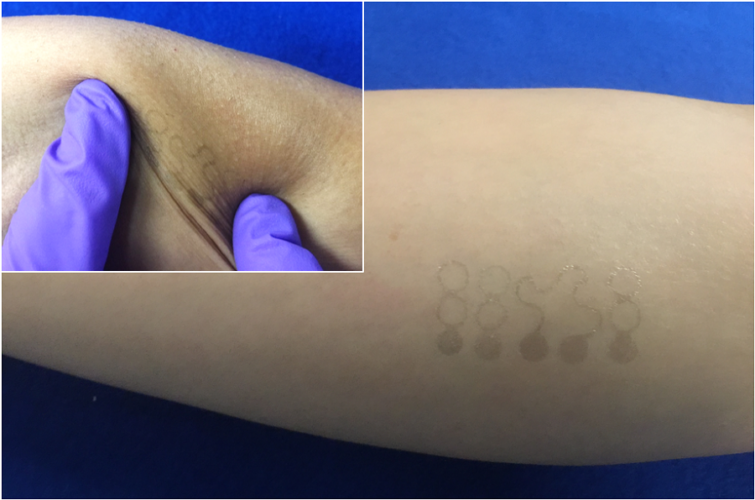
We report a cost and time effective, completely dry, benchtop “cut-and-paste” method for the freeform and portable manufacture of multiparametric epidermal sensor systems (ESS) within minutes. This versatile method works for all types of thin metal and polymeric sheets and is compatible with any tattoo adhesives or medical tapes. The resulting ESS are multimaterial and multifunctional and have been demonstrated to noninvasively but accurately measure electrophysiological signals, skin temperature, skin hydration, as well as respiratory rate. In addition, planar stretchable coils exploiting double-stranded serpentine design have been successfully applied as wireless, passive epidermal strain sensors.
Graphene e-tattoo
Graphene electronic tattoo (GET) is a group of ultrathin stretchable dry sensors for measuring electrocardiogram (ECG), electromyogram (EMG), electroencephalogram (EEG), skin temperature, and skin hydration. Because of low thickness (463 ± 30 nm) and ultra low areal mass density of GET, it forms conformal contact to the skin and stays intact without any adhesive or tape just via van der Waals force. A bare GET is able to stay attached to skin for several hours without fracture or delamination. With liquid bandage coverage, a GET may stay functional on the skin for up to several days. The optical transparency of GET is ∼85%, and it is more stretchable (40%) than human skin (10 to 30%). The GET can be directly laminated on human skin just like a temporary tattoo and can fully conform to the microscopic morphology of the skin.