By Elizabeth Donaway, PhD student in the UT Government Department
This summer I had the opportunity to work with NDI Albania, where I focused on the relationship between civic education, civic participation, and democratic institutions. Much of my work centered on the Albanian Parliament and its Parliamentary Institute, a nonpartisan institution that supports members of Parliament through research, library services, and civic education programming. Through this work, I came to appreciate that democracy assistance is not only about elections, parties, or formal institutional reform. It is also about helping citizens understand that democratic institutions belong to them and helping institutions create meaningful ways for citizens to participate.

Democracy is often defined simply as government by the people. But that definition raises a harder question: what must citizens know, believe, and practice in order for self-government to work? Democracy is not only a set of rules for choosing leaders. It is also a practice of “ruling with” others rather than “ruling over” them. That practice requires habits of mind that are difficult to build in the abstract. Citizens must learn to see one another as equal participants in public life. They must learn to disagree without treating opponents as enemies. They must learn to persuade, listen, compromise, and hold public officials accountable. These capacities do not come into being automatically; instead, they must be developed through experience.
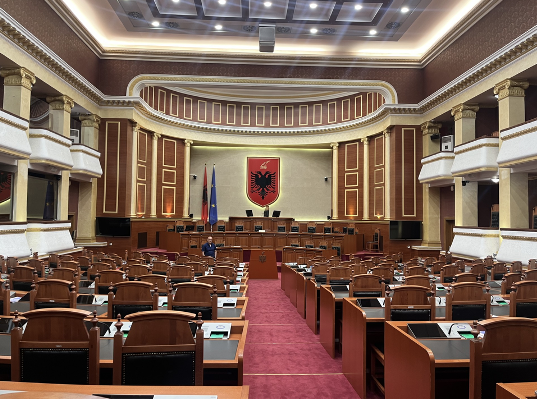
Democracy’s dependence on virtuous and engaged citizens is why civic education matters. At its best, civic education does not simply teach students the names of institutions or the steps in a legislative process. It helps people understand how public decisions are made, why those decisions matter, and how citizens can participate in shaping them. It also helps demystify government. When citizens see Parliament only as a distant building occupied by politicians, democracy can feel remote. When they enter the building, speak with representatives, ask questions, and see themselves as part of the political community, Parliament can become more accessible.
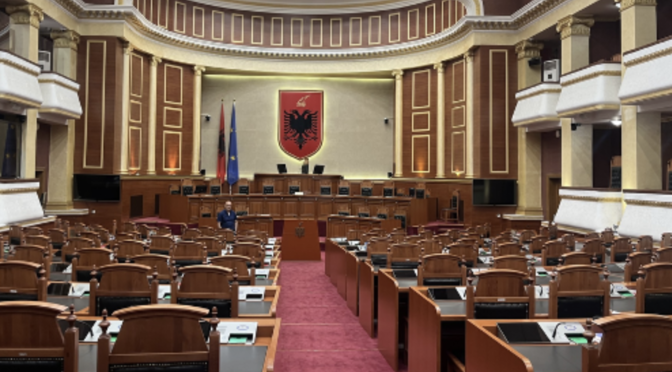
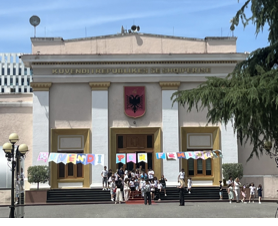
One of the most memorable parts of my internship was visiting the Albanian Parliament during an Open Day hosted by the Parliamentary Institute in honor of International Children’s Day. Elementary and secondary school students toured the Parliament, interacted with members of Parliament, and participated in educational activities. The event illustrated one of the simplest but most powerful functions of civic education: bringing people into the physical space where political decisions are made. For young people especially, entering Parliament can change the meaning of the institution. It becomes not only a place where politicians work, but also a public institution that citizens have a right to enter, understand, question, and engage.
The Parliamentary Institute’s Civic Education Service offers several programs designed for different age groups. These programs introduce students to Parliament’s role, but they also cultivate specific civic skills. For example, the “My Point of View” program invites secondary school students to debate current issues. That experience teaches more than public speaking. It shows students that their opinions about public problems matter. Moreover, it also teaches that democratic participation requires listening to others. In a democracy, citizens do not simply express preferences. They must learn to explain, defend, revise, and sometimes compromise those preferences in conversation with others.
At NDI, my role involved researching civic education programs and thinking about how the Parliamentary Institute might continue to develop its work. I compared Albania’s approach with civic education models with that of the United States. The two countries organize civic education quite differently. In Albania, the Parliamentary Institute has developed a more centralized ladder of programs connected directly to Parliament. In the United States, civic education is more decentralized. Many government-supported programs are based at the state level, while national initiatives are often supported by nonprofit organizations. Each approach has its advantages. Albania’s model can connect students directly to the national legislature. The U.S. model benefits from pluralism, local experimentation, and a large nonprofit sector. At the same time, each model has limitations. Centralized programs must work hard to reach students beyond the capital, while decentralized systems may provide uneven access to civic education opportunities.
This comparative work was one example of how democracy assistance often operates in practice. It is not a matter of copying an institution from one country and placing it in another. Instead, it requires identifying useful lessons from other contexts and adapting them to local institutions, needs, and capacities. The most useful question is not, “What works elsewhere?” but rather, “What might work here, and under what conditions?”
That question became especially important in a second project I worked on. For this project, I researched how the Albanian Parliament could create more continuous relationships with young people. Civic education programs can introduce youth to Parliament, but short-term programs alone cannot create sustained participation. Like many democracies, Albania faces concerns about youth disengagement and disaffection from politics. If young people experience Parliament only through occasional visits, they may learn about institutions without gaining a meaningful channel to influence the Parliament. The challenge is to move from civic education to civic participation.
To explore that challenge, I researched several models used in other countries, including youth parliaments, legislative youth advisory councils, youth select committees, and research-centered youth councils. Each model offers something valuable. Youth parliaments can give young people a sense of representation. Legislative youth advisory councils can create a continuing relationship between youth and lawmakers. Youth select committees can teach young people how to investigate a public problem, gather evidence, question experts, and produce recommendations. Research-centered youth councils can combine lived experience with policy analysis.
The model I ultimately explored for Albania combined elements of these approaches. Rather than recommending a large youth parliament immediately, I focused on a more workable proposal. Namely, I proposed a permanent youth policy and research council housed in the Parliamentary Institute. Such a council would allow young people to identify issues affecting their lives, consult peers across the country, work with nonpartisan research staff, and present evidence-based recommendations to parliamentary committees. This approach would be designed to build on the Institute’s existing strengths. The Civic Education Service would support recruitment, training, outreach, and youth engagement. The Research and Analysis Service would help youth members understand laws, institutions, data, and policy options. The Library and Publications Service would support access to information and help publish reports.
This proposal helped me see the connection between civic education and institutional design. Civic education can prepare citizens for participation, but institutions must also create pathways through which participation matters. If young people are invited to speak but no one is required to listen or respond, participation risks becoming symbolic. A stronger model would require a parliamentary committee or public authority to respond to youth recommendations. Even when recommendations are not adopted, a reasoned response can teach young people how democratic institutions evaluate proposals, weigh tradeoffs, and make decisions.
My internship also connected civic participation to broader questions of accountability. As part of a separate project related to the prevention of state capture, I researched public participation in local budgeting. Albanian law provides for public consultation in municipal budgeting, but legal requirements do not automatically produce meaningful engagement. Citizens must know that opportunities to participate exist, and public officials must treat participation as more than a formality. A public hearing or consultation process has limited democratic value if citizens’ concerns are recorded but never answered. Meaningful participation requires both access and accountability. First, citizens need channels to express their views. Second, institutions need procedures for responding.
This lesson appeared not only in my research but also in the civic life around me. During my time in Tirana, I observed protests over environmental degradation and perceived government corruption. These protests were different from the formal participation mechanisms I was studying, but they reflected a related democratic impulse. When people believe that ordinary channels are insufficient, they may turn to public protest to make their concerns known to responsible officials. Protest can signal frustration, but it can also reflect democratic agency. It shows that citizens do not see themselves merely as subjects of government decisions. Instead, they see themselves as people entitled to question those decisions.
Together, these experiences changed how I think about democracy assistance. The work is often practical and specific. Major components include researching programs, comparing institutional models, drafting proposals, reviewing public participation procedures, or helping an organization think through implementation. However, these practical tasks are connected to a larger democratic purpose. Civic education helps people understand their institutions. Civic participation gives them ways to influence those institutions. Accountability ensures that participation is taken seriously.

My time with NDI in Albania showed me that democracy is sustained not only through constitutional rules or electoral competition, but also through the everyday relationships between citizens and institutions. A student walking into Parliament for the first time, a young person debating a public issue, a youth council developing recommendations, or a citizen asking questions about a municipal budget, all of these are democratic acts. They help transform government from something distant into something shared. That transformation is difficult, gradual, and incomplete, but it is also essential. Democracy depends on citizens who believe they have a role to play and institutions willing to make room for them.