
Aside from CO2, methane is the most prevalent greenhouse gas (GHG), with 7,195.56 MtCO2e of CH4 emitted every year (2010). The lifespan of methane, a short-lived atmospheric gas, is about 12 years. Because methane is a potent radiative forcer that only stays in the atmosphere briefly (relative to CO2), efforts to mitigate methane emissions have great potential for near-term effects.The agricultural sector, by far the biggest source of methane, comprises 43% of methane emissions. Agricultural methane emissions primarily come from enteric fermentation (ruminant livestock), rice cultivation, and manure management. While manure management is not the largest contributor, it has a readily available solution – capture of biogas through anaerobic digestion (AD) technology.
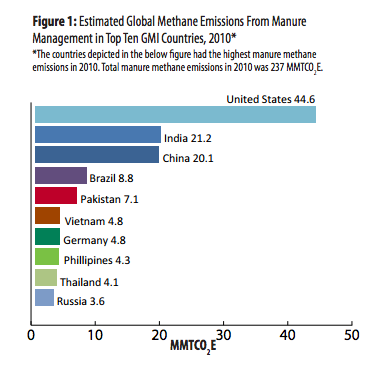
Source: Global Methane Initiative
The decomposition of waste in anaerobic conditions contributes to GHG emissions through the production of (uncaptured) biogas, of which 70% is methane. Manure management systems can capture this methane using AD facilities. Similarly, biogas can be captured from from waste water treatment plants or from food waste using the same AD processes. Biogas is then converted into energy, heat, or fuel. This waste-to-bioenergy strategy is both “economically viable and environmentally benign.” The use of AD technology to capture biogas reduces CO2 and methane emissions while simultaneously reducing waste and lowering energy costs for farmers. Capturing biogas from animal waste also contributes to better air and water quality.

Source: Creative Energy Engineering
Potential Barriers
Prohibitive upfront costs may make conversion of waste into biogas seem like a potentially impractical solution, but for larger producers who can take advantage of economies of scale, methane capture can be cost effective. Also, the potential for monetization and savings through reuse of waste to meet energy needs means that, in the long run, anaerobic digestion facilities essentially pay for themselves.
A few examples, from the last month alone, of current uptake of waste-to-bioenergy technology:
- The UK government just granted a £3m loan to help farmers develop AD facilities.
- CleanWorld, the leading AD company in North America recently began construction of the UC Davis Renewable Energy Anaerobic Digester (UC Davis READ) facility in Davis, California.
- The Lagos Waste Management Authority in Nigeria is creating electricity from converting fruit waste into biogas.
- GE announced that they will be supplying eight biogas engines to the Dan Region (Shafdan) Wastewater Treatment Plant in Israel.
Hopefully this technology continues to expand and receive both private and government support. Solutions that are easily adopted because of co-benefits, in this case waste management and lower energy costs, should be pursued in the effort to mitigate climate change. Biogas production through methane capture may only address a somewhat small percentage of global GHG emissions, but these small percentages add up.