
Virtual MSRs

Since there are no operating molten salt reactors today from which to build full digital twins, the University of Texas and Texas A&M University are working together to create virtual MSRs based on the legacy of the MSRE. Each team is developing its own independent virtual reactor using advanced simulation tools such as VERA, GenFoam, Serpent, SyTH, SAM, and Moltres. These virtual reactors will act as stand-ins for real plants, allowing each institution to generate synthetic measurement data for the other and use those data to develop and test digital twin methods. In doing so, the partnership is helping jump-start digital twin capabilities for molten salt reactors ahead of the advanced systems expected to come online in the near future.
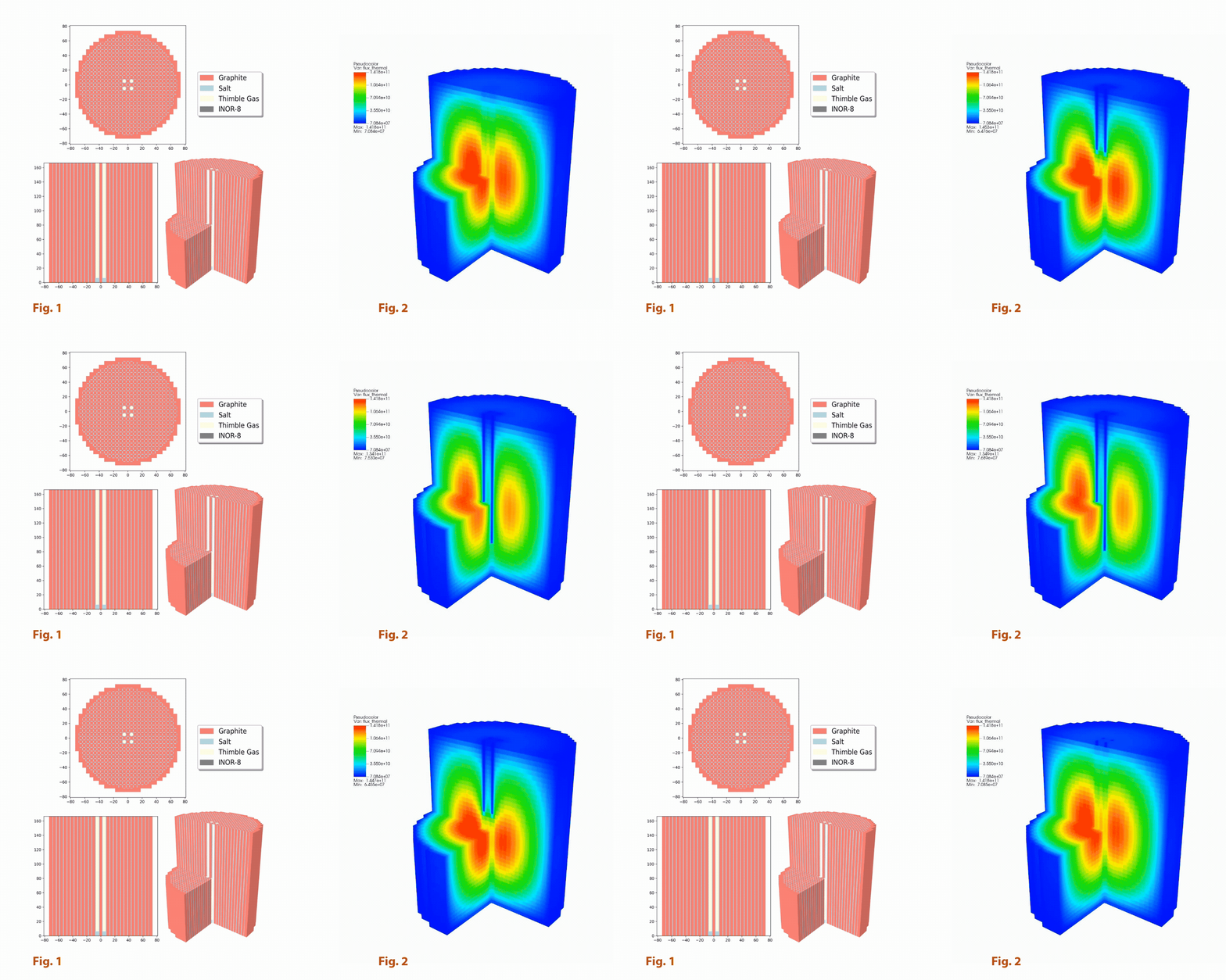
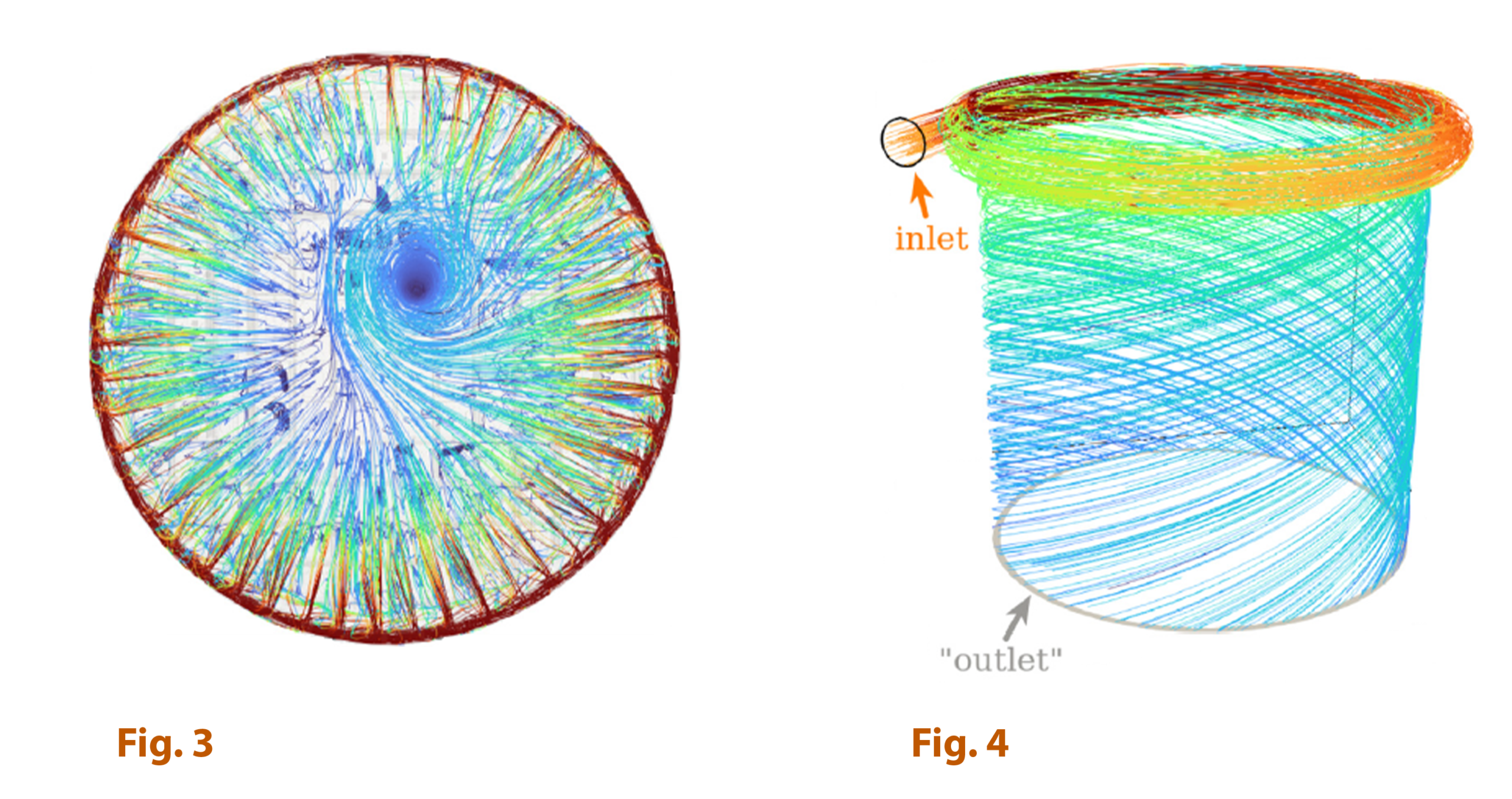
 

Figure 1 shows three views of a cylindrical reactor core model with color‑coded materials. The top view is a circular cross‑section dominated by graphite (salmon color), with a small cluster of lighter regions near the center indicating salt (light blue) and thimble gas (pale yellow). A legend identifies materials as Graphite, Salt, Thimble Gas, and INOR‑8 (gray). The bottom left view is a vertical cross‑section showing tall graphite columns with narrow vertical channels of salt and thimble gas near the center. The bottom right view is a three‑dimensional cutaway of the same cylinder, revealing the vertical channels running through the graphite body. Figure 2 shows a three‑dimensional cutaway of a cylindrical reactor core colored by a pseudocolor map of thermal neutron flux. A vertical slice reveals the interior, with the highest flux shown in red and orange concentrated in two central vertical regions. Flux decreases outward through yellow and green to blue at the outer edges of the core. A color bar on the left labeled “Pseudocolor Var: flux_thermal” ranges from a minimum of approximately 7.08×10⁷ to a maximum of 1.42×10¹¹. The overall pattern indicates peak thermal flux near the core center and lower flux toward the periphery.
Figure 1: Computational Model of an MSRE-Like Reactor Core. Figure 2: Predicted Thermal Flux Response to Control Rod Insertion in an MSRE-Like Virtual Reactor
Two side-by-side scientific visualizations of fluid flow inside a cylindrical container.Left (Fig. 3): Top-down view of a circular chamber filled with many curved, colored streamlines (blue, green, and red). The lines spiral inward toward a darker blue vortex at the center. The outer boundary is ringed in red, and numerous lines radiate and curve from the edge toward the center, showing rotational flow. Right (Fig. 4): Three-dimensional view of a cylinder with tightly wound streamlines forming a swirling, helical pattern from top to bottom. A small pipe at the upper side is labeled “inlet” with an arrow pointing into the cylinder. Near the bottom, a gray arrow labeled “outlet” indicates where fluid exits. Colors transition from red and orange near the inlet at the top to green and blue farther down, illustrating changes in flow as the fluid spirals through the vessel.
Figure 3: Flow Streamlines in the lower Plenum. Figure 4: Flow Streamlines in the volute and downcomer. R. Krpan, C. Gentry, J. C. Ragusa, K. Clarno, and C. Fiorina, “A full-resolution multiphysics model of the Molten Salt Reactor Experiment,” Annals of Nuclear Energy, vol. 235, p. 112314, 2026, doi: 10.1016/j.anucene.2026.112314.