Texas Nuclear Digital Twin Program
- The nuclear industry is rapidly building a new fleet of first-of-a-kind advanced reactors that can transform the power industry for the 21st century. However, history has shown that leading companies in every industry continue to innovate to grow their business and stay ahead of the competition. However, this hasn’t happened in nuclear because the time to drive innovation to licensed changed in reactor operation (new fuels, advanced materials, increased power) rarely happen because the demonstration and licensing time required is burdensome.
- Recent advances in artificial intelligence, sensing, and high-performance computing are making it possible to continuously evaluate and improve the software, which is required for licensing any reactor changes, and also evaluate the quality of the data to guide AI systems to better understand the operational data to improve performance. Meanwhile, high-fidelity software can evaluate the system during normal and accident conditions to anticipate and identify failure to improve the response and minimize downtime.
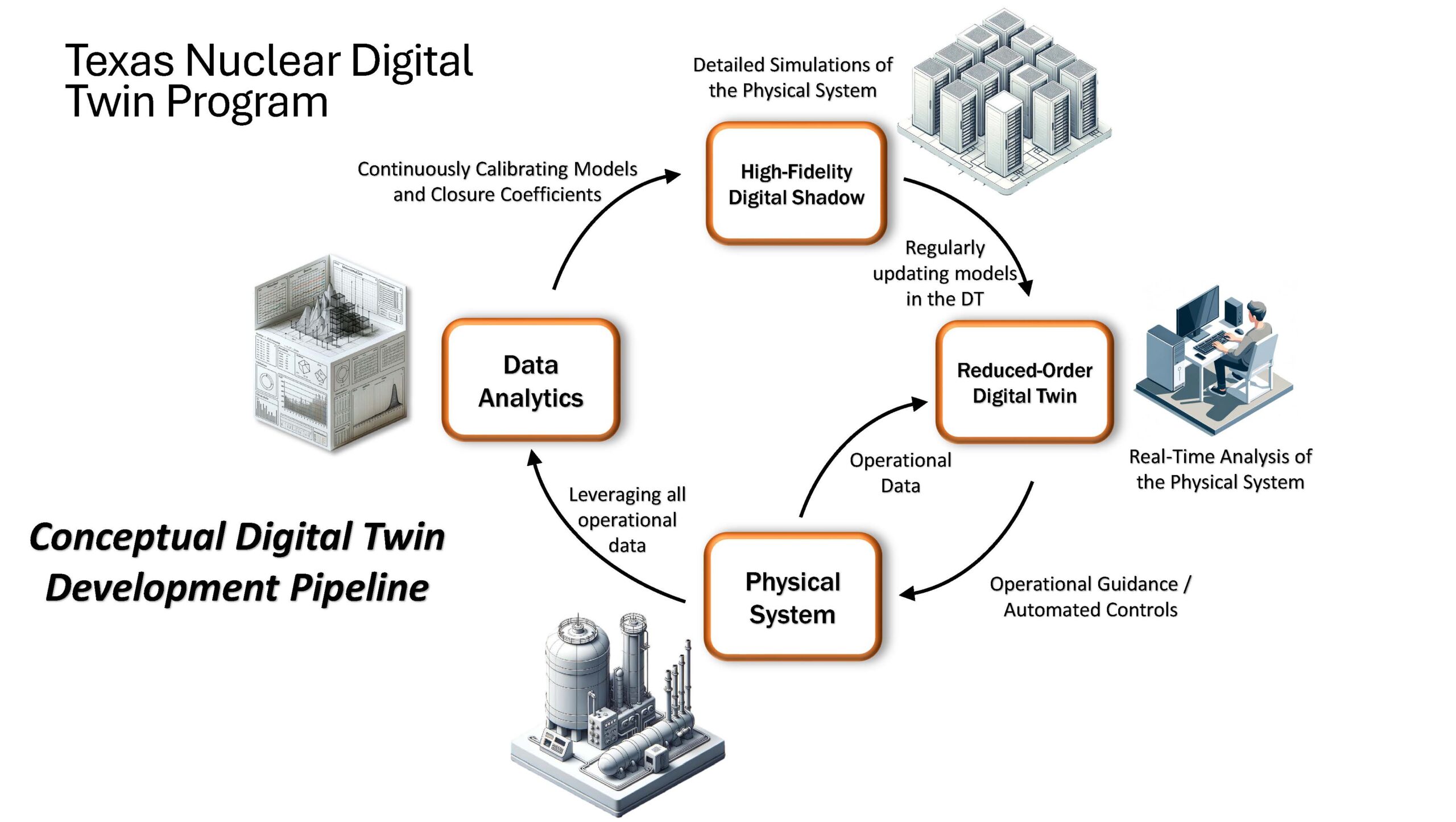
- The high-fidelity software, once demonstrated to be accurate, can be used to evaluate how the measured data and operational controls interplay during normal and accident conditions, which enable the creation of digital twins that physically connect to the nuclear reactor and provide the operators additional information to improve the operational performance and minimize confusion during accident scenarios. These capabilities could transform how systems are designed, licensed, and operated by enabling faster analysis, increasing confidence in reactor models, and improving the speed and quality of information available for planning, decision-making, and automation. As a result, interest in nuclear digital twins has grown quickly, and multiple efforts are now underway to explore their use in reactor research and development.
- To help lead this effort, the State of Texas established the Texas Nuclear Digital Twin Program, an $18.5 million initiative dedicated to learning how to develop effective digital twins for nuclear systems and building long-term bridges between experimental and computational research communities. The program is also working to better understand how to engage with the Nuclear Regulatory Commission on licensing pathways for control systems that use digital twins, communicate the value of these technologies for advanced reactors to stakeholders in Texas, and demonstrate how digital twins can help predict performance when designs change. In partnership with universities and their experimental facilities, the program is taking a stepwise approach to build the technical foundation for future nuclear digital twin applications, starting with simpler systems and progressing toward more complex ones. This approach is helping position Texas to play a leading role in advancing the methods, partnerships, and infrastructure needed to realize the promise of nuclear digital twins.