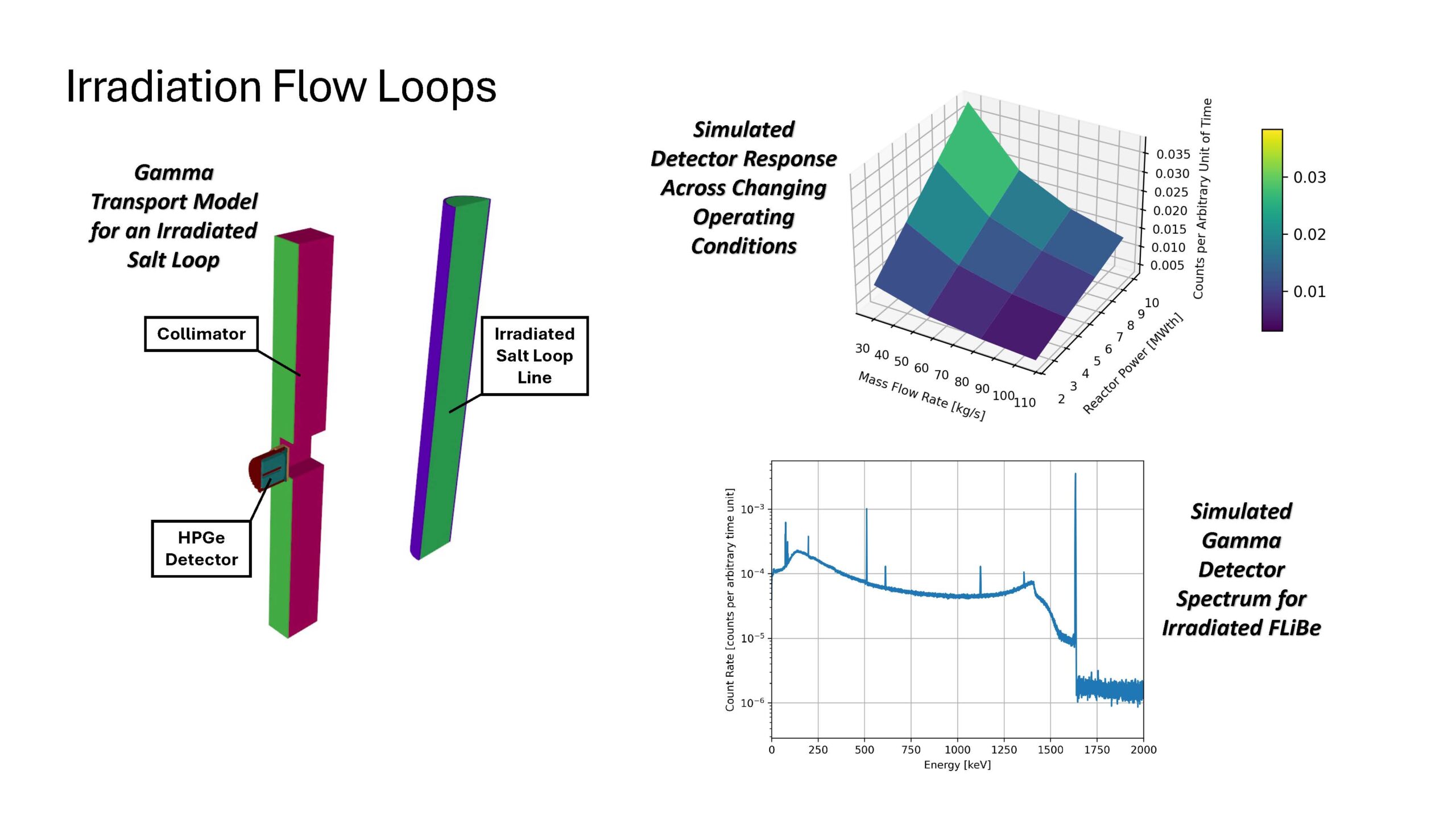
The University of Texas is investigating how digital twins can use radioactive signatures from irradiated fluids to infer system conditions, an approach with particular promise for molten salt reactors. UT has already shown this capability in simulation by using the signals from two in-line detectors to estimate reactor power and secondary salt coolant flow rate based on the irradiation signature of the secondary salt line. To extend this work, UT is partnering with MIT to test a simple FLiBe molten salt loop and monitor it with multiple gamma detectors, with the goal of experimentally validating these inference models and expanding them to estimate other important characteristics such as corrosion, flow distribution, residence time, and isotopic inventory for fissile material tracking, burnup estimation, and isotope production.