• Skip to primary navigation
  • Skip to main content
  • Skip to primary sidebar
UT Shield
The University of Texas at Austin
  • Research
  • People
  • Facilities
  • Publications
  • Our Github
  • Contact

Archived

September 17, 2025, Filed Under: Archived, Autonomous Platforms, Nuclear, Research

Condition Monitoring of Dry Storage Canisters

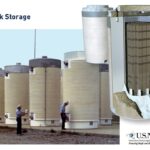
Dry Cask Storage

Summary: Over 90% of SNF dry cask storage systems in the United States use welded dry storage canisters (DSCs). Typically, these canisters represent the confinement barrier in the dry storage system preventing any release of SNF or radioactive noble gases to the environment. As the dry storage terms of SNF are extended, DSC monitoring issues become more important for safe operation of the dry cask storage systems. The objective of this research program is to develop a technology to enable the next generation of “intelligent spent nuclear fuel (SNF) dry storage canisters (DSCs),” that is, canisters with integrated sensing and processing capabilities to enable real-time state awareness of the DSC. This project was funded by DOE NEUP

Collaborator: Dr. Salvatore Salamone (UT Austin), Orano TN, Idaho National Lab

  • Wall climbing robot youtube playlist
  • Elgavish, E., and Pryor, M., “Development and Validation of a 3d Force and Moment Balancing Simulation Software for Evaluating Wall Climbing Robots on Varied Surfaces,” ASME/DETC, November 2024. (doi link)

January 1, 2024, Filed Under: Archived, Research, Space

Satellite Servicing

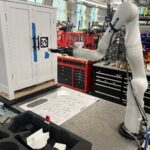
This project explores how advanced robotic autonomy can enable future satellite maintenance, repair, and disassembly missions in space. Conducted in collaboration with PickNik Robotics, the work focuses on advancing autonomous robotic manipulation for in-space satellite servicing. Leveraging the MoveIt Pro platform, we developed and validated algorithms for perception, motion planning, and compliant control, allowing a robotic arm to perform complex servicing operations such as inspection, cutting, and component replacement.

To achieve precise and adaptive interactions in uncertain environments, the project integrates key methods including Next Best View (NBV) planning, AprilTag-based pose detection, and impedance force control.

Video Material (Kinova Gen3 Satellite Servicing Demo)

January 1, 2023, Filed Under: Archived, Research

TeMoto

TeMoto is a software framework, intended for facilitating the creation of human-robot collaboration and multi-robot applications. With regular ROS-based applications a change in mission specification, component failures, or energy conservation via powering down unused components would require a downtime for adaptation (redesign of mission logic, switching sensor data processing pipeline, etc). This may not be feasible in time-critical scenarios, i.e., firefighting, or in environments with restricted access, such as disaster areas. TeMoto adds functionality to dynamically control the components to start, stop, monitor and combine them, and define tasks which control the execution flow of the robot.

  • Github: https://github.com/temoto-framework
  • TeMoto-Framework (Home · temoto-framework/temoto Wiki)
  • Use Cases (Use cases · temoto-framework/temoto Wiki)
  • Temoto Video Playlist (youtube)
  • Temoto Video Playlist (github)
  • Journal Article: https://doi.org/10.3390/robotics7010009
  • Journal Article: https://doi.org/10.1109/ACCESS.2022.3173647
  • Temoto Research at the University of Tartu
… read more 

September 17, 2022, Filed Under: Archived, Autonomous Platforms, Nuclear, Research

Self Exploration and Mapping for Indoor Robotic Applications

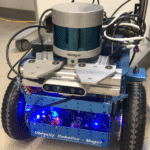
Magni Robot

Summary: The purpose of this effot is to develop a robotic system that is fully capable of autonomous survey tasks with little to no human interaction. The system uses a Veloydne VLP-32 LIDAR sensor and an Intel RealSense D435 camera to simultaneously map the environment and avoid all obstacles autonomously. Combination of these sensor to detect positive, negative, and overhead obstacles results in 3D object detection, which is then used to create a 2D map using SLAM mapping algorithms.

Primary Sidebar

Recent Posts

  • Digital Twin Augmented Reality – Radiation in AR
  • AugRE
  • Affordance Templates for Complex DOE Robotics Tasks
  • AugRe Drone Integration
  • Autonomous Alpha Radiation Sensing and Reporting

UT Home | Emergency Information | Site Policies | Web Accessibility | Web Privacy | Adobe Reader

© The University of Texas at Austin 2026