
Three 2026 Embedded Scholars spent their summer internships aiding democratic efforts in Yerevan, Armenia, where they observed elections, analyzed public opinion data, worked with the Armenian Parliament and civil society, and researched a range of democracy issues at the National Democratic Institute in Armenia.
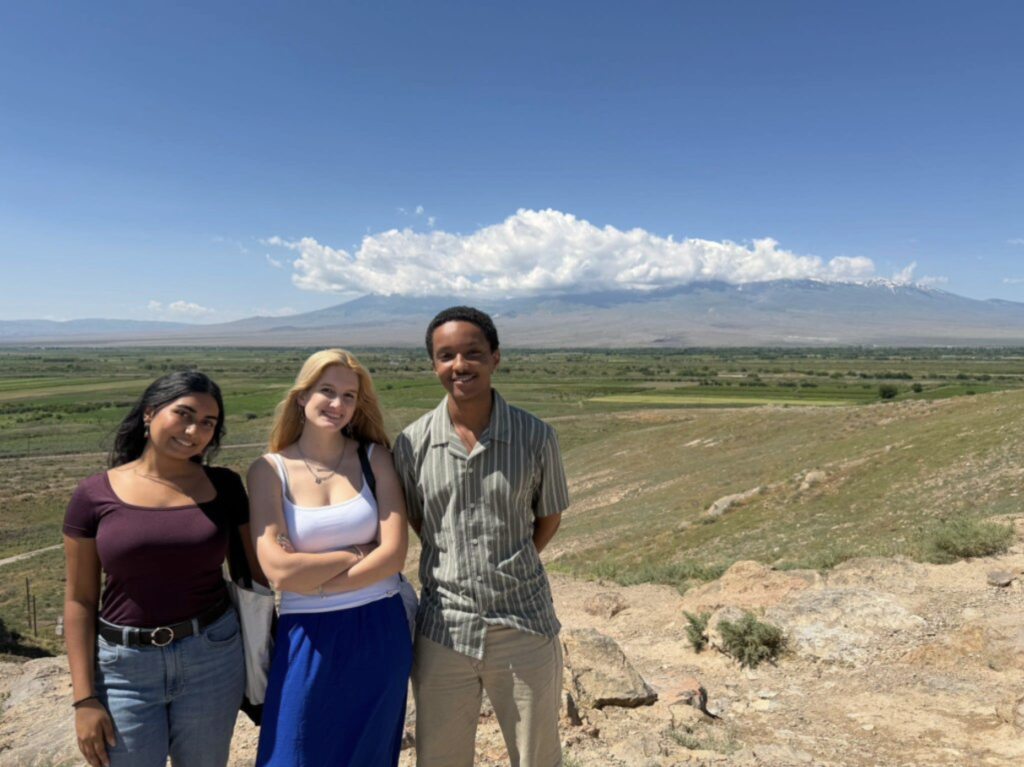
All three fellows shared their experiences interning in Armenia on the Embedded Scholars’ blog.
Meera Hatangadi, a 2026 UT graduate from the International Relations and Global Studies Department and Plan II Honors, writes that serving as an official election observer in the June 2026 national elections in Armenia was a “truly surreal experience” to be involved in such a critical moment for the country. During her first week in Armenia, she was paired with local observers and tasked with helping to ensure integrity of the voting and counting process by observing the election.
“We visited around 10 polling stations throughout the day, observing the voting process,” she writes in her blog post, Elections and the Future of Democracy in Armenia. “The number of voters in each precinct varied significantly, with the smallest number being around 85 and the largest around 2,000 voters. It was fascinating to see the voting process, which was standardized across these precincts with multiple verifications needed to validate each vote: from an untainted ballot, to a photo verification slip, to a verification stamp.”
Caleb Mulugeta, a senior with the UT Government Department and Economics Department, traveled to rural polling stations in the Aragatsotn Province on election day, starting from when polls opened to counting ballots long after they closed. “We remained at the final polling station through the counting process and did not leave until approximately five the next morning,” he writes in his blog, Building Parliamentary Oversight Capacity in Armenia. “By that point, many of those administering the election had been working for almost an entire day. Election Day allowed me to observe Armenian democracy at its most local level, but my other work with NDI helped me understand the broader political and historical pressures under which that democracy operates.”
In addition to their responsibilities on NDI election programs, fellows pursued research in their fields of interest related to democracy. Caleb supported NDI’s parliamentary oversight work, noting “elections alone cannot guarantee accountable government. Parliament must also be capable of requesting information, questioning officials, reviewing the implementation of laws, examining public spending, and investigating whether government agencies are fulfilling their responsibilities.”
“I developed a method for distinguishing ordinary legislative business from activities that constituted meaningful oversight…. I then analyzed how the frequency and character of oversight changed across different political periods…. By studying these processes, I gained a deeper appreciation for the work NDI and its Armenian partners undertake to make political institutions more transparent, representative, and accountable.”
Eva White, a senior in UT’s Slavic and Eurasian Studies Department and International Relations and Global Studies Department, focused on an issue she plans to continue to study into the new academic year, as she describes in her piece Democracy and Energy in the Former Soviet Union.
“For me, that meant energy security and its relationship to democratic strength–a particularly relevant topic in contemporary Armenia–and I was lucky enough to explore this connection further via collaboration with both NDI and Kinetic, an energy consulting group,” she writes. “My research focused on great power competition in the nuclear sector, domestic energy security in Armenia, and the influence of both on democratization. I gained significant knowledge in these areas and found this prong of the internship to be highly fulfilling and fascinating, and I intend to continue engaging with these topics in the upcoming semester as a Brumley Next Generation Scholar through UT’s Strauss Center for International Security and Law.”
Eva further reflected on her time as an Embedded Scholar, writing, “I will forever be grateful for the invaluable experience that the Embedded Scholars program has provided me. The lessons I have learned and insight I have gained through my internship are certain to bolster my academic and professional pursuits and help me to achieve my goals as a student and young professional.”
The Embedded Scholars program provides internships for graduate and undergraduate students from UT Austin to work in democratic and constitutional development abroad. Current opportunities allow students to work with CID Gallup and International IDEA in Latin America and with International IDEA, the National Democratic Institute, and Transparency International in Europe and Eurasia.
Applications for the 2027 summer cohort are open and will be accepted through October 15, 2026. Join us for an Embedded Scholars Info Session on September 10, 2026.
To read more reflections from this year’s fellows interning in countries across Latin America and Europe, visit the Embedded Scholars’ blog.