
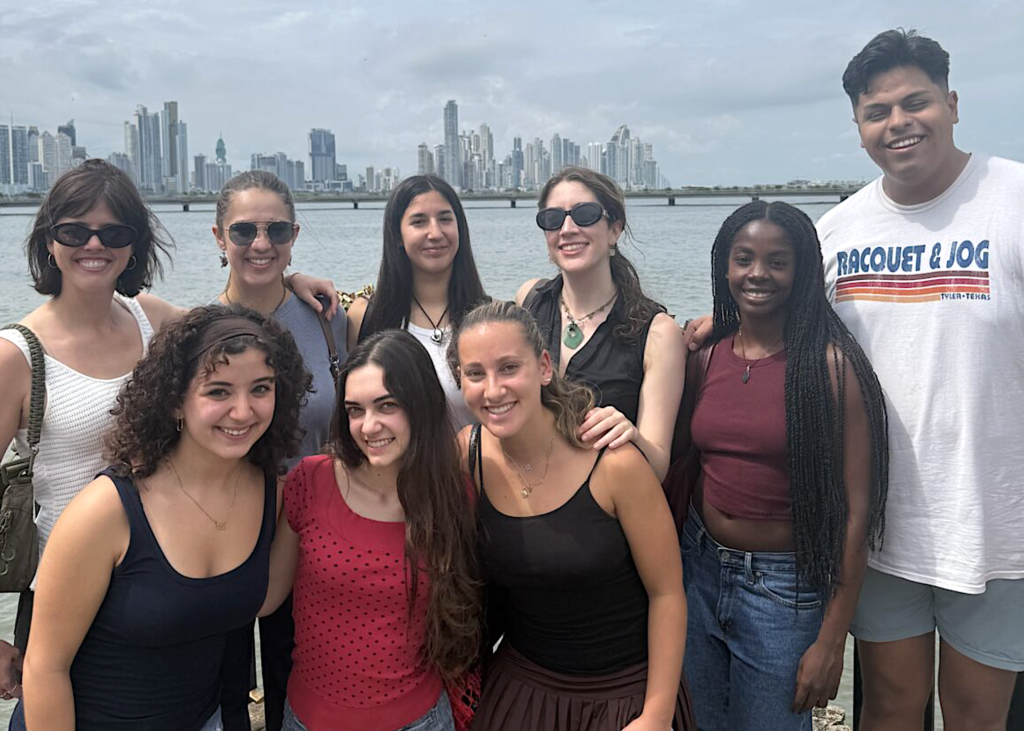
Nine UT students in the Center’s 2026 Embedded Scholars cohort recently completed their internship with CID Gallup in Panama this summer, gaining first-hand experience conducting public opinion research and collecting data that inform policymaking across Latin America. Throughout the summer, the fellows surveyed members of the public, conducted interviews, contributed to major research projects, and participated in every stage of the research process—from designing surveys to collecting data to analyzing results—all in Spanish.

Along the way, they reflected on their experiences while working with CID Gallup and living in Panama City through the Embedded Scholars blog.
Bela Madrid, an undergraduate student in the UT Butler School of Music, wrote that every day in the office was different. “One thing that has become clear, however, is the enormous amount of attention that goes into understanding the needs, concerns, and aspirations of a population,” Bela writes. “I have enjoyed observing the art and the tact this type of work requires. It is a combination of both analysis and data collection, graphs and numbers. All of these attributes come together to make a compelling story.”
The fellows surveyed respondents from across Latin America and conducted door-to-door interviews throughout Panama City. They collected public opinion on topics ranging from the state of democracy to artificial intelligence to retirement and economic security. Two of their major projects culminated in reports examining public perceptions of government policies on retirement issues in the region and on the well-being of women in the ‘sandwich generation’ taking care of both children and aging parents.
For Brittni Palkert, a graduate student at the LBJ School of Public Affairs, participating in the design of a major research project offered valuable hands-on experience. “In the design of this research project, we applied skills we learned from workshops with CID Gallup, conducting a literature review on the topic, identifying the theoretical survey population, and designing the research methodology,” Brittni writes. “The literature review for this project gave me a deeper understanding for the concerns of women in Latin America today and the impact of changing demographics and societal pressures.”
Juan Romero, an economics and philosophy major, reflected on the human side of survey research, writing, “The experience of watching a question you drafted in a Google Doc come back as a response from a real Costa Rican citizen is difficult to describe. It teaches you that behind every number in every report you will ever read, there was a person who thought it worthwhile to know, one who opened a door, and another person who asked.”
CID Gallup is the leading company in market research in Latin America, working with a range of national and multilateral government institutions. Co-headquartered in Panama City and San Jose, Costa Rica, they work in twelve different countries producing some 300 surveys a year. The founding director, Carlos Denton, was a UT PhD in Government from 1968. Denton passed away this spring but had worked closely with previous interns and had helped to shape the UT-CID Gallup partnership. Director Ana Patricia Alfonso honored Denton by naming the CID Gallup part of the Embedded Scholars program in his honor as the Carlos Denton Global Internship Program at CID Gallup.
At the internship, Embedded Scholars are trained on how to support policymaking processes through ethnographies, evaluation of public policies, face-to-face interviews, focus group sessions, in-depth interviews, online surveys, telephone interviews, and other methodologies.
“Observing and conducting these interviews has been incredible,” writes Josie Mandrea, a civics honors major. “While the day can be exhausting, the work is what allows for completed reports and further analysis which direct policymakers in their decisions. It is the first, most necessary step towards action, and getting to be a small part of that effort has been an immense privilege.”
In addition to supporting CID Gallup’s ongoing research, fellows pursued independent research projects in areas that aligned with their academic interests, including Panama-U.S. relations and national security.
“I was given freedom to pursue my own project as well,” writes recent UT Austin graduate and Government major Veronica Martin. “I endeavored to evaluate the way Panamanians balance political autonomy and the fight against the drug trade and cartel activity. That is, are Panamanians willing to accept U.S. aid for combatting contraband smuggling if it means a potential sacrifice of political autonomy? For weeks, I combed through press releases, parsed through federal drug confiscation data, and assessed timelines and policy changes to understand public sentiment and the true effects of U.S. involvement.”
“Working entirely in Spanish has been the biggest challenge so far, but it’s also where I’ve grown the most,” writes Hana Sawaf, an international relations and global studies major. “Some days I leave work mentally exhausted because I’ve been translating nonstop for eight hours, but looking back to my first week, I can already tell how much more comfortable I’ve become.”
Beyond research, the internship challenged fellows to strengthen their professional Spanish skills. Daily responsibilities included conducting interviews, calling respondents across Latin America, proofreading reports, and collaborating with colleagues—all in Spanish.
The Embedded Scholars program provides internships for graduate and undergraduate students from UT Austin to work in democratic and constitutional development abroad. Current opportunities allow students to work with CID Gallup and International IDEA in Latin America and with International IDEA, the National Democratic Institute, and Transparency International in Europea and Eurasia.
Applications for the 2027 summer cohort are open and will be accepted through October 15, 2026. Join us for an Embedded Scholars Info Session on September 10, 2026.
To read more reflections from this year’s fellows interning in countries across Latin America and Europe, visit the Embedded Scholars blog.