Funding: Project GO Scholarships for ROTC Students (U. of Pittsburgh)

Deadline for Applications: January 18, 2019

Pitt Project GO Scholarships for Intensive Summer Russian Language Study by ROTC Students

About the program: The University of Pittsburgh invites Army, Navy/Marine, and Air Force ROTC students from any US college or university to apply for a Pitt Project GO (Global Officers) scholarship for intensive study of 1st- 4th year Russian in Summer 2019. Project GO is sponsored by the federal Defense Language and National Security Education Office (DLNSEO) and administered nationally by the Institute of International Education (IIE).

Students who have not yet begun their pursuit of Russian are encouraged to apply for an 8-week beginning-level class, which will cover the equivalent of one academic year’s worth of language training. The beginning-level classes, offered by Pitt’s Summer Language Institute (SLI), are held at the University’s main campus in the Oakland neighborhood of Pittsburgh from June 3 – July 26, 2019. Pitt Project GO scholarships for Beginning Russian cover:
•       Full tuition for 8 University of Pittsburgh credits
•       Housing and a living stipend
•       Travel between the student’s home city and Pittsburgh
•       Textbooks Continue reading “Funding: Project GO Scholarships for ROTC Students (U. of Pittsburgh)”
Funding: Pre- and Postdoc Fellowships (UW-Madison)

Deadline for Applications: March 01, 2019

The Center for Russia, East Europe, and Central Asia<https://creeca.wisc.edu/> (CREECA) at the University of Wisconsin-Madison invites applications for Wisconsin Russia Project<https://russiaproject.wisc.edu/> postdoctoral research fellowships (for US and/or Russian social scientists) and pre-doctoral dissertation fellowships (for Russian social scientists), funded with a grant from Carnegie Corporation of New York. Fellows are expected to be in residence in Madison, Wisconsin, and to conduct research about Russia in one or more of the five topic areas: 1) Education, labor markets, and inequality; 2) Law and society; 3) Political economy; 4) Identity, place, and migration; and 5) Demographic change. Fellows will conduct research in consultation with UW-Madison faculty and will join a vibrant community of scholars working on the social science of Russia.

The application deadline for both competitions is March 1, 2019.

More detailed information about the program, eligibility, and how to apply are available on the Wisconsin Russia Project website:
One-year postdoctoral research fellowships<https://russiaproject.wisc.edu/2018/11/30/academic-year-2019-2020-postdoctoral-fellowships-in-social-science-of-russia-at-the-university-of-wisconsin-madison/> (2019-2020)

One-semester pre-doctoral dissertation fellowships<https://russiaproject.wisc.edu/2018/12/03/pre-doctoral-dissertation-fellowships-in-social-science-of-russia-at-the-university-of-wisconsin-madison/> (fall 2019 or spring 2020)

Questions may be addressed to Amy Beilke, Wisconsin Russia Project graduate assistant, at russiaproject@creeca.wisc.edu<mailto:russiaproject@creeca.wisc.edu>

CFP: Political and Military Histories of Russian-Kurdish Relations – 19th-21st Centuries (Moscow, Russia)

Deadline for Submissions: January 01, 2019

CALL FOR PROPOSALS
Workshop on
Political and Military Histories of Russian-Kurdish Relations
(19th-21st Centuries)
Moscow, 10-11 June 2019

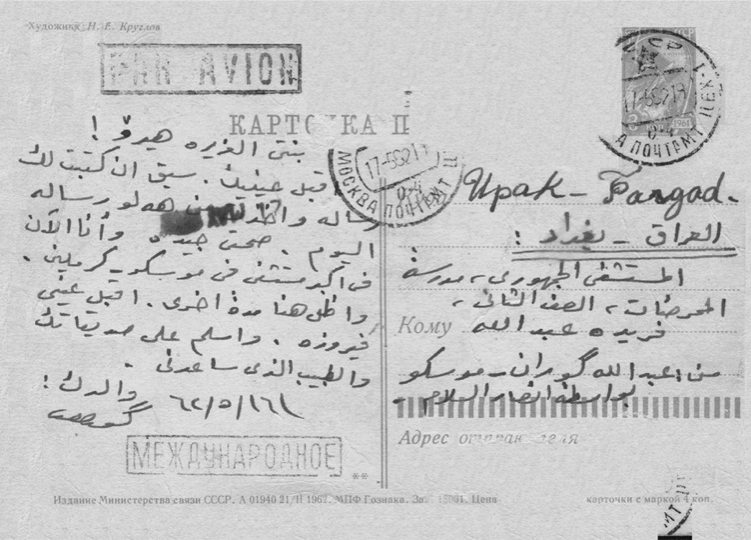
The involvement of Kurdish forces during the Crimean War inaugurated the political and military encounter of Russians and Kurds between Eastern Europe and the Middle East. Since then, these relations have formed an important and disputed aspect of Russian, and later Soviet, policies in the Middle East. Most significantly, these policies have extended well beyond the clash of the Tsarist and Ottoman Empires at the turn of the 20th century.While Russian and Soviet policies have included a sustained focus on the role of the Kurds, their political mobilization and activism in the 1920s-1930s and during the Cold War, the relationship has never been a simple one. It was deeply entangled in the nexus of regional politics and Russian/Soviet policies toward Turkey, Iran, Iraq and Syria, as well as in global dynamics. Conversely, mobilities and alliances with the ‘’East’’ have been important in shaping political identities, but remain a still understudied part of Kurdish political strategies on the international arena.

Organized as part of the research project RUSKURD (Sciences Po Lille-EHESS), in partnership with the CEFR (Moscow) and the IFEA (Istanbul), this workshop aims at exploring key aspects of the political history of Russian-Kurdish relations. Ph.D candidates, postdoctoral researchers and senior researchers are invited to present research based on historical, social and anthropological methods to explore the place of politics, ideology, violence and wars throughout two centuries.

Possible topics to be discussed include:

  • The changing dynamics of the Russian-Kurdish relation in military encounters since the mid-19th century, integrating local conflicts and imperial power struggles,
  • Techniques of insurgency and counterinsurgency, and their transformations in the wake of imperial collapse,
  • The geopolitical use of Kurdish political and military forces by Russia and the Soviet Union from the 19th to the late 20th century,
  • The interplay of police and military factors, logics and actors in the construction of a new border order framing Russian-Kurdish relations,
  • Routes, forms and techniques of political and military influence (including both people and goods, notably weapons),
  • Transnational political, diplomatic and military circulations.

Travel to and accommodation in Moscow will be taken in charge by the organizers.

Administrative help for visa issues will be provided to successful applicants who would need it.

Proposals consisting of a resume and a short proposal (one-two pages, summarizing the paper, methodology and sources) should be sent before 1 January 2019 to etienne.peyrat@sciencespo-lille.eu. Successful applicants will be notified by the end of January 2019.

Organizing team:

  • Masha Cerovic (EHESS),
  • Adnan Çelik (IFEA),
  • Etienne Peyrat (Sciences Po)

More on the project:

https://ruskurd.hypotheses.org/

Funding: Visiting Fellows Program – Predoctoral Scholars (Emory University)

Deadline for Applications: January 28, 2019

National Call for Applications

The 2019-2020 competition is open. The application deadline is January 28, 2019 at 11:59pm ET.

jwj portrait

The James Weldon Johnson Institute of Emory University invites applications for its Visiting Fellows Program. Supported by a generous grant from the Andrew W. Mellon Foundation, the Johnson Institute offers five fellowships per year.

  • Visiting Fellowships for Post-Doctoral and Advanced Scholars: Three (3) fellowships for both junior and senior scholars and their career equivalents. Candidates must hold a Ph.D. by the start of the fellowship period in August 2019. Fellows will each teach one course in the spring semester.
  • Visiting Fellowships for Pre-Doctoral Scholars: Two (2) fellowships for doctoral dissertation completion. Dissertation Fellows are not required to teach courses.

We welcome applications from scholars in the humanities. We are interested in research projects across the spectrum of the humanities that examine the origins, evolution, impact and legacy of race, difference, and the modern quest for civil and human rights. We also support research projects that examine race and ethnicity and its points of intersection with other identities and movements addressing differences along gender, class, religious, or sexual lines. Visiting Fellows will be in residence at Emory for the academic year 2019-2020.

For more information, and to learn how to apply, click here.

Internship: Junior Fellows Summer Internship Program (Library of Congress)

Deadline for Applications: January 11, 2019

  • Compensation: $4,500.00 (taxable income of $450.00 per week)
  • Academic Credit: The Library does not provide academic credit, but you may arrange with your school in advance to receive credit.
  • Available Benefits: Transit. LC Internal Discounts.
  • Program Duration: Short-term. May 29th – August 3rd, 2018

Program Overview

The Library of Congress Junior Fellows Summer Intern Program enables undergraduate and graduate students to experience the integrated analog and digital collections and services of the world’s largest, all-inclusive library. Working under the direction of Library curators and specialists in various divisions, fellows explore digital initiatives and increase access to the institution’s unparalleled collections and resources. Fellows are exposed to a broad spectrum of library work: copyright, preservation, reference, access, and information technology. In the past, summer fellows have identified hundreds of historical, literary, artistic, cinematic and musical gems representing the Library’s rich cultural, creative and intellectual assets. No previous experience is necessary, but fellowships are competitive and special skills or knowledge are usually desired. Selections are based on academic achievement, letters of recommendation, and an interview with a selection official. Continue reading “Internship: Junior Fellows Summer Internship Program (Library of Congress)”

Funding: Fellowships (American Jewish Archives)

Deadline for Applications: February 19, 2019

About the Fellowship Program

The Fellowship Program of The Jacob Rader Marcus Center of the American Jewish Archives was established in 1977 by our institution’s founder, the late Dr. Jacob Rader Marcus. Since its inception, more than 350 scholars from over 20 countries have been named Marcus Center Fellows.

The Marcus Center’s Fellowship Program was founded with the intent of creating a forum where students and scholars of the American Jewish experience could gather together to research, discuss, and study their chosen topics. Under the auspices of this unique program scholars come to Cincinnati to conduct in-depth research at the American Jewish Archives and to take part in the academic community of the Hebrew Union College-Jewish Institute of Religion. The program provides fellows with an opportunity not only to pursue their own research, but also to interact and exchange ideas with research peers as well as with the faculty and students of HUC-JIR.

Today, The Marcus Center administers fifteen endowed fellowships, all funded by generous friends and supporters of the American Jewish Archives. Marcus Center fellows are teachers, students, scholars, and practitioners who, both individually and as a group, come to the American Jewish Archives to study some aspect of the American Jewish past. It is The Marcus Center’s hope that this Fellowship Program will advance our understanding of American Jewish history and, simultaneously, of the American nation as a whole. Continue reading “Funding: Fellowships (American Jewish Archives)”

Funding: Fellowships (IIAS/CEM-FMSH)

Deadline for Applications: March 01, 2018; October 01, 2019

IIAS invites outstanding scholars to apply for a fellowship at IIAS. Applicants may also apply for an extra two months of research at the Collège d’études mondiales of the Fondation Maison des sciences de l’homme (CEM-FMSH) in Paris, in the framework of an additional combined IIAS/CEM-FMSH fellowship.

For whom?

The information provided on this page is intended for researchers who would like to apply for an IIAS Fellowship (with or without an additional research period in Paris). Please do NOT file an application with IIAS if you will be visiting IIAS in the framework of an (exchange) agreementbetween IIAS and a partner institution. In that case you will be selected and nominated to IIAS by the partner institution.


Eligibility

The position of affiliated fellow is intended for outstanding researchers (also see ‘Terms and conditions’) from around the world, to work on an important aspect of Asian studies research in the social sciences and humanities. Interdisciplinary interests are encouraged. We also welcome researchers who would like to work on a collaborative grant proposal or develop their PhD thesis into a book publication. Continue reading “Funding: Fellowships (IIAS/CEM-FMSH)”

CFP: Translation Pedagogy Conf. (Hunter College)

Deadline for Submissions: January 1, 2019

Hunter College, CUNY will be hosting its first conference dedicated to teaching translation and interpretation on April 6-7, 2019. The conference aims to facilitate intellectual exchange and discussion on the overall role of translation and interpretation in the undergraduate and graduate education, from specific pedagogical tools to overarching questions of curriculum structure and program development. The conference will explore developing professional translation and interpretation programs, raising awareness of the importance of translation within global literacy, and developing undergraduate and graduate translation curricula. The conference seeks to bring together teaching pedagogies that contribute to increasing the visibility of translation and bridging the gap between the growing global demand for translation and interpretation and the underrepresentation of translation in the academic curriculum.
Hunter College invites submissions of presentation proposals on any aspect of the role of translation in the classroom and the foreign language curriculum. Continue reading “CFP: Translation Pedagogy Conf. (Hunter College)”

Study Abroad: Intensive Theatre in Moscow (ASU/MATS)

Deadline for Applications: February 25, 2019

The University of Arizona is pleased to announce a new study abroad opportunity at the Moscow Art Theatre School (MATS), scheduled for May 11-31, 2019. The first two weeks of the program will take place in Moscow, where students will engage in rigorous coursework at MATS; the third week of the program will consist of online learning activities and writing assignments (to be completed remotely).
Continue reading “Study Abroad: Intensive Theatre in Moscow (ASU/MATS)”

Internship: The Altai Project (Altai)

Deadline for Applications: Ongoing

The Altai region, encompassing land in Russia, Kazakhstan, China, and Mongolia, is a unique environment home to many threatened and endangered species. Historical artifacts, such as petroglyphs and burial mounds, dating all the way back to the Stone Age are located in the relatively untouched region, with local significance for indigenous populations and international visitors. The region is in danger from climate change, poaching, and increased tourism leading to more construction and energy projects.

The Altai Project has regular short-term opportunities and internships for people with relevant expertise to get involved: natural sciences, issues of concern to indigenous peoples, climate change, alternative energy and energy conservation, natural building and sustainable design, land use planning, wildlife biology.

They are also in regular need of volunteer translators (Russian, Altaian, and English), web support, graphic designers/desktop publishing, and writers/editors.

To participate with them, contact the Altai Project with a proposal or email Jennifer Castner, Director of the Altai Project, at jennifer@altaiproject.org