
Funding Opportunity: Hunt Postdoctoral Fellowships (Wenner-Gren Foundation)

Deadline for Applications: April 10, 2017

Title: Hunt Postdoctoral Fellowships
Sponsor: Wenner-Gren Foundation
Amount: $40,000

Description: Hunt Postdoctoral Fellowships support the writing-up of already completed research. The fellowship is awarded to scholars in the earlier stages of their careers, when they frequently lack the time and resources to develop their research for publication. Scholars with a Ph.D. in hand for no more than ten years (from the application deadline) are eligible to apply. A maximum of eight Hunt Postdoctoral Fellowships are awarded annually. By providing funds for scholars to devote themselves full-time to writing, the Foundation aims to enable a new generation of scholars to publish significant works that will impact the development of anthropology. The program contributes to the Foundation’s overall mission to support basic research in anthropology and to ensure that the discipline continues to be a source of vibrant and significant work that furthers our understanding of humanity’s cultural and biological origins, development, and variation. The Foundation supports research that demonstrates a clear link to anthropological theory and debates, and promises to make a solid contribution to advancing these ideas. There is no preference for any methodology, research location, or subfield. The Foundation particularly welcomes proposals that employ a comparative perspective, can generate innovative approaches or ideas, and/or integrate two or more subfields.

How to Apply: Contact your departmental Grants and Contracts Specialist or Brook Davis (davis@austin.utexas.edu) in Liberal Arts Grants Services and return the Proposal Review Form by April 10.

More Info: http://www.wennergren.org/programs/hunt-postdoctoral-fellowships
Funding Opportunity: J.M.K Innovation Prize (J.M. Kaplan Fund)

Deadline for Applications: April 07, 2017

Title: J.M.K. Innovation Prize
Sponsor: J.M. Kaplan Fund
Amount: $175,000

Description: The J.M.K. Innovation Prize is an exciting initiative of The J.M. Kaplan Fund, a New York-based family foundation.  The Prize seeks to support innovation in the fields of the environment, heritage conservation and social justice.  The Prize is particularly designed for early stage ideas being piloted or prototyped by dynamic visionaries. This year, prize recipients will ideally present innovative concepts that fall within, in-between or in a matter related to the Fund’s three funding categories: The Environment – Reducing the pace and impacts of climate change; Heritage Conservation – Conserving America’s greatest monuments and places; and Social Justice – Supporting decarceration and humane immigrant integration.

How to Apply: Contact your departmental Grants and Contracts Specialist or Vanessa Lopez (volopez@austin.utexas.edu) in Liberal Arts Grants Services and return the Proposal Review Form by April 7.

More Info: http://www.jmkfund.org/introduction2017-j-m-k-innovation-prize/2017-j-m-k-innovation-prize/

Prof. Devel.: Russian Heritage Learners and Speakers Webinar Series (UCLA)

Russian Heritage Learners and Speakers Webinar Series: February 28 at 4PM EST

Russian heritage learners and speakers webinar series organized by ACTR continues with the webinar which will be led by Dr. Olga Kagan (UCLA) on February 28 at 4PM EST:

Heritage Language Curricular Development for Russian Heritage Speakers: Foundations and Rationale

Dr. Kagan will discuss curricular development for HL speakers of Russian addressing 1) the foundations of HL curriculum built on From-To principles (e.g., exploiting existing strengths as a point of departure); and 2) the rationale for an outcome/proficiency-based curriculum for HL learners. She will base some of her recommendations on data from the UCLA Russian HL placement test.

Dr. Olga Kagan is a professor in the UCLA Department of Slavic, East European and Eurasian Languages and Cultures and the director of the Title VI National Heritage Language Resource Center (NHLRC). Dr. Kagan is in charge of the Russian Language Program and is the director of the Russian Flagship Center at UCLA. She has published textbooks of Russian both as a foreign language and as a heritage language. Her textbook of Russian as a Heritage Language, Russian for Russians, received a book award from the American Association of Teachers of Russian and Eastern European Languages (AATSEEL). Her current main research interest is the teaching of heritage languages. In 2015 she received the MLA Award for Distinguished Service to the Profession.

The webinars are free for all ACTR members. Non-members of ACTR pay $15 per webinar or $40 for all three.

All registered participants will receive access to the video recording of the webinar(s).

Register for the webinars here: http://www.actr.org/heritagewebinar.html

Funding Opportunity: Language Legacies Grant Program (The Endangered Language Fund)

Deadline for Applications: March 20, 2017

Title: Language Legacies Grant Program
Sponsor: The Endangered Language Fund
Amount: Avg. $2,000 

Description: The Endangered Language Fund provides grants for language documentation and revitalization, and for linguistic fieldwork. The work most likely to be funded is that which serves both the native community and the field of linguistics, although projects which have immediate applicability to one group and more distant applicability to the other will also be considered. Support for publication is a low priority, although it will be considered. Proposals can originate in any country. The language involved must be in danger of disappearing within a generation or two. Endangerment is a continuum, and the location on the continuum is one factor in our funding decisions.  Eligibility: Language activists and researchers from any country are eligible to apply.

How to Apply: Contact your departmental Grants and Contracts Specialist or Brook Davis (davis@austin.utexas.edu) in Liberal Arts Grants Services and return the Proposal Review Form by March 20.

More Info: http://www.endangeredlanguagefund.org/request.php

Funding Opportunity: History of Arts Grants Program (Kress Foundation)

Deadline for Applications: March 09, 2017

Title: History of Arts Grants Program
Sponsor: Kress Foundation
Amount: Unspecified

Description: The History of Art program supports scholarly projects that will enhance the appreciation and understanding of European art and architecture. Grants are awarded to projects that create and disseminate specialized knowledge, including archival projects, development and dissemination of scholarly databases, documentation projects, museum exhibitions and publications, photographic campaigns, scholarly catalogues and publications, and technical and scientific studies.  Grants are also awarded for activities that permit art historians to share their expertise through international exchanges, professional meetings, conferences, symposia, consultations, the presentation of research, and other professional events.  Kress Foundation can only award grants to American organizations that are registered as non-profits with the Internal Revenue Service. International applicants must identify a U.S. non-profit as the financial agent for their proposal, and provide a copy of that organization’s IRS Determination Letter to confirm its 501(c) 3 status. The Foundation does not pay grants directly to individuals. 

How to Apply: Contact your departmental Grants and Contracts Specialist or Vanessa Lopez (volopez@austin.utexas.edu) in Liberal Arts Grants Services and return Proposal Review Form by March 9.

More Info: http://www.kressfoundation.org/grants/history_of_art/

CFP: Conference “Privacy Outside Its ‘Comfort Zone’: Late Socialist Eastern and East-Central Europe between the Private and the Public” (Univ. of Passau)

Deadline for Submissions: February 28, 2017

CfP Conference “Privacy Outside Its ‘Comfort Zone’: Late Socialist Eastern and East-Central Europe between the Private and the Public”

“Privacy” is a well-researched yet highly disputed concept in Western scholarship. While most privacy research comes from and concentrates on Western liberal societies, great potential of privacy studies beyond this traditional framework still remains largely unexplored. The framework of Western liberal societies may therefore be seen not only as a “comfort zone” of privacy studies, but also as a barrier that often limits the potential of the research. This conference aims at elucidating the problems and the perspectives of privacy studies beyond the traditional liberal framework by bringing together scholars and PhD students who work on the concept of “privacy” in the context of Late Socialist Eastern and East-Central Europe.
A common challenge to privacy researchers of non-Western societies, especially if they come from such a society, is to refute the erroneous misconception of the absence of “privacy” in non-liberal societies, and to embrace the constructions of “privacy” that these local societies offer. This conference endeavors to create a dialogue between scholars and PhD students from all fields of humanities and social and political sciences to discuss the challenges of transgressing the borders of liberal frameworks, the strategies to cope with these challenges, and the perspectives for privacy research that such transgressions offer.
The use of this concept in the context of Late Socialist Eastern and East-Central Europe leads to a range of questions that challenge liberal dichotomies and pave the way for alternative visions of “privacy”. These questions are particularly resonant now, in the centennial year of the October Revolution, when its consequences are debated anew. While the liberal concept of “privacy” usually fails in the framework of authoritarian regimes of post-war Europe, the region offers a diversity of other impulses similar to the liberal idea of “privacy”. In the post-war years, Socialist Eastern and East-Central Europe witnessed the expansion of the material as well as immaterial private sphere, which did not only come as a result of the changed world order and subsequent transformations of Socialist societies, but can also be seen as a process that was meticulously planned, carried out, and controlled by the authorities of respective countries in an attempt to stabilize their regimes in the process of de-Stalinization. However, we should also consider whether the private sphere, so benevolently tolerated by Socialist states, continuously developed into an enfant terrible that nurtured not only stability, but also the disruptive forces of dissidence and civil rights movements, which ultimately undermined the Socialist bloc from within. These stabilizing and simultaneously disruptive currents of “privacy” within non-liberal societies are of particular interest, as they elucidate the multifaceted nature of this concept.
Participants are therefore asked to revisit and question the concept of “privacy” in liberal contexts as well as within the frameworks of Late Socialist Eastern and East-Central Europe by renegotiating the underlying categories within a certain society. The conference will specifically examine ways of addressing the concepts of “privacy” and “publicity” in said contexts by debating the applicable frameworks and by challenging existing approaches. It will further explore the potential of “reverse applicability” by discussing how privacy research in liberal contexts can benefit from other frameworks of privacy—the transfer that is of particular interest now, in the “post-privacy age”, when Snowden’s revelations elucidated the approximations of Western liberal states to the authoritarian models of the past and the present. In the light of such developments, the examination of Late Socialist authoritarian societies becomes advantageous for our understanding of contemporary privacy paradigms.

Continue reading “CFP: Conference “Privacy Outside Its ‘Comfort Zone’: Late Socialist Eastern and East-Central Europe between the Private and the Public” (Univ. of Passau)”

Funding Opportunity: Explore the World Travel Scholarship (Hostelling International USA)

Deadline for Applications: March 15, 2017

Hostelling International USA is still accepting applications for our Explore the World Travel Scholarship.

This is a $2,000 travel scholarship being offered for Austin Area residents, and this year we’re awarding 5 scholarships.

Also, HIU is hosting a World Travel 101 Travel Class at REI Downtown on Tuesday, Feb 28th at 6:30 pm if you or anyone you know is interested in learning more about international travel and more about the scholarship. Here is a link to learn more about what the class will cover and to RSVP. It’s a free class, but requires an RSVP since they do fill up quickly.

The scholarship is open to individuals, ages 18-30, who will engage in an educational or service learning component during their trip.  Eligible candidates must also meet specific financial need requirements. More information can be found at www.hiusa.org/travel-scholarships.

Application deadline: March 15, 2017

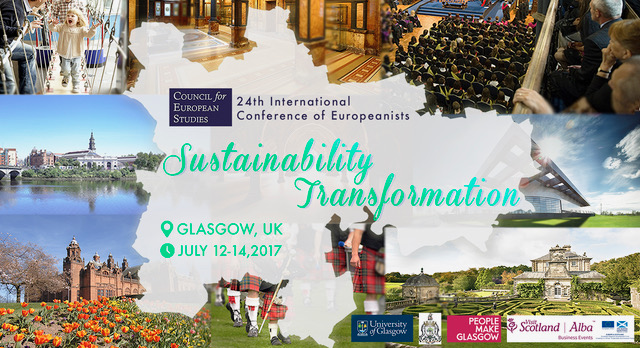
Conference: 24th International Conference of Europeanists (Glasgow, UK)

Date of Conference: July 12-14, 2017

Open book - very shallow dof

The 24th International Conference of Europeanists in Glasgow promises to bring together a wide range of experts  to present and debate new research on critical, timely topics such as Brexit vote, the immigration crisis, the stability of the Eurozone, the resurgence of populist political movements, and the opportunities and challenges of technological advances in artificial intelligence and data gathering. The conference also features a set of exhibits, digital and print advertising, and numerous sponsored special events. Here are some program highlights and events that we’re already looking forward to!

Keynote Speaker: Judy Dempsey

Judy Dempsey is a nonresident senior associate at Carnegie Europe and editor-in-chief of its blog, Strategic Europe. Prior to joining Carnegie in 2012, Dempsey had a long and distinguished career in journalism. She was a columnist for the International New York Times after serving as the International Herald Tribune’s Germany Correspondent between 2004-2011.

Before moving to Berlin, Dempsey was the diplomatic correspondent for the Financial Times in Brussels (2001-2004), covering the big NATO and European Union enlargements. Between 1990 and 2001, she was the FT’s Jerusalem bureau chief (1996– 2001), Berlin correspondent (1992–1996), and Eastern European correspondent. (1990–1992). During the 1980s, Dempsey reported on Central and Eastern Europe and the Balkans for the Financial Times, the Irish Times, and the Economist from Vienna.

Dempsey graduated from Trinity College, Dublin, where she studied history and political science. She has contributed to several books on Eastern Europe. In 2013, her book on Chancellor Angela Merkel “Das Phänomen Merkel” was published (Edition Körber-Stiftung,) to critical acclaim. She has also published Carnegie papers on NATO and on Germany.

CFP: XXII International Conference “Slavic Readings” (Daugavpils U.)

Deadline for Submissions: March 01, 2017

The Department of Russian and Slavic Linguistics of Daugavpils University is pleased to announce the XXII International Conference „Slavic Readings” to be held at DU, Daugavpils (Latvia), on May 18-19, 2017.

The conference welcomes presentations of research done on contemporary issues of Russian and Slavic studies, and functioning of the Russian language, literature and culture in a foreign language environment.
The Conference will work in the following sections:

1. Contemporary issues of Russian and Slavic studies (a theoretical aspect):
– Slavic languages: historical and contemporary context.
– Literature of the Slavs: historical and contemporary context.
– Slavic-Baltic language, literature and culture connections.
– Russian literature within the world literature context.

2. Russian language, literature and culture in a foreign language environment (a pragmatic aspect).
– Studying Russian literature and culture in the modern world.
– Russian language in a multicultural environment.
– Innovative methods of teaching Russian as a foreign language. Continue reading “CFP: XXII International Conference “Slavic Readings” (Daugavpils U.)”

Funding Opportunity: Elizabeth Barman Museum Internship (Archaeological Institute of America)

Deadline for Applications: April 01, 2017

Title: Elizabeth Bartman Museum Internship
Sponsor: Archaeological Institute of America
Amount: $2,000 – $4,750

Description: A scholarship established in honor of AIA Past President Elizabeth Bartman to assist graduate students or those who have recently completed a master’s degree with the expenses associated with participating in a museum internship either in the United States or abroad. The internship fund is intended to help graduate students, or those who have recently completed a master’s degree, in Archaeology or a related field (e.g., Anthropology, Art History, Classics, History, etc.) meet expenses associated with undertaking a museum internship (minimum duration a summer or semester). Specific projects will vary and might include the following: collection cataloguing, provenance or archival research, exhibition preparation, the writing of labels and/or didactic panels, assisting with websites and presentations in other media, such as audio guides and exhibition videos, and participating more broadly in museum activities, working with conservators, art handlers, designers, and other museum professionals. Applicants must be members of the AIA at the time of application. 

How to Apply: Apply directly to the sponsor by April 1. See the announcement for a list of materials to be submitted with the application. 

More Info: https://www.archaeological.org/grants/16811